
Classroom management in 2026 isn’t about maintaining silence; it’s about co-regulating the storm. You didn’t sign up to be a therapist, yet here you are, facing a room where 30% of your students feel too hopeless to function. It’s heavy. It’s exhausting. If you’re searching for classroom management strategies for high school mental health that actually work, you’ve likely realized that the old “command and control” model is dead. Students are drowning in anxiety and social media pressure, and they don’t need a warden; they need a guide who isn’t afraid to be real.
I know that feeling of standing at the front of the room, heart racing, terrified that one wrong word will trigger a crisis you can’t fix. You want to teach, but the emotional distress behind those desks is deafening. This guide is your roadmap to transforming that chaos into a sanctuary of resilience using radical transparency. We’re going to dive deep into connection-based management and practical tools to handle emotional outbursts. You’ll learn how to build a classroom environment where both you and your students can finally breathe and focus on what matters.
Key Takeaways
- Move beyond outdated compliance models by prioritizing co-regulation to meet the unique emotional needs of the 2026 high school student.
- Master the art of radical transparency to build an authentic bridge of trust through shared, appropriate vulnerability that proves you care.
- Learn to spot invisible crises by integrating suicide prevention and a postvention mindset directly into your daily classroom rhythm.
- Discover five actionable classroom management strategies for high school mental health designed to prioritize human connection before academic content.
- Understand why teacher self-care is a non-negotiable management tool that prevents burnout while fostering a calmer, more resilient school culture.
What is Mental Health-First Classroom Management?
Traditional Classroom Management is dying. For decades, we were told that a “good” teacher is one who keeps the room quiet through compliance and fear. But in 2026, that model is a relic. Mental health-first management is a radical shift from punitive discipline to co-regulation. It’s the understanding that you can’t teach a child whose brain is stuck in a “fight or flight” response. By adopting classroom management strategies for high school mental health, you’re not just managing behavior; you’re managing human souls. When you prioritize emotional safety, you aren’t ignoring the curriculum. You’re actually making it possible for the brain to process it. You’re showing up as a vulnerable authority, a leader who has been in the trenches and isn’t afraid to show the scars.
The 2026 Reality: Why High Schoolers are Different
The modern teenage brain is under an unprecedented siege. We aren’t just dealing with typical hormones anymore. Recent data shows that 30% of high schoolers report feeling so hopeless they’ve stopped their usual activities. For girls, that number spikes to over 50%. Their brains are in a state of high plasticity, absorbing the social stress of a digital world that never sleeps. In this climate, vulnerability is the new currency. If you want respect, you have to earn it through connection. This isn’t just about “good vibes” anymore. With 20% of students seriously considering suicide, effective classroom management strategies for high school mental health must include life-saving awareness. You have to see the pain before you can teach the person.
Compliance vs. Connection: The Great Shift
A quiet classroom isn’t always a learning classroom. Sometimes, it’s just a room full of students who are shut down. We have to stop chasing compliance and start chasing connection. When a student has an outburst, the old way was to kick them out. The new way is co-regulation. This is the heavy lifting of teaching. It requires you to stay grounded when everything around you is falling apart. By choosing to connect instead of correct, you de-escalate the moment and keep the student in the room. This shift creates a sanctuary where students feel safe enough to take the risks that learning requires. Co-regulation is the teacher using their calm to settle a student’s storm.
Radical Transparency: The Heart of Your Management Plan
Let’s get real. Your students can smell a fake from a mile away. They’ve spent their whole lives being marketed to and lied to by screens. If you walk into your room acting like a “perfect” expert who has it all figured out, you’ve already lost them. My core philosophy is simple: students don’t care how much you know until they know how much you care. Radical transparency is about showing them that heart. It’s about moving away from clinical classroom management strategies for high school mental health and moving toward something that feels human. When you share your own “appropriate struggles,” you build a bridge that students in pain can actually walk across.
Breaking the myth of the perfect teacher reduces performance anxiety for everyone in the room. If you’re having a rough morning, say so. You don’t need to give them your life story, but acknowledging your humanity gives them permission to be human too. Programs like Classroom WISE offer incredible evidence-based tools, but those tools only work if the relationship is authentic. Use direct address. Use “real talk.” Cut through the noise of their busy, distracted lives by being the one adult who doesn’t hide behind a desk or a degree.
The Vulnerable Authority Model
Leading by example means showing your students how to handle imperfections. It’s about being a “vulnerable authority.” You’re still the leader, but you lead with your scars, not just your credentials. This requires a radical shift in how we view our roles. If you want to master this, my Trauma-Informed Teaching Professional Development is designed to help you navigate these boundaries. You need to know what to share to build connection and what to keep private to maintain safety. It’s a delicate balance, but it’s where the magic happens. When you lead with honesty, your classroom becomes a place where students feel seen rather than just managed.
Emotional Honesty as a De-escalation Tool
When the energy in your room is off, don’t ignore it. Name the elephant. If everyone is tense or checked out, stop the lesson and address it. “Hey guys, the vibe in here feels heavy today. Is everyone okay?” This simple act of emotional honesty is one of the most powerful classroom management strategies for high school mental health available to you. It shows you’re paying attention to them, not just the clock. And if you lose your cool? Apologize. A sincere apology to a teenager is a masterclass in trust-building. It proves that you value the relationship more than your ego. This level of transparency creates long-term engagement because students will work for someone they respect and trust. If you’re ready to see this transformation in your own school, let’s talk about bringing a Teen Mental Health Speaker to your campus to jumpstart the conversation.
Identifying Invisible Crises: Suicide Prevention in the Classroom
If you think classroom management is only about keeping kids in their seats, you’re missing the most critical part of your job. In 2026, managing a room means keeping a watchful eye for the invisible crises that walk through your door every single morning. We can’t afford to ignore the “scary” topics. When 20% of high schoolers have seriously considered ending their lives, your management plan must double as a safety net. Effective classroom management strategies for high school mental health aren’t just about behavior; they’re about life and death. You are the first line of defense. You see them every day. You know their rhythms better than almost anyone else.
This is where my Teen Suicide Prevention Programs come into play. We have to be willing to look at the “empty chair” scenario before it happens. If a tragedy does strike, how you manage the aftermath determines whether your students find a path to healing or spiral further into despair. Resources like SchoolSafety.gov provide foundational frameworks for safe environments, but the “real work” happens in the honest, raw conversations you have between the bells. You have to be the one adult who isn’t afraid to go there.
Warning Signs Teachers Often Miss
We often focus our energy on the “acting out” student because they’re the loudest. They disrupt the flow. But the “quiet” student who is slowly withdrawing is often the one in the most danger. Watch for the sudden drop in academic performance. It’s rarely about laziness; it’s usually about a brain that’s too overwhelmed to care about a rubric. Use a “real talk” approach. If you notice a change, don’t just send an email. Pull them aside. Look them in the eye. Ask, “Are you okay? I’ve noticed you’ve been a bit quiet lately, and I’m worried about you.” That simple act of seeing them can be the bridge they need.
Management During Crisis: The Postvention Approach
When a school community faces a tragedy, the first 48 hours are a blur of shock and grief. Your classroom management needs to pivot instantly. This is the postvention mindset. You have to normalize the conversation around grief. Don’t try to “get back to normal” too fast. Address the empty chair with grace and honesty. Tell them you’re hurting too. Postvention is the bridge between tragedy and a new normal. It’s about creating a space where it’s okay to not be okay while maintaining the structure that keeps them feeling safe. You are managing the collective heartbeat of the room.
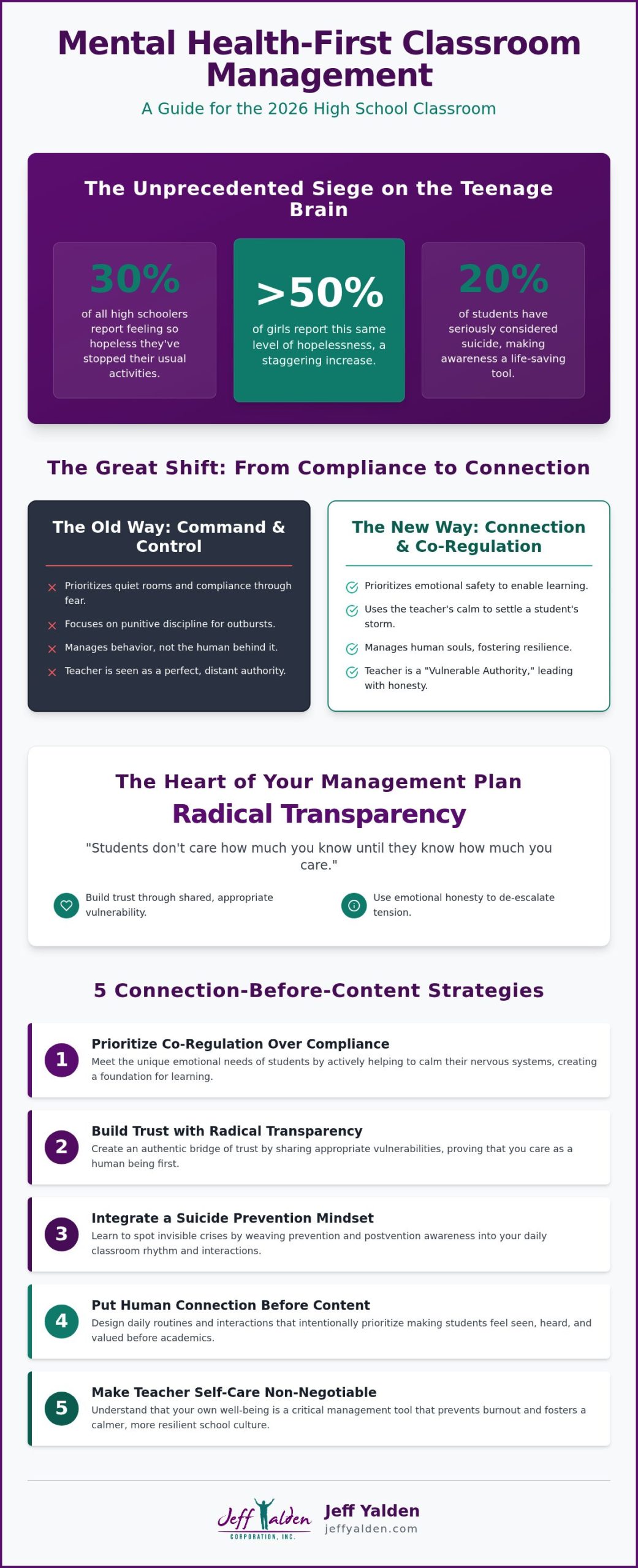
5 Connection-Before-Content Strategies for 2026
Stop trying to push curriculum onto a brain that’s stuck in survival mode. It doesn’t work. In 2026, the most effective classroom management strategies for high school mental health are those that put the human soul before the lesson plan. You have to win the heart before you can reach the mind. This isn’t soft; it’s smart. It’s about creating a culture where students feel seen, known, and valued. When you build that foundation, the academic performance follows naturally. You’re teaching them more than just facts; you’re Building Resilience in Teens by showing them how to navigate their own internal storms.
Beyond the connection rules, you need physical and structural shifts. Create a “Safe Seat” in your room. This isn’t a “time-out” chair for bad behavior. It’s a voluntary space for overstimulated students to regroup without being sent to the office. Combine this with collaborative rule-making. When you give students agency to help set the boundaries, you strip away the fuel for anxiety-based defiance. They aren’t following your rules; they’re following *our* rules. This ownership changes the entire energy of the room.
The 2-Minute Rule in Action
The “2-Minute Connection Rule” is your highest ROI activity. Find 120 seconds to talk to a high-risk student about anything except school. Talk about their shoes, their music, or their weekend. Do this for ten days straight. Track your connections on a clipboard to ensure no one goes “unseen” in the back of the room. You’ll find that those 20 minutes of total investment over two weeks will save you hours of disciplinary headaches. It’s much harder for a student to disrespect a teacher who actually knows who they are.
Pulse Checks and Emotional Regulation
Start every period with a “Pulse Check.” Use a quick “fist-to-five” or color-coded check-in to gauge the room’s mental health. If the pulse check shows high stress, pivot. You might need to spend five minutes on a grounding exercise before you touch the whiteboard. Teach your students the “staccato” declaration: “I am overwhelmed.” Encourage them to say it before they hit a breaking point. This simple phrase acts as a pressure release valve, preventing explosive outbursts before they start. You’re giving them the language of self-regulation.
If your staff is struggling to implement these shifts, it might be time for a change in perspective. Book a High School Speaker who can bring this message to life for your entire school community.
Professional Development: Moving from Theory to Transformation
Most Professional Development is a total waste of your time. You sit in a cramped cafeteria, scrolling through emails, while someone who hasn’t stepped in a classroom since the flip-phone era drones on about “engagement metrics.” It’s clinical. It’s detached. And it fails because it ignores the raw emotional reality of 2026. You can’t effectively implement classroom management strategies for high school mental health if you’re running on empty yourself. Real transformation doesn’t come from a thick manual or a boring slideshow. It comes from a cultural shift. It starts with you moving from a distant lecturer to a lived-experience mentor-guide who leads with heart and authority.
We have to stop treating teacher self-care like a “nice to have” luxury. It’s a tactical management strategy. If you aren’t regulated, your students won’t be either. They mirror your energy. They catch your stress like a virus. When you lead from a place of personal resilience, you create a ripple effect that settles the entire room. Specialized training isn’t just about learning new tricks; it’s about giving you the permission to be human so your students can do the same. This is how we move from surviving the day to actually thriving in the trenches together.
Why Radical PD is the Answer
Forget the workshops that treat your students like data points on a spreadsheet. Radical PD is about emotional resonance. It’s about the “victor” mentality. We empower you to lead through your own resilience, proving that struggle isn’t a life sentence for you or your kids. This shift is the missing piece in schools that are currently drowning in culture issues. If you want to see this energy in action, look at how we structure our High School Assemblies. We don’t just talk at kids; we connect with them. Your staff deserves that same level of respect, intensity, and honesty. You deserve a speaker who gets it.
Booking Jeff Yalden for Your Staff
When I walk onto your campus for a Teacher Professional Development workshop, we don’t do “polite.” We do “real.” We have to normalize the mental health conversation among your faculty first. You can’t lead where you haven’t gone yourself. We’ll tackle the heavy stuff together, including suicide prevention and the “Postvention Checklist,” with the urgency they deserve. My mission is to leave your team feeling inspired, grounded, and equipped with classroom management strategies for high school mental health that actually stick. The 2026 season is filling up fast. If you’re ready to move beyond theory and start saving lives, let’s get to work. Book a Teen Mental Health Speaker who has been exactly where you are and knows the way out.
Transform Your Campus Culture Today
The time for polite, clinical education is over. Your students are fighting battles you can’t always see; they need a leader who isn’t afraid to get real. We’ve explored the shift from compliance to co-regulation and the power of radical transparency as your new foundation. By implementing these classroom management strategies for high school mental health, you’re doing more than just managing a room. You’re building a sanctuary where resilience can finally grow.
You don’t have to navigate this heavy path alone. I’ve spent 30 years in the trenches, impacting over 4,000 schools worldwide as a suicide prevention and crisis intervention expert. I’m here to help you move from theory to transformation. Whether it’s through a raw assembly or deep-dive professional development, we can change the heartbeat of your school together. It’s time to lead with heart and authority.
Bring Jeff Yalden to your school for a life-changing Teacher PD or High School Assembly.
Keep showing up. Keep being real. Your students are watching, and your vulnerability might just be the thing that saves a life.
Frequently Asked Questions
How do I handle a student having a panic attack in class?
First, stay calm yourself because your anxiety will only fuel theirs. Clear the immediate space around them without making it a scene. Use grounding techniques like “5-4-3-2-1” or simple box breathing. Don’t ask them “why” they are panicking; their brain can’t process logic right now. Just be a steady presence until it passes or help arrives. Your calm is the most powerful tool you have in that moment.
What is the most effective way to manage a defiant high schooler with trauma?
Stop trying to win the argument and start trying to win the relationship. Defiance in a traumatized student is often a defense mechanism, not a personal attack on you. Use de-escalation techniques that prioritize safety over compliance. Give them space and choices instead of ultimatums. When you lead with empathy, you strip the power away from the defiance. This is a core part of effective classroom management strategies for high school mental health.
Can classroom management actually prevent teen suicide?
Absolutely, because you are the one adult who sees them every single day. A management style built on connection creates a safety net where students feel seen. When you notice a sudden shift in their baseline behavior, you can intervene before it’s too late. It isn’t about being a therapist; it’s about being a bridge to the help they need. Your watchful eye is often the first line of defense in a crisis.
How do I balance being “vulnerable” with maintaining professional boundaries?
Vulnerability isn’t about dumping your trauma on your students; it’s about sharing “appropriate struggle” to build trust. You can be honest about having a bad day or a past challenge without crossing a line. Share the lesson, not just the pain. You remain the authority figure, but you become a humanized authority. This creates a bridge of respect that a clinical, distant persona could never build. It’s about being real, not being their peer.
What should I say to my class after a student death or crisis?
Be honest and name the elephant in the room immediately. You don’t need a perfect script; you just need to be human. Say, “I’m hurting, and I know you are too.” Acknowledge the loss and give them space to breathe before trying to return to the curriculum. This is the postvention mindset in action. You are showing them that their grief is valid and that your classroom is a safe place to process it.
How can I prevent teacher burnout while supporting student mental health?
You have to stop viewing self-care as a luxury and start seeing it as a professional requirement. You cannot co-regulate a student if your own nervous system is fried. Set firm boundaries on your time and energy outside of school hours. Remember that being a “mentor-guide” means leading by example, and that includes showing them how to rest. Your well-being is the foundation of your classroom management strategies for high school mental health.
Do these strategies work for students with IEPs or 504 plans?
These strategies are actually the perfect complement to IEP and 504 accommodations. Most plans for students with emotional or behavioral needs require a safe, predictable environment and positive teacher-student relationships. By focusing on co-regulation and radical transparency, you are naturally meeting many of those legal requirements. It creates an inclusive space where every student, regardless of their specific plan, feels they have a fair shot at success and belonging.
How do I get my administration on board with a mental health-first approach?
Show them the data on how emotional safety directly impacts academic performance and discipline referrals. When students feel safe, they learn better and act out less. Frame it as a proactive solution to teacher burnout and school culture issues. If they are still hesitant, suggest bringing in a professional development expert like Jeff Yalden. Sometimes, hearing the message from a “vulnerable authority” with 30 years of experience is what it takes to spark a real shift.
