
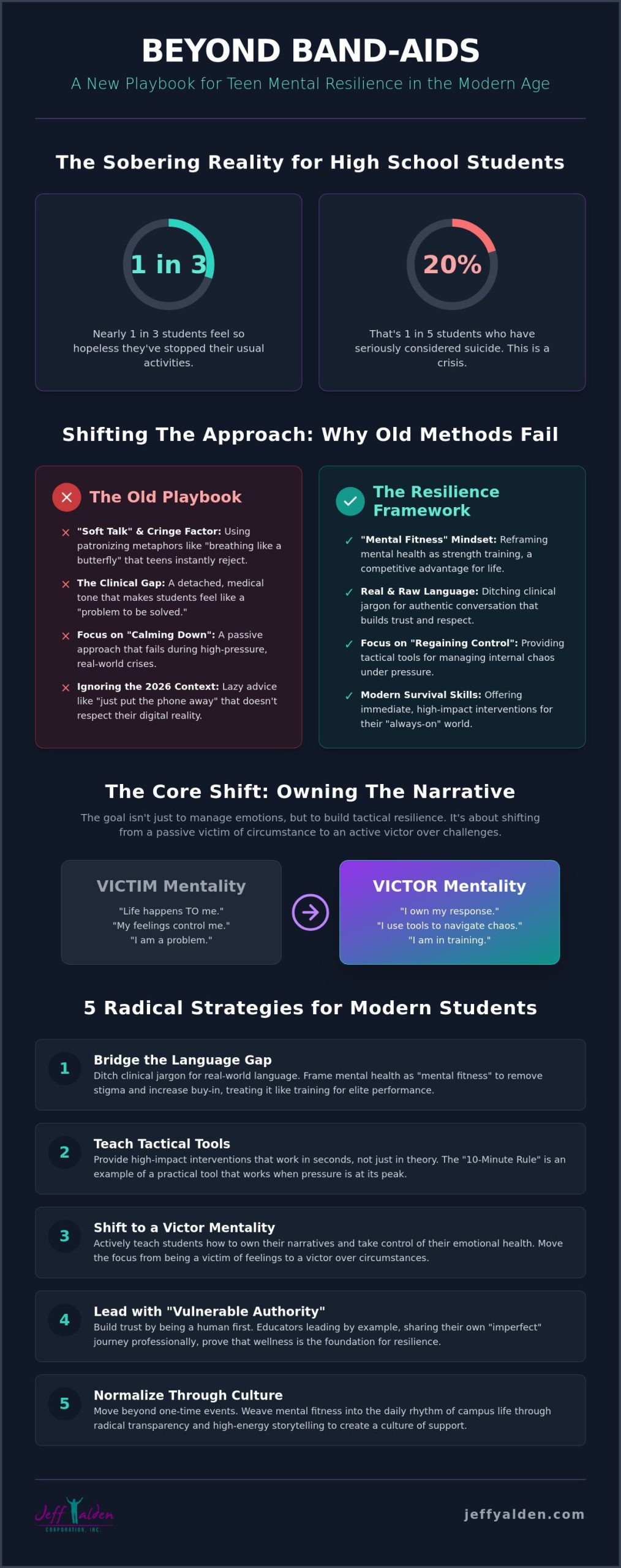
What if the reason your students roll their eyes at “mental health days” is because we’re giving them band-aids for bullet wounds? It’s time to stop pretending that a colorful poster or a soft-voiced lecture can fix the chronic distress of 2026. You’re here because you want to know how to teach coping skills to high school students in a way that actually sticks when they’re in the heat of a crisis. You see the 20% of students who’ve seriously considered suicide and the nearly 1 in 3 who feel so hopeless they’ve stopped their usual activities. It’s heavy. It’s real. And honestly, you’re likely feeling the burnout of trying to hold it all together while the incident rates keep climbing.
I get it because I’ve been in those trenches with you. We agree that the old clinical way is failing our kids. This article is your roadmap to move beyond the “soft talk” and into radical, life-saving resilience. You’ll discover how to build a campus culture where students own their mental health and use practical tools that work in the real world. We’re going to explore the “real and raw” approach to transformation, giving you the exact strategies needed to lower incident rates and spark genuine student engagement. It’s time to move from surviving to thriving.
Key Takeaways
- Bridge the gap between staff and students by ditching clinical jargon for real-world language that high schoolers actually respect.
- Discover how to teach coping skills to high school students using tactical tools like the “10-Minute Rule” that work when the pressure is at its peak.
- Shift your students from a victim mindset to a victor mentality by teaching them to own their narratives and take control of their emotional health.
- Learn the “Vulnerable Authority” approach to lead by example, proving that your own wellness is the foundation for student resilience.
- Move beyond one-time events and learn how to normalize mental health through a culture of radical transparency and high-energy storytelling.
Why Traditional Coping Skills Programs Fail High Schoolers
Let’s be honest. If you walk into a room of seventeen year olds and start talking about “breathing like a butterfly” or “finding your zen,” you’ve already lost the room. That’s the cringe factor. High schoolers in 2026 have a high-definition radar for anything that feels patronizing or fake. Traditional Social-Emotional Learning (SEL) metaphors often feel like they were designed for elementary students and simply recycled for teens. They reject it because it doesn’t match the intensity of their lives. They don’t need “soft” talk. They need armor. They need to know how to teach coping skills to high school students in a way that respects their intelligence and their struggle.
The clinical gap is another massive wall. When educators adopt a detached, medical tone, it signals to the student that they are a problem to be solved rather than a person to be heard. This clinical distance creates a barrier. Students don’t want a therapist in the classroom; they want a leader who understands the raw reality of their “always-on” brain. We’re talking about a generation facing unprecedented academic pressure and the constant noise of social media. We must move away from just “managing emotions” and start building tactical resilience. It’s about shifting the narrative from being a victim of your feelings to becoming a victor over your circumstances. To discover practical, story-driven psychological guidance for these challenges, visit Dr. Grant Johnson – Common Sense Psychology for Everyday Living.
Breaking the ‘Soft’ Stigma of Mental Health
To get buy-in, we have to change the language. Stop calling it “mental health” if that triggers a shutdown and start calling it “mental fitness.” It’s like training for a sport. You wouldn’t enter a championship game without conditioning, so why expect students to handle a crisis without mental reps? We need to move the goalpost from “calming down” to “regaining control.” Coping is the tactical management of internal chaos. When you frame psychological coping strategies as tools for elite performance, the stigma evaporates. Students stop seeing these skills as a sign of weakness and start seeing them as a competitive advantage for life.
The 2026 Context: Why the Stakes are Higher Now
The world has changed, and our advice has to change with it. In 2026, teens are battling AI-driven comparison and a level of digital fatigue that previous generations can’t imagine. Telling a student to “just put the phone away” is lazy and ineffective. It’s their lifeline and their landmine all at once. They need immediate, high-impact interventions that work in the seconds before a panic attack or an outburst. Long-term clinical theory is great for a textbook, but it fails in the hallway. We need to provide how to teach coping skills to high school students through the lens of modern survival. These kids are tired of being told what to do by people who haven’t walked a mile in their digital shoes. They need real-time strategies for a real-time world.
The Resilience Framework: Shifting from Surviving to Thriving
Survival is exhausting. For too many teens, getting through the school day feels like walking through a minefield. The 2026 digital landscape has only made this worse. Between AI-perfected social feeds and the crushing weight of hyper-connectivity, their brains are in a constant state of high alert. Mastering how to teach coping skills to high school students means moving beyond reactive crisis management. We need a proactive Resilience Framework. This isn’t a set of rules. It’s a shift in identity. We’re moving them from the “Victim” mentality, where life happens to them, to the “Victor” mentality, where they own their response to the chaos.
This framework doesn’t live in a workbook. It lives in the daily rhythm of your campus. It’s about integration, not just instruction. If coping skills are treated like a separate lesson, students will treat them like homework they don’t want to do. When we weave these tools into every interaction, we normalize the struggle. We show them that mental fitness is a lifestyle, not a clinical intervention. This is how we build a culture where students feel empowered to take charge of their own mental health before the breaking point arrives.
Normalizing the Conversation Through Radical Transparency
If you want a teenager to trust your tools, they have to trust you first. They don’t need a perfect authority figure. They need a human being. Radical transparency means being willing to share your own “imperfect” journey. When you say, “I’m struggling too,” in a professional and high-impact way, you build an immediate bridge. You’re showing them that resilience isn’t the absence of struggle; it’s the ability to navigate it. This aligns perfectly with the core mission of a teen mental health speaker who prioritizes breaking the silence and building real-world resilience. Your vulnerability is your greatest strength in the classroom.
The 4 Pillars of the Victor Mentality
Redefining how to teach coping skills to high school students requires a structure they can lean on. The Victor mentality is built on four tactical pillars:
- Self-Awareness: Learning to identify the “trigger” in the body before the emotional explosion happens. It’s recognizing the tight chest or the racing heart.
- Self-Regulation: Having the tactical tools ready for the heat of the moment. This is about taking control of the nervous system.
- Social Connection: Building a “tribe” that supports resilience. No one wins alone. Students need to know who their people are.
- Purpose: Finding the “why” that makes the struggle worth it. When students have a mission, they have a reason to keep fighting.
When these pillars are in place, students stop asking “Why is this happening to me?” and start asking “How am I going to handle this?” That is the heart of transformation. If you’re looking to spark this change on your campus, bringing in a teen mental health speaker can be the catalyst your students need to start building their own resilience framework.
5 Radical Coping Strategies for Modern High School Students
Enough theory. Let’s get tactical. If you want to know how to teach coping skills to high school students, you have to give them tools that work when the world is screaming in their ears. We’re talking about battle-tested strategies for the 2026 landscape. These aren’t suggestions. They’re survival tactics for the modern teenager. When a student is spiraling, they don’t need a lecture on mindfulness. They need a way to reclaim their brain in the next sixty seconds.
- Tactical Grounding: We’re rebranding the 5-4-3-2-1 technique. Call it a “Situational Awareness Reset.” It’s not about being calm. It’s about gathering intel. Five things you see, four you can touch, three you hear, two you smell, and one you can taste. It forces the brain to snap out of the “what if” and back into the “what is.”
- The 10-Minute Rule: Anxiety thrives on the idea that the pain will last forever. Teach your students to commit to just ten minutes. They don’t have to survive the whole day. They just have to survive the next ten minutes. Once they hit that mark, they reset the clock. It makes the overwhelming manageable.
- Digital Detox Sprints: In 2026, the notification cycle is a constant dopamine drain. Encourage “sprints” where the phone goes into a locker or a drawer for thirty minutes of deep work or real-world connection. It’s about reclaiming the prefrontal cortex from the algorithm.
- Physical Outletting: Stress is biological. It’s stored in the muscles. High schoolers need “Big Body Movements” to process heavy emotions. Whether it’s a heavy lift in the weight room, a sprint on the track, or just a literal “shake-off” in the hallway, they have to move the energy out.
- Cognitive Reframing: This is the shift from “I can’t” to “How can I?” It’s a subtle change in language that opens up the problem-solving centers of the brain. It turns a dead-end into a mission.
Tactical Breathwork for High-Pressure Situations
Forget the yoga class imagery. We’re talking about the same techniques used by elite performers and tactical teams. Box breathing is a 4-count tactical tool used to reset the nervous system during acute stress. Inhale for four, hold for four, exhale for four, hold for four. It’s a physiological override. When you teach it as a high-performance tool rather than a “relaxation exercise,” students buy in. They see it as a way to stay sharp when everyone else is losing their cool.
The ‘Pause and Pivot’ Method
There is a biological gap between a stimulus and your response. That gap is where your power lives. We teach students to recognize that split second when the heart starts racing. That’s the “Pause.” Then comes the “Pivot.” Instead of sliding into a panic attack, they pivot to a productive action, like a grounding exercise or a physical movement. Integrating these skills into high school assemblies allows you to demonstrate this in real-time, showing students that they aren’t victims of their biology. They are the captains of their own ship. This is how to teach coping skills to high school students that actually change lives.
How Educators Can Model Resilience and Radical Transparency
You are the thermostat of your classroom. If you are running hot with stress, your students will feel the heat. If you are cold and detached, they will freeze up. Understanding how to teach coping skills to high school students starts with your own self-regulation. Students don’t just listen to what you say; they watch what you do. This is the “Vulnerable Authority” approach. It’s about leading by example. It’s about showing them that even experts have bad days and that resilience is a muscle we all have to flex together. When you are real, they are real.
Your wellness is the foundation. You can’t pour from an empty cup, and you certainly can’t lead a student through a crisis if you’re on the verge of your own. When you prioritize your own mental fitness, you give your students permission to do the same. We also need to create “Safe to Fail” zones. Academic anxiety is at an all-time high in 2026. If a mistake feels like the end of the world, students will never take the risks necessary for growth. We must handle every student crisis with calm, assertive leadership that de-escalates the situation rather than adding fuel to the fire.
The Power of the ‘Real’ Teacher
High schoolers connect with your scars far more than your trophies. They don’t need a superhero in a blazer. They need a human who has navigated the same storms they’re facing. You can weave these skills into any subject. A math teacher can model the “Pause and Pivot” method when a complex equation goes wrong on the board. A science teacher can discuss the resilience required for the scientific method. To truly master this shift, many schools are investing in trauma-informed teaching professional development to give staff the specific tools they need to lead with empathy and authority.
Pre-empting the Crisis: Daily Check-ins That Matter
Don’t wait for the explosion to happen. Use proactive tools to gauge the room. The “Fist to Five” method is a quick, non-verbal way to check the emotional temperature of your students. A fist means “I’m struggling,” and a five means “I’m great.” This helps you identify the kids who are “masking.” These are the students who look perfectly fine on the outside but are drowning on the inside. By building a culture where asking for help is seen as a sign of strength, you lower the stakes of vulnerability.
- Daily Temperature Checks: Use non-verbal cues to identify struggling students early.
- Normalize the Struggle: Share small, professional examples of your own coping strategies.
- Assertive Calm: Lead through crises with a steady voice and clear direction.
If you want to transform your staff’s approach to student mental health and build a more resilient campus, consider booking a session for Teacher Professional Development today. It is time to lead by example.
Transforming Campus Culture: The Jeff Yalden Approach
Culture isn’t something you print on a banner and hang in the cafeteria. It’s the pulse of your building. If you want to master how to teach coping skills to high school students, you have to realize that a one-time event is just the spark. It’s the match that lights the fire, but your daily commitment is the fuel that keeps it burning. The Jeff Yalden approach isn’t about clinical checklists or detached lectures. It’s about high-energy, relatable storytelling that makes mental health feel as normal as talking about the weekend. We move from “prevention” as a buzzword to “proactive resilience” as a lifestyle. This means being ready before the crisis hits and having a plan for postvention when your community needs to heal.
Transformation happens when students stop looking at the floor and start looking each other in the eye. It happens when the “masking” stops and the radical transparency begins. By bringing in a world-class teen mental health speaker, you aren’t just hosting a program. You’re making a statement. You’re telling your students that their struggle is seen and their lives matter. This is how to teach coping skills to high school students through a lens of shared humanity. It’s about building a campus where the “Victor” mentality is the standard, not the exception.
The Impact of a Radical Mental Health Assembly
Jeff Yalden has a unique ability to break through student walls in under ten minutes. How? By being real. He doesn’t show up as a distant expert; he shows up as a lived-experience guide. The long-term effects of a high-impact speaker on campus culture are profound. Schools that have embraced this “real and raw” approach report a shift from a culture of crisis to one of resilience. When students see a grown man be vulnerable and resilient at the same time, it gives them a roadmap for their own lives. They start to own their mental health because they finally see a version of it that isn’t “cringe.”
Taking the Next Step for Your Students
It’s time to evaluate your current mental health strategy. Is it just “checking a box” to satisfy a requirement, or is it actually saving lives? In 2026, the noise is louder than ever, and our kids are tired of the same old talk. They need a spark that turns into a permanent change. You can book Jeff Yalden for assemblies, teacher professional development, or community nights to ensure everyone is on the same mission. Don’t wait for another incident rate to climb before you take action. The tools are here. The path is clear. It’s time to lead your campus toward a future of radical resilience. Book Jeff Yalden for your 2026 High School Assembly and start the fire that changes everything.
Ignite a Culture of Radical Resilience Today
The time for clinical detachment is over. Our students don’t need another lecture; they need a lifeline. You’ve seen how shifting to a Victor mentality and using tactical tools like Box Breathing can change the game. It’s about more than just managing a crisis. It’s about mastering how to teach coping skills to high school students through radical transparency and real connection. When we lead with our scars and model true mental fitness, the campus culture shifts from silence to strength.
You don’t have to carry this burden alone. Jeff Yalden brings over 30 years of experience as a specialist in teen suicide prevention and postvention. As a youth life coach and author, he uses a radical transparency approach that actually works to break through student skepticism. Bring Jeff Yalden to Your Campus to Transform Your Students’ Mental Health. Your students are ready for the real talk. It’s time to show them that their struggle is the foundation for their future victory. Let’s change the narrative together.
Frequently Asked Questions
How do I teach coping skills to a student who refuses to participate?
You reach a resistant student by ditching the clinical lecture and leading with your own vulnerability. If they sense a “fake” teacher persona, they’ll shut down. Instead, use radical transparency to share a time you struggled and used a specific tool to get through it. When you stop acting like an authority figure and start acting like a lived-experience guide, the “cringe” factor disappears and they’ll start to listen.
What are the best coping skills for students with high academic anxiety?
The 10-Minute Rule and Cognitive Reframing are the most effective tools for crushing academic anxiety. Teach them to commit to just ten minutes of work when they feel overwhelmed. This breaks the paralyzing cycle of “perfection or nothing.” Pair this with reframing their internal dialogue from “I can’t do this” to “How can I tackle the first step?” This shifts their brain from panic mode into tactical problem-solving.
Can I teach mental health skills if I’m not a licensed counselor?
How do coping skills help with teen suicide prevention?
Coping skills act as a critical buffer by providing students with a tactical alternative to permanent solutions for temporary pain. These tools create a “biological gap” between an overwhelming emotion and a dangerous impulse. By mastering techniques like Box Breathing or Situational Awareness Resets, students learn they can survive the “heat of the moment.” It gives them the resilience to hold on until they can reach out for professional help.
What is the difference between healthy and unhealthy coping mechanisms for teens?
Healthy coping mechanisms build long-term resilience, while unhealthy ones offer temporary numbness that leads to deeper distress. Healthy tools, like physical outletting or tactical grounding, help the brain process and move through the stress. Unhealthy habits, such as doom-scrolling on social media or substance use, just mask the pain. We must teach students that “numbing out” isn’t the same as “moving through” their internal chaos.
How often should we be teaching coping skills in the classroom?
Resilience should be woven into the daily campus rhythm rather than being a standalone lesson. If you want to master how to teach coping skills to high school students, you have to make these tools part of the atmosphere. Use a quick “Fist to Five” check-in every morning. Model a “Pause and Pivot” when a tech glitch happens in class. Consistency is what turns a one-time spark into a permanent campus culture.
How can I get parents involved in teaching coping skills at home?
Bring parents into the fold by sharing the “Mental Fitness” language you use in the classroom. When parents use the same tactical terms, like “The 10-Minute Rule,” it creates a unified front of support. Encourage them to model radical transparency at the dinner table. If a parent can say, “I had a rough day and used my breathing tools to stay calm,” it normalizes the struggle for the student in every environment.
What should I do if a student’s coping skills aren’t enough and they are in crisis?
When a student is in a full-blown crisis, your role shifts from mentor to a calm, assertive guide through the school’s emergency protocol. Stay with the student and use your own self-regulation to keep the environment steady. Do not leave them alone. Follow your specific school training to involve counselors or administration immediately. Your “assertive calm” is the most powerful tool you have when the situation moves beyond the classroom.
