
Your phone’s vibrating off the hook. Outside your office, the hallway that used to feel like home now feels like a combat zone. Gallup reports that 38% of K-12 parents already fear for their child’s physical safety. In this moment, every one of those parents is looking to you for an answer that feels real. Knowing how to talk to parents after a school tragedy isn’t just about managing a PR crisis. It’s about holding a breaking community together when your own heart is in pieces. You’re caught between legal warnings to stay silent and a desperate need to be transparent, all while battling the secondary trauma that comes with the job.
I’ve been in those trenches. I know the gut-punch of a campus in chaos. You deserve a way out of the noise. I’m here to help you master the art of trauma-informed communication so you can lead your people from this wreckage toward real healing. We’re going to build a clear communication roadmap that restores trust, reduces student anxiety, and turns panicked parents into your strongest partners. Let’s move from the silence that creates panic to the radical transparency that saves lives.
Key Takeaways
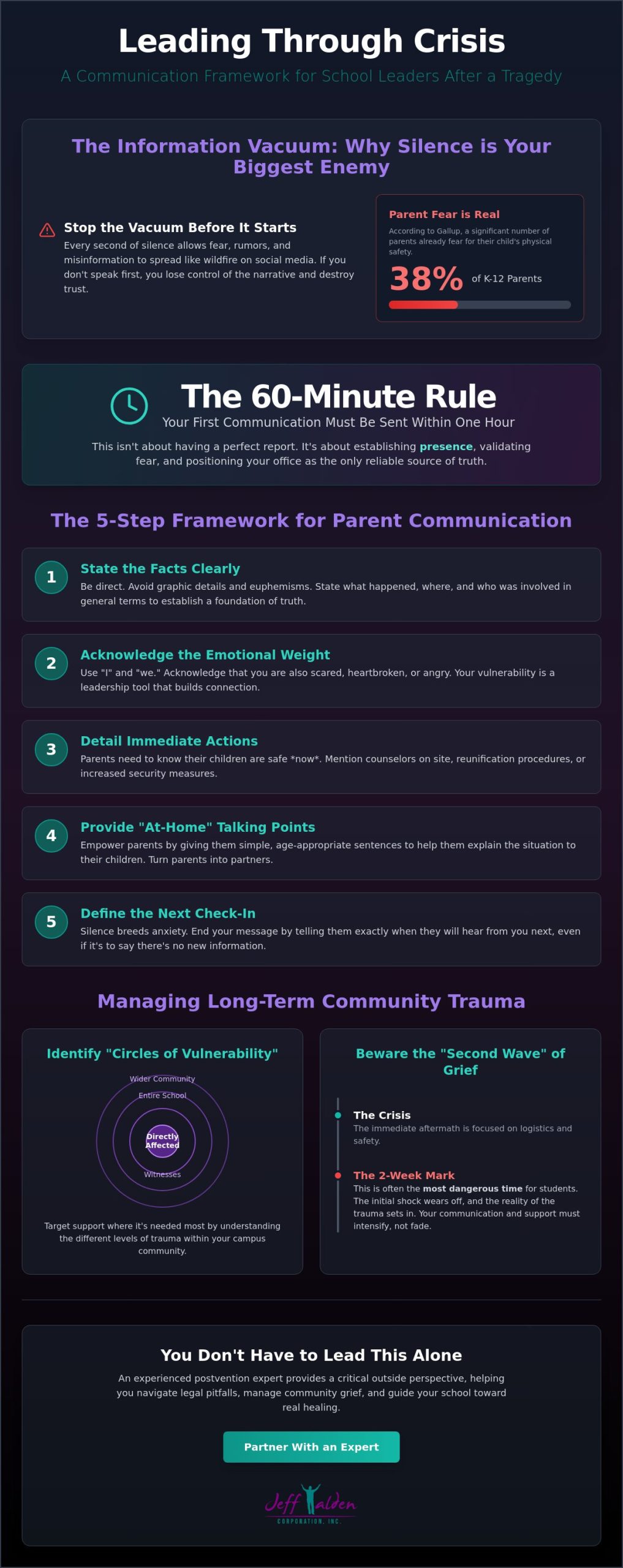
- Stop the information vacuum before it starts. If you don’t speak first, social media will fill the silence with rumors that destroy trust.
- Discover how to talk to parents after a school tragedy using a 5-step framework that balances hard facts with raw, human emotion.
- Identify the “Circles of Vulnerability” within your campus to target support where it’s needed most and validate the community’s collective fear.
- Anticipate the “Second Wave” of grief. The two-week mark is often the most dangerous time for students, and your communication must reflect that reality.
- Learn why an outside expert can often reach parents and students in ways that internal leadership cannot during a time of crisis.
The Immediate Response: Why Silence is Your Biggest Enemy
When the unthinkable happens on your campus, the clock doesn’t just tick. It screams. Every second you spend behind closed doors with lawyers and PR consultants is a second that your community spends in a spiral of terror. Silence isn’t a strategy. It’s a vacuum. In our digital age, that vacuum is filled instantly by the toxic noise of social media rumors and frantic group texts. If you want to know how to talk to parents after a school tragedy, you have to understand one thing: you must speak first. You must speak now.
We call this work postvention. It isn’t just a clinical term for the aftermath of a crisis. Postvention is the bridge between the initial crisis and the long road to recovery. It’s the organized, intentional response designed to stabilize your community and prevent further trauma. When you say “No Comment,” you aren’t protecting the district. You’re failing the families who trusted you with their children’s lives. Your first message has three non-negotiable jobs: acknowledge the pain, validate the fear, and promise a path forward. Anything less is a leadership failure.
The 60-Minute Rule for School Leaders
You have sixty minutes. Once an event is confirmed, your first communication must go out within the hour. This isn’t about having a polished, five-page report. It’s about presence. Parents don’t need a perfect statement; they need to know you’re at the helm. Focus strictly on what you know to be true. If you don’t know the “why” or the “how” yet, say exactly that. Speculation is a wildfire that you can’t put out later. By implementing postvention strategies immediately, you position yourself as the only reliable source of truth in a sea of chaos.
Radical Transparency vs. Legal Liability
I know the fear. The lawyers are whispering about FERPA and potential lawsuits. They want you to be a robot. Don’t listen. While you must respect privacy laws, you cannot hide behind them to avoid the community’s need for truth. There is massive power in saying, “I don’t have all the answers yet, but I am right here with you.” This is what it means to lead as a vulnerable authority. You aren’t a distant expert. You’re a grieving human who is also a resilient leader. When you’re learning how to talk to parents after a school tragedy, remember that they don’t want a perfect leader. They want a real one. They want to know that while the world is falling apart, you’re the one holding the line.
Crafting the Message: A 5-Step Framework for Parent Communication
When you sit down to type that first official email, your hands might shake. That is okay. It means you’re human. Understanding how to talk to parents after a school tragedy requires a delicate, high-stakes balance of cold facts and a warm heart. You aren’t just a bureaucrat filing a report. You are the voice of a community in mourning. This framework ensures your message provides the stability parents are desperately seeking while maintaining the transparency they deserve.
- Step 1: State the facts clearly. Be direct. Avoid graphic details that could trigger further trauma, but don’t use euphemisms that mask the reality. State what happened, where it happened, and who was involved in general terms.
- Step 2: Acknowledge the emotional weight. Don’t be a robot. Use “I” and “we” statements. Acknowledge that you are scared, heartbroken, or angry too. This vulnerability is your greatest leadership tool.
- Step 3: Detail immediate actions. Parents need to know their children are safe right now. Mention the counselors on site or the extra security measures in place. If your district uses wearable safety technology, which saw a 31% increase in usage during the 2025-2026 school year, highlight how these tools are being utilized.
- Step 4: Provide “at-home” talking points. Empower parents to be the heroes for their kids. Give them two or three simple sentences they can use to explain the situation to different age groups.
- Step 5: Define the next check-in. Silence breeds anxiety. Tell them exactly when the next update is coming, even if you won’t have new information. “You will hear from me again by 4:00 PM today” provides a mental anchor for a panicked parent.
The Anatomy of a Crisis Email
Subject lines must be informative without being inflammatory. “Important Safety Update” is better than “Emergency at School.” The middle section of your email should be the anchor. This is where you reaffirm your commitment to campus safety and list available resources. For leaders dealing with loss of life, integrating Teen Suicide Prevention Programs: A Radical Approach can provide a structured way to discuss prevention and mental health during the recovery phase. If you find yourself overwhelmed by the weight of the moment, bringing in a seasoned Mental Health Speaker can help bridge the gap between the administration and the families you serve.
Talking Points for Different Scenarios
Your tone must shift based on the event. A campus-wide threat requires a tone of firm, protective authority. A student death requires a tone of deep, communal grief. When parents ask “Why?”, and they will, it’s okay to say you don’t know. Honesty builds more trust than a manufactured answer ever will. Your job is to empower parents to be the primary support for their children. Remind them that their presence and their calm are the best medicine for their child’s anxiety. You are the guide. They are the healers.
Managing Community Trauma: Moving from Panic to Resilience
Trauma isn’t a single event. It’s a ripple effect. It’s a contagion that spreads through every hallway and every living room in your town. When you’re figuring out how to talk to parents after a school tragedy, you have to look past the immediate crisis. You need to map out the “Circles of Vulnerability.” Start with the students who were physically present. Then move to the close friends and teammates. Finally, look at the entire student body and their families. Each circle needs a different level of transparency and care. If you treat everyone with a one-size-fits-all statement, you’ll miss the ones who are hurting the most.
There is a collective ache in the community’s gut. It’s the “Solar Plexus” of fear. Don’t try to fix it with clinical platitudes. Validate it. Say, “It’s okay to feel unsafe right now. We feel it too.” This is where a teen mental health speaker comes in. They break the silence. They give students and parents the language to describe their pain without the fear of judgment. They act as a bridge, turning a community of victims into a community of victors.
The Town Hall Strategy: Real, Raw, and Regulated
A community meeting can be a healing circle or a firing squad. It depends entirely on your leadership. You need a neutral, expert moderator. This person isn’t there to defend the district or cite policy. They’re there to hold space for the parents’ grief. Set ground rules immediately. No personal attacks. No legal speculation. We are here for the kids. Your goal is to move the energy from “Who is to blame?” toward “How do we heal together?” When parents feel heard, their panic begins to transform into partnership.
Supporting the Supporters: Communicating with Staff First
Your teachers are drowning. They’re trying to manage their own grief while holding 30 terrified students in a classroom. They are parents too, and they need the truth before anyone else gets it. Give them scripts. When a frantic parent calls a teacher at 9:00 PM, that teacher needs to know exactly what to say. This is why Trauma-Informed Teaching Professional Development is non-negotiable. It gives your staff the tools to be the secondary caregivers without burning out. They can’t pour from an empty cup; you must fill theirs first.
Long-Term Support: Beyond the Initial Notification
The initial shock is a storm. You survived the first 48 hours. But now, the silence starts to creep back in. This is where most leaders stop communicating, and that is a massive mistake. If you want to master how to talk to parents after a school tragedy, you have to understand that the “Second Wave” of grief is often more dangerous than the first. Around the two-week mark, the casseroles stop coming. The news trucks leave. The adrenaline fades. This is when the reality of the loss truly hits your students, and the risk of mental health crises or even contagion spikes.
You need to schedule regular check-ins. Don’t wait for a crisis to send an update. Tell parents what the “new normal” looks like on campus. Are students quiet in the lunchroom? Are they struggling to focus in class? Share these observations. It makes parents feel less alone in their own homes. You also have to monitor the digital hallways. Social media memorialization can be a beautiful tribute, but it can also romanticize tragedy in a way that is dangerous for vulnerable teens who are looking for a way to express their own pain.
The Postvention Timeline
Your communication strategy needs to evolve as the community heals. On Day 1, your only goal is presence and physical safety. By Week 1, you shift to emotional stability and identifying those in the inner circle of trauma. By Month 1, you must transition the conversation toward building resilience in teens. The two-week danger zone is the critical window where student mental health often takes a sharp, silent decline as the community’s initial support system begins to withdraw.
Normalizing the Help-Seeking Behavior
Every email you send is an opportunity to kill the stigma. Use your platform to tell parents that it is okay to not be okay. Highlight stories of resilience without minimizing the tragedy. Don’t just list a phone number for a counselor; explain what that counselor actually does to support a grieving student. Encourage parents to “Ask the Question.” If they are worried about their teen, they shouldn’t dance around the subject. They need to be direct and honest.
As you navigate upcoming milestones like prom or graduation, remember that these events are massive trauma triggers. They are loud reminders of who isn’t there to celebrate. Acknowledge this early in your parent newsletters. If you need a partner to help guide your students through these emotional peaks, bringing in a High School Motivational Speaker can provide the outside perspective your community needs to keep moving forward.
Bringing in a Postvention Expert: Why You Can’t Lead This Alone
You’ve been the face of strength for weeks. You’ve sent the emails, stood in the hallways, and navigated how to talk to parents after a school tragedy while your own heart was heavy. But there is a limit to how much one person can carry. Sometimes, despite your best efforts, the community stops hearing the leader they see every day. I call this the “Prophet in his own land” syndrome. Your parents see the administration building and the official title; they don’t always see the human being behind the desk. That is when you need an outside voice to step in and say the things you simply can’t.
Jeff Yalden brings a unique brand of vulnerable authority to your campus. He doesn’t show up with a clinical clipboard or a rehearsed PR script. He shows up with raw honesty and a lived-experience perspective that creates an immediate, visceral connection. By leading a high school assembly focused on truth and hope, he breaks the cycle of silence. He coordinates the narrative between your office, the teachers in the trenches, and the families at home. This isn’t just about managing a crisis. It is about transforming a tragedy into a catalyst for a healthier, more resilient campus culture.
The Jeff Yalden Postvention Approach
The healing process requires a multi-layered attack. Jeff provides immediate on-campus support for students, meeting them exactly where they are in their grief. He follows this with professional development for staff, giving teachers the emotional tools to keep leading. The most critical piece is often the evening parent seminar. These sessions bridge the gap between school and home. They give parents the language to continue the conversation in the living room, ensuring the message of resilience stays consistent across the entire community. We move from the “What happened?” to the “How do we live now?”
How to Start the Healing Process Today
Don’t wait for the “perfect” time to ask for help. There is no such thing. The time is now. Every day you wait is another day that rumors can fester and student anxiety can grow. You’ve done the hard work of stabilizing the ship; now it’s time to chart the course toward recovery. Reach out for a consultation on community-wide crisis messaging and postvention planning. Let’s take the weight off your shoulders and start the real work of recovery together. You don’t have to lead this alone. Book Jeff Yalden for Crisis Postvention Support and give your community the expert guide they deserve.
Leading Your Community Toward a New Dawn
The weight you’re carrying right now is immense, but you don’t have to carry it in silence. We’ve covered the 60-minute rule for that first critical alert and the 5-step framework for maintaining radical transparency. You now know that the two-week mark is the most dangerous window for your students’ mental health. Mastering how to talk to parents after a school tragedy is about more than just words; it’s about being the steady hand that guides a broken community back to a place of hope. You’ve stabilized the ship. Now, it’s time to lead the healing.
When the path forward feels too steep, remember that an outside perspective can break the cycle of fear. With over 30 years of experience in crisis intervention and a deep specialization in teen suicide postvention, Jeff Yalden is a trusted partner for thousands of high schools worldwide. He brings the “vulnerable authority” your campus needs to turn this pain into a catalyst for growth. Bring Jeff Yalden to your school for immediate Postvention support and start the real work of recovery today. You are a victor, not a victim. Your community will rise again.
Frequently Asked Questions
What is the first thing a principal should say to parents after a tragedy?
The first thing you say must be an acknowledgment of the pain and a confirmation of physical safety. Don’t hide behind a clinical script. Tell them you’re heartbroken and that your team is on the ground right now. Your first job is to stop the panic by being present and human. Parents need to know you’re feeling the weight of the moment just as much as they are.
How do we handle parents who want more information than we are legally allowed to give?
Be radically transparent about the legal wall you’re hitting. Tell them, “I want to give you every detail, but federal privacy laws like FERPA prevent me from sharing specifics about individual students.” When you explain the “why” behind your silence, you aren’t being evasive; you’re being a professional. Most parents will respect the law if they know you aren’t just using it as an excuse to hide the truth.
Should we hold an assembly immediately after a school tragedy?
No. Holding a mass assembly in the immediate wake of a tragedy is often a recipe for chaos. Focus on small-group stabilization first. You need to identify the most vulnerable students before you bring the whole body together. Large crowds can trigger panic and spread misinformation. Wait until the initial shock has passed and you have an outside expert who can lead the room with authority.
How do we talk to parents about a student suicide without encouraging contagion?
When learning how to talk to parents after a school tragedy involving suicide, avoid romanticizing the death at all costs. Focus on the fact that mental health struggles are real and that help is always available. Stick to the facts without sharing the method or location. Your goal is to de-stigmatize the struggle while making it clear that suicide is never a heroic or romantic choice.
What are the warning signs parents should look for in their teens after a campus crisis?
Look for drastic changes in sleep, appetite, or social withdrawal. The two-week “danger zone” is critical. If a teen is suddenly “perfectly fine” or becomes overly obsessed with the tragedy on social media, it’s time to step in. Don’t wait for them to come to you. Direct, honest questions are your best tool for uncovering the pain they’re trying to hide.
How long should a school continue to provide extra counseling support for parents?
This isn’t a one-week fix. You need to keep extra support available through the first full cycle of milestones like prom, graduation, and the one-year anniversary. Trauma doesn’t have an expiration date. Keep the lines of communication open as long as your community continues to show elevated levels of fear or anxiety. Healing is a marathon, not a sprint.
Is it better to email parents or hold a town hall meeting first?
Email always comes first. You have sixty minutes to get the facts out and kill the rumors before they take over social media. The town hall is for the “Second Wave” of grief. It’s a space for communal healing and dialogue, not for breaking news. Use the email to stabilize the situation and the town hall to rebuild the trust.
How can we support staff members who are also parents in the district?
These people are fighting a war on two fronts. Give them a private, internal briefing before any public announcement goes out. They need to hear the truth as colleagues so they can process it as parents before they have to lead a classroom. Provide them with specific scripts so they don’t have to think under pressure when their neighbors and friends start calling for answers.
