
The standing ovation is the biggest lie in education. We’ve all seen it. A speaker finishes, the gym erupts, and you think, “We did it.” Then Monday rolls around, and nothing’s changed. It’s frustrating. It’s exhausting. And in 2026, it’s a waste of your limited budget. If you’re tired of guessing how to measure the impact of a school assembly, you’re in the right place. You know that student well-being is more than just a feeling, yet you’re often stuck trying to explain the “vibe” of an event to a school board that only cares about hard numbers.
I’ve been on those stages for 30 years, and I’m telling you that the real work starts when the microphone turns off. This guide is your roadmap to stop the guesswork. You’ll learn the exact metrics to track, from counselor self-referral spikes to digital pulse surveys. We’re moving past the “rah-rah” hype and diving into a framework that proves your assembly actually saved lives and shifted your campus culture for the long haul. We’ll look at pre-assembly baselines, immediate post-event metrics, and the 90-day behavioral shifts that define true transformation.
Key Takeaways
- Move beyond the “smile sheet” by defining real impact as a measurable shift in mental health literacy and campus culture rather than just immediate applause.
- Discover how to measure the impact of a school assembly by blending qualitative student stories with hard quantitative data to provide the school board with undeniable proof of ROI.
- Implement a rigid three-phase measurement timeline that tracks the immediate 24-hour emotional response and the critical 30-day behavioral integration period.
- Leverage modern tools like AI-driven sentiment analysis and the “One Question” strategy to secure a 90% response rate from even your most disengaged students.
- Focus on the “victor” mentality to ensure the assembly creates a lasting legacy of resilience that continues to transform lives long after the speaker leaves the stage.
Beyond the Standing Ovation: Defining Real Impact in 2026
The standing ovation is a drug. It feels incredible. It’s loud, it’s emotional, and it makes every administrator in the room breathe a sigh of relief. But here is the raw truth: it is also the biggest lie in education. If you are relying on a “smile sheet” or a quick post-event survey to prove your event was a success, you are building your house on sand. A smile sheet measures a temporary mood. It doesn’t measure a movement. In 2026, you don’t have the luxury of “maybe” anymore. With the sunset of federal ESSER funding, every single dollar in your budget is under a microscope. You have to know how to measure the impact of a school assembly with data that stands up to a skeptical school board.
Real impact isn’t found in the noise of the gym; it’s found in the depth of the silence when a student finally feels seen. We have to look at the multidimensional framework of school climate to see if the needle actually moved. Are students more likely to seek help? Is the stigma around mental health literacy actually dissolving? To answer these questions, you must stop viewing the person on stage as a “guest speaker” and start seeing them as a strategic partner in student well-being. A partner doesn’t just show up and leave. A partner helps you build a legacy of resilience that lasts long after the chairs are stacked.
The Difference Between Entertainment and Transformation
Engagement is the hook, but transformation is the only goal that matters. You can find plenty of speakers who can juggle, tell jokes, or perform “rah-rah” routines that keep kids entertained for sixty minutes. That is a one-off event. A catalyst is different. A catalyst uses radical transparency to create an immediate, visceral connection that breaks through the “I’m fine” armor students wear. You can spot the difference by the conversations that happen in the hallways the next day. Are they talking about the speaker’s jokes, or are they talking about their own lives? Transformation changes the internal narrative from “victim” to “victor.”
Identifying Your School’s Core Objectives
You cannot measure what you haven’t defined. Before the speaker ever sets foot on your campus, you need a “North Star” metric. Are you fighting a specific crisis like a spike in suicidal ideation, or are you trying to build a foundation of long-term resilience? Aligning your goals with proven High School Assemblies ensures you aren’t just filling an hour on the calendar. When you set clear objectives, you give yourself a baseline to measure against. This clarity allows you to move from guessing about student well-being to proving that your intervention actually saved lives.
The Impact Framework: Qualitative vs. Quantitative Data
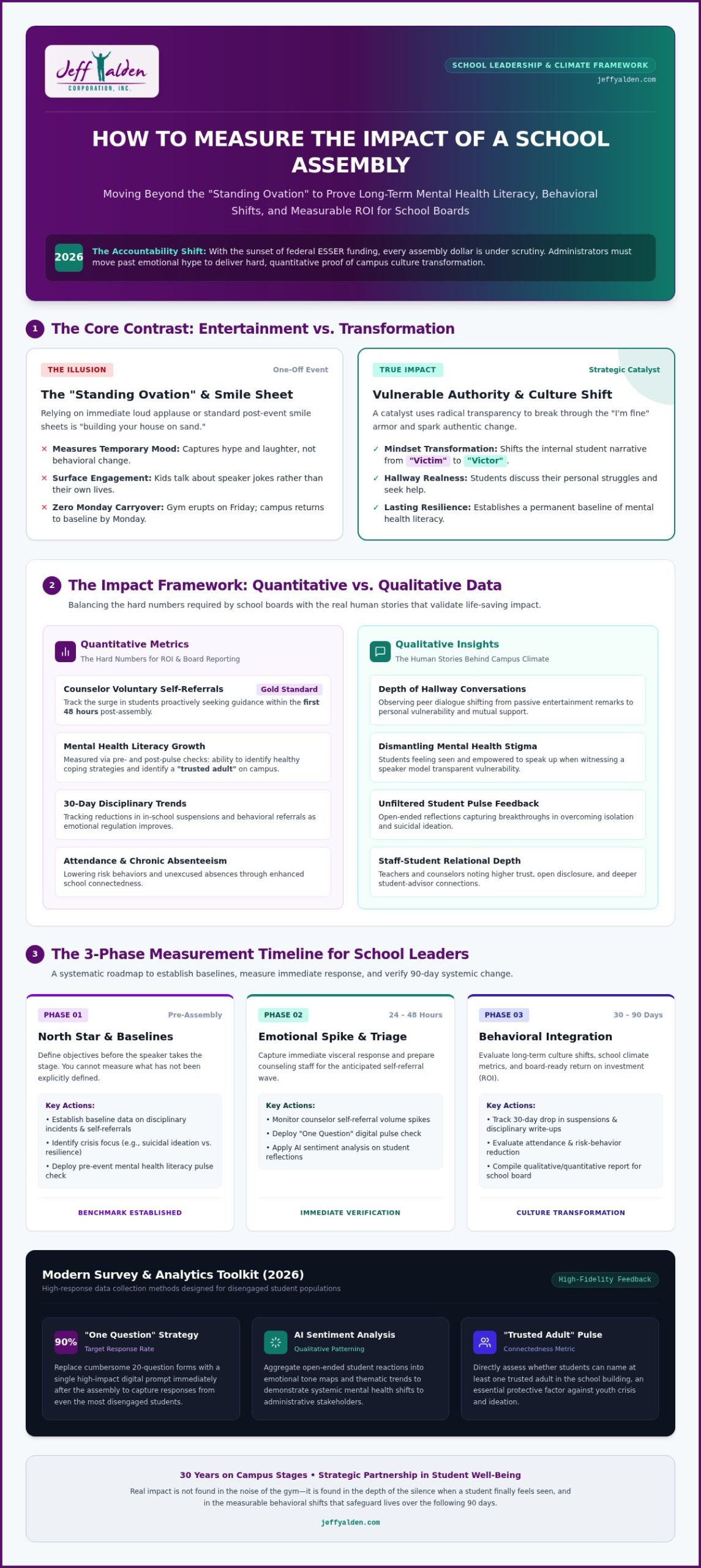
Numbers don’t lie; they just don’t tell the whole truth. If you want to understand how to measure the impact of a school assembly, you have to look at the data through two different lenses. One lens focuses on the hard, cold facts that satisfy the school board. The other lens captures the raw, human stories that prove you’ve actually reached a student’s heart. In 2026, administrators are under immense pressure to justify every cent of their budget. You can’t just say the kids liked it. You need a framework that balances the “what” with the “why.”
A speaker who leads with “vulnerable authority” creates moments of intense, visceral connection. These aren’t just feel-good moments. They are triggers for behavioral change. When a student sees a grown man be transparent about his struggles, it gives them permission to do the same. This is where the shift from victim to victor begins. To capture this transformation, you need to track both the metrics you can count and the stories you can’t ignore.
Quantitative Metrics: The Hard Numbers
The gold standard for measuring an assembly’s immediate success is the counselor’s office. Watch for a spike in voluntary self-referrals in the 48 hours following the event. If students are coming forward to ask for help, the assembly worked. You should also look at CDC research on school connectedness to understand how these interventions lower risk behaviors. Consider these metrics:
- Mental Health Literacy: Use pre- and post-assembly pulse checks to see if students can identify coping strategies or “trusted adults.”
- Disciplinary Trends: Monitor in-school suspensions and referrals over the following 30 days. A drop often indicates improved emotional regulation.
- Attendance: Look for a decrease in unexcused period absences among “at-risk” student populations.
Qualitative Metrics: The Radical Stories
The “Post-Assembly Lineup” is where the most profound data lives. This is the line of students waiting to speak to the speaker one-on-one. They aren’t there for an autograph; they are there to share a secret, a struggle, or a breakthrough. These stories are the “heart” of your data. When you work with a teen motivational speaker who values transparency, these interactions become a powerful indicator of campus climate shifts. Teachers also play a critical role here. Their observations of classroom dynamics and student-to-student empathy provide the “gut check” that spreadsheets often miss. Listen to the language students use in their journals or on social media. Are they echoing the themes of resilience and hope? That is the sound of a culture actually changing.
The 3-Phase Measurement Timeline for School Leaders
Stop thinking in minutes. Start thinking in months. The biggest mistake school leaders make is assuming the data collection ends when the speaker drives off campus. If you want to master how to measure the impact of a school assembly, you have to look at the timeline as a marathon, not a sprint. A single hour of radical transparency can spark a fire, but you need a structured rhythm to ensure that fire doesn’t burn out. In 2026, we track transformation across three distinct phases: immediate response, integration, and cultural shift.
This long-term view is absolutely critical for building resilience in teens. We aren’t just looking for a temporary high. We’re looking for a fundamental change in how your students process struggle and choose a “victor” mentality over a victim one. Learning how to measure the impact of a school assembly effectively means looking past the initial excitement to see what sticks when things get hard again. Here is how you break it down.
Phase 1: Capturing the Raw Energy
The first 24 to 48 hours are about the “Counselor’s Pulse.” This is the rawest data you’ll ever get. Don’t wait. Deploy short, anonymous digital surveys immediately while the emotional connection is still visceral. Ask one thing: “Do you feel more comfortable asking for help today than you did yesterday?” You also need to brief your staff. Are they seeing students who usually hide in the back suddenly speaking up? This immediate window is your best chance to capture the spike in mental health literacy before the daily grind of school life settles back in. It’s about crisis intervention and immediate safety.
Phase 2: From Inspiration to Action
At the 30-day mark, the “new car smell” of the assembly has faded. This is where the real work shows up. We check in with academic life coaches and teachers to see if behavioral shifts are sticking. Are students actually using the resilience tools they were given? You’re looking for the “normalizing” effect. If students are talking about mental health in the cafeteria without shame, you’ve moved past inspiration and into action. We measure this through follow-up pulse checks and by tracking the volume of ongoing support requests compared to your pre-assembly baseline. We want to see if the “victor” mentality is becoming a habit.
Phase 3: The Cultural Shift
Six months later, you look at the big picture. This is where you compare year-over-year disciplinary data and attendance rates. A successful assembly isn’t just an event; it’s a milestone in your school’s history. By this phase, the speaker’s message should be part of your campus vocabulary. If the language of resilience is still being used in June for an assembly that happened in October, you haven’t just measured impact. You’ve proven it. This is the stage where the school board sees the true ROI of their investment.
Practical Tools and Survey Strategies for 2026
Data doesn’t have to be a cold, clinical autopsy of an event. It can be a living, breathing pulse of your campus heart. In 2026, the technology exists to capture student sentiment at scale without losing the human element. If you want to know how to measure the impact of a school assembly, you have to move beyond the paper surveys that end up in the recycling bin. We use AI-driven sentiment analysis tools like ThoughtExchange or Renaissance Pulse to see what students are actually thinking in real-time. This isn’t just about collecting words; it’s about spotting the red flags and the breakthroughs before the bell rings.
The “One Question” strategy is your secret weapon for a 90% response rate. Stop overwhelming kids with ten-minute forms. Ask one raw question: “After today, do you feel more confident reaching out to a trusted adult when things get dark?” That is it. That is the only data point that truly matters in the immediate aftermath. When you create this kind of safe space for radical transparency, the feedback becomes the fuel for your teen suicide prevention programs. You are no longer guessing who is at risk. You are looking at a roadmap of student needs.
Designing the Perfect Post-Assembly Survey
Stop asking “Did you like the speaker?” It is a useless question that measures mood, not movement. Instead, use frictionless QR codes on the way out of the gym to ask questions that demand action. You need to know: what is one thing you will change about your life today? Who is the one person on this campus you trust with your story? These answers reveal the deep impact that a “fun” assembly misses. If you want to see how these results translate into long-term change, you can book a Youth Motivational Speaker who understands that the data is just as important as the delivery.
Staff and Parent Feedback Loops
The impact doesn’t stop with the students. You have to measure the shifts in your adults, too. Track how the assembly integrates with your trauma-informed teaching PD. Are your teachers using the speaker’s vocabulary in the classroom? Are they reporting more meaningful check-ins with “quiet” students? Don’t forget the parents. Measuring engagement at community-wide events gives you the final piece of the puzzle. When you present this multi-layered data to the School Board, you aren’t just showing them a receipt. You are showing them a transformed community.
Scaling Impact: Why Jeff Yalden’s Assemblies Drive Measurable Change
Most speakers are afraid of data. They hide behind high-fives and loud music because they don’t want you to see what happens when the adrenaline wears off. Jeff Yalden is different. He welcomes the scrutiny. Why? Because the “Jeff Yalden Effect” isn’t about a sixty-minute performance. It’s about a fundamental shift from a victim mentality to a victor mentality. When you’re looking at how to measure the impact of a school assembly, you have to look at the legacy left behind. Jeff’s model of “Vulnerable Authority” creates a specific, trackable breakthrough because it demands radical honesty from the audience. When the person on stage is raw and real, the students stop performing and start processing.
Working with a teen mental health speaker who has spent thirty years in the trenches means you aren’t just getting a speech. You’re getting a strategic intervention. This approach is built for measurement because it targets the root causes of student disengagement and mental health crises. We don’t just hope for change. We create the conditions where change is the only option. By the time the microphone is turned off, your students have a new vocabulary for their struggle and a clear path toward resilience.
The Postvention Connection
Impact is often measured by what doesn’t happen. In the wake of a tragedy, the success of crisis intervention and postvention strategies is found in the stabilization of the student body. Jeff is a specialist in suicide postvention, and his assemblies are designed to scale this impact through every layer of your school. We don’t just talk to the kids. We provide teacher professional development and community workshops that ensure the adults are equipped to carry the message forward. This ecosystem of support is what makes the impact measurable. You see it in the reduced “contagion” risk and the increased confidence of your staff to handle “gut-wrenching” conversations.
Your Next Step: Booking for Impact
A high-impact assembly requires more than just an open date on the calendar. It requires a commitment to radical transparency on your campus. Before Jeff arrives, we work with you to prepare your staff and set the stage for a deep, visceral connection. You need to identify your “trusted adults” and have your support teams ready for the influx of students who will finally be ready to speak their truth. This preparation is the first step in how to measure the impact of a school assembly effectively. You are creating the baseline for the transformation that is about to happen.
Ready to transform your school culture and move from guessing to proving? Stop settling for “rah-rah” and start investing in real, measurable change. Book Jeff Yalden for your 2026 assembly and give your students the tools they need to become victors in their own stories.
Ignite a Legacy: Your Roadmap to Measurable Change
You’ve moved past the lie of the standing ovation. You now have the framework to track real transformation through raw data and student breakthroughs. By balancing hard numbers like counselor referrals with the visceral stories told in the post-assembly lineup, you’ve cracked the code on how to measure the impact of a school assembly. This isn’t just about justifying a budget. It’s about proving that your students are choosing the victor mentality over the victim one across every phase of your school year.
Real transformation requires a guide who has been in the trenches. With over 30 years of high-impact experience, Jeff Yalden has been voted the #1 Youth Motivational Speaker for a reason. As a specialist in suicide prevention and postvention, he doesn’t just deliver a speech; he delivers a lifeline. It’s time to stop guessing about your school climate and start leading with radical transparency and concrete proof of student well-being.
Bring a Life-Saving Message to Your School – Book Jeff Yalden
Your students are waiting for a reason to speak their truth. Give them the voice they need and the data-backed results your community deserves. Let’s make this year the one where everything changes for your campus.
Frequently Asked Questions
How do I measure the ROI of a motivational speaker?
Measuring ROI means looking at the reduction in crisis incidents and the increase in student help-seeking behaviors. You aren’t just buying a speech; you’re investing in a cultural shift that lowers disciplinary costs and improves academic focus. Look at the volume of students visiting the counselor’s office as a primary indicator of value. This is how you prove the investment actually paid off for your campus.
What are the best survey questions to ask students after an assembly?
The best questions move past “Did you like it?” and focus on “What now?” Ask students to name one trusted adult they can talk to if they’re struggling. Ask them to identify one specific change they’ll make in their daily routine to build resilience. These answers provide the raw data needed when you’re figuring out how to measure the impact of a school assembly with depth and accuracy.
Can a one-hour assembly really change school culture?
An assembly is a catalyst, not a magic wand. It can’t fix everything in sixty minutes, but it can break the silence that keeps students trapped in a victim mentality. It creates the opening for counselors and teachers to do the real work. The change happens when the speaker’s radical transparency gives students permission to finally be honest about their own lives and struggles.
How do we track long-term mental health improvements in students?
Use digital pulse surveys to monitor student sentiment every few weeks. Track long-term metrics like unexcused absences and disciplinary referrals to see if the initial breakthrough led to lasting behavioral changes. You should also monitor the sustained use of the speaker’s vocabulary in the classroom. This shows that the resilience tools have been integrated into the school’s daily culture for the long haul.
What should I look for in a speaker’s references regarding impact?
Don’t just ask if the speaker was “good.” Ask the references about the specific aftermath of the event. Did students come forward with secrets they’d been keeping? Did the faculty feel empowered to handle mental health conversations? Look for a speaker who has a proven track record in suicide postvention and crisis intervention to ensure they can handle the weight of a real breakthrough.
How do I present assembly impact data to my school board?
Give them the “heart” and the “head.” Start with a powerful student story that illustrates the visceral connection made during the event. Then, hit them with the hard numbers: the percentage of students who identified a trusted adult or the spike in counselor visits. Connecting these results to your MTSS Tier 1 goals makes the impact undeniable and justifies the future budget for your programs.
How soon after an assembly should we collect data?
Collect your first round of data within 24 to 48 hours while the emotional energy is still high. This captures the immediate “Help-Seeking” spike. Follow up again at the 30-day mark to see if the inspiration has turned into action. This dual-window approach is the most effective way to understand how to measure the impact of a school assembly across the entire integration timeline.
Is qualitative or quantitative data more important for school assemblies?
Neither is more important; they are two sides of the same coin. Quantitative data satisfies the requirement for objective proof and fiscal responsibility. Qualitative data provides the emotional weight that reminds everyone why we do this work. You need the numbers to show the board, but you need the stories to show the heart of your campus transformation and the lives that were changed.
