
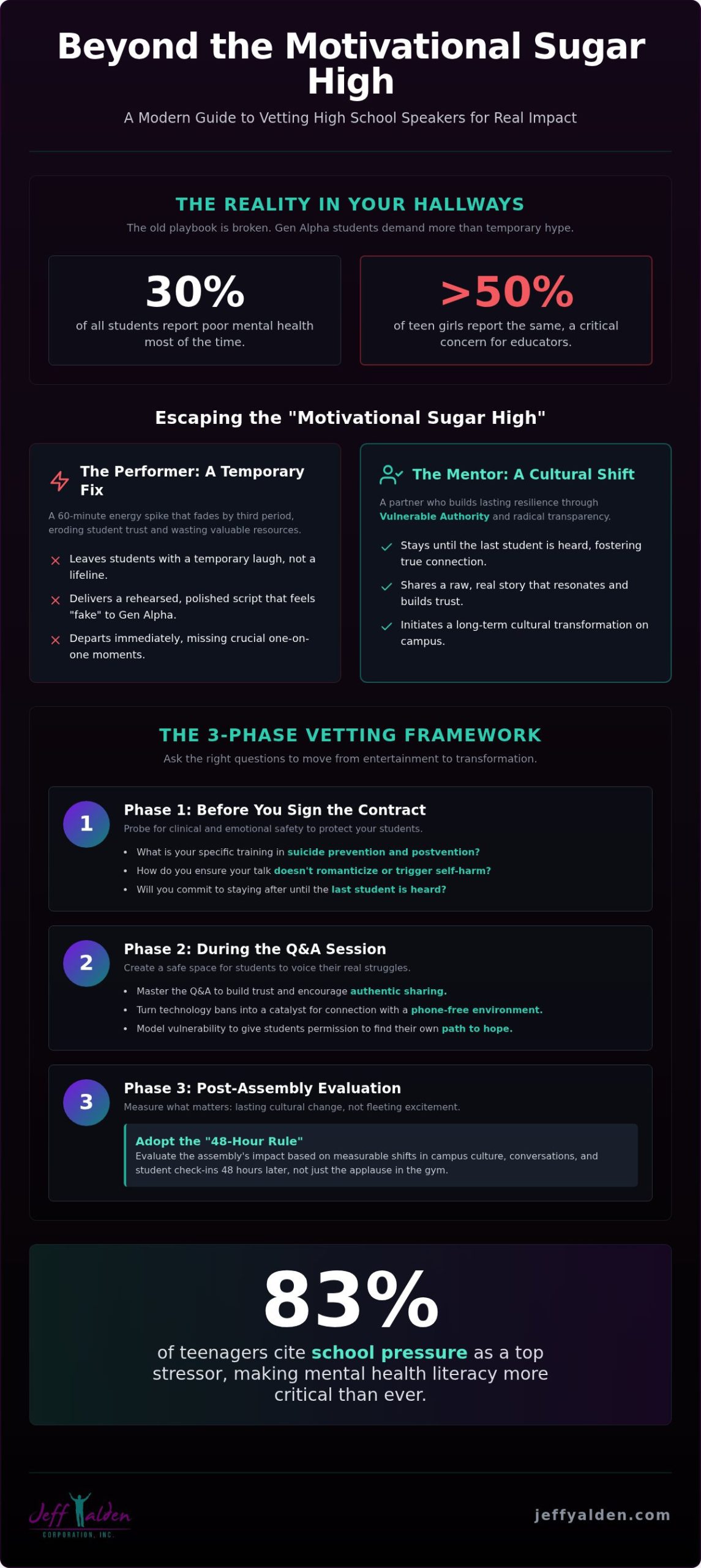
30% of your students report that their mental health is poor most of the time, and for your teen girls, that number is over 50%. You see it in the hallways. You feel it in the heavy silence of the classrooms. You’re searching for how to improve student morale in high school because you know the old playbook is broken. The “motivational sugar high” doesn’t work anymore. Gen Alpha is too smart and too cynical for fake energy or clinical jargon that doesn’t touch their reality.
You’re tired of the budget fatigue and the fear that a speaker might accidentally trigger a crisis instead of preventing one. I get it. You need a shift that lasts long after the assembly ends. This article will show you how to vet a high school speaker for “Vulnerable Authority” so you can move beyond entertainment and into true transformation. We’re breaking down 31 critical questions to ask in 2026 to ensure you hire a mentor who stays until the last student is heard and leaves your campus culture measurably stronger.
Key Takeaways
- Stop settling for “motivational sugar highs” and learn to vet speakers for the radical transparency that Gen Alpha students demand.
- Use 31 specific questions to discover how to improve student morale in high school while ensuring your speaker is equipped to handle student disclosures safely.
- Master the assembly Q&A to create a safe space where students can voice their real struggles and find a path toward hope and resilience.
- Turn 2026 technology bans into a catalyst for connection by creating a phone-free environment that demands presence and vulnerability.
- Adopt the “48-Hour Rule” to evaluate your assembly based on measurable cultural transformation rather than just the initial excitement in the gym.
Beyond the Motivational Sugar High: Why Your Vetting Process Matters
You’ve seen it before. The gym is electric. Students are cheering. For sixty minutes, everything feels perfect. Then the bell rings. By the time third period starts, that energy has evaporated into the vents. That is a motivational sugar high. It’s a temporary spike in emotion that leaves your campus crashing into the same old patterns of apathy and isolation. When administrators ask how to improve student morale in high school, they often reach for the loudest voice in the room instead of the most honest one. This approach doesn’t just fail; it backfires.
In 2026, the cost of a “zero” assembly is higher than ever. It’s not just the thousands of dollars pulled from a tightening budget. It’s the erosion of trust. Gen Alpha students have a radar for “fake” that would put a lie detector to shame. If you bring in a performer who doesn’t understand their world, you aren’t just wasting time. You’re teaching your students that mental health talks are just another box to check. We need to shift the goal. We’re not trying to keep them quiet for an hour. We’re trying to get them to speak up for a lifetime. With 30% of U.S. high school students reporting poor mental health most of the time, the stakes are too high for fluff.
The 2026 Student Landscape: Resilience vs. Perceived Fragility
Students today are navigating a world where human connection is being replaced by mediated social loops. With 2026 smartphone regulations and bans sweeping across districts in states like Utah and Indiana, students are suddenly facing a reality without their digital crutches. They’re cautious and selective. A generic pep talk won’t cut it. To truly reach them, you need a teen mental health speaker who can bridge the gap between their digital isolation and their need for real-world connection. We have to move past basic character education and start focusing on actual mental health literacy. It’s about giving them the tools to handle the 83% of teenagers who cite school pressure as a top stressor.
From Entertainment to Cultural Transformation
Improving morale isn’t about a one-off event. It’s about understanding school spirit as a foundation for safety and belonging. Your speaker shouldn’t be a guest; they should be a partner in your long-term plan. Stop hiring performers who leave as soon as the mic is off. You need a mentor-guide who stays until the last student is heard. This level of commitment is the only way to begin building resilience in teens. The right questions during the vetting process will reveal if a speaker has the “Vulnerable Authority” to handle the raw truth of your campus culture. When you ask how to improve student morale in high school, the answer starts with radical transparency, not a rehearsed routine.
The Vetting Phase: 12 Questions to Ask Before You Sign the Contract
Don’t sign that contract based on a flashy highlight reel. If you want to know how to improve student morale in high school, you have to look past the stage lights. You’re looking for a partner, not a performer. A storyteller entertains. A “Vulnerable Authority” transforms. One leaves your students with a temporary laugh; the other leaves them with a lifeline. Gen Alpha can smell a script from the back of the bleachers. They don’t need a polished presentation. They need a raw, real human who has walked through the fire and knows the way out.
The vetting process is your first line of defense. It’s where you separate the “motivational sugar highs” from the cultural shifts. You need to know exactly how a speaker handles the heavy lifting when the microphones are turned off. If their plan is to fly out twenty minutes after the assembly, they aren’t the right fit for a campus struggling with 83% of students reporting significant academic stress. Real change happens in the one-on-one moments. It happens when a student feels seen for the first time in years.
Probing for Clinical and Emotional Safety
Safety is not a buzzword. It’s a protocol. When you’re dealing with a student body where one in seven adolescents experiences a mental health condition, you cannot afford an amateur. Ask these questions directly:
- “What is your specific training in suicide prevention and postvention?” You need a professional who understands the nuances of crisis intervention, not someone who just “has a heart for kids.”
- “How do you ensure your talk doesn’t romanticize or trigger self-harm?” If they can’t explain the difference between sharing a story and triggering a crisis, they aren’t safe for your gym.
- “Will you stay after the assembly until the last student is heard?” This is the hallmark of a true high school speaker. The most critical work starts when the crowd disperses.
Assessing Relevance for Gen Alpha and Gen Beta
Your students are navigating an unprecedented digital landscape. With 2026 smartphone bans becoming the norm in states like Utah and Indiana, students are feeling a new kind of isolation. Your speaker must bridge that gap without sounding like an out-of-touch lecturer. Ask them:
- “How do you address the 2026 smartphone bans without sounding like a dinosaur?” They need to validate the student’s sense of loss while pointing toward the value of human connection.
- “What current teen pressures are you seeing in schools right now?” If they don’t mention the erosion of social support or the pressure of 4.5 hours of daily social media use, they aren’t in the trenches.
- “How do you bridge the gap between student experience and teacher expectations?” A great speaker acts as a translator, helping staff understand why students are selective and cautious while helping students see the heart behind the rules.
Vetting is the most important step in discovering how to improve student morale in high school. It ensures your budget isn’t just spent, but invested. Ask the hard questions. Demand radical transparency. Your students’ lives might literally depend on the answers you get.
Igniting Student Engagement: Questions to Ask During the Q&A Session
The Q&A session is the most dangerous part of any assembly. It’s also the most important. This is the moment where the script disappears and the real work begins. If a speaker is just a performer, they’ll dread this part. They’ll try to keep it brief or steer toward safe, shallow topics. But if you want to know how to improve student morale in high school, you have to embrace the unscripted. This is where students test the speaker’s “Vulnerable Authority.” They’re looking to see if the person on stage is a hero to be admired or a human to be trusted. When a speaker models radical transparency, they give the entire room permission to be real.
We have to move beyond the surface. If the first question is about how much the speaker makes or what kind of car they drive, the energy dies. You need to empower your student leaders to set a different tone. When a respected student athlete or a quiet leader from the art room asks a “hard truth” question, it shifts the atmosphere. It tells every other student in the bleachers that it’s safe to stop pretending. This is how you bridge the gap between a simple event and a cultural transformation.
The “Hard Truth” Framework for Student Leaders
Prepare your student leaders to lead the way. Give them the green light to ask the questions everyone is thinking but no one is saying. These questions break through the cynicism of Gen Alpha and force a real connection:
- “When was the last time you actually felt like giving up, and how did you stop yourself?” This forces the speaker to move from theory to lived experience.
- “What do adults get wrong about our generation’s mental health in 2026?” This validates the student’s perspective and highlights the unique pressures of the current year.
- “How do you stay resilient when it feels like the world is constantly in crisis?” This addresses the “global anxiety” that many students carry daily.
Managing Sensitive Moments in Front of the Whole School
When students start being real, things can get heavy. A world-class speaker knows how to pivot from a deeply personal disclosure to a universal lesson that supports everyone. They don’t just “handle” the moment; they honor it. Radical transparency is the courageous act of a speaker dismantling the “expert” facade to meet students in the messy, unfiltered reality of their own lived experience. This creates a bridge of empathy that is essential for discovering how to improve student morale in high school.
Safety remains the priority. If a student makes a public disclosure of a crisis, the “Hand-Off” protocol must be seamless. The speaker should acknowledge the student’s bravery, connect the lesson to the room, and then ensure that student is immediately and warmly transitioned to a school counselor or a pre-arranged support staff member. No student should ever be left alone after being vulnerable. This level of care is what separates a mentor-guide from a mere entertainer.
The Hard Truth Logistics: Safety, Crisis, and 2026 Regulations
Logistics aren’t just about the tech. They’re about the trust. When you’re looking for how to improve student morale in high school, you have to realize that a broken microphone is a broken connection. You need to build a container that can hold the raw emotions of Gen Alpha and Gen Beta. This starts with the 2026 smartphone regulations. Districts in states like Utah and Indiana are already seeing the impact of these bans. An assembly without phones isn’t just a rule; it’s a sanctuary from the digital noise that drives 94% of Gen Z to report monthly mental health struggles. Presence is the ultimate gift you can give your students.
Coordination with your school counselors isn’t optional. It’s the baseline. You need a pre-event meeting to discuss emergency protocols. What happens if a student has a panic attack? Who is the point person? These aren’t “what-ifs.” They are “when-ifs.” A world-class speaker doesn’t just show up and talk. They integrate into your crisis team. They understand that how to improve student morale in high school involves more than a speech; it requires a coordinated safety net.
Postvention and Crisis Intervention Protocols
If your school is in the middle of a crisis, you need a specialist. A “hot” crisis zone, like the days following a student death, requires a specific set of skills. You need someone who can navigate teen suicide prevention programs with radical transparency and clinical safety.
Step 1: Define the communication chain. The speaker must know exactly who to signal if a student is in distress.
Step 2: Establish a “Safe Room.” This is a quiet, supervised space for students who need to exit the assembly without shame or judgment.
Technical Requirements for Emotional Impact
In a high school gym, sound quality is a safety issue. If the audio is muddy, the emotional impact is lost. While schools often discover Easy Cee Entertainment for professional DJ and sound services during celebrations, it is equally important that your assembly speaker brings high-quality equipment to ensure their message is heard. The “Eye Contact” rule is also non-negotiable. Lighting should prioritize the human connection on stage over a digital slide. Ask the speaker: “Do you provide your own sound, or do we need to stress-test our system?” A professional speaker arrives with the tools to ensure their message lands with every single student, from the front row to the very back of the bleachers.
Your students deserve more than a lecture. They deserve a lifeline. If you’re ready to hire a teen mental health speaker who prioritizes safety as much as inspiration, let’s get to work.
Measuring the Shift: Questions for Post-Assembly Evaluation
The standing ovation is a rush. It feels like a win. But if you really want to understand how to improve student morale in high school, you have to look past the immediate noise. I call it the “48-Hour Rule.” Don’t evaluate the assembly while the adrenaline is still pumping. Wait two days. That’s when the “motivational sugar high” wears off and the real cultural shift begins to show its face. Is there a new level of honesty in the cafeteria? Are students seeking out counselors they used to avoid? This is the true measure of success.
A great message shouldn’t just fill an hour. It should fuel the next thirty days of your character education program. You’ve brought in a speaker to be a catalyst for high school assemblies that actually matter. Now, you have to keep that fire burning. If the conversation stops when the guest drives away, you’ve missed the opportunity for lasting transformation. You’re not looking for a spark; you’re looking for a controlled burn that changes how your campus breathes. This is how to improve student morale in high school for the long haul.
The Staff-Room Audit: Questions for Your Educators
Teachers are your early warning system. They see the shifts that administrators might miss in the daily grind. After the speaker leaves, get in the trenches with your staff and ask the hard questions:
- “Did the speaker make your job easier or harder in the classroom?” A professional should provide a shared language that simplifies difficult conversations.
- “Which students reached out to you specifically because of something they heard?” Look for the “invisible” kids who suddenly feel safe enough to be seen.
- “What ‘Radical Truths’ from the assembly are now being discussed in the hallways?” If the students are quoting the speaker, the message had teeth.
Long-Term Impact and Culture Integration
Integration is where the “BOOM” happens. My “BOOM” philosophy isn’t just a catchphrase; it’s a recurring theme for your advisory periods. It’s a reminder that every student has the power to choose their response to life’s challenges. Ask your student leaders: “What did we learn about our own resilience today?” When they take ownership of the message, morale doesn’t just improve. It becomes part of the school’s DNA. You’ve moved from a one-time event to a year-long culture shift that supports every student and staff member on campus.
The students are waiting. They don’t want more fluff. They want the truth. They want to know that they aren’t alone in their struggle. If you are ready to bring real change to your campus and finally see a measurable shift in your culture, Book Jeff Yalden for your 2026 assembly. Let’s stop checking boxes and start saving lives together.
Your Campus Transformation Starts Now
You’ve got the questions. Now you need the courage to ask them. We’ve explored how to move past the temporary hype and vet for the type of “Vulnerable Authority” that actually keeps kids safe. We’ve seen how the 2026 smartphone regulations can be a bridge to real presence rather than digital isolation. Learning how to improve student morale in high school isn’t about finding a magician; it’s about finding a mentor who isn’t afraid of the raw, unfiltered truth of your students’ lives.
Jeff Yalden has been on the front lines since 1992. He’s served over 4,000 schools worldwide and stands as a lived-experience expert in suicide postvention. He doesn’t just deliver a speech. He stays until the job is done. He helps you turn a 45-minute assembly into a permanent shift in how your students see themselves and each other. The hallways are waiting for a voice that speaks to their heart, not just their ears. You have the tools to vet the right partner. Now, take the next step toward a campus where every student feels seen and supported.
Bring Radical Transparency to Your School: Book Jeff Yalden Today
Your students deserve a victor who leads by example. Let’s go make a difference together.
Frequently Asked Questions
How do I know if a speaker is “safe” for a school that just experienced a suicide?
A safe speaker must have documented training in suicide postvention and a clear protocol for avoiding contagion. They should focus on being a “victor” rather than just a “survivor” to avoid romanticizing the struggle. Always ask for their specific crisis intervention plan before they step onto your campus. This ensures they can navigate the heavy atmosphere of a “hot” crisis zone with clinical precision and heart.
What is the average cost of a high-quality high school assembly speaker in 2026?
Industry reports for 2026 show that professional national speakers typically command fees ranging from $3,500 to $7,500 per day. While entry-level performers might cost less, those with decades of experience and specialized mental health training fall into the professional tier. When you’re looking for how to improve student morale in high school, remember that you’re investing in a cultural shift, not just an hour of entertainment.
How long should a typical high school motivational assembly last for maximum impact?
Aim for 45 to 60 minutes of high-intensity delivery followed by a dedicated Q&A session. Gen Alpha students have a sharp “BS detector” and limited patience for fluff, so the message needs to be punchy and direct. The most impactful assemblies often end with the speaker staying in the gym for one-on-one conversations, ensuring that every student who needs to be heard has that opportunity.
What should I do if a student has an emotional crisis during the assembly?
You must have a pre-arranged “Hand-Off” protocol with your school counselors and a designated “Safe Room” for immediate support. If a student becomes overwhelmed, a staff member should quietly escort them to the safe space where a counselor is waiting. A world-class speaker will notice the distress and signal your team without breaking the flow of the assembly, keeping the rest of the student body focused and secure.
How do we handle the new 2026 smartphone bans during a school-wide event?
Use the 2026 smartphone regulations as a tool for radical presence rather than a point of conflict. Frame the assembly as a “digital sanctuary” where students are safe from the pressure of social comparison for one hour. When students are untethered from their devices, they’re more likely to engage with the raw, human connection happening on stage. This presence is a key factor in how to improve student morale in high school.
Can a motivational speaker actually help with teacher professional development?
Absolutely, because teachers are often the ones carrying the heaviest emotional load. A speaker who provides teacher professional development can offer a shared language that bridges the gap between staff expectations and student reality. This alignment reduces classroom friction and gives educators the tools to support student resilience without sacrificing their own mental well-being or burning out from the daily pressure.
What is the difference between a storyteller and a “vulnerable authority” speaker?
A storyteller performs a script designed to entertain; a “vulnerable authority” shares a lived experience to transform. Storytellers often leave as soon as the applause dies down. A vulnerable authority stays until the last student is heard. They lead by example, showing their own imperfections to prove that resilience is possible for everyone. This transparency is the antidote to the cynicism often found in today’s high schools.
How far in advance should we book a school assembly speaker?
You should aim to book your speaker at least four to six months in advance to secure your preferred dates. Peak times like the start of the school year or Mental Health Awareness months fill up fast. Early booking also allows for a deeper collaboration between the speaker and your administration, ensuring the message is perfectly tailored to your campus’s specific needs and recent history.
