
What if the reason your students are tuning out your mental health talks is because they can smell the clinical detachment from a mile away? You see the glazed eyes in every assembly. You hear the “I’m fine” that actually means “I’m drowning.” With 71 percent of educators reporting a decline in student behavior and character since 2021, learning how to build resilience in high school students isn’t about following a script anymore. You aren’t alone in feeling helpless as crisis rates climb. We all know the old ways are failing. It’s time for something different.
This radical approach for 2026 requires more than a sterile PowerPoint. It demands transparency. I’m going to show you how to move beyond clinical frameworks to build genuine, life-saving resilience through real-world connection. We’ll explore how to forge a campus culture where students finally feel empowered to ask for help before they reach a breaking point. It’s time to trade the academic jargon for something real. Let’s build a foundation that actually works for the kids in your classrooms right now.
Key Takeaways
- Stop teaching “grit” and start teaching students how to transform their struggles into strength through emotional intelligence.
- Master how to build resilience in high school students by showing up as a “vulnerable authority” instead of a detached, clinical expert.
- Break through student apathy by replacing toxic positivity with a raw, honest acknowledgment of the high-stress culture they live in.
- Implement immediate strategies like “Safe Failure Zones” and daily human-first check-ins that put student well-being before the grade book.
- Learn why a high-impact school assembly is the essential catalyst to jumpstart a campus-wide movement toward genuine mental health.
What Does Resilience Actually Mean for High School Students in 2026?
We’ve been lying to our kids. For decades, we’ve told them that resilience is about “grit” or just “powering through.” We treat it like a shield they should wear to stay untouched by the world. But that’s not What Does Resilience Actually Mean in a world that feels like it’s constantly on fire. In 2026, resilience isn’t about remaining unchanged. It is the raw, difficult process of growing through struggle rather than just surviving it. It is about transformation, not just endurance.
If we want to understand how to build resilience in high school students, we have to stop using the “bouncing back” metaphor. When a student hits a wall, they don’t just pop back to who they were before. They are changed. The goal shouldn’t be to return to a previous state. It should be to integrate that pain into a stronger, more self-aware version of themselves. This requires a shift from traditional grit to deep emotional intelligence. It’s about knowing how you feel, why you feel it, and what you’re going to do with that energy.
The 2026 Stress Landscape: Why Old Strategies Fail
Our students are exhausted. They are living in a digital pressure cooker where every mistake is archived and every success is compared to an impossible, curated feed. Recent data shows that 83 percent of teenagers cite school and the pressure to get good grades as their top source of stress. It isn’t just external pressure anymore. It is an internal perfectionism trap that tells them anything less than “perfect” is a total failure.
Old strategies fail because they often rely on toxic positivity. When we tell a student to “just stay positive” or “look on the bright side,” we are effectively telling them their pain isn’t valid. They see right through it. They are skeptical of school messaging that feels like a Hallmark card. They want the truth. They need to know that life is hard, but they are harder. Understanding how to build resilience in high school students starts with acknowledging their reality, not sugar-coating it.
Resilience as a Life-Saving Skill
This isn’t just about better grades. It’s about survival. With the 2023 CDC Youth Risk Behavior Survey reporting that 30 percent of students feel persistent hopelessness, building these skills is a direct form of suicide prevention. When students lack resilience, a single bad grade or a social media conflict can feel like the end of the world. Resilience is a muscle built through acknowledged struggle.
When we focus on building resilience in teens, we are giving them the tools to navigate a crisis before it becomes a tragedy. It is the foundation of long-term well-being. It is the difference between a student who feels crushed by life and one who knows they have the capacity to handle the weight. We are teaching them that their history doesn’t have to be their destiny.
The Mechanics of Resilience: Transparency and Vulnerable Authority
You can’t lead a student through a dark tunnel if you’re standing safely at the exit with a megaphone. You have to be in there with them. This is what I call “Vulnerable Authority.” It is the radical process of leading through shared imperfection rather than a polished image of success. When we look at The Mechanics of Resilience, we see that it isn’t just about coping skills. It is about trust. High schoolers are drowning in a sea of “perfect” influencers and high-stakes testing. They don’t need another expert telling them what to do. They need a guide who has been where they are.
Radical transparency is the only way to smash the stigma of mental health in 2026. When we are open about our own battles, we give students a “permission slip” to drop their guards. We show them that struggle is a part of the human condition, not a sign of weakness. This is exactly how to build resilience in high school students. We stop pretending we have it all together. We start showing them that our scars are actually our greatest strengths. It moves the conversation from a clinical “problem to be solved” to a human “journey to be shared.”
The Power of the ‘I’ve Been There’ Narrative
Personal storytelling is a tactical tool. It bypasses the natural defense mechanisms teens use to protect themselves from typical adult advice. But there’s a vital distinction here. We aren’t oversharing for the sake of attention. We are using purposeful vulnerability. Every story must have a point. Every struggle shared must lead to a strategy for growth. This is why teen mental health speakers must lead with their own story first. It builds an immediate bridge of trust that no clinical framework can match. It says, “I’m not just here to talk. I’m here because I know.”
Building Trust in a Cynical Generation
Gen Z and Gen Alpha are absolute masters at spotting a fake. They’ve grown up in a world of filters and deepfakes; they crave what is real. If you want to know how to build resilience in high school students, start by being the most authentic person in the room. Educators can do this without crossing professional lines. It’s as simple as admitting when you’re having a tough day or sharing a time you failed and had to try again. This transparency changes the atmosphere of a classroom. It creates a space where it’s okay to be imperfect. When students see their leaders being human, they feel safe enough to be human too. If you are ready to see this shift happen on your campus, bringing in a motivational school assembly can be the spark that starts the fire.
Resilience vs. Toxic Positivity: Addressing the Student Objection
“You don’t understand how hard this is.” That’s the wall every educator hits. It’s the number one objection from students today. They aren’t just being difficult. They are calling out the gap between our advice and their reality. If we want to master how to build resilience in high school students, we have to stop offering toxic positivity. This is the dangerous idea that a positive mindset can fix every problem. It can’t. When we tell a kid who feels invisible or overwhelmed to “just think happy thoughts,” we aren’t helping. We are gaslighting them.
Toxic positivity actively damages resilience because it shuts down the honesty required for growth. In my work, I use a framework called “Validating the Struggle.” We start by saying the words adults are usually afraid to say: “This sucks.” Acknowledging the pain is the first step to finding a way through it. It isn’t about wallowing. It’s about honesty. You can’t navigate a map if you refuse to admit where you are starting from. Once the struggle is validated, the student stops fighting the reality of their situation and starts looking for a solution.
Why Students Tune Out Clinical SEL
Students are masters at tuning out clinical Social Emotional Learning (SEL). They hear the academic language and they hear a lecture. They don’t hear a lifeline. There is a massive “Clinical Gap” between a textbook definition and a teen’s daily experience. We have to move from SEL to Real World Connection. This is why the language used in high school assemblies matters so much. It must be grounded. It must be accessible. It must sound like a conversation between peers, not a sermon from a mountaintop. When we speak their language, they finally start to listen.
Embracing the Struggle as Part of the Process
We need to teach them that failure is fuel. It isn’t the opposite of success. It’s the cost of admission for a life well-lived. We have to normalize the “messy middle” of personal development. Growth isn’t a straight line. It’s a jagged, confusing, and often painful process. When we reframe setbacks as data points, we take the sting out of the mistake. We show them that a bad grade or a social media conflict is just information for their next victory. This is how to build resilience in high school students in a way that actually sticks. We give them permission to be messy while they’re becoming strong. We show them that their struggle isn’t a detour. It is the path.
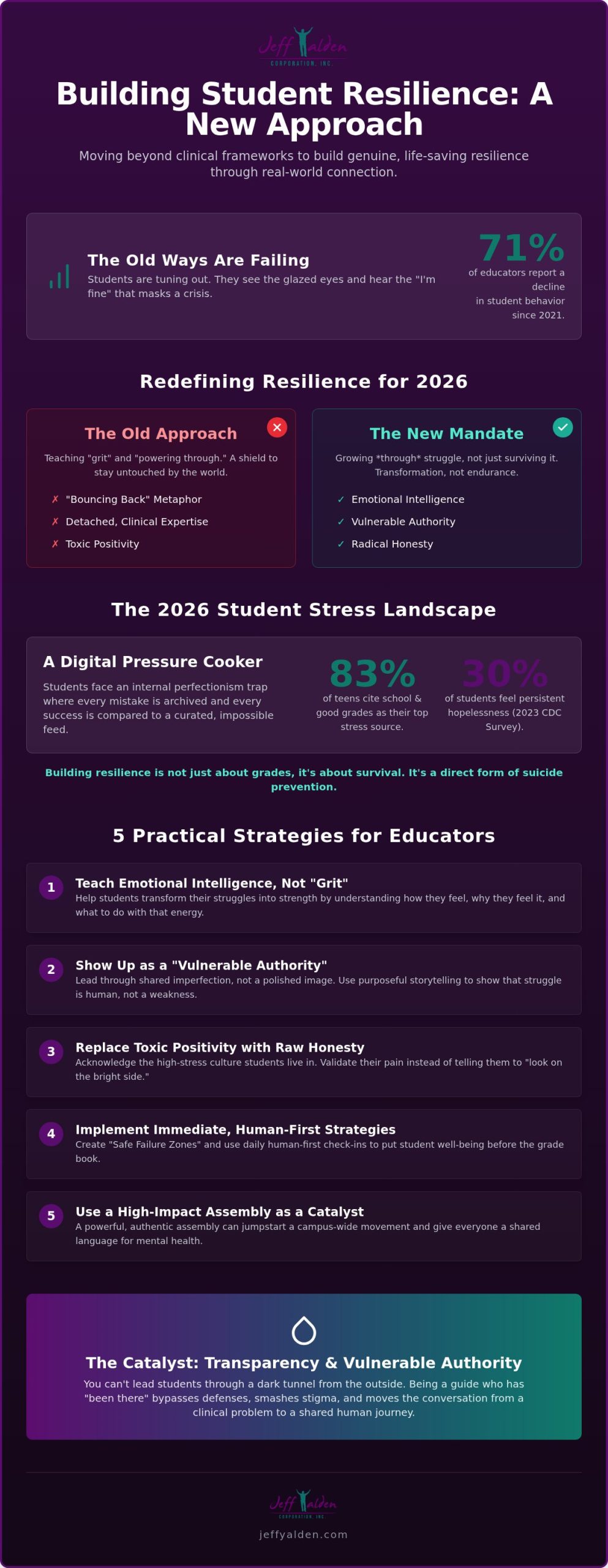
5 Practical Strategies for Educators to Build Classroom Resilience
You are the front line. Every day you walk into that classroom, you have the opportunity to be more than a content deliverer. You can be a lifeline. If you are wondering how to build resilience in high school students, the answer starts with your daily routine. It isn’t about adding more to your plate; it’s about changing the flavor of what’s already there. We need to move from a culture of compliance to a culture of connection. Here are five radical strategies you can start using tomorrow morning.
- Create Safe Failure Zones: Stop treating every mistake as a permanent stain on a transcript. Create assignments where mistakes are analyzed and revised for credit. When we de-stigmatize failure, we give students the room to breathe and the courage to try again.
- Integrate Daily Check-In Moments: Spend the first three minutes of class asking how they are. Not “how is the homework?” but “how is your heart?” Prioritize their humanity over your curriculum. They won’t learn from you until they know you care about them.
- Implement the Mentorship Minute: You don’t need an hour to make an impact. One minute of intentional, one-on-one eye contact and a genuine question can change a student’s entire trajectory. Let them know they are seen.
- Normalize Mental Health Dialogue: Talk about stress. Talk about anxiety. Use grounded language that removes the shame from the struggle. When you make these topics a regular part of the conversation, you break the silence that leads to crisis.
- Invest in Specialized Training: You can’t pour from an empty cup. Utilize trauma-informed teaching professional development to gain the tactical tools needed to spot warning signs and support students who are carrying heavy burdens.
Creating a Culture of Accountability and Support
Resilience is not a free pass. We have to balance high expectations with deep emotional support. If we lower the bar, we tell the student we don’t believe they can reach it. Instead, keep the bar high but provide the ladder of support they need to climb. Encourage students to take healthy risks. Let them own the outcomes, both good and bad. When they see that they can survive a setback and come out stronger on the other side, that is how to build resilience in high school students in real time. Peer-to-peer training also helps; let them lead each other.
The Role of the Educator as a Resilience Coach
It is time to shift your identity from “Content Deliverer” to “Life Guide.” Your subject matter is the vehicle, but resilience is the destination. Practice active listening. When a student comes to you with a problem, resist the urge to fix it immediately. Validate the emotion first. Say, “That sounds incredibly hard.” Let them sit in the struggle while you sit beside them. You don’t have to carry the burden alone. Build a referral network with your school counselors and administration so you know exactly where to turn when a situation exceeds your role. If you are ready to transform your school’s approach to well-being, book a professional development session that will empower your entire staff.
The Catalyst: How a High School Assembly Ignites Resilience
You can’t lecture a student into caring about their mental health. They’ve heard it all before. They’ve sat through the dry PowerPoints and the clinical handouts. To truly master how to build resilience in high school students, you have to break through that wall of apathy with a shock to the system. You need a spark. That’s what a high-energy, emotional assembly provides. It’s a visceral, raw experience that demands attention and refuses to be ignored.
When the entire school sits in that gym together, something shifts. It’s no longer just a “mental health talk” for a few selected kids in a counselor’s office. It’s a collective moment of truth. This shared experience creates a common vocabulary for the entire campus. It gives students, teachers, and administrators a single foundation to build on. When everyone hears the same message at the same time, the culture begins to change before the final bell even rings.
These programs also serve as a critical postvention tool. If your campus has faced a recent crisis or tragedy, the silence can be suffocating. You need a voice that isn’t afraid to address the elephant in the room. With over 30 years of experience in crisis intervention and suicide prevention, I help schools process the pain so they can start moving toward hope. We don’t just talk about the struggle; we show them the way out.
Beyond the Speech: Sustaining the Momentum
An assembly is the beginning, not the end. The real work happens on day 61 and beyond. You have to integrate the message into the daily school routine. This means having follow-up materials and teacher support ready to go the moment the assembly ends. For at-risk youth who need deeper, more personalized support, academic life coaching for high school students provides the one-on-one guidance that turns a moment of inspiration into a lifetime of change. It’s about keeping the fire burning long after the speaker has left the stage.
Booking the Right Voice for Your Campus
Don’t book a speaker who reads from a script. Your students will see right through them. In 2026, radical transparency is non-negotiable. You need a voice that can handle heavy topics like teen suicide prevention with both professional authority and lived-experience heart. You need someone who leads by example. This is how to build resilience in high school students: you show them a victor, not just a survivor. You give them a guide who knows the terrain because they’ve walked it. If you are ready to ignite this change on your campus, it’s time to take action. Book Jeff Yalden for your 2026 assembly and let’s start this journey together.
It’s Time to Lead Your Students Back to Life
The old playbooks are finished. You can’t lecture a generation out of a mental health crisis using sterile curriculum or toxic positivity. True transformation happens when we trade clinical distance for radical transparency. By mastering how to build resilience in high school students through the lens of vulnerable authority, you create a space where it’s finally safe for them to be real. We’ve seen how the right catalyst, a shared and high-energy experience, can break through years of apathy and ignite a campus culture of genuine support.
I’ve spent over 30 years in the trenches of crisis intervention and postvention. I’ve been trusted by thousands of schools worldwide because I lead with my own scars. We can build a campus where students don’t just survive the pressure; they grow because of it. You don’t have to carry this mission alone. It’s time to stop the silence and start the work. Let’s give your students the tools they need to become victors over their own stories. There is hope on the other side of the struggle, and we can reach it together.
Bring Jeff Yalden’s Radical Resilience to Your School
Frequently Asked Questions
How do you build resilience in a student who has given up?
You build resilience in a student who has given up by first validating their exhaustion. Don’t start with a generic pep talk. Start by acknowledging that their world feels heavy. When you learn how to build resilience in high school students who have checked out, you realize that connection is the only way back. They need a “vulnerable authority” who isn’t afraid to sit in the dark with them before trying to turn on the lights.
Can resilience be taught in a traditional classroom setting?
Resilience can be taught in a traditional classroom if you prioritize humanity over the grade book. It isn’t a separate subject. It’s integrated into how you handle mistakes and feedback. You create “Safe Failure Zones” where a wrong answer is a data point rather than a dead end. This shift turns your classroom into a laboratory for growth where students learn to navigate real-world stress within a supportive structure.
What are the early warning signs that a student lacks resilience?
The most common warning signs include extreme perfectionism, social withdrawal after a minor mistake, or “all-or-nothing” thinking. If a student views a B-minus as a total life failure, they are lacking the emotional tools to process setbacks. Watch for students who stop trying entirely because they are terrified of falling short. These are the moments when knowing how to build resilience in high school students becomes a life-saving intervention.
How does resilience help in preventing teen suicide?
Resilience acts as the critical buffer between intense emotional pain and a permanent, tragic decision. When a student has built this muscle, they understand that their current struggle is a season, not a final sentence. It gives them the internal language to say, “This hurts, but I can handle it.” By fostering this mindset, we provide students with the perspective they need to reach out for help before they reach a breaking point.
Is there a difference between resilience and mental toughness?
There is a massive difference. Mental toughness is often about “gritting your teeth” and staying unchanged by the pressure. Resilience is about being changed and growing through the experience. Toughness is a shield; resilience is a transformation. We don’t want kids who are just “tough” enough to hide their pain. We want kids who are resilient enough to acknowledge their struggle and use it as fuel for their future.
What role do parents play in building student resilience?
Parents play the role of the “resilience mirror.” If a parent “snowplows” every obstacle out of a child’s way, that child never learns how to walk on uneven ground. Parents must model healthy failure and show their kids that it’s okay to be imperfect. When families stop over-protecting and start empowering, students gain the confidence to handle the high-stress culture of 2026. It starts with letting them face natural consequences.
How can a school assembly change student behavior long-term?
A school assembly serves as the emotional anchor for your entire campus culture. It provides a “shared experience” that breaks through apathy and gives everyone a common language. While the speech lasts 60 minutes, the impact continues when teachers reference the message during daily check-ins. It is the catalyst that makes the daily, quiet work of building resilience feel urgent and possible for every student in the room.
What should a teacher say to a student going through a crisis?
The most powerful thing you can say is, “I am here, you are safe, and we will walk through this together.” Avoid the urge to fix the problem immediately. Your first job is to validate their emotion and provide a sense of stability. Let them know that their struggle doesn’t change their value. By sitting in the “messy middle” with them, you model the very resilience you want them to develop.
