
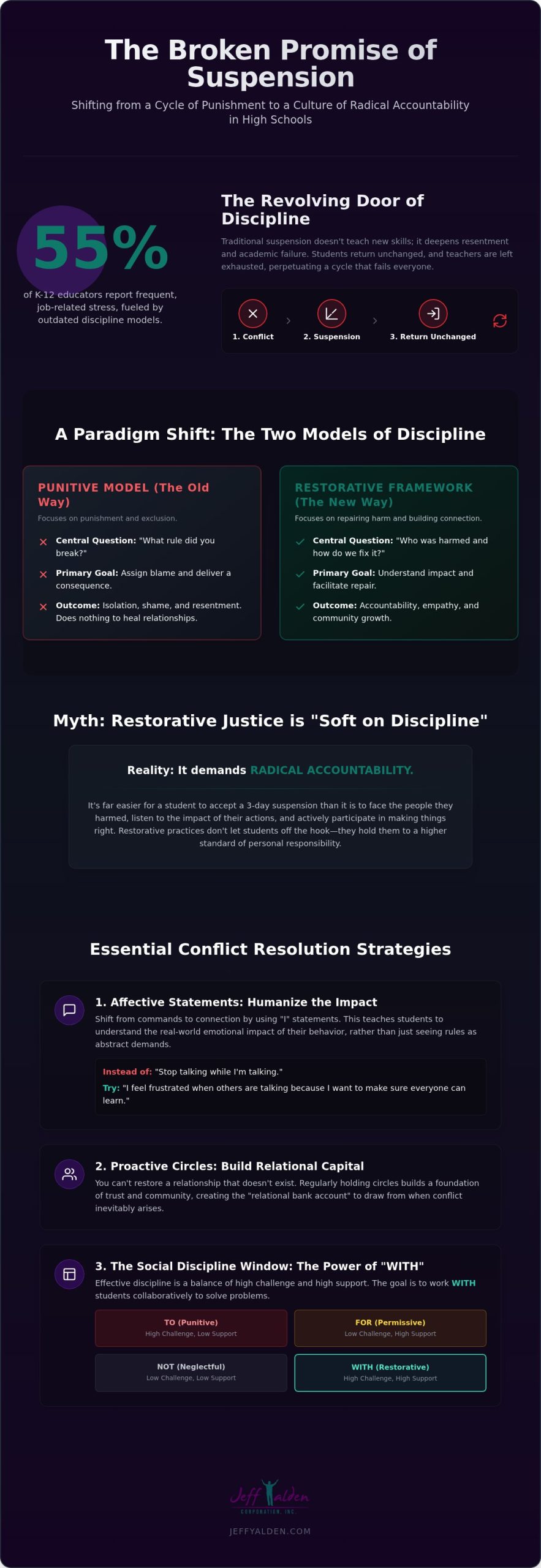
Suspension is a broken promise that leaves teachers exhausted and students unchanged. With 55% of K-12 educators reporting frequent job-related stress in 2026, the old way of “kick them out and hope for the best” is officially failing. You’re likely seeing the same cycle; a blow-up in the hall, a referral written in frustration, and a student who returns three days later with the same chip on their shoulder. It’s time to stop chasing compliance and start demanding connection. Implementing effective conflict resolution strategies for high school students isn’t about being “soft” on behavior. It’s about radical accountability that heals the community instead of just punishing the individual.
I’ve walked those halls and seen the burnout firsthand. You’re exhausted from the post-pandemic behavioral surge, and you deserve a climate that feels safe and productive. This guide will show you how to replace outdated punitive measures with high-accountability strategies that actually work. We’ll explore how to navigate the July 2026 federal policy changes by building a culture of care. You’re going to learn how to transform your campus into a place where students take radical ownership of their actions and teachers finally feel supported again.
Key Takeaways
- Stop the cycle of ineffective suspensions. Learn to shift from a punitive model to a restorative framework that actually heals your campus.
- Master essential conflict resolution strategies for high school students. Use affective statements to teach teens how to communicate the real impact of their actions.
- Break the “soft on discipline” myth. See how restorative practices demand more ownership from students than a simple day out of school ever could.
- Protect your educators from burnout. Follow a roadmap that prioritizes professional development and administrative support to create a safer school climate.
- Ignite the change with vulnerable authority. Use high-impact school assemblies to launch a culture where students and staff thrive together.
Beyond Zero Tolerance: Why Traditional Discipline Fails Modern High Schools
The world of school discipline shifted on its axis in July 2026. With the U.S. Department of Education rolling back regulations on “disparate impact” liability, schools now have more autonomy than they’ve had in decades. But with that power comes a massive responsibility. We can either retreat into the failed, “Zero Tolerance” policies of the past, or we can step into a new era of Radical Accountability. Let’s be real. The old way of kicking kids out of school doesn’t work. It never did. When we rely solely on exclusionary discipline, we aren’t teaching students how to handle their emotions. We’re just making the problem someone else’s for a few days.
Punitive-only models like suspension and expulsion fail because they don’t teach replacement behaviors. If a student lacks the skills to navigate a disagreement, sitting on a couch for three days won’t magically grant them those skills. It only deepens the cycle of resentment and academic failure. In 2026, conflict resolution strategies for high school students must be viewed through a restorative framework. This isn’t about being “soft.” It’s about being effective. We have to move away from the shame-based models that isolate students and toward connection-based models that demand growth. Traditional discipline is a bandage on a broken limb; it hides the injury but does nothing to heal the bone.
The Crisis of Connection in the Digital Age
Conflict doesn’t start at the school gate anymore. It starts at midnight in a group chat or a viral post. By the time that student walks into first period, the fuse is already lit. This digital spillover is a direct result of a massive loneliness epidemic that has left our teens feeling more isolated than ever. When students feel disconnected, they lash out. We have to treat conflict resolution strategies for high school students as a vital tool for building resilience in teens. It’s about teaching them to navigate the “real world” noise without losing their cool. If we don’t address the root of this loneliness, the outbursts will only get louder.
The 2026 Vision for Campus Culture
A high-accountability, restorative campus in 2026 looks different. It’s a place where we stop asking “What rule did you break?” and start asking “Who was harmed and how do we fix it?” This shift requires a deep commitment to Restorative justice principles. We are building trauma-informed environments that prioritize healing over isolation because we know that a student who feels safe is a student who can learn. Restorative justice is a community-led process of repairing harm through dialogue and collective responsibility. It’s about bringing people together to do the hard work of restoration instead of just checking a box on a referral form.
The 5 Essential Conflict Resolution Strategies for High School Students
Conflict is inevitable. How we handle it is optional. If you’re tired of seeing the same three students in the office every week, it is time to pivot. These conflict resolution strategies for high school students aren’t just theories from a textbook. They are life rafts for your staff and students. We are moving from a system that asks “What rule did you break?” to one that asks “What happened, and how do we make it right?” This is about building a culture where students don’t just sit through a detention; they take radical ownership of their impact on others.
- Affective Statements: This is the simplest, most powerful tool in your kit. It’s about humanizing the conflict. Instead of “Stop talking,” a teacher says, “I feel frustrated when there is noise because I want to make sure everyone learns.” It teaches students to express the personal impact of their actions.
- Proactive Circles: You can’t fix a relationship that doesn’t exist. Circles build the “relational capital” you need. When the fire starts, you’ll be glad you spent time building the foundation.
- The Social Discipline Window: This is the “WITH” box. We don’t do things *to* kids (punitive) or *for* kids (permissive). We do things *with* them. It is the perfect balance of high challenge and high support.
- Responsive Conferencing: This is face-to-face accountability. It’s intense. It’s raw. It’s where the real healing happens between the person who caused harm and the person who was affected.
- Fair Process: Engagement, explanation, and expectation clarity. Students need to know their voice was heard, even if they don’t like the final decision.
If your staff needs a spark to start this journey, bringing in a pro for high school assembly programs can break the ice and open the door for these hard conversations.
Proactive Strategies: Building the Foundation
Eighty percent of restorative work happens when there is no conflict. Check-in circles normalize vulnerability. They make it okay to be “not okay.” By using a “talking piece,” you ensure that the loudest voice in the room doesn’t drown out the quietest. Everyone has a seat at the table. This is the exact kind of work I highlight as a teen mental health speaker. We have to build the trust before we can ever hope to resolve the tension.
Responsive Strategies: Repairing the Harm
When things go wrong, we stop asking “Why did you do it?” That question only leads to excuses. Instead, we ask “Who was affected by what happened?” This shifts the focus from the rule to the person. Every serious incident should end with a “Restoration Plan.” This is a written contract where the student outlines exactly how they will make things right. It isn’t about shame; it is about the power of making a different choice next time. This is how we implement conflict resolution strategies for high school students that actually stick.
Restorative vs. Punitive: Addressing the ‘Soft on Discipline’ Myth
Let’s clear the air right now. Sitting at home on a couch for three days isn’t discipline. It’s a vacation. The biggest myth surrounding restorative conflict resolution strategies for high school students is the idea that they’re “soft” or “easy” on kids. That couldn’t be further from the truth. Asking a student to sit in a circle, look the person they hurt in the eye, and hear exactly how their actions caused pain is the hardest thing they will ever do. It’s easy to be angry behind a keyboard or in a hallway shouting match. It’s agonizingly difficult to be vulnerable and take ownership of your mess.
When we suspend students, we often trigger a shame response. Shame says, “I am bad.” It leads to isolation, resentment, and eventually, more bad behavior. Remorse is different. Remorse says, “I did something bad, but I can make it right.” This is the psychological shift that changes lives. We move from exclusionary discipline, which currently sees national suspension rates around 5%, toward a model that keeps students in the community where they can actually learn. Data shows that when schools commit to this, safety doesn’t just stay the same; it improves. You’re not just managing a classroom. You’re building character that lasts a lifetime.
Accountability Without Shame
We have to practice what we call “reintegrative shaming.” This means we condemn the act, but we never condemn the human being. We make it clear that the behavior was unacceptable while simultaneously showing the student they still belong. This connection is the only thing that prevents a repeat performance. I use high school assemblies to model this mutual respect. When students see an adult being raw and honest about their own imperfections, it gives them permission to do the same. It breaks the “tough guy” facade and opens the door for real dialogue.
Long-term Resilience and Life Skills
These aren’t just school rules. They are career skills. In the real world, you don’t get suspended from your job for a disagreement; you get fired or you fix it. By teaching these conflict resolution strategies for high school students, we are preparing them for the high-stakes environments of adulthood. This localized intervention is our best weapon against the school-to-prison pipeline. More importantly, it’s a lifeline. Restorative practices are a cornerstone of effective teen suicide prevention programs because they ensure no student feels truly alone or beyond redemption. When a student knows they have a path back to the community, they have a reason to keep moving forward.
Implementation Roadmap: Bringing Restorative Justice to Your Campus
You can’t just hang a poster in the cafeteria and call it a culture shift. Transforming a school requires more than slogans; it requires a structural overhaul that starts at the top. If you want to see real results with conflict resolution strategies for high school students, you need a roadmap that balances heart with hard data. This isn’t a quick fix. It is a commitment to a new way of being. Research shows that the initial cost of implementing these programs is approximately $139 per student. It is an investment in the future of your community that pays dividends in safety and sanity.
- Step 1: Secure Administrative Buy-In. If the principal isn’t in the circle, the students won’t be either. Define the “Why” for your staff and make it clear that this is a permanent shift; not a “flavor of the month” initiative.
- Step 2: Invest in Professional Development. You cannot give what you do not have. Teachers need trauma-informed teaching professional development to understand the “why” behind the behavior.
- Step 3: Pilot Proactive Circles. Start small. Choose a few homerooms or a specific grade level to build momentum and prove the concept before a full rollout.
- Step 4: Revise the Code of Conduct. Your handbook must reflect your heart. If your rules still prioritize “automatic suspension,” your restorative efforts will feel like a lie to your students.
- Step 5: Celebrate the Data. Look at the numbers. In New York City, suspensions declined by 2.4% between 2023 and 2024 because they stayed the course. Use your wins to fuel the next phase.
If you are ready to stop the burnout and start the healing, let’s talk about Teacher Professional Development that actually changes lives.
Training Your Staff for the Mindset Shift
Teachers are humans too. We have triggers. We have bad days. Before an educator can facilitate a student circle, they have to learn to manage their own emotional responses. Skepticism is a natural reaction to years of failed “new” programs. We overcome that skepticism with radical transparency and real-world success stories. This is about coaching and long-term support; not a one-time workshop that gets forgotten by Monday morning. We have to be honest about how hard this is before we can be honest about how good it can be.
Empowering Student Peer Leaders
The most effective conflict resolution strategies for high school students are often the ones led by the students themselves. When you train peer leaders to facilitate circles, the perceived fairness of school rules sky-rockets. Students know the drama better than we do. They know the group chats and the hallway tensions. By giving them the keys to the process, you aren’t just resolving a fight. You are building a generation of leaders who know how to mend what is broken. Their voices have the power to shift the entire narrative of your campus.
Leading the Change: Jeff Yalden’s Radical Approach to School Culture
Real transformation doesn’t happen in a vacuum. It needs a spark. You can have the best roadmap in the world, but if your students are apathetic and your staff is running on empty, those plans will gather dust on a shelf. I’ve spent over 30 years in the trenches of school culture. I’ve seen the burnout. I’ve felt the tension in the hallways. Implementing conflict resolution strategies for high school students requires a leader who isn’t afraid to be real. It requires “vulnerable authority.” This is my radical approach. I lead by example, sharing my own imperfections to give your students and staff permission to own theirs. We stop pretending everything is fine and start doing the hard work of getting better together.
I position myself as your partner in this mission. I’m the one who handles the “hard conversations” that your staff might be too exhausted to initiate. When I step onto a campus, the goal isn’t just to give a speech. It’s to be the catalyst for the mindset shift that makes restorative justice possible. We move from a culture of silence and shame to one of radical transparency and growth. This is how we lower suspension rates and build a safer school climate that actually lasts.
Assemblies That Bridge the Communication Gap
My High School Assemblies are the launchpad for your new initiative. We use high-energy storytelling to create a shared language between students and staff. I model the exact vulnerability required for restorative work. When students see a Teen Motivational Speaker who is raw and honest, their walls come down. We set the stage for a year of growth and accountability. We stop the eye-rolling and start the real talk. This is where the communication gap closes and the community begins to heal.
Immersion That Transforms Your Staff
If assemblies are the spark, Teacher Professional Development is the heartbeat. We move beyond dry theory to “raw” and “real” classroom strategies that you can use on Monday morning. I know that 55% of educators are facing frequent job-related stress in 2026. You can’t facilitate healing for students if you are drowning yourself. We prioritize teacher wellness as a non-negotiable prerequisite for restorative justice. I invite administrators to book a full-day culture immersion session. Let’s get into the messy details of your campus and build a foundation of resilience that supports everyone. We are in this together. Let’s lead the change.
Ready to Transform Your School Culture?
We’ve spent enough time reacting to fires. It’s time to build a campus where those fires don’t start in the first place. You now have the blueprint to move beyond the failed Zero Tolerance era and embrace a model of radical accountability. By implementing these conflict resolution strategies for high school students, you are giving your teens the tools to own their mistakes and your teachers the breathing room they desperately need. This isn’t just about discipline; it’s about life skills that change the trajectory of a student’s future.
I’ve spent 30+ years helping schools navigate these exact challenges. As an expert in crisis intervention and postvention who was voted the top youth motivational speaker, I know what it takes to break through the noise. Don’t let another semester slip by with the same cycle of burnout and suspensions. Bring Jeff Yalden to your school for a transformational assembly or staff PD! You have the power to lead this change. Let’s make your school a place where every student feels seen, heard, and held accountable. The work starts today.
Frequently Asked Questions
Is restorative justice just a way to avoid suspending students?
Restorative justice is a high-accountability model that demands students face the consequences of their actions directly. It isn’t a “get out of jail free” card to avoid punishment. While it aims to reduce exclusionary discipline, it actually requires more effort from the student than a traditional suspension. They must listen to the person they hurt and work to repair the relationship. It is about teaching life skills that a day at home never could.
How much time does a typical restorative circle take in a high school classroom?
A proactive check-in circle usually takes about 10 to 15 minutes and can be done during homeroom or advisory periods. These short sessions build the relational capital needed for more intense situations. However, a formal responsive conference for a serious incident can take anywhere from 45 to 90 minutes. It requires a dedicated facilitator to ensure every voice is heard and a solid restoration plan is created to move the community forward.
Can restorative justice work for serious offenses like fighting?
Restorative practices are highly effective for serious incidents like fighting, but they require rigorous preparation. You don’t just put two students in a circle immediately after a blow-up. Facilitators conduct separate pre-conferences to ensure both parties are ready to be honest and respectful. By addressing the root cause of the violence, the school can prevent future retaliation. It’s a proactive way to ensure that a temporary truce becomes a long-term peace.
What is the biggest challenge when implementing restorative practices in schools?
The biggest hurdle is the radical mindset shift required from the adults in the building. Many educators were trained in a “crime and punishment” model, so moving toward a restorative framework feels counterintuitive at first. It takes consistent conflict resolution strategies for high school students and ongoing teacher support to overcome the fear that the school is becoming “soft.” This transition typically takes two to three years to fully take root in a campus culture.
How do parents typically react to restorative justice instead of traditional punishment?
Parent reactions often start with skepticism, especially if they believe their child was the “victim” and want retribution. However, once parents see that their child is learning real-world empathy and communication skills, they usually become the program’s biggest advocates. They appreciate that the school is looking at the “whole child” and teaching life lessons that extend far beyond the classroom walls. Transparency about the process is key to winning their trust early on.
Is there evidence that restorative justice improves graduation rates?
While graduation rates are influenced by many factors, reducing out-of-school suspensions is a proven way to keep students on track for a diploma. When students stay in class, they stay connected to their teachers and their credits. Schools that prioritize these conflict resolution strategies for high school students often see a decrease in chronic absenteeism. By keeping the community intact, you give every student a better shot at reaching the finish line together.
What training do teachers need to lead restorative practices effectively?
Teachers need more than just a handbook; they need immersive training in trauma-informed care and circle facilitation. It’s about learning how to manage your own emotional triggers while holding space for student vulnerability. Effective training isn’t a one-day event. It requires ongoing coaching and peer support groups where staff can share their struggles and successes. This professional development is the heartbeat of a successful culture shift on any high school campus.
How does restorative justice support student mental health and suicide prevention?
Restorative practices fight the isolation that often leads to mental health crises. By creating a culture where every student feels seen and heard, we build a protective layer of belonging around our most vulnerable teens. This sense of community is a primary tool in suicide prevention because it ensures no student feels like they are beyond help or redemption. When we mend relationships through honest dialogue, we give students a reason to stay connected.
