
Your straight-A student isn’t just driven. They’re drowning. We celebrate the “perfect” kid while their internal world is quietly on fire. High functioning anxiety in teenagers is a silent, high-interest loan on their future mental health. It looks like motivation; it feels like a cage. You see the trophies and the 4.0 GPA, but you also see the late nights, the shaking hands, and the sudden, unexplained outbursts. You’re terrified they’re going to snap. You’re right to be concerned.
I’ve been there. I know the weight of that mask. We agree that your teen’s success shouldn’t come at the cost of their sanity. This article is your roadmap to identify the cracks in the armor before they become craters. You’ll discover how to identify and support high-achieving kids who are secretly crumbling under the weight of internal expectations. We’re going to move from toxic pressure to radical resilience. I’ll give you the tools to help them manage internal pressure and deepen your connection through vulnerability. It’s time to trade the “perfect” facade for a healthy, grounded future.
Key Takeaways
- Learn why high functioning anxiety in teenagers often hides behind straight A’s and perfect attendance; it’s the most invisible struggle in our schools today.
- Identify the subtle red flags of internal panic, like over-preparation and the inability to say “no,” that are frequently mistaken for high-level motivation.
- Understand why using anxiety as a “false fuel” for success is a high-interest loan that leads to burnout, regardless of how many trophies are on the shelf.
- Discover the power of Radical Transparency and how sharing your own imperfections can bridge the gap between you and your struggling teen.
- Shift your teen’s focus from performance-based worth to Radical Resilience, helping them find purpose in activities that don’t come with a grade or a score.
Beyond the Straight A’s: What is High Functioning Anxiety in Teens?
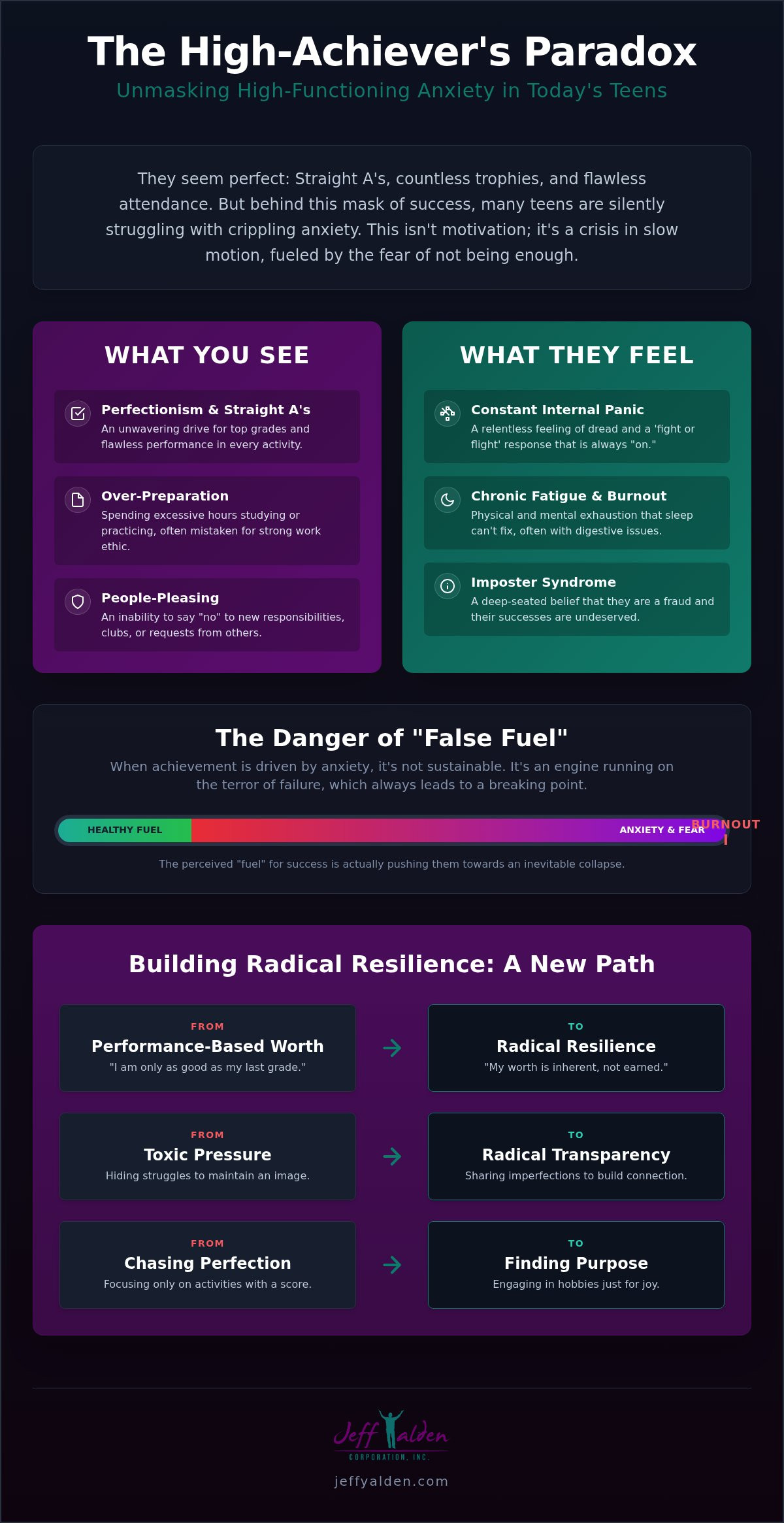
Your teen is winning. At least, that’s what the report card says. But behind those straight A’s is a storm you can’t see. High functioning anxiety in teenagers is the ultimate invisible battle. It’s where outward achievement acts as a mask for internal panic. While other kids might skip class or withdraw when they’re overwhelmed, these kids do the opposite. They work harder. They stay later. They obsess over every detail. It’s not a formal clinical diagnosis, but for Gen Z and Gen Alpha, it’s a pervasive, exhausting reality. It’s a specific way of experiencing an Anxiety disorder where the ‘fight or flight’ response is stuck on ‘fight.’ They aren’t running from the fear; they’re trying to outrun it through sheer performance.
I call myself a “Vulnerable Authority” because I’ve stood on those stages and felt that same crushing weight. We have to be real about this. If we don’t talk about the struggle, we’re just teaching our kids how to be better actors. We need to pull back the curtain and show them that their worth isn’t tied to their output. I’ve spent thirty years in the trenches of youth mental health, and I’ve learned that the “perfect” kids are often the ones closest to the edge.
The Anatomy of the High-Achieving Mask
Perfectionism isn’t about being the best. It’s a shield. It’s a way to stay safe from the feeling of being “not enough.” Your teen becomes a master people-pleaser because saying “no” feels like a death sentence to their reputation. But this mask has a price. Their bodies are keeping the score. Look for the physical red flags: the constant digestive issues, the dark circles from lack of sleep, and a level of chronic fatigue that a weekend nap can’t fix. They are running on fumes and adrenaline, waiting for the world to notice they are struggling.
Why 2026 is the Hardest Year Yet for Teens
It’s harder to be a kid now than it was thirty years ago. Period. Digital performance has turned every moment into a potential highlight reel. Social media hustle culture tells them if they aren’t “grinding,” they’re failing. The pressure of college admissions has reached a fever pitch, creating a sense of future uncertainty that feels like a heavy fog. This is where a Youth Life Coach or targeted academic life coaching can make a massive difference. It’s about providing a space where the pressure to perform is replaced by the permission to be human. They need a bridge between the classroom and their internal world.
The Success Trap: Why Achievement Isn’t the Same as Wellness
We’ve been lied to. We’ve been told that as long as the grades are good, the kid is fine. That’s a dangerous lie. In my thirty years of experience, I’ve seen that high functioning anxiety in teenagers is often the engine behind that success. But it’s an engine running on “false fuel.” It’s not passion or purpose driving them; it’s the terror of failure. This anxiety works until it doesn’t. It leads to an inevitable, crushing burnout because no one can maintain that pace forever. When success is fueled by fear, it’s not wellness. It’s a crisis in slow motion.
These teens often struggle with a brutal case of Imposter Syndrome. They look at their trophies and think, “If they only knew how much of a mess I am, they’d take it all back.” They feel like frauds. This is why building resilience in teens is the only real way out. It’s about teaching them that their identity is separate from their GPA. If we don’t help them disconnect their worth from their work, we are setting them up for a lifetime of chasing a finish line that doesn’t exist.
The High Cost of Being “The Best”
There is a devastating trade-off happening in our homes. We trade internal peace for external validation. These high achievers live in a world of all-or-nothing thinking. If they aren’t the best, they are nothing. There is no middle ground. This is why these are often the kids who “snap” unexpectedly. To the outside world, it looks like it came out of nowhere. To the teen, it’s the result of months, or years, of internal pressure reaching a breaking point. They are tired of being the “perfect” kid because perfect is a heavy weight to carry.
When the Drive Becomes Destructive
How do you know when ambition has crossed the line? It’s when the drive becomes an obsession. It’s when they can’t eat, sleep, or laugh because they’re worried about a B+. We need to be brave enough to look at the link between high functioning anxiety in teenagers and more serious outcomes. According to the CDC, nearly one in three high school students reported persistent feelings of sadness in 2023. For these high achievers, that sadness is often hidden. You can find more resources on High-Functioning Anxiety in Teens to help spot these patterns. We have to look for the subtle teen suicide warning signs, like sudden withdrawal or a loss of interest in things they once loved. The only way to break this cycle is through radical transparency. We, as adults, have to lead the way. If you need someone to help bridge that gap, a Teen Life Coach can provide the perspective your family needs to heal.
Recognizing the Mask: Signs of High Functioning Anxiety You’re Missing
We see the “perfect” kid and we breathe a sigh of relief. We think they’ve got it together. But we’re looking at the mask, not the human. High functioning anxiety in teenagers often disguises itself as the very traits we praise in our culture. Punctuality isn’t just about being on time; it’s a frantic fear of being seen as disrespectful or lazy. Over-preparation isn’t just a good study habit; it’s a desperate attempt to control an environment that feels chaotic. Detail-orientation becomes a prison where one misplaced comma feels like a personal failure. These kids are performing, but they are exhausted.
Inside, the experience is a constant, nagging need for reassurance. They ask, “Is this okay?” a dozen times because they can’t trust their own judgment. They have a total inability to say “no” because they fear that setting a boundary will make them “difficult” or “unworthy.” This leads to the “Crash and Burn” cycle. They perform at a high level for weeks, fueled by adrenaline, until the tank hits zero. Then comes the total withdrawal. They shut down. They disappear into their rooms. I see this reality play out every time I lead high school assemblies. When I talk about the mask, the high achievers are the ones who stop breathing for a second. They realize someone finally sees them.
The Over-Achiever’s Secret Symptoms
Behind the scenes, these teens are over-analyzing every single social interaction. They replay conversations in their heads for hours, looking for mistakes. This leads to “Procrastination-Paralysis.” If they fear they can’t do a project perfectly, they might not start it at all. It looks like laziness to a parent, but it’s actually an intense fear of failure. They won’t try new things unless success is guaranteed. They’d rather stay in their lane than risk looking like a beginner.
What Teachers and Counselors Often Miss
The “quiet, good kid” is often the one in the most danger. In 2025, 18% of adolescents reported moderate to severe anxiety symptoms, yet many of these kids never get flagged. Why? Because their grades are good. We use academic success as a reason to ignore emotional distress. We assume that if they are winning, they are healthy. This is why the role of teen mental health speakers is so critical. We have to speak directly to this hidden demographic and let them know it’s okay to be imperfect. We need to look past the GPA and see the person underneath.
Breaking the Cycle: How to Support Your Teen Without Quenching Their Fire
Stop trying to fix your kid. The goal isn’t to eliminate the pressure; it’s to help them find themselves underneath it. High functioning anxiety in teenagers thrives in the silence of perfection. To break the cycle, you have to lead with Radical Transparency. Share your own mess. Tell them about the time you felt like a fraud at work or when you were terrified of failing a project. When you show your scars, you give them permission to stop hiding theirs. We need to pivot from performance-based success to value-based success. Your teen needs to know that their worth is non-negotiable, regardless of the trophies they bring home.
It’s about building a concrete support system that prioritizes resilience over a 4.0 GPA. While clinical therapy focuses on the “why” of the past, a teen life coach focuses on the “how” of the future. This approach provides a different level of accountability and mindset training that helps high achievers navigate high functioning anxiety in teenagers without losing their drive. It’s coaching for the real world.
Changing the Narrative at Home
Stop praising the grade. Start praising the grit. When your teen stays up late to study, don’t just celebrate the A; celebrate the character it took to persevere. We have to make “The Mental Health Day” a standard part of the family calendar. Sometimes, the most productive thing they can do is put the books away and breathe. Create a safe space for failure. If they bomb a test, treat it as a data point, not a tragedy. Mistakes are the greatest learning tools we have. If they never fail at home, they’ll be terrified to try in the real world.
Communication Strategies That Actually Work
Change the first question you ask when they walk through the door. Instead of “How was the test?” try “How are you doing?” It sounds simple, but it shifts the focus from their output to their humanity. Follow the “Listen-First” rule. When they vent, don’t jump in to solve the problem. Just be there. Your silence is often more powerful than your advice. Use short, punchy declarations of support. “I’m with you.” “I see you.” “You’re enough.” These words cut through the noise of their internal panic. If you’re ready to bring this message to your community and change lives, hire a youth motivational speaker who understands the struggle.
Building Radical Resilience: Moving from Performance to Purpose
High functioning anxiety in teenagers isn’t a life sentence. It’s a loud, ringing signal that the current system of performance-based worth is broken. We need to move toward Radical Resilience. This isn’t about being bulletproof or never feeling stressed. It’s the ability to be whole even when you aren’t perfect. It’s about being okay with the messiness of being human. I want these kids to find hobbies where there is no score. No grade. No ranking. They need a space where they can fail safely and just enjoy the process for the sake of joy, not for a resume. When we move from achievement-driven living to purpose-driven living, the anxiety loses its power. Purpose is about the impact you have on others; achievement is just a trophy on a shelf. It’s time to stop the high-interest loan on their future mental health.
The Path to a Victor Mentality
We have to shift the internal dialogue from “I have to” to “I get to.” It sounds small, but it’s massive. “I get to take this AP class because I have the opportunity to learn.” This reframe changes the energy from victimhood to victory. Life is messy, and a growth mindset is the only way to navigate it without breaking. Mentorship and community are the safety nets that catch these high achievers when they finally let the mask slip. They need to see adults who are winning but are also radically transparent about their own struggles. That’s how we build lasting resilience. We move from being victims of our stress to being victors over our mindset.
Taking the Next Step for Your School or Family
With 83% of teenagers citing school pressure as their top source of stress according to national surveys, we can’t afford to wait. A teen mental health speaker is a catalyst for campus-wide change. It’s about normalizing the struggle and giving students the language to ask for help before they hit a breaking point. This isn’t just for the kids; we need to integrate these strategies into teacher professional development to create a culture of support that lasts. I’ve spent thirty years helping schools bridge this gap and move past the “perfect” facade. Bring Jeff Yalden to your school to start this radical conversation and give your students the tools they need to thrive. Remember: you are more than your GPA. You are enough right now, exactly as you are.
It’s Time to Trade Perfection for Peace
The “perfect” mask is a heavy burden to carry. We’ve seen that high functioning anxiety in teenagers isn’t a sign of success; it’s a silent cry for help that hides behind straight A’s and a crowded schedule. You now know how to spot the cracks in that armor. You know that shifting from performance-based worth to value-based purpose is the only way to save a generation from burnout. We have to stop celebrating the grind and start protecting the kid. It’s time to move toward a healthy, grounded future.
I’ve spent over 30 years in the trenches of youth mental health. I use a radically transparent approach because I’ve been there myself. My work is trusted by thousands of schools worldwide because I speak the truth that teens are desperate to hear. If you’re ready to bring this vital conversation to your community, Book Jeff Yalden for your next High School Assembly or Parent Seminar. We can break this cycle together. Your teen is more than a GPA. They are a human being who deserves to feel whole, even when they aren’t perfect. Keep fighting for them. You’ve got this.
Frequently Asked Questions
How is high functioning anxiety different from generalized anxiety disorder?
High functioning anxiety is not a clinical diagnosis. It is a way of living with Generalized Anxiety Disorder where a person uses their fear to drive performance rather than being paralyzed by it. While GAD often leads to avoidance, high functioning anxiety in teenagers leads to over-achievement and perfectionism. It is the difference between being unable to leave the house and being unable to stop working until every detail is perfect.
Can high functioning anxiety be a good thing for a teenager’s future?
No, because it is a high-interest loan on their future mental health. While it produces short-term results like good grades, it builds a foundation of fear and eventual burnout. Using anxiety as fuel is like redlining an engine; eventually, it will blow. True success comes from purpose and resilience, not from a constant state of internal panic. We want our kids to be high-achieving, but not at the cost of their soul.
What are the most common triggers for high functioning anxiety in high school?
The top triggers are academic competition, college admissions, and social performance. In 2026, the pressure to have a perfect digital presence adds a new layer of stress. Teens feel they are always being watched and graded, not just in class but in their social lives. This constant surveillance makes any small mistake feel like a total failure. It is an environment where “good enough” no longer exists for them.
How can I tell if my teen is just a hard worker or if they have high functioning anxiety?
Look for the “why” behind the work. A hard worker finds satisfaction in the task and can rest when it is done. A teen with high functioning anxiety in teenagers works to avoid the feeling of being a failure and cannot turn their brain off. If they are irritable when they aren’t working or if their self-worth is entirely tied to their output, it isn’t just a strong work ethic. It’s a coping mechanism.
What should I do if my high-achieving teen refuses to admit they are struggling?
Lead with Radical Transparency. Stop asking about their stress and start talking about yours. Share your own imperfections and moments of feeling “not enough.” When you lower your shield, they feel safe enough to lower theirs. Don’t push for a confession; create an environment where vulnerability is modeled and rewarded. They need to see that you love the person, not the performer. Connection is more important than a breakthrough.
Are there specific breathing or grounding exercises that help high functioning teens?
The “5-4-3-2-1” grounding technique is a powerful tool to pull them out of an internal spiral and back into the present moment. They identify five things they see, four they can touch, three they hear, two they smell, and one they can taste. This physical check-in interrupts the cycle of over-analysis. It is a quick way to remind their nervous system that they are safe in the here and now.
How does social media contribute to high functioning anxiety in 2026?
Social media creates a 24/7 performance stage. It isn’t just about FOMO anymore; it’s about the pressure to curate a life that looks successful to peers and future recruiters. Data from 2023 shows that excessive social media use doubles the risk of poor mental health outcomes. For the high achiever, every post is a potential failure. They are constantly comparing their internal mess to everyone else’s highlight reel.
Is a life coach or a therapist better for a teen with high functioning anxiety?
It depends on the need. Therapy is essential for processing deep trauma or clinical disorders. However, a Youth Life Coach is often better for high-functioning teens who need practical tools to manage pressure and build a “victor” mentality. Coaching focuses on the future and actionable mindset shifts. Many families find that a coach provides the bridge between clinical support and the daily grind of high school life.
