
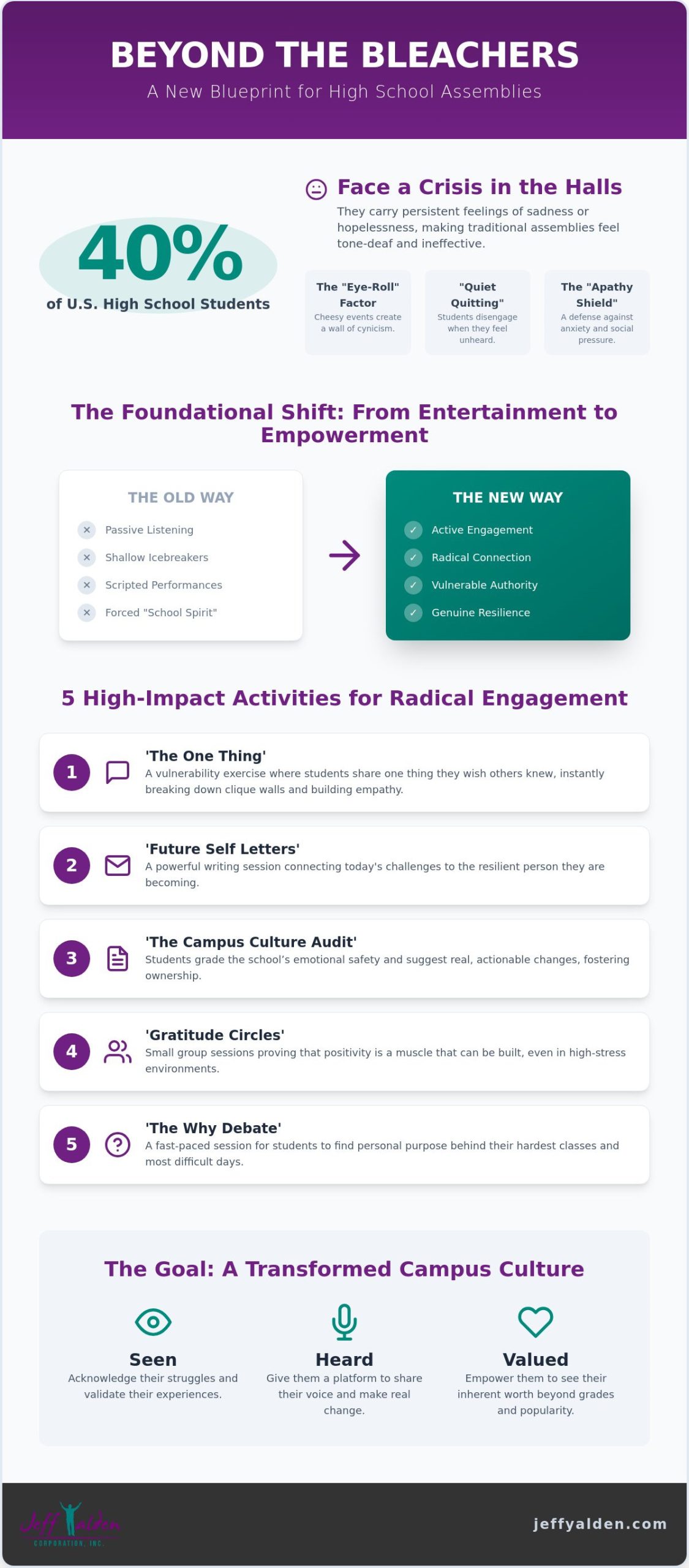
Did you know that 40% of U.S. high school students are walking through your halls right now carrying persistent feelings of sadness or hopelessness? It is a staggering reality that educators face every single day. You see the eye-roll factor every time you announce a mandatory gathering. You feel the quiet quitting in the back row. Let’s be honest: traditional, cheesy school spirit events aren’t just failing; they are creating a wall between you and the kids who need you most. If you are tired of the same old scripts, it’s time to explore fresh high school assembly ideas that actually land.
I have been in those trenches and I know that real motivation isn’t a performance. It’s the radical connection that happens when we drop the act and get real. This article will help you stop using shallow icebreakers and discover high-impact concepts that build real resilience on your campus. We’re going to dive into how you can create a culture of trust where students feel seen, heard, and valued. Get ready to move past the cringe and start delivering programs that measurably improve student well-being in 2026.
Key Takeaways
- Learn why modern teens are “quiet quitting” traditional spirit events and how to replace the “eye-roll factor” with radical transparency.
- Discover high-impact high school assembly ideas like “The One Thing” that break down social cliques and build instant, visceral empathy.
- Shift from passive listening to active engagement by using real-world stress simulations that foster genuine resilience and life skills.
- Master the “vulnerable authority” model to lead with heart and normalize mental health conversations without needing a clinical background.
- Find out how to scale small classroom wins into a full campus transformation where every student feels seen, heard, and deeply valued.
Why Traditional High School Assembly Ideas Fall Flat (And What Works)
Let’s be real. The traditional pep rally is dying. You see it in the back row where students are hunched over their phones or staring blankly at the bleachers. While the history of school assemblies was built on administrative updates and moral guidance, that model doesn’t touch the hearts of 2026 teens. They are hyper-aware. They are skeptical. Most importantly, they are exhausted. When we look for fresh high school assembly ideas, we usually reach for “fun” activities or “spirit” games. But fun is just a distraction. What these kids actually crave is connection.
Real motivation isn’t a carrot you dangle in front of a student. It’s an internal fire. You can’t ignite that fire with a cheesy icebreaker or a scripted speech. Traditional events fall flat because they ignore the “apathy shield.” This is a defense mechanism students use to protect themselves from the crushing weight of anxiety and social pressure. If your assembly feels like a performance, they’ll tune out. If it feels like a lecture, they’ll rebel. To break through, you need radical transparency. You have to be willing to drop the “perfect educator” mask and show them the human underneath. That’s where the magic happens.
The Science of Student Disconnection
Mental health struggles aren’t just a “topic” to cover; they’re invisible barriers to every lesson you teach. In 2026, the average teen spends nearly five hours a day on social media. They’re constantly comparing their internal mess to everyone else’s highlight reel. This creates a state of chronic burnout. When you try to force “school spirit” onto a student who feels fundamentally broken, you aren’t helping. You’re alienating them. Authentic high school assembly ideas must acknowledge this pain before they can ever hope to inspire. We have to validate their struggle before we can ask for their engagement.
Shifting from Entertainment to Empowerment
Stop trying to entertain your students. Start trying to empower them. Entertainment is passive. It’s something done to them. Empowerment is active. It’s something built with them. This shift requires a “vulnerable authority” model. When staff members share their own stories of resilience, it gives students permission to do the same. It breaks down the “us vs. them” wall that defines so many campuses. We want to move from a teacher-led event to a student-owned campus culture. This isn’t about being their friend; it’s about being a guide who has been through the fire and came out the other side. That’s how you set the stage for a high-energy, high-trust school environment.
5 High-Impact Activities for Radical Student Engagement
We’re moving past the surface. If you want a campus that breathes life, you need High-Impact Activities that force students to look at each other differently. These aren’t just games. They’re catalysts. I’ve seen these high school assembly ideas turn a room full of skeptics into a community of supporters. It starts with dropping the “cool” factor and getting raw. Here are five ways to spark that fire:
- ‘The One Thing’: A vulnerability exercise where students share one thing they wish people knew about them, breaking down clique walls instantly.
- ‘Future Self Letters’: A powerful writing session where students connect their current grind to the version of themselves waiting in 2030.
- ‘The Campus Culture Audit’: Giving students the floor to grade the school’s emotional safety and suggest real, actionable changes.
- ‘Gratitude Circles’: Small group sessions designed to prove that positivity is a muscle that can be built even in high-stress environments.
- ‘The Why Debate’: A fast-paced session where students find the personal purpose behind their hardest classes and most difficult days.
Implementing these requires more than just a schedule. It requires heart. If you’re ready to bring this level of energy to your next event, consider how a high school motivational speaker can scale these activities into a full-campus culture shift.
Implementing ‘The One Thing’ Safely
Modeling vulnerability is the key. You have to go first. You share a real struggle, not a “polished” one. But keep it professional; don’t make it your personal therapy session. Set clear safety guardrails. Remind them that sharing is a gift, not a requirement, and that everything shared stays within that circle of trust. This activity shatters the “perfect” masks students wear, replacing judgment with a profound sense of shared humanity.
The Future Self Letter: A 2026 Twist
In 2026, the future can feel blurry and overwhelming. Use digital vaults or physical envelopes to bridge the gap between today and 2030. Don’t just ask about career or money. Ask: “Who will you be when things get hard?” and “What values did you hold onto?” These letters become a “motivation anchor.” When finals hit or life gets messy, students pull these out to remember their “why.” It’s about connecting current academic effort to a future identity they actually care about. These are the high school assembly ideas that stick long after the gym lights go down.
Building Resilience Through Group Problem-Solving
Resilience isn’t a soft skill. It’s a survival skill. In a post-crisis world, the ability to bounce back is the secret sauce that separates students who thrive from those who spiral. We’ve spent too long focusing on “fun” high school assembly ideas like the Human Knot. Those games are fine for elementary school, but they don’t prepare a sixteen-year-old for real-world stress. We need to move into simulations that mirror the actual pressure these kids feel every day. When we build group cohesion through shared struggle, we aren’t just making the campus “nicer.” We are directly impacting individual mental health.
Healthy struggle is the goal. You want to push them to the edge of frustration without letting them fall into a shutdown. This is where grit is born. If a student never learns how to fail in a safe environment, they’ll crumble when the stakes are high. By integrating these concepts into your strategy for building resilience in teens, you create a safety net made of peer support and personal strength. It’s about moving from “I can’t” to “We can,” even when the situation feels impossible. This collective confidence is what transforms a school from a collection of cliques into a unified front.
The ‘Crisis Response’ Simulation
The “Crisis Response” Simulation is a low-stakes way to teach emotional regulation. You create a scenario where the group must solve a complex problem under a tight time crunch. The noise is loud. The pressure is on. But the lesson is simple: Stop, Breathe, Think. By practicing this as a collective unit, students learn that they don’t have to carry the weight alone. This type of training is a vital component of effective teen suicide prevention programs because it normalizes seeking help during a storm. It teaches them that a crisis is a moment to lean in, not pull away.
Collaborative Resilience Challenges
Design tasks that are literally impossible to solve on the first try. You want them to fail. You want them to feel that “suck” of frustration. Why? Because the magic happens in the debrief. We have to teach them how to talk about failure productively. If they can find the lesson in the loss, they win. The debrief is actually more important than the activity itself because it’s where students consciously translate a stressful moment into a repeatable life skill for the future. It’s about training the brain to see every setback as a setup for a comeback. This is how you build a campus that doesn’t just survive challenges but is actually strengthened by them.
Leading with Heart: The Teacher’s Role in Motivation
Teachers, I am speaking directly to you. You are the pulse of the building. You are the ones who see the heavy eyes and the slumped shoulders before anyone else. But here is the truth: you cannot lead your students to a place of resilience if you are unwilling to go there yourself. We have to move past the idea that being a professional means being a robot. The “Vulnerable Authority” model is the only way forward in 2026. It is about dropping the “perfect” act and showing your students that you are a human being who has navigated the same storms they are facing right now. When you drop the mask, they drop their guard. That is when real learning begins.
We need to normalize mental health conversations on every campus. You don’t need a clinical degree to be a lifeline. You don’t need to be a therapist to show empathy. Your job is to be a witness to their struggle. Start every gathering or class with the “Check-In” Ritual. It takes two minutes. Ask them to rate their energy or their mood. This simple act tells them they are seen. It tells them they matter. And I know you are feeling the weight. Preventing teacher burnout isn’t about doing less; it’s about doing what matters most. You give your best when you are emotionally whole, not when you are empty. While many high school assembly ideas focus on the kids in the seats, the real engine of change is the person standing at the front of the room.
The Power of the ‘Real’ Story
Your story is your greatest tool for engagement. When you share a moment where you failed, struggled, and eventually bounced back, you provide a roadmap for their own survival. There is a vital distinction between being transparent and being unprofessional. Transparency is a gift you give to help them grow. If you want to dive deeper into this approach, consider trauma-informed teaching professional development. It equips you to handle the “why” behind student behavior without losing your own peace of mind.
Creating a ‘Safe to Fail’ Zone
You must build a fortress of safety with your words. Use verbal cues that reward the process, not just the result. When a student has a raw emotional moment, don’t recoil. Handle it with a balance of grace and authority. This level of support transforms your classroom management. When students feel safe to fail, they stop acting out to hide their insecurities. They start taking risks. They start showing up. If you want to see this culture shift in action, bring in a youth motivational speaker who can validate the hard work you do every single day.
From Classroom Activities to Campus Transformation
The small wins in your classroom are vital. They are the seeds of change. But if those seeds stay in a silo, they’ll never grow into a full campus culture. You need to scale that energy. You need a moment where the entire student body feels the same heartbeat at the same time. This is where high school assemblies become the ultimate catalyst. They take the individual sparks of engagement and turn them into a campus-wide blaze. It’s about moving from a few motivated classrooms to a school that breathes resilience.
A live speaker does more than just talk. They validate the hard work you put in every single day. When an outside voice echoes the same values you’ve been preaching, it gives those values a new level of weight. Students realize that these high school assembly ideas aren’t just “school stuff”; they are life skills. To build a connected campus in 2026, you need a roadmap that bridges the gap between a Tuesday morning lesson and a Friday afternoon assembly. It’s a continuous loop of trust, transparency, and growth that makes every student feel they belong.
The Assembly as a Catalyst
Let’s be honest. Sometimes students tune out the people they see every day. It’s not personal; it’s just human nature. A “radical” outside voice can break through that noise because they don’t carry the baggage of grades or discipline. I call it the “Jeff Yalden Effect.” In 60 minutes, we move from shallow motivation to deep, visceral transformation. We drop the masks. We get real. But the magic doesn’t end when the gym clears out. The real impact happens when you take that high-energy moment and bring it back into the classroom. You use the assembly as a reference point for every conversation that follows, keeping the momentum alive for months.
Next Steps for Your School
Take a hard look at your campus right now. What’s your “Motivation ROI”? If you see gaps in your culture or a rising tide of isolation, don’t wait for a crisis to act. You can jumpstart this shift by booking a teen mental health speaker who knows how to speak their language. It’s time to stop settling for the status quo and start building a school where every student feels seen and valued. Don’t let another semester slip by without making a move. Book Jeff Yalden for your 2026 school assembly!
Ignite a Culture of Resilience on Your Campus
You have the heart. You have the tools. Now, it’s time to take action. We’ve explored how to shatter the apathy shield by choosing empowerment over entertainment. We’ve seen how vulnerability can bridge the gap between staff and students; creating a safe space where resilience isn’t just a buzzword, it’s a lived reality. These high school assembly ideas are the spark, but the transformation happens when you commit to being “real” every single day. Your students are starving for authenticity. They don’t need a polished performance; they need a guide who has been through the fire and came out stronger.
Jeff Yalden has been delivering that raw impact since 1992. As the industry leader in the vulnerable authority model, he has served over 4,000 schools worldwide. He knows how to scale your classroom wins into a full-campus movement. Don’t let another semester pass with students feeling invisible or unheard. It’s time to lead the shift. Bring Radical Transformation to Your Campus-Book Jeff Yalden Today. You’ve got this. Your students are worth the effort, and the change starts with one bold move.
Frequently Asked Questions
What are the best motivational activities for high school students who are completely disengaged?
The most effective way to reach disengaged students is through a “Step into the Circle” exercise. You ask questions about shared struggles, and students step forward if they’ve experienced them. This breaks the apathy shield because it proves they aren’t alone. When you use these high school assembly ideas, you’re not just talking at them; you’re showing them that their invisible pain is actually a shared bond.
How can I motivate my students without spending money on prizes or rewards?
Connection is the only currency that matters in 2026. Students don’t need another plastic trophy; they need to feel seen and valued by the adults in the building. Focus on intrinsic rewards like the “Why Debate” mentioned earlier. When a student discovers their own personal purpose for showing up, that internal fire will outlast any external carrot you could ever offer them.
Are these vulnerability-based activities safe for students with existing mental health struggles?
Yes, they are safe as long as you set clear guardrails and model the “vulnerable authority” approach. These activities are designed to validate emotions, not to provide clinical therapy. You are acting as a witness to their journey. Always ensure your school’s counseling team is aware of high-impact activities so they can provide a soft landing for any student who needs extra support afterward.
How often should I do motivational activities in a high school classroom?
Consistency beats intensity every single time. You should use the two-minute “Check-In” ritual daily to keep the pulse of your room. Save the deeper, more radical high school assembly ideas for quarterly events or mid-semester resets. This rhythm builds a foundation of trust that makes the high-energy moments more impactful because the students already know you are for real.
What do I do if a student has an emotional breakdown during a vulnerability activity?
Don’t panic. Handle the moment with grace and authority by validating their feelings immediately. A simple “I see you, and it’s okay to feel this” can be incredibly powerful. If the emotion is too raw for the classroom, walk them to a quiet space or involve a counselor. Your calm presence proves that the room is a safe place to be human.
How do I measure if these motivational activities are actually working for my campus?
Look for the shift in your “Motivation ROI.” You’ll see it in decreased disciplinary referrals, improved attendance, and the way students interact in the halls. If students are talking to peers outside their usual cliques, the culture is shifting. You can also use anonymous surveys to see if that 40% sadness statistic is trending downward on your specific campus.
Can these ‘radical’ activities be used for middle school students as well?
Absolutely, but you have to adjust the delivery for their developmental stage. Middle schoolers need more physical movement and shorter bursts of reflection. The core concept of radical transparency still works because even younger teens are hyper-aware of inauthenticity. Keep it fast-paced, keep it high-energy, and never talk down to them. They’ll respect the “realness” just as much as high schoolers do.
How do I get other teachers and administrators on board with this ‘real and raw’ approach?
Show them the data and share your own wins. Most staff members are just as exhausted as the students and are looking for a way to fall back in love with teaching. Start small in your own department. When they see your classroom management improving and your students actually leaning in, they’ll want to know your secret. Leading by example is the best way to spark a campus-wide transformation.
