
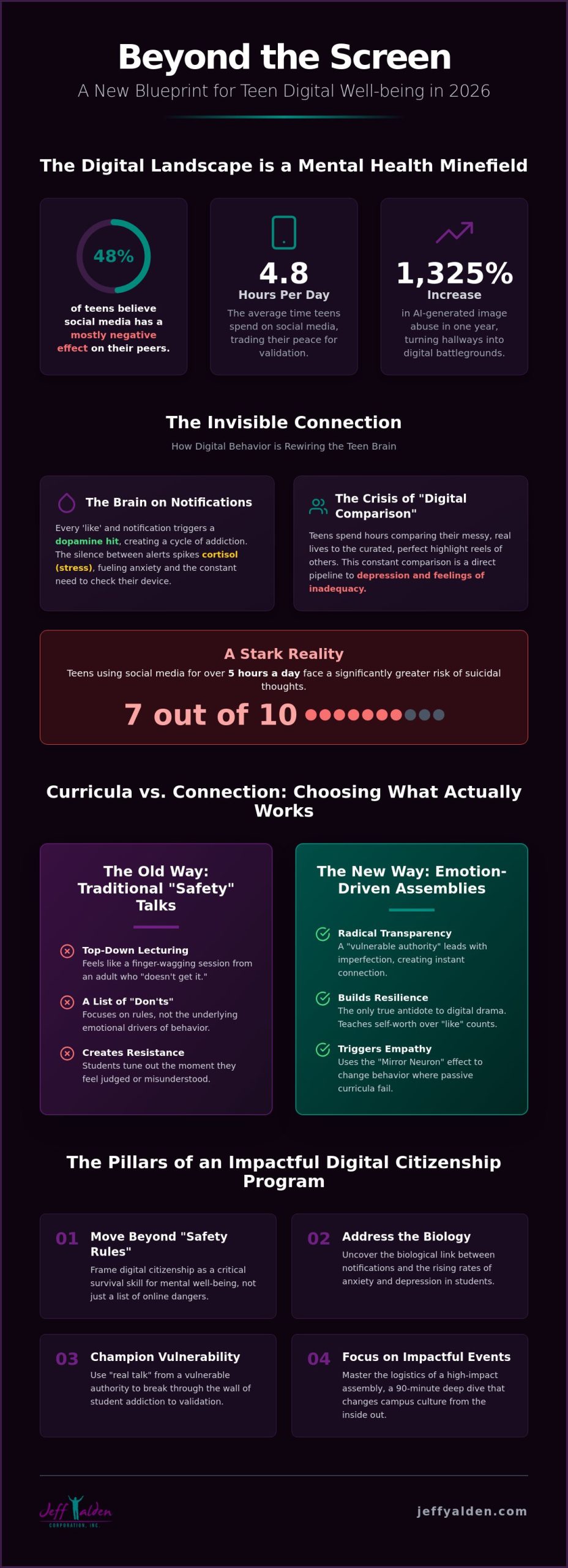
Hey there. Let’s get real for a second. Your students are drowning in a sea of digital validation, and that standard 45-minute PowerPoint on “internet safety” is just white noise to them. They’ve heard the lectures. They’ve ignored the warnings. Meanwhile, 48% of teens now believe social media has a mostly negative effect on their peers. You see the digital drama in your hallways every single day. You feel the weight of the crisis because you know it’s not just about apps. It’s about their hearts.
We agree that the old way of teaching digital literacy is broken. It’s time for a different approach. This guide will show you how a digital citizenship assembly for high school can actually bridge the gap between online behavior and teen mental health through radical transparency. You’re going to learn how to move beyond a list of “don’ts” to create a culture of resilience and real impact. We’ll explore the strategies that turn bored students into empowered leaders who finally understand the connection between their screens and their sanity.
Key Takeaways
- Understand why digital citizenship in 2026 is no longer just about safety rules. It’s now a critical intervention for teen mental well-being.
- Uncover the biological link between social media notifications and the rising rates of anxiety and depression in your students.
- Learn why an emotion-driven digital citizenship assembly for high school triggers the “mirror neuron” effect to change student behavior where passive curricula fail.
- Master the logistics of hosting a high-impact event. This includes everything from priming your staff to managing the raw energy of a 90-minute deep dive.
- Discover how radical transparency and “real talk” from a vulnerable authority can finally break through the wall of student addiction to validation.
Beyond the Screen: Why Your High School Needs a Digital Citizenship Assembly in 2026
Digital citizenship is not a textbook definition or a list of “don’ts” anymore. It is a survival skill. At its core, What is Digital Citizenship? It is the raw intersection where technology, ethics, and mental well-being collide. In 2010, we warned kids about “stranger danger.” In 2026, the danger is the device in their pocket and the algorithm designed to keep them hooked. Your students are caught in a “Validation Trap,” trading their privacy and peace of mind for a temporary hit of dopamine. With teens spending an average of 4.8 hours per day on social media, this isn’t just a tech issue. It is a mental health crisis. Waiting until a tragedy occurs on your campus is a failed leadership strategy. You need a digital citizenship assembly for high school that hits them where they live before the next crisis hits your office.
The 2026 Digital Landscape for High Schoolers
The game has changed. AI-generated image abuse skyrocketed by 1,325% in just one year. Deepfakes are no longer just for celebrities; they are being used to destroy teen reputations in high school hallways across the country. Students have moved away from public posts and into encrypted “dark” social groups where adult supervision cannot reach. This shift, combined with a toxic “cancel culture,” has created a climate of constant fear. Kids are terrified that one wrong click or one leaked screenshot will end their social lives forever. They are anxious, they are exhausted, and they are looking for a way out of the noise.
Why Traditional “Internet Safety” Talks Fail
Most “safety” talks are a joke to students. They tune out the second they feel judged by a speaker who doesn’t understand their world. Clinical, top-down lecturing feels like a finger-wagging session, and teens have mastered the art of looking like they are listening while they are actually miles away. To make a real impact, you have to move toward “Peer-Level” radical transparency. A digital citizenship assembly for high school only works if the speaker is a vulnerable authority who leads with their own imperfections. Instead of just listing rules, we focus on building resilience in teens. This is the only real antidote to digital drama. When students learn to value their own worth over a “like” count, the culture on your campus starts to shift from the inside out.
The Invisible Connection: Linking Digital Behavior to Teen Mental Health
Your brain is under siege. Every notification is a chemical hit. Dopamine floods the system when a “like” pops up, but cortisol spikes when the phone stays silent. This isn’t just about being distracted. It’s about a physiological addiction that is re-wiring how our students feel about themselves. When we bring a digital citizenship assembly for high school to a campus, we aren’t just talking about apps. We are talking about the biology of happiness. Teens today spend hours comparing their messy behind-the-scenes lives to everyone else’s curated highlight reels. This “Digital Comparison” fuels an epidemic of depression. Research shows that seven out of ten teens using social media for more than five hours a day face a significantly greater risk of suicidal thoughts. This is why we treat digital awareness as a foundational pillar of teen suicide prevention programs. It’s about saving lives before the screen becomes a weapon.
The “Permanent Record” isn’t a dusty folder in the principal’s office anymore. It’s a Google search. In 2026, college admissions are more competitive than ever. Digital skeletons are the quickest way to get a rejection letter. We have to be honest with students. Their digital behavior isn’t just a phase; it’s a footprint that follows them into their future. If you want to see a culture shift on your campus, you might consider booking a high school motivational speaker who understands the weight of these choices.
The Psychology of the Anonymous Troll
Why does a straight-A student suddenly become a monster in a group chat? It’s the Online Disinhibition Effect. The screen acts as a mask. It strips away empathy and makes kids feel invincible. Good kids do bad things when they feel hidden. We have to teach students to recognize their “Digital Alter Ego” before it destroys their real-world character. Developing strong digital citizenship skills isn’t just a school requirement. It is a character requirement for the modern world.
Digital Footprints and Future Resilience
Your digital footprint is a living resume that never sleeps. A single impulsive post can bypass years of hard work and character building in an instant. We see it every day. A student works for four years to get a scholarship, only to lose it over a five-second video. But resilience is about more than just avoiding mistakes. It is about the ability to bounce back. We teach students that while their footprint is permanent, their growth is possible. Digital citizenship is about making choices today that your future self will actually thank you for.
When students learn to curate a digital footprint that highlights their genuine interests—whether that is following the automotive engineering of a brand like Eikon Motorsports or participating in creative digital communities—they begin to see the internet as a tool for growth rather than a trap for validation.
Curricula vs. Connection: Choosing an Assembly That Changes Behavior
Let’s be honest about what’s happening in your classrooms. You can hand out all the worksheets you want. You can assign 140 lesson plans. But data doesn’t change hearts. Emotion does. A passive classroom curriculum is great for learning the “rules of the road,” but it rarely stops a kid from hitting “send” on a toxic post in the heat of the moment. To change behavior, you need a visceral, human connection. That’s why a digital citizenship assembly for high school is the “Mountaintop” experience your students actually need. It leverages the “Mirror Neuron” effect. When students see a speaker who is raw, real, and vulnerable, their brains literally sync up with the person on stage. They aren’t just hearing words; they’re feeling the weight of the experience. This is how you reach Gen Z. They have a “BS meter” that’s always on. They don’t want a clinical expert with a scripted slide deck. They want a “vulnerable authority” who has been in the trenches and survived. If you’re looking for a teen mental health speaker, you have to find someone who leads with their scars, not just their stats.
When to Use a Curriculum vs. When to Book a Speaker
Curricula are for the day-to-day reinforcement. They provide the structure. But the assembly is “The Shift.” It’s the moment the energy in the room changes from “just another school day” to a life-altering conversation. A speaker can say things that a principal or a teacher simply cannot. They can push boundaries and challenge students in a way that feels like a peer-to-peer intervention rather than a top-down lecture. The magic happens in the synergy. You use the assembly to break the ice and shatter the silence, then you use the curriculum to keep the conversation alive in the weeks that follow. One provides the facts; the other provides the “Why.”
Evaluating Speaker Credibility
Don’t get fooled by a fancy degree or “Motivational Fluff” that lacks substance. Gen Z respects one thing above all else: radical transparency. If a speaker stands on your stage and pretends to have it all figured out, your students will check out in five minutes. You need lived experience. You need someone who can admit their mistakes and show students how to build a growth-oriented future from the wreckage of a digital mistake. An effective digital citizenship assembly for high school must provide actionable mental health strategies. It’s not enough to just tell them to “be kind.” You have to show them how to protect their peace in a world that is constantly trying to steal it. Look for a mentor-guide persona who is both humble and highly confident in their ability to effect change.
Planning for Impact: How to Host a Successful Digital Citizenship Event
Hosting a digital citizenship assembly for high school is not about checking a box on your annual calendar. It is a mission. If you treat it like a routine disruption, your students will treat it like a nap. You have to prime the pump. Weeks before the event, start the conversation with your staff. Be transparent about the specific digital drama happening in your hallways. When the speaker finally stands on that stage, the students should already feel the urgency of the topic. The “Day Of” is about managing energy. A 90-minute deep dive requires a speaker who can read the room and pivot when the tension gets high. It is about holding their attention without a script, using the mirror neuron effect to build a bridge of trust that a PowerPoint simply cannot reach.
The real work begins when the gym lights go out. This is the “Postvention” period. You need a clear plan to support the students who were moved or triggered by the message. This isn’t a one-off performance; it is a catalyst. You must integrate this message into your broader strategy for high school assemblies throughout the entire academic year. If you are ready to stop the digital drama and start a real conversation, you should book a high school speaker who understands the raw truth of 2026.
Involving Parents and Community
A student-only message often fails because it hits a brick wall at the school gate. Parents are frequently just as overwhelmed by the 2026 digital landscape as their kids. You need to host a “Parent Night” that mirrors the radical transparency of the student assembly. It is about bringing families into the fold. Work together to create a “Digital Covenant.” This isn’t a list of rules; it’s a shared promise between the school and families to prioritize mental wellness over digital validation. When the home and school speak the same language, the message finally sticks.
The Role of Student Leaders
Empower your influencers. I’m not just talking about the student council; I’m talking about the kids who actually set the social tone on campus. If the leaders buy into the message of digital resilience, the rest of the student body will follow. Encourage them to use the school’s social media accounts to run a year-long “Digital Wellness” campaign. Let them take ownership of the narrative and find_out_more about using interactive gaming software to foster healthy social environments. When students lead the charge, digital citizenship stops being a school requirement and starts being a campus culture.
The Jeff Yalden Approach: Radical Transparency in a Digital World
Jeff Yalden doesn’t do scripts. He doesn’t do fluff. When he walks into a digital citizenship assembly for high school, he brings the raw, unfiltered truth. Since 1992, Jeff has been standing on stages and looking students in the eye, refusing to give them the same recycled lectures they’ve heard a thousand times before. His “Real Talk” philosophy is built on one thing: radical transparency. He uses his own life story, including the mistakes and the moments of deep vulnerability, to illustrate the power of choices. He doesn’t position himself as a distant expert. He is a lived-experience guide who has been in the trenches. This connection is why students actually listen. They see a version of themselves in his stories, and they finally understand that their digital behavior is a reflection of their character.
The core of Jeff’s message is the “Victors, Not Victims” mentality. In a world where algorithms are designed to exploit teen insecurities, it is easy for students to feel like they have no control. Jeff flips that narrative. He empowers them to take ownership of their digital footprint and their mental health. He shows them that while they might be targets for validation-seeking apps, they don’t have to be victims of them. This is why Jeff is the preferred high school motivational speaker for campuses in the middle of a crisis or those desperately seeking a culture shift. He doesn’t just talk about the problem; he provides the emotional tools to rise above it.
From Crisis to Character
Jeff’s background in suicide prevention serves as the foundation for his digital wellness programs. He understands that a single screenshot or a “dark” social media group can be the catalyst for a life-altering crisis. He handles the “tough questions” during Q&A sessions with a level of honesty that disarms even the most cynical students. He doesn’t offer pat answers. He stays in the moment with them. He stays in the trenches. This commitment creates a lasting impact because students feel seen and heard by a “vulnerable authority” who isn’t afraid of their reality. It turns a one-day event into a lifelong lesson in character.
Booking the Right Voice for 2026
Bringing Jeff Yalden to your campus is about more than just a 90-minute deep dive. It is about starting a transformation that includes every person in the building. To truly make the message stick, consider pairing the student event with trauma-informed teaching professional development for your staff. Your teachers need the tools to support the students long after the assembly ends. The digital world isn’t slowing down, and the risks for your students are only growing. Don’t wait for a tragedy to teach digital responsibility. Reach out today and bring a voice to your campus that can actually bridge the gap between technology and the heart.
Take the Lead in Your School’s Digital Transformation
The digital landscape of 2026 is moving fast. Your students don’t have to be left behind. We’ve seen that digital citizenship is no longer just about rules. It is a mental health strategy. It requires a visceral connection. By choosing an emotion-driven approach over a passive curriculum, you can finally bridge the gap between online choices and teen resilience. A high-impact digital citizenship assembly for high school is the spark that ignites a culture of wellness on your campus. It is the moment when the “Validation Trap” loses its grip and real character begins to grow.
Jeff Yalden brings over 30 years of high school assembly experience to the table. As a specialist in teen suicide prevention, he knows the stakes are high. He doesn’t offer fluff. He offers a radical transparency approach that saves lives. It’s time to move from managing digital crises to building digital character. You have the power to change the narrative for your students right now. You can choose to lead them toward a future of purpose and peace.
Bring Jeff Yalden to Your High School for a Digital Citizenship Assembly and start the shift today. You aren’t just booking a speaker. You are investing in a future where your students are victors, not victims. Let’s do this together.
Frequently Asked Questions
What is a digital citizenship assembly for high school?
It is a live, high-impact event that goes beyond basic internet safety to address the intersection of technology, ethics, and mental well-being. A modern digital citizenship assembly for high school focuses on helping students navigate the “Validation Trap” and the biological impact of social media. It’s about building character and resilience in a world where digital choices have permanent, real-world consequences. We move past the clinical lectures and get real about how screens affect the heart.
How long should a digital citizenship assembly last?
A deep-dive session typically lasts between 60 and 90 minutes to allow for a true emotional connection. This timeframe provides enough space for a “vulnerable authority” to break down barriers, share lived experiences, and engage in a raw Q&A session. Shorter talks often miss the “Mirror Neuron” effect needed to shift campus culture. You need time to move from the surface-level noise to the heart-level truth.
Can a digital citizenship speaker help with cyberbullying?
Yes, because cyberbullying is rooted in the “Online Disinhibition Effect” and a lack of empathy behind the screen. A speaker addresses the psychology of the anonymous troll and the “Digital Alter Ego” to help students recognize the human on the other side of the device. By focusing on resilience and character, the speaker empowers students to be victors. They learn to stop the drama before it starts by valuing their own integrity over a cheap shot online.
Is digital citizenship part of mental health education?
Absolutely, and in 2026, it is a critical component of any suicide prevention strategy. Since teens spend nearly five hours daily on social media, their mental well-being is directly tied to their digital behavior. A digital citizenship assembly for high school bridges the gap between screen time and the physiological triggers of anxiety and depression. It is a foundational mental health intervention that deals with the reality of dopamine-driven addiction.
How do we measure the success of a school assembly?
Success is measured by the shift in campus culture and the quality of post-assembly conversations. You look for a reduction in digital drama incidents and an increase in students seeking help for online stressors. Success is also seeing student influencers take charge of wellness campaigns. Long-term impact is proven when students begin to treat their digital footprint as a living resume rather than a playground for impulsive, destructive choices.
What topics are covered in a modern digital citizenship talk?
Modern talks cover AI literacy, the “Validation Trap,” deepfake reputation risks, and the biological impact of notifications. We move past “don’t talk to strangers” to discuss the ethics of encrypted “dark” social groups and the reality of cancel culture. The focus is on radical transparency. We teach students how to protect their peace while navigating a high-stakes digital landscape that never sleeps and never forgets.
Do we need a parent seminar along with the student assembly?
Yes, because the message needs to be reinforced at home to truly stick. A “Parent Night” mirrors the student experience and provides families with the tools to create a “Digital Covenant.” When parents and schools speak the same language about digital wellness, students are less likely to fall back into toxic habits. It creates a unified front against the pressures of social media and ensures the conversation doesn’t end when the school bell rings.
How much does a professional high school assembly speaker cost?
Pricing varies based on the speaker’s experience, travel requirements, and the scope of the program. You are investing in a catalyst for campus-wide change, not just a 90-minute presentation. It’s important to reach out to the speaker’s team directly to discuss your school’s unique needs and budget. Focus on the value of preventing a crisis and building a culture of resilience that lasts long after the event ends.
