
When 83% of teens identify academic pressure as their primary source of stress, we aren’t just looking at a heavy workload. We are looking at a crisis of the soul. You feel it in your chest every Sunday night. You’re staring at a screen at 2 AM, convinced that one B-minus defines your entire worth. I’ve been there. I know that suffocating weight of peer comparison. I know the physical exhaustion. Dealing with academic pressure and stress isn’t about managing your time better; it’s about radical honesty and reclaiming your life.
You likely believe that success requires sacrificing your sanity. I’m here to tell you that’s a lie. You can achieve your goals without losing your mind. This guide will show you how to transform overwhelming pressure into a foundation for lifelong resilience through proven mental health strategies. We’ll explore how to build a mindset that handles failure, how to fix the dialogue with your parents, and how to manage the work without burning out. It’s time to stop drowning. It’s time to start leading.
Key Takeaways
- Understand why the 2026 academic landscape feels like a pressure cooker and how to dismantle the “perfection trap” that leads to burnout.
- Master radical transparency as your primary tool for dealing with academic pressure and stress before it evolves into a full-blown mental health crisis.
- Implement “Radical Prioritization” to protect your sleep and physical movement, ensuring your success doesn’t come at the cost of your sanity.
- Shift your internal metric from “grade-focused” to “growth-focused” to build a resilient mindset that views failure as a foundation for future victory.
- Discover how fostering school-wide connection through high school assemblies can transform a competitive campus culture into a supportive community.
The Academic Pressure Cooker: Why 2026 Feels Different
Stop for a second. Take a breath. If you feel like your chest is tightening every time you check your student portal, you aren’t alone. Academic pressure is the crushing, cumulative weight of expectations from your parents, your teachers, and most of all, that relentless voice in your head. In 2026, this weight has shifted. It isn’t just about a heavy backpack anymore. It’s about digital saturation, global competition, and a culture that treats students like data points instead of human beings.
You are not a machine. You were never meant to be. Dealing with academic pressure and stress in this era requires us to acknowledge that the game has changed. We are living in a world where you are expected to be “on” 24/7. Between constant notifications and the endless comparison to everyone else’s highlight reel, your brain is exhausted. Academic stress is a real, physiological response to this environment, and validating your struggle is the first step toward reclaiming your power. We start this journey with Radical Transparency. It means being honest about the struggle before it breaks you.
The Perfectionism Trap and the Fear of Falling Behind
Social media has poisoned our definition of success. You scroll through feeds of “study-gram” influencers with their perfect highlighters and 4.0 GPAs, and you feel like a failure just for being tired. This creates a dangerous all-or-nothing mindset. You start believing that one bad grade is a life sentence. It feels like if you aren’t at the top, you’re at the bottom. This cycle of peer comparison is a thief. It steals your joy and replaces it with a hollow fear of falling behind a curve that doesn’t even exist.
Physical and Emotional Signs You’re Hitting the Wall
Your body usually knows you’re in trouble before your mind admits it. Have you noticed “the fog” lately? That heavy, distant feeling where you can’t focus on a single page? Maybe you’re snapping at your parents for no reason or lying awake at 3 AM with a racing heart. These aren’t just personality quirks. Chronic stress manifests as real physical symptoms like headaches, digestive issues, and a weakened immune system. You aren’t “weak” for feeling this. You’re human, and you’re hitting a wall that was built too high.
Burnout is the point where your ‘why’ is eclipsed by your ‘must’.
Beyond the Books: When Academic Stress Becomes a Mental Health Crisis
We need to talk about the bridge. It is the narrow, terrifying path between being “stressed out” and “giving up.” For too many students in 2026, academic failure isn’t just a bad grade. It is a trigger for a total mental health collapse. When you feel like your entire future is over because of a single semester, that isn’t just stress. It is a crisis. Dealing with academic pressure and stress often means standing on that bridge and wondering if anyone sees you. I see you. I have been there.
Talking about the dark places saves lives. Period. We have to stop pretending that every student is just “fine” or “hanging in there.” This is why the role of a teen mental health speaker is so critical. It is about breaking the silence with raw, radical honesty. If we don’t normalize the conversation about the darkest thoughts, we leave students to fight them alone in their rooms. Vulnerability is the only way out of the dark.
Recognizing the Warning Signs in Yourself and Friends
Look for the shifts. They are rarely loud; usually, they are quiet retreats. Is your best friend suddenly missing practice? Did they stop playing the guitar they used to love? Withdrawal is a scream for help. If you notice drastic personality changes or someone starts “giving away” prized possessions, don’t wait. You have to ask the hard questions. Ask them directly: “Are you thinking about hurting yourself?” It is uncomfortable. It is scary. But it is the most important question you will ever ask. If you are struggling with coping with academic stress, reach out before the weight becomes unbearable.
The Critical Need for Crisis Intervention in Schools
Schools can’t just hang posters and call it “awareness.” Awareness doesn’t save a student in the middle of a panic attack. We need active prevention. Real teen suicide prevention programs change the DNA of a campus. They move the needle from reactive to proactive. We need to build a culture where asking for help is a sign of strength, not a badge of shame. We need to make it “cool” to be human. If your school is ready to change the narrative, bringing in a teen life coach can provide the personalized support students need to navigate these high-stakes years.
Radical Transparency: Owning Your Stress Before It Owns You
“I am not okay.” Those four words are the hardest to say, yet they are the most powerful weapons you have. In a world that demands you stay “on” 24/7, admitting you’re struggling feels like a defeat. It isn’t. Radical transparency is about taking off the mask of the “perfect student” and being real about the weight you’re carrying. When you own your struggle, you stop letting the struggle own you. This is the heart of my “vulnerable authority” model. I lead by showing my imperfections so you know it’s safe to show yours.
Vulnerability isn’t a weakness. It is the ultimate tool for building resilience in teens. Resilience isn’t about never falling; it’s about being honest enough to admit when you’re down so you can get back up. Dealing with academic pressure and stress becomes much easier when you stop pretending it doesn’t exist. You don’t have to be a martyr for a GPA. You just have to be human.
The ‘Real’ Conversation: Student to Parent
Talking to high-achieving parents about burnout is terrifying. You’re afraid of disappointing them. Try this script: “I want to succeed as much as you want me to, but right now, my mental health is hitting a wall. I need us to focus on how I am doing, not just what I am getting.” Move the conversation from the gradebook to your well-being. Set clear boundaries. Tell them you need 9 PM to 7 AM to be a “no-school zone” for your brain. It isn’t a war; it’s a negotiation for your sanity.
Vulnerability as a Leadership Skill
The most successful students in 2026 aren’t the ones who never sleep. They are the ones who know when to pause. They understand the difference between a “Victor” and a “Victim” mentality. A victim blames the teacher, the system, or the test. A victor acknowledges the setback, owns the emotion, and uses it to fuel the next step. A Victor is someone who uses their scars as a roadmap for others. When you are transparent about your setbacks, you become a leader that others can actually follow. You show them that success isn’t a straight line; it’s a series of pivots fueled by radical honesty.
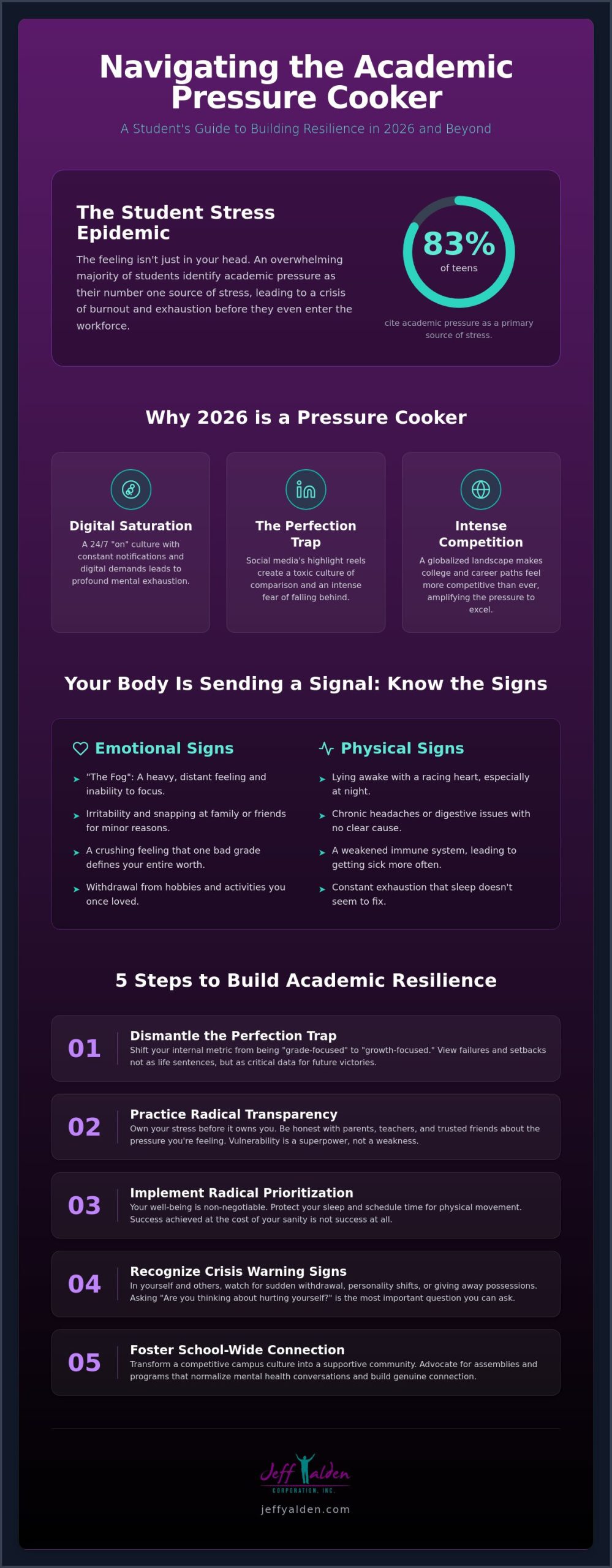
5 Steps to Building Academic Resilience Without Burning Out
You are tired of being told to “manage your time.” If one more person hands you a color-coded planner while you’re drowning, you might scream. Dealing with academic pressure and stress isn’t about fitting more work into your day. It’s about changing how you show up for that work. You need a strategy that protects your soul while you chase your goals. Here is how we build that resilience in 2026.
- Step 1: Audit your ‘Why’. Are you working for a grade or for growth? If your only goal is a letter on a transcript, you’ll burn out the moment things get hard. Work for the person you are becoming.
- Step 2: Practice Radical Prioritization. Protect your sleep and your movement first. They are not rewards for finishing your work; they are the fuel that makes the work possible.
- Step 3: Build a ‘Resilience Squad’. You cannot do this alone. Find mentors, coaches, and friends who see the real you, not just the “student” version of you.
- Step 4: Reframe Failure. A bad grade is just data. It tells you what you haven’t mastered yet. It is a roadmap, not a definition of your worth.
- Step 5: Seek Professional Mentorship. Sometimes you need an academic life coach for high school students to help you navigate the noise and build a personalized battle plan.
Redefining Success: The Character Over Grades Model
Your GPA is a number. It is not your value as a human being. In the long run, the world doesn’t care if you aced AP History; it cares if you have grit, empathy, and integrity. We need to flip the script. Focus on building a resilient heart. When you prioritize your character, you develop the internal strength to handle any setback. A perfect transcript can get you in the door, but your character is what keeps you in the room.
The Role of a Youth Life Coach
Traditional therapy is vital for healing, but coaching is about moving forward. A youth life coach works with you to bridge the gap between where you are and where you want to be. It’s about navigating the specific hurdles of the high school and college transition with a pro who has been in the trenches. We build a plan that balances your academic demands with your personal peace. If you’re ready to stop surviving and start leading your own life, let’s talk about your future today.
Bringing the Conversation to Your School: Why Connection is the Cure
Connection is the cure. You can have the best individual coping skills in the world, but if you are swimming in a toxic culture, you are still going to struggle. Dealing with academic pressure and stress is not a solo mission. It requires a total shift in how our schools operate. We have to move away from the “grind at all costs” mentality and toward a community that values the human being behind the student ID number. Grit is important, but a culture of support is what actually keeps students alive and thriving.
This change often starts with a single, powerful catalyst. I have seen it happen a thousand times in gyms and auditoriums across the country. A single day of high school assemblies can shatter the silence that keeps students isolated in their pain. When we stand together and admit that we are struggling, the shame disappears. That is the “Jeff Yalden Effect.” It moves a campus from a collection of stressed individuals to a unified support system. We create a safety net where every student feels seen and heard for who they are, not just for what they produce on a scantron sheet.
Transforming Campus Culture with Radical Transparency
One assembly can change the entire trajectory of a school year. It provides a common language for students and staff. It gives everyone permission to be real. When a “vulnerable authority” stands on that stage and shares their own scars, it gives every person in that room the courage to do the same. We stop competing to see who is the most stressed. We start connecting over our shared humanity. This radical transparency turns a school from a pressure cooker into a place of genuine growth.
Support for the Supporters: Professional Development
We cannot ask teachers to pour from an empty cup. Educator wellness is the foundation of student wellness. If our teachers are burnt out, they cannot effectively guide our students through their own struggles. This is why trauma-informed teaching professional development is so vital. We have to equip our educators to spot the subtle signs of academic distress before they turn into a full-blown crisis. It is about integrating resilience training into the daily classroom experience. When teachers are supported, they build classrooms that are greenhouses for resilience rather than factories for perfection.
Don’t wait for a tragedy to start this conversation. Don’t wait for a crisis to change your culture. The time to build resilience is right now. If you are ready to bring this message of hope and radical honesty to your community, reach out to a youth motivational speaker who can help you lead the way. Let’s make 2026 the year we chose connection over competition.
Take the Lead: Your Resilience is Your Power
You’ve seen the data. You’ve felt the weight. Dealing with academic pressure and stress in 2026 isn’t a battle you have to fight in silence. Real success isn’t defined by a perfect GPA; it is defined by the grit you build when you choose to be radically transparent about your struggles. You now have the steps to audit your “why,” prioritize your peace, and transform your setbacks into a roadmap for others. You are ready to move from surviving to leading.
True transformation often requires a catalyst to shift an entire campus culture. With over 30 years of experience as a specialist in suicide postvention and crisis intervention, I provide a direct, high-energy approach that actually resonates with Gen Z and Gen Alpha. We don’t just talk about problems; we build the safety nets that save lives and foster growth. It is time to stop the burnout and start the breakthrough.
Bring Jeff Yalden to your school to transform your campus culture today.
You are more than a test score. You are a victor in the making. Take that first step toward a resilient future and don’t look back. You’ve got this.
Frequently Asked Questions
Is academic stress always a bad thing?
Academic stress isn’t always a villain; it can be a driver for growth when it’s short-term and manageable. This is often called eustress. The problem starts when it becomes chronic and suffocating. When 83% of teens identify it as a major source of stress, we’ve moved past “motivation” into a danger zone. You need to know the difference between being pushed to your best and being pushed off a cliff.
How can I tell if my child is just stressed or experiencing a mental health crisis?
Look for the “shutdown” rather than just the “stress out.” A stressed student might be irritable or tired, but a student in crisis often withdraws from activities they used to love. If they stop hanging out with friends, experience drastic personality shifts, or start giving away prized possessions, it’s a crisis. Don’t wait for a “perfect” moment to ask. Ask directly. Your gut is usually right about these shifts.
What should I do if my school doesn’t talk about mental health?
If your school is silent, you have to find your own safety net outside those walls. Dealing with academic pressure and stress is nearly impossible when the environment ignores the problem. You can advocate for a youth motivational speaker to come in and break that silence for the whole student body. Until that happens, you can check out Balanced Minds Psychology & Wellness for professional support, or look for community resources that validate your experience and offer real tools.
Can a youth life coach help with academic pressure?
Absolutely, because a youth life coach focuses on the practical “how” of moving forward. While traditional therapy in 2026 can cost between $100 and $250 per session, coaching is about building a personalized battle plan for your daily life. It’s about bridging the gap between your heavy workload and your mental health. We focus on resilience, character, and practical strategies to handle the heat without losing your soul.
How do I talk to my parents about taking a mental health day?
Be raw and honest about your “why.” Instead of just saying you’re tired, tell them you’re hitting a wall and need a strategic reset to stay productive. Explain that a mental health day isn’t an escape; it’s a tool for dealing with academic pressure and stress. If you’re in New Jersey, you can even point to the state’s free teletherapy programs for students as proof that mental health is a priority in 2026.
What are the most common warning signs of teen burnout?
Burnout usually shows up as “the fog.” You’ll notice persistent brain fog, chronic irritability, and significant sleep disturbances. It’s that moment where your “why” is totally eclipsed by your “must.” When 61% of students report feeling overwhelmed, these signs are widespread. If you’re waking up at 3 AM with a racing heart about a quiz, you’re already there. Your body is telling you that the system is broken.
How can I balance extracurricular activities with heavy course loads?
You have to practice radical prioritization. This means protecting your sleep and movement first, not last. If your schedule doesn’t allow for seven hours of sleep, something has to go. It’s about auditing your activities to see which ones actually fuel you—like the therapeutic joy of pet ownership—and which ones are just for the resume. For help building a more harmonious home life with your pet, check out I Wuff You Dog Training. Quality of character and mental peace beat a quantity of clubs every single time. Don’t sacrifice your sanity for a line on a transcript.
Why is radical transparency important for students?
Radical transparency is your ultimate weapon because it shatters the “perfection trap.” When you admit you’re struggling, you give every other student in the room permission to do the same. This is how we change the culture of a school. It turns you from a victim of the system into a victor who owns their story. Vulnerability isn’t a weakness; it’s the foundation of real, lasting resilience.
