
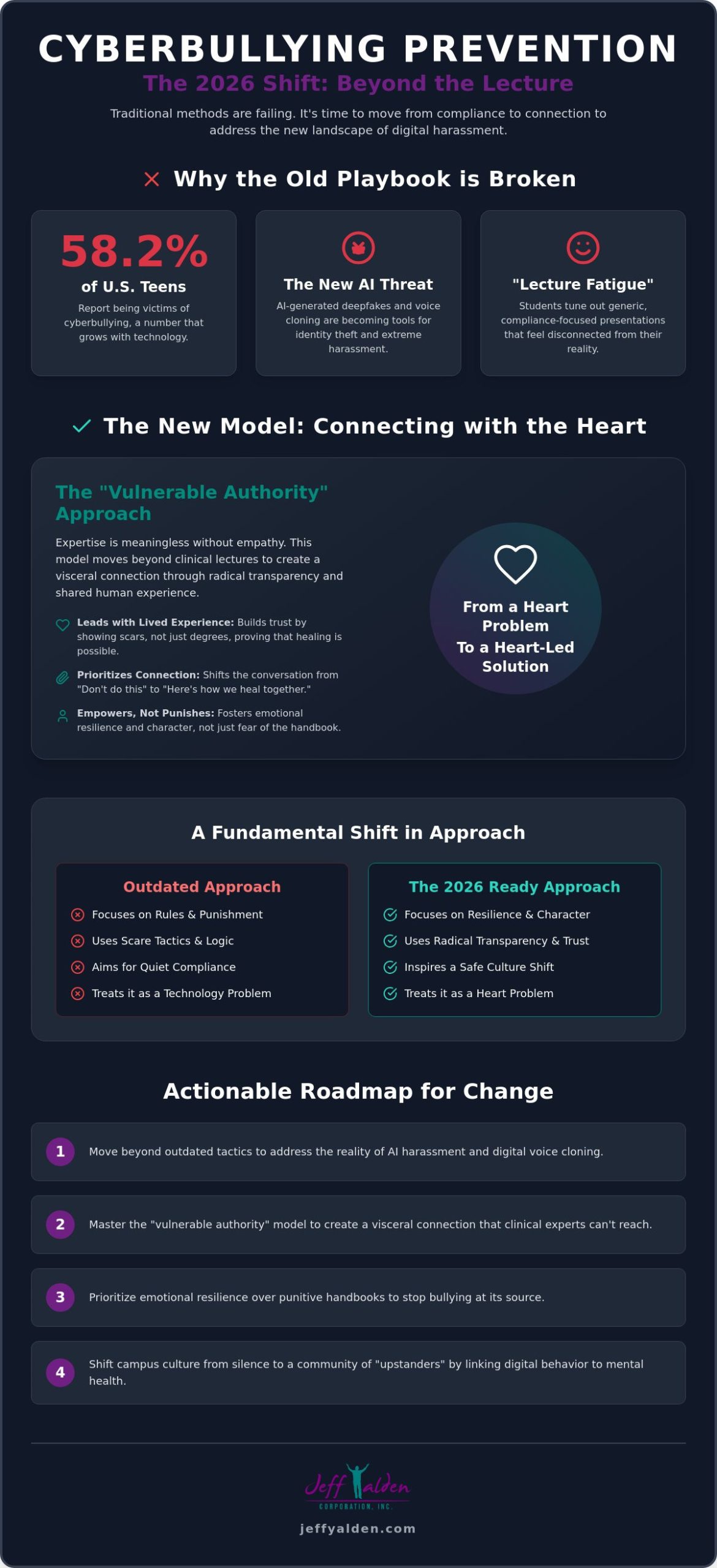
What if the standard “don’t bully” lecture is actually making the problem worse by boring the very kids we need to save? You’ve seen it. You stand in the back of the gym while a speaker drones on, and you see the students’ eyes glaze over. They’ve heard it all before, yet the stakes have never been higher. With 58.2% of U.S. teens now reporting they’ve been cyberbullied, and new threats like AI-generated deepfakes hitting campuses in 2026, the old playbook is broken. It’s failing our kids, and it’s leaving educators feeling helpless.
It’s time for a radical shift. A cyberbullying prevention presentation for schools shouldn’t just be a box to check; it needs to be a visceral, life-changing experience that builds a resilient school culture from the heart up. I know the fear of student self-harm is real, and the pressure to fix a toxic digital environment is heavy. You want a campus where students actually look out for each other. This article shows you how to move beyond dry lectures and use radical transparency to stop bullying at the source. We’ll explore how connecting digital behavior to mental health creates a measurable shift in campus culture and turns quiet bystanders into courageous upstanders.
Key Takeaways
- Move beyond outdated “scare tactics” to address the 2026 reality of AI-generated harassment and digital voice cloning.
- Master the “vulnerable authority” model to create a visceral connection with students that clinical experts simply can’t reach.
- Implement a cyberbullying prevention presentation for schools that prioritizes emotional resilience over punitive handbooks to stop bullying at the source.
- Get a step-by-step roadmap for pre-assembly engagement that turns student leaders into active allies before the speaker even hits the stage.
- Shift your campus from a culture of silence to a community of “upstanders” by connecting digital behavior directly to mental health.
The 2026 Landscape: Why Traditional Cyberbullying Presentations Fail
The old ways are dead. If you’re still using the same slide deck from five years ago, you’re not just out of touch; you’re invisible to your students. In 2026, the digital world is a battlefield of sophisticated tech that most school policies can’t even define yet. We have to be honest. A typical cyberbullying prevention presentation for schools fails because it treats a heart problem like a technology problem. It tries to use logic to solve an emotional crisis. It ignores the fact that for Gen Z and Gen Alpha, there is no “offline” world. The harassment follows them into their bedrooms, under their covers, and into their dreams. There is no safe harbor anymore.
To understand the gravity of this shift, we have to look at the evolving definition of What is Cyberbullying? in this new era. It’s no longer just about mean comments or embarrassing photos. It’s a total assault on a student’s reality. When we rely on “lightning strike” analogies or scare tactics, students roll their eyes. They live in this world every day. They don’t need a lecture; they need a guide who isn’t afraid to get real about the damage being done. They need a presentation that is raw, relevant, and grounded in the actual struggles they face behind their screens.
The AI Threat: Deepfakes and Digital Identity
Students today are facing a level of cruelty that was science fiction a decade ago. They’re using AI to create non-consensual deepfake imagery and voice cloning to ruin reputations in seconds. Imagine a student hearing their own voice on a recording saying things they never said. It’s a violation of their very identity. This “identity theft” bullying doesn’t just hurt; it traumatizes the soul. Most school handbooks are three years behind this technology. They’re still banning “mean texts” while students are dealing with digital replicas of themselves being used as weapons. We can’t protect them with outdated rules; we have to protect them with character.
While character is the ultimate shield, schools also need to stay ahead of the curve with modern digital platforms that reflect current safety and professional standards. To see how professional web development can support your organization’s digital goals, learn more about Evolve Media.
The “Lecture Fatigue” Phenomenon
Students tune out the second they see a podium and a PowerPoint. They know the “compliance training” routine. They know you’re checking a box to satisfy a state mandate. But this isn’t about checking boxes; it’s about saving lives. We have to stop lecturing and start connecting. There is a massive gap between teaching kids how to stay out of trouble and teaching them how to be resilient humans. Digital citizenship in 2026 is a matter of character, not just clicks. We need a cyberbullying prevention presentation for schools that hits them in the chest and makes them realize that their online footprint is actually a trail of their own heart.
- Generic presentations focus on rules; radical presentations focus on resilience.
- Scare tactics create anxiety, but radical transparency creates trust.
- Compliance training keeps things quiet; culture shifting keeps things safe.
The “Vulnerable Authority” Model: Connecting with the Heart
Expertise is meaningless if it lacks empathy. Students in 2026 can smell a fake from a mile away. They don’t want a clinical expert with a wall of degrees who has never felt the sting of rejection or the weight of anxiety. They want a human being. They want someone who has walked through the fire and come out on the other side. This is the heart of the “Vulnerable Authority” model. It’s about leading through radical transparency. It’s about showing your scars so they know it’s possible to heal. When I step on that stage, I don’t hide my imperfections; I lead with them. That is how we break through the thick layer of cynicism that defines the modern student experience.
A truly impactful cyberbullying prevention presentation for schools moves the conversation from “Don’t do this” to “Here is how we heal together.” It’s a massive shift from punishment to empowerment. We aren’t just talking about apps, algorithms, or passwords. We’re talking about the human heart. We’re talking about why we feel the need to hurt others when we feel broken inside. This high-energy, spoken-word style delivery creates an immediate visceral connection. It’s fast. It’s punchy. It’s real. It demands their attention because it respects their intelligence and acknowledges their pain.
Radical Transparency in Action
I don’t use scripts. I don’t use teleprompters. I use my life. By sharing my own lived experience, I validate the struggles these students face every single day. I’m not just another adult telling them what to do; I’m a guide who has been in the trenches. This “Real and Raw” method creates a safe space where students feel seen. It’s about projecting a “victor” persona—someone who has faced the darkness and chose to stay. When students see an authority figure being vulnerable, it gives them permission to put down their own masks. It creates a sanctuary in the middle of a crowded gym.
Normalizing the Mental Health Conversation
You cannot separate digital behavior from internal emotional states. Every time a kid hits “send” on a hateful comment or shares a deepfake, there is a root cause buried in their mental health. That’s why every cyberbullying prevention presentation for schools I deliver must also function as a teen mental health speaker event. We have to talk about the “why.” While many organizations offer standard cyberbullying prevention tips, we have to go deeper into the soul. We have to foster hope and empowerment rather than just dumping more shame on their shoulders. If you are ready to move beyond the surface and change your campus culture, it might be time to bring in a High School Speaker who isn’t afraid to tell the truth.
- Vulnerability is the ultimate bridge to connection.
- Transparency kills cynicism faster than any policy.
- Connection is the only real antidote to digital isolation.
Policy vs. Connection: Why Handbooks Aren’t Enough
You can’t policy your way out of a culture crisis. Most schools have a handbook thicker than a phone book, filled with “Zero Tolerance” rules that look great on paper but fail in the real world. These policies are reactive. They wait for a student to get hurt before they kick in. In the digital landscape of 2026, a punitive-only approach doesn’t stop the bullying; it just teaches kids how to hide it better. It drives the vitriol into encrypted chats and disappearing messages where adults can’t see it until it’s too late. We have to stop thinking that a signed code of conduct is a shield for our students’ hearts.
A truly effective cyberbullying prevention presentation for schools must bridge the gap between legal compliance and human connection. We need a community-wide strategy that brings teachers, parents, and students into the same room with the same mission. When we focus only on the act of bullying, we miss the human being behind the screen. This is why the most successful teen suicide prevention programs start by addressing digital culture. The data is clear: 21% of cyberbullied teens have considered suicide in the past year. We aren’t just managing social media accounts; we are quite literally fighting for their lives. We must move from a culture of policing to a culture of protecting.
Beyond the Student Handbook
Reporting procedures fail when students don’t trust the adults in the building. If a kid thinks their phone will be confiscated or they’ll be judged for their online choices, they will stay silent. We need to build a culture where being an “upstander” is the social norm, not the exception. This requires more than just a student assembly. It requires trauma-informed teaching professional development so staff can spot the subtle signs of digital distress before a crisis erupts. When teachers are equipped to lead with empathy, the “reporting” happens naturally because the trust is already there.
The Postvention Connection
Cyberbullying is rarely an isolated event; it is frequently the primary trigger for a larger school crisis. I’ve spent decades as a crisis intervention expert, often called in during the painful aftermath of digital harassment that went too far. We have to do better at connecting the dots between school safety and cyberbullying. It’s not just about “online safety” or digital citizenship. It’s about saving lives. My cyberbullying prevention presentation for schools is designed to be the catalyst that turns your school from a place of rules into a place of resilience. We move through the pain to find a path toward hope.
- Rules create compliance, but relationships create change.
- Punishment stops the behavior, but connection heals the impulse.
- A handbook is a document; a culture is a living, breathing choice.
Designing the Ultimate Cyberbullying Assembly for 2026
An assembly shouldn’t be a nap time for your students. It needs to be a movement. If you want a cyberbullying prevention presentation for schools that actually sticks, you have to design it like a high-stakes performance. It starts with momentum. You can’t just show up and hope for the best. You need a strategy that captures their attention in the first thirty seconds and refuses to let go until the final word is spoken. We’re moving beyond the “don’t be mean” talks and into a space where students feel the weight of their choices and the power of their influence.
The architecture of a radical assembly follows a specific, five-step path to change. First, we use pre-assembly engagement. This means getting your student leaders on board before I even step onto campus. When the “influencers” in your hallways are already bought in, the rest of the student body follows. Second, we focus on delivery. I use staccato-like declarations and fast-paced storytelling to keep them on the edge of their seats. There are no boring PowerPoint slides here. Third, we integrate interactive elements that demand honesty. We don’t just ask for questions; we ask for commitments. Fourth, we provide a clear “Call to Action.” Every student leaves with a specific, immediate task to improve the digital culture of their school. Finally, we ensure follow-up. The message has to live on in the classroom long after the gym has emptied. This is how you turn a single event into a lasting shift in campus climate.
Maximizing the Assembly Impact
The energy in the room is everything. Modern high school assemblies have to be high-energy and fast-paced to compete with the digital noise in a student’s pocket. I use direct address and personal pronouns to make every student feel like I’m speaking only to them. We build to an emotional peak, and then we capitalize on that “Post-Assembly Glow” by giving them a space to talk. If you’re ready to see this energy on your campus, it’s time to book one of our High School Assembly Programs today.
Empowering Student Upstanders
We have to give students the tactical “how-to” of intervening. It’s not enough to tell them to “be kind.” They need to know exactly what to say when a deepfake goes viral or a group chat turns toxic. We role-play digital resilience in real-time. We show them how to shut down a thread without becoming a target themselves. When we focus on building resilience in teens, we provide them with the ultimate shield against digital harassment by anchoring their identity in truth rather than the shifting opinions of others. We turn quiet bystanders into courageous leaders who protect their peers.
- Engagement starts before the speaker arrives.
- Momentum is the key to holding a teenager’s attention.
- Tactical training turns empathy into action.
The Jeff Yalden Advantage: A Catalyst for Campus Change
Jeff Yalden isn’t just a name on a flyer. He’s a catalyst. When you bring Jeff to your campus, you aren’t just booking a speaker; you are inviting a lived-experience guide who has spent over three decades in the trenches with students. Since 1992, Jeff has been the “vulnerable authority” that schools need to break through the noise. He doesn’t just talk at kids. He stands with them. He shares his own battles with depression and PTSD to show them that a “victor” mentality is possible even when the digital world feels like it’s closing in. This is the ultimate cyberbullying prevention presentation for schools because it doesn’t just address the screen; it addresses the soul.
Jeff moves students from a state of victimhood to a place of resilience. In a world where 58.2% of teens have experienced digital harassment, we can’t afford to be passive. We need a mentor who understands the visceral pain of a deepfake or a viral lie and knows how to lead students back to their own worth. It’s about transformation. It’s about hope. It’s about showing every kid in that gym that their mistakes don’t define them, and the comments of others don’t have to break them.
A Multi-Pronged Approach to Prevention
Change doesn’t happen in a vacuum. A single assembly is a spark, but a “Day of Impact” is the fire. Jeff integrates high-energy student assemblies with teacher professional development and community programs to create a unified front. It’s about making sure the adults are just as equipped as the students to handle the 2026 digital landscape. When the assembly ends, Jeff’s work continues as a youth life coach for students who need that extra layer of support. This multi-pronged approach ensures that the message of digital citizenship and mental health doesn’t fade when the gym lights go down. We’re building a culture that lasts long after the final bell rings.
Booking Your 2026 Presentation
Preparing your campus for this radical shift is the first step toward a safer environment. When you book a cyberbullying prevention presentation for schools with Jeff, you can expect more than just a speech. You can expect a total shift in energy. We handle the logistics so you can focus on your students. Whether it’s addressing the 79% of kids facing bullying on YouTube or the rising threats on TikTok and Snapchat, Jeff meets them exactly where they are. He speaks their language. He respects their world. Don’t wait for a crisis to act. Book Jeff Yalden for your Cyberbullying Prevention Presentation today. Let’s build a resilient school culture together.
- Experience matters: Over 30 years of connecting with youth.
- Real talk: No scripts, just radical transparency and heart.
- Lasting impact: Multi-pronged strategies for students, staff, and parents.
Lead Your Students Toward a Resilient Digital Future
The screens won’t stop glowing. The apps won’t stop evolving. But your approach can change starting today. We’ve explored how a cyberbullying prevention presentation for schools must move beyond dry handbooks and into the heart of the matter. You now know that radical transparency is the only bridge to reaching students who have tuned out the traditional lectures. You’ve seen that connection is the ultimate antidote to digital isolation. Our kids aren’t looking for another rule; they’re looking for a reason to hope.
It’s time to turn this knowledge into action. Jeff Yalden brings over 30 years of experience in youth mental health as a specialist in suicide prevention and crisis intervention. He uses radical transparency to connect with even the toughest students, turning a simple assembly into a life-altering event. Don’t wait for a digital crisis to define your campus culture. Take the lead and show your students what resilience really looks like. Bring Jeff Yalden to Your School for a Life-Changing Assembly. Your students are ready for the truth. Let’s give it to them together.
Frequently Asked Questions
What is the best format for a cyberbullying presentation for high schools?
The most effective format is a high-energy, narrative-driven experience that keeps students on the edge of their seats. You have to ditch the podium and the PowerPoint. A radical cyberbullying prevention presentation for schools uses staccato-like declarations and direct address to foster intimacy. It moves methodically through an emotional journey, starting with raw truth and ending with empowerment. This isn’t compliance training; it’s a spoken-word performance that demands attention and respects student intelligence.
How do you address AI-generated harassment and deepfakes in a school assembly?
You address AI-generated harassment by framing it as a direct assault on a student’s soul and identity. Don’t focus on the technical details of the software; focus on the human impact of digital voice cloning and deepfakes. We teach students that their digital character is a reflection of their heart. By normalizing the conversation around these new threats, we give them the tactical tools to stand up when they see technology being used as a weapon.
Can a one-day assembly actually prevent cyberbullying long-term?
A one-day assembly is a powerful catalyst, but it must be part of a multi-pronged approach. Real change happens when the energy from the stage is carried into the classroom and the home. This is why we integrate student messages with teacher professional development and community outreach. The assembly sparks the fire, but the ongoing support from staff and parents keeps the culture of resilience alive long after the speaker leaves campus.
How much does a professional cyberbullying speaker cost for a school assembly?
Speaking fees for a professional cyberbullying prevention presentation for schools vary depending on the location, travel requirements, and the scope of the event. Every school has unique needs, whether they require a single assembly or a full day of impact including staff training. To get an accurate quote, it’s best to reach out directly to booking agencies who can provide current rates based on your specific goals and schedule.
What is the “Upstander” model and how do you teach it to students?
The “Upstander” model is about moving students from silent observation to courageous action. We teach this by giving them specific, tactical scripts to use when they witness online harassment. It’s not about being a hero; it’s about being a human who refuses to let cruelty go unchecked. We role-play these scenarios in real-time so students feel empowered and equipped to intervene safely and effectively in their digital circles.
How should schools handle the mental health aftermath of a cyberbullying incident?
Schools must adopt a trauma-informed postvention strategy that prioritizes the victim’s emotional safety. This means moving beyond punishment and looking at the mental health roots of the behavior. We bridge the gap between digital safety and crisis intervention by connecting students with mentors and life coaches. The goal is to provide a safe space for healing where digital distress is treated with the same urgency as any other campus emergency.
Why is radical transparency important in youth motivational speaking?
Radical transparency is the only way to kill the cynicism that most students feel toward adult authority. When a speaker is willing to share their own imperfections and battles, it creates a visceral connection that clinical experts can’t match. It validates the student’s struggle. It shows them that someone who has “been there” can still become a victor. Vulnerability isn’t a weakness; it’s the ultimate bridge to building a resilient school culture.
