
A clinical checklist has never saved a life in the middle of a hallway panic attack. You know the feeling. Your heart races when you see that look in a student’s eyes, the one that screams they’re drowning, and you feel completely unqualified to pull them out. You’re a teacher, not a therapist, yet you’re the first responder every single day. It’s exhausting. It’s terrifying. And the standard crisis intervention training for teachers often feels like reading a manual while the house is on fire.
I’ve been in those trenches, and I know that what you need isn’t more jargon; it’s the radical courage to be human. You deserve to feel prepared, not panicked. This article is your roadmap to moving beyond cold medical boxes to build real, life-saving connections with students in crisis. We’ll explore a practical framework for de-escalation designed for the realities of 2026, giving you the confidence to intervene effectively while protecting your own emotional health. It’s time to stop fearing the crisis and start leading the breakthrough.
Key Takeaways
- Understand why the 2026 mental health landscape makes “wait and see” a dangerous strategy for educators on the front lines.
- Discover how the Radical Transparency model transforms crisis intervention training for teachers from a clinical chore into a powerful, life-saving tool.
- Learn why relational, connection-based training is far more effective than compliance checklists when you’re under the pressure of a real-time crisis.
- Master immediate de-escalation steps, including the one essential question that determines student safety and grounding techniques to keep you both calm.
- Build the confidence to lead through emotional trauma, reducing your own burnout while fostering a safer, more resilient school culture.
The State of Student Mental Health in 2026: Why Teachers are the New First Responders
The world changed while we were busy trying to teach algebra. By 2026, the digital isolation of the last decade has hit a breaking point. Our students are hyper-connected but emotionally starved. They navigate a global reality of uncertainty that makes the traditional high school experience feel like a pressure cooker. We can’t pretend the old ways still work. The “wait and see” approach to student distress is officially dead. If you see a student struggling and choose to wait for a specialist, you might be waiting too long. That delay can be the difference between a breakthrough and a tragedy.
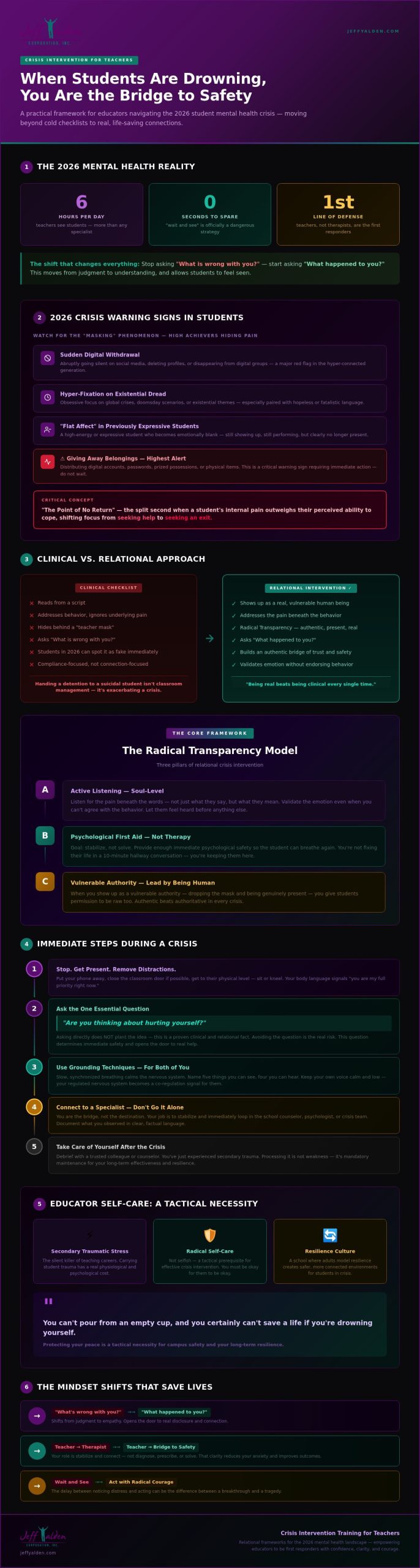
You aren’t a therapist. Nobody is asking you to diagnose a disorder or prescribe medication. But you are the bridge to safety. You are the person they see for six hours a day. Effective crisis intervention training for teachers acknowledges this reality. It shifts the conversation from “What is wrong with you?” to “What happened to you?” This isn’t just semantics. It’s a radical shift in how we view human pain. It moves us away from judgment and toward understanding. It allows a student to feel seen in a world that often ignores their depth. You are the first line of defense, and your presence is more powerful than any clinical checklist.
Identifying the 2026 Crisis Warning Signs
In 2026, the signs aren’t always loud or obvious. Sometimes, it’s a sudden silence on social media or a student abruptly deleting their digital footprint. You need to watch for the “masking” phenomenon. This is common in high achievers who look like they have it all together while they’re actually falling apart. They keep their grades up and stay active in clubs, but their internal world is crumbling. Watch for these subtle shifts:
- Sudden withdrawal from digital groups or social threads.
- Hyper-fixation on global crises or existential dread.
- A “flat” affect in students who were previously expressive or high-energy.
- Giving away digital assets, accounts, or physical belongings.
The Point of No Return is that split second when a student’s internal pain outweighs their perceived ability to cope, shifting their focus from seeking help to seeking an exit.
The Emotional Toll on Educators
Let’s be real. Carrying the weight of your students’ trauma is exhausting. This secondary traumatic stress is the silent killer of teaching careers. You’re a first responder, and that comes with a heavy price tag. You can’t pour from an empty cup, and you certainly can’t save a life if you’re drowning yourself. That’s why preventing teacher burnout through radical self-care is a prerequisite for any meaningful crisis intervention training for teachers. You have to be okay so they can be okay. It is not selfish to protect your peace. It is a tactical necessity for the safety of your campus and your own long-term resilience.
What is Crisis Intervention for Teachers? Moving Beyond the Checklist
Crisis intervention is not a long-term treatment plan. It is psychological first aid. It is the immediate, short-term response designed to stabilize a student who is currently spiraling. When a student is in the middle of a breakdown, they don’t need a clinical diagnosis. They need a human being. Effective crisis intervention training for teachers teaches you how to create a bridge of safety in the middle of a storm. The goal isn’t to “fix” the student or solve their life’s problems in a ten-minute hallway conversation. The goal is to provide enough immediate psychological safety so they can breathe again.
In my experience, being “professional” is often a barrier to being effective. I call this the Radical Transparency model. Students in 2026 can spot a fake from a mile away. If you hide behind a “teacher mask” and read from a script, you’ll lose them. Being real beats being clinical every single time. When you show up as a vulnerable authority, you give them permission to be raw too. Traditional discipline often fails here because it addresses the behavior without acknowledging the pain. If you try to hand out a detention to a student who is contemplating self-harm, you aren’t managing a classroom; you’re exacerbating a crisis.
The Core Pillars of Relational Intervention
Building a connection in a crisis requires more than just being nice. It requires a specific set of relational tools. You have to listen for the pain beneath the words. This is active listening on a soul level. It’s about validating the emotion even if you can’t agree with the behavior. You might not agree that they should kick a locker, but you can validate that they feel incredibly frustrated. This creates what I call a “Circle of Trust.” When students know there’s a safe person in the building who won’t judge their darkest moments, the entire school culture shifts.
De-escalation Strategies for the Modern Classroom
When the temperature rises, your job is to be the thermostat, not the thermometer. Don’t mirror their energy. If they yell, you whisper. This is verbal judo. Use your body language to signal safety. Stand at an angle, not chest-to-chest. Sometimes, the most powerful thing you can do is stay silent. Silence gives a student room to process their own emotions without feeling pressured to perform or fight. If you want to see how this looks in practice, you can explore more about my teacher professional development programs that focus on these real-world skills. Knowing when to step in and when to give them space is a masterclass in intuition, and it starts with your own calm presence.
Clinical vs. Relational: Choosing the Right Training for Your Staff
Most school districts choose training based on insurance requirements or state mandates. It’s compliance-heavy. It’s clinical. It’s a box to be checked. But when a kid is spiraling in a crowded hallway, you won’t remember step four of a fifteen-point clinical checklist. Your brain isn’t wired to follow complex algorithms during a fight-or-flight response. You need something that sticks to your ribs. Relational training is about connection. It’s about heart. It’s about knowing how to be a person when another person is hurting.
Clinical models often treat students like a series of symptoms to be managed. In contrast, relational crisis intervention training for teachers treats them like a human being in pain. Teachers forget clinical steps under pressure because those steps are external. Relational skills are internal. They become part of who you are. The Jeff Yalden difference is simple: we don’t just train your head; we train your heart. When the training touches the heart, it becomes an intuitive response rather than a memorized procedure. That’s how you save lives in the heat of the moment.
Why Procedural Training Often Fails in Schools
There is a massive gap between a quiet seminar room and a chaotic school hallway. In the room, you’re calm and rational. In the hallway, your adrenaline is pumping. The “fear factor” takes over. Teachers often become more afraid of liability or “saying the wrong thing” than they are focused on the child in front of them. This fear paralyzes action. We need vulnerable authority in our schools. We need leaders and educators who are willing to be real and present, even when it’s messy. Compliance doesn’t build trust; vulnerability does.
Building a Culture of Radical Empathy
We have to move from “zero tolerance” to “zero exclusion” when it comes to mental health. Empathy isn’t soft. It’s a survival skill. When you build a culture of radical empathy, you actually reduce the frequency of crises over time. Students feel safe enough to speak up before the explosion happens. They know they won’t be cast out for having a dark day. This is the foundation of comprehensive teen suicide prevention programs. When you train the heart, the hands follow. You create a campus where every student feels seen, heard, and valued. That is the ultimate safety net. It’s not just about reacting to a crisis; it’s about building a world where crises have less room to grow.
Immediate Steps for Teachers During and After a Crisis
When the bells stop ringing and you’re standing in the quiet of a crisis, you need a plan that works at 100 miles per hour. This isn’t the time for theory; it’s the time for action. The first and most critical step is assessing immediate safety. Look them in the eye and ask the hard question: “Are you safe right now?” It’s direct. It’s honest. It cuts through the static of their panic. If the answer is no, you don’t leave their side. This is where crisis intervention training for teachers becomes a lived reality. You are the anchor they need to stay grounded when their world is spinning out of control.
Once you’ve established immediate safety, move into regulatory breathing. You can’t lead a student to a place of calm if you’re hyperventilating yourself. Use box breathing. Four seconds in, four seconds hold, four seconds out. Do it together. This physical synchronization tells their nervous system that they aren’t alone. When it’s time to transition, the hand-off is vital. Don’t just drop them off at the office and run back to your lesson plan. Transfer that trust to the counselor or administrator. Say, “I’m walking you to the office, and I’ll check on you later.” That simple promise of a follow-up prevents the feeling of abandonment that often follows a public breakdown.
The Art of Postvention: Recovery After the Storm
The 48 hours following a breakdown are the most critical window for a student’s long-term health. This is when the risk of relapse or emotional contagion among peers is at its peak. You have to balance the student’s privacy with the reality that the rest of the class witnessed the event. Don’t ignore the elephant in the room. Acknowledge that something difficult happened, focus on the support resources available, and pivot back to the safety of the daily routine. To protect your entire campus, follow these essential postvention guidelines for schools to ensure your response builds resilience instead of fear.
The Post-Crisis Debrief for Educators
After the student is safe, the “What if’s” will start crawling under your skin. You’ll second-guess every word you said. This emotional residue is heavy, and you shouldn’t carry it alone. A post-crisis debrief is a mandatory part of effective crisis intervention training for teachers. It’s a space to dump the trauma and use the event as a data point for future prevention. Administrators, your support here is non-negotiable. You have to be the safety net for your staff. If your team needs to master these high-stakes moments and build a culture of true safety, it is time to bring in a teen mental health speaker who has been in these trenches and knows how to lead your staff through the fire.
Transform Your School with Jeff Yalden’s Professional Development
Generic professional development is often where passion goes to die. You sit in a hard chair for six hours while someone who hasn’t been in a classroom in a decade reads slides at you. That’s not training; that’s a hostage situation. Jeff Yalden is the radical alternative. His workshops are the highest-rated in the country because they don’t hide behind academic theories. They live in the raw, messy reality of 2026. This is crisis intervention training for teachers that actually works because it’s built on 30 years of standing in high school hallways and looking into the eyes of hurting kids.
When you bring Jeff to your district, you aren’t getting a canned presentation. You’re getting a masterclass in human connection. You can expect real stories that hit like a freight train. You’ll see raw emotions and walk away with actionable life skills that you can use the very next morning. Whether your district is battling a cluster of suicides, deep-seated trauma, or massive staff burnout, the training is customized to your specific pain points. We move beyond the one-day assembly to help you build a year-long culture of resilience. It’s about creating a campus where everyone feels safe enough to be real.
Booking a Speaker Who Has Been in the Trenches
There’s a specific kind of authority that only comes from lived experience. Jeff isn’t just an expert; he’s a guide who has walked the path of struggle and resilience himself. This “vulnerable authority” is exactly what connects with staff members who are jaded by traditional, top-down training. They’ve seen it all, and they don’t want more checklists. They want someone who understands the emotional weight of being a first responder. School leaders consistently report immediate culture shifts after Jeff’s visits. Teachers stop feeling like they’re alone in the fight and start feeling empowered to lead with their hearts again.
Take the Next Step for Your Students
The ripple effect of a single day of radical honesty can change the trajectory of an entire school year. It starts with one keynote or one intensive workshop, but the impact lasts far longer. You have the power to transform your campus from a place of high-stress compliance into a sanctuary of safety and connection. Don’t wait for another crisis to realize your team needs better tools. Crisis intervention training for teachers is about more than just safety; it’s about the soul of your school. Book Jeff Yalden for your Teacher Professional Development today! and give your staff the radical support they deserve.
Build a Culture of Radical Resilience Today
The world of 2026 demands more from us than just academic excellence. It demands that we show up as humans first. We’ve explored why old clinical checklists fail and how relational connection is the only thing that moves the needle in a crisis. You don’t have to be a therapist to save a life. You just have to be present, grounded, and radically honest. When you shift your focus from compliance to connection, you turn your school into a sanctuary where students feel safe enough to heal.
This is the heart of effective crisis intervention training for teachers. It’s about building a year-long culture of resilience that supports both the students and the staff who carry them. With 30+ years of high school assembly expertise and a specialization in suicide postvention and crisis management, I bring a radically transparent approach that engages even the most skeptical staff. Don’t wait for the next emergency to wish you had better tools. Bring Jeff Yalden to your school for life-saving Professional Development today. You have the power to change the narrative. Let’s build that bridge to safety together.
Frequently Asked Questions
What is the difference between crisis intervention and counseling?
Crisis intervention is immediate, short-term stabilization. It is psychological first aid. Counseling is typically a long-term process to address underlying issues or mental health disorders. While I serve as a youth counselor and life coach to help teens navigate challenges, my crisis intervention training for teachers focuses on the “right now” moment. We want to stop the bleeding, not perform the surgery. It is about safety first. It is about providing a bridge to the next level of care.
How do I know if a student is in a real crisis or just having a bad day?
Look for the intensity and the Point of No Return signs. A bad day usually involves venting or frustration that subsides with time. A real crisis involves a loss of coping skills where the student feels their internal pain outweighs their ability to survive it. Watch for sudden digital withdrawal, giving away possessions, or a flat affect. If you feel that gut punch of worry, trust it. It’s better to over-respond than to ignore a cry for help.
Can a teacher be held liable if they intervene in a mental health crisis?
Most states have Good Samaritan laws or specific school board policies that protect educators who act in good faith during an emergency. You should always check your specific district’s regulations and legal requirements. However, the greatest liability is often doing nothing when a student’s life is at risk. Effective training ensures you follow established safety protocols while maintaining the radical transparency needed to build trust and ensure the student is never left alone during their darkest moment.
What should I say to a student who mentions they want to hurt themselves?
Be direct and ask the hard question. Say, “I’m hearing you’re in a lot of pain. Are you thinking about hurting yourself right now?” Don’t use metaphors or sugarcoat it. Validation is your strongest tool. Tell them, “I hear you, and I’m not going to leave you alone in this.” Your job isn’t to fix the pain; it’s to be the bridge to safety and ensure they get to a professional who can help them navigate the situation.
How can I implement crisis intervention training on a limited school budget?
Start with high-impact teacher professional development that focuses on relational skills rather than expensive clinical software. You can maximize a limited budget by choosing workshops that train your entire staff at once, creating a unified culture of resilience. Instead of individual certifications, look for programs that offer school-wide assemblies that normalize mental health conversations. Investing in your people is always more cost-effective than managing the fallout of a tragedy. Real training is about heart, not just technology.
What is postvention and why is it important for teachers to know?
Postvention is the organized response following a traumatic event, such as a student suicide or a major mental health crisis. It’s critical because it prevents contagion and helps the community heal. As a specialist in suicide postvention, I teach schools how to manage the 48 hours after a crisis. It involves supporting the witness students and re-integrating the student in distress without making them feel like an outcast. It’s about building resilience through the recovery process together.
How do I handle the emotional burnout that comes with crisis work?
You have to protect your own peace to be an effective first responder. Burnout happens when you carry the student’s trauma home without a way to process it. I advocate for radical self-care and structured debriefs after every incident. Don’t suppress the “What if” thoughts; dump them in a safe space with your peers or administrators. You aren’t a robot. Acknowledging your own vulnerability makes you a stronger, more resilient advocate for your kids and your school.
Does Jeff Yalden provide training for both middle and high school teachers?
Yes, I provide specialized training and assembly programs for both middle and high school settings. The approach shifts slightly based on the age group, but the core pillars of radical transparency and resilience remain the same. Middle schoolers often need more focus on digital behavior and social belonging, while high schoolers deal with existential dread and transition stress. I customize every session to meet the specific developmental needs of your students and staff during my teacher professional development workshops.
