
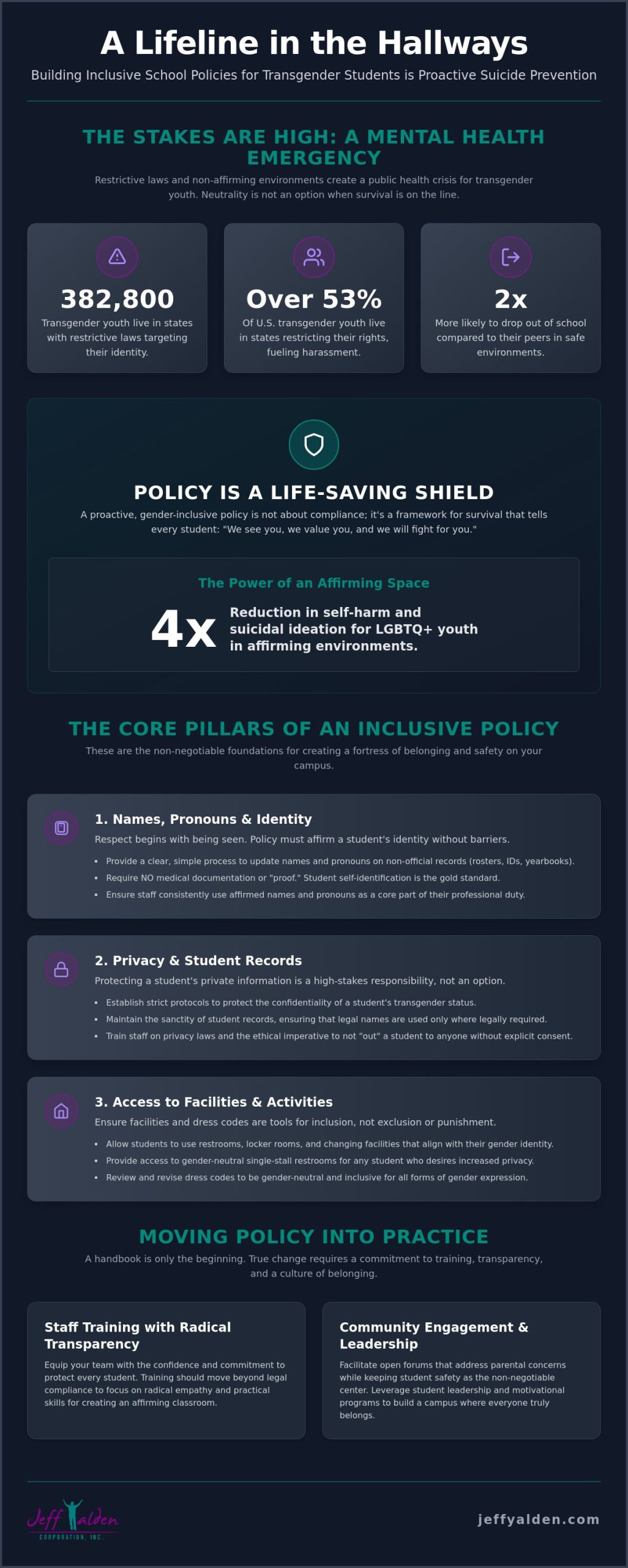
Your school policy is not just a stack of legal compliance papers; it is a life-saving shield for a child who feels the world is closing in. Right now, 382,800 transgender youth live in states with restrictive laws that target their identity. I know you feel the weight of this. You are caught between the noise of shifting legislation and the raw, heartbeat-to-heartbeat reality of students in crisis. Creating inclusive school policies for transgender students is no longer just a suggestion; it is the frontline of student survival.
I am here to tell you that there is a better way. You can move beyond fear and build a radical foundation for mental health that protects both your staff and your kids. This article provides a clear, actionable roadmap to transform your campus into a place of resilience and respect. We will explore how to navigate the tension of parental rights through radical transparency and build a culture where every child has the chance to thrive, regardless of the political storm outside. It’s time to stop reacting to the conflict and start leading with heart and courage.
Key Takeaways
- Understand why a proactive policy is your most powerful tool for suicide prevention and long-term mental health.
- Identify the essential pillars of creating inclusive school policies for transgender students, focusing on names, pronouns, and the sanctity of student privacy.
- Master the “Radical Transparency” approach to staff training so your team feels confident and committed to protecting every kid on campus.
- Learn how to facilitate community forums that address parental concerns while keeping student safety as the non-negotiable center of the conversation.
- Move beyond the handbook by leveraging student leadership and motivational programs to build a campus where everyone truly belongs.
Why Inclusive Policies are a Life-Saving Mental Health Strategy
A school policy is not just words on a page. It is a living, breathing framework that tells a student whether they are safe or whether they are a target. When we talk about creating inclusive school policies for transgender students, we are talking about a proactive strategy for survival. This isn’t about bureaucracy. It is about building a wall of protection around the most vulnerable hearts in your hallways. A gender-inclusive policy sets the standard. it says, “We see you, we value you, and we will fight for you.”
The data is staggering and it should keep us up at night. Research from organizations like The Trevor Project consistently shows that LGBTQ+ youth who have access to affirming spaces report significantly lower rates of suicide attempts. In some studies, inclusive environments are linked to a 4x reduction in self-harm and suicidal ideation. This is not a “political” issue. It is a public health crisis. When a student feels they have to hide who they are just to get through the school day, their brain enters a state of chronic “minority stress.” This isn’t just a bad mood. It is a physiological state where the developing teen brain is flooded with cortisol, making it nearly impossible to learn, grow, or feel safe. Policy is the foundation of a trauma-informed culture that shuts that stress response down.
The Reality of Transgender Student Mental Health in 2026
As of July 2026, the landscape for our kids is fractured. Over 53% of transgender youth in the U.S. now live in states with at least one law that restricts their rights. Harassment is not an “unfortunate byproduct” of these laws; it is a direct result. Students in these environments are twice as likely to drop out compared to their peers. Many schools try to stay “neutral” to avoid conflict, but neutrality in the face of a mental health crisis is just quiet permission for the struggle to continue. As a school leader, your authority comes from your willingness to be human first, showing your students that their safety matters more than your own comfort with the status quo.
From Compliance to Connection: Shifting the Narrative
Checking a legal box might keep you out of a courtroom, but it won’t keep a kid in your classroom. We have to move past the fear of litigation and start leading with radical empathy. Understanding the legal protections for transgender students is a starting point, not the finish line. When your administration prioritizes connection over mere compliance, the entire culture shifts. You stop asking “How do we avoid a lawsuit?” and start asking “How do we build a culture where this student feels they truly belong?” That shift in perspective is what transforms a policy handbook into a life-saving tool for every student on campus.
The Core Pillars of a Gender-Inclusive School Policy
When we get down to the brass tacks of creating inclusive school policies for transgender students, we have to talk about the non-negotiables. These are the pillars that hold up the house. If one is missing, the whole structure of student safety starts to lean. We aren’t just adjusting a handbook; we’re building a fortress of belonging. This requires clear, uncompromising stances on names, pronouns, and the digital sanctity of student records. In an age where everything is tracked, protecting a student’s private information is a high-stakes responsibility. We must also ensure that facility access and dress codes aren’t used as tools of exclusion or punishment.
Names, Pronouns, and the Power of Identity
Identity begins with how we are addressed. It is the most basic form of respect. Your policy must provide a clear, step-by-step path for students to update non-official records like class rosters, yearbooks, and ID cards. We don’t demand “proof” or medical documentation. If a student tells us who they are, our job is to listen and reflect that back to them. Transitioning from a legal name to an affirmed name in the classroom should be seamless and supported by every staff member. We can take cues from NYC’s guidelines for transgender students, which emphasize that student self-identification is the gold standard. This isn’t just a courtesy. It is a vital intervention. It is why robust teen suicide prevention programs must be written directly into your policy requirements. We don’t just wait for the smoke; we build the fireproofing into the foundation.
Physical Spaces: Restrooms, Locker Rooms, and Athletics
The conversation around physical spaces often feels like a battlefield, but it doesn’t have to be. The principle is simple: dignity and privacy for everyone. Students should have access to restrooms and locker rooms that align with their gender identity. If any student feels uncomfortable or simply wants more space, the school should provide a neutral, single-user option. This solves the problem without targeting or isolating transgender youth. Facility access is a fundamental issue of physical safety. When a student is afraid to use the bathroom, they aren’t learning; they are surviving. The same goes for athletics. While state-level rules are shifting, our local commitment to inclusion must remain unshakable. We play to win, but we win by making sure everyone gets to be on the team. If you feel your campus culture is resisting these changes, a youth motivational speaker can help open hearts and minds before the policy even hits the desk.
Finally, look at your dress code. Is it truly gender-neutral? Or is it a list of “dos and don’ts” that forces kids into boxes? A non-punitive, gender-blind dress code removes a massive layer of anxiety for trans and non-binary students. It allows them to show up as their authentic selves without fear of being “called out” for their clothing. Every one of these pillars is a brick in the wall of protection we are building together.
Implementation: Moving Policy from the Handbook to the Classroom
A policy sitting in a dusty binder is a dead policy. It does nothing for the kid being harassed in the hallway or the student who is terrified to raise their hand. Real change doesn’t happen at a board meeting; it happens in the cafeteria, on the morning bus, and in the back row of a third-period math class. Creating inclusive school policies for transgender students requires more than a signature from the superintendent. It requires a total cultural reset. You need your staff to buy in with their hearts, not just their job descriptions. If your team only follows the rules to avoid a grievance, they will miss the subtle moments where a student’s spirit is actually breaking. We need to move from “have to” to “want to.”
This work must be woven into the very fabric of your trauma-informed teaching professional development. You cannot separate gender inclusion from student safety. They are the same mission. Start by identifying your “inclusion champions.” These are the teachers and staff members who already lead with empathy. They are your frontline. Empower them to lead the charge, to mentor their peers, and to be the visible safe harbors on campus. When a student sees a “champion” in the hallway, they see a future where they actually belong.
Professional Development for Every Stakeholder
Training can’t just be for the classroom teachers. It has to include everyone. Your bus drivers are the first and last faces a student sees every day. Your cafeteria staff and front-office personnel hear the conversations that happen when adults aren’t “watching.” Customize your training for these roles. Use raw, real-world role-play. Practice what to do when a student is misgendered. Practice how to shut down bullying with authority and grace. We have to focus on the heart of the educator. We all have biases. Radical transparency means admitting those biases so we can move past them for the sake of the kids. It’s about the person, not the persona.
The Role of the Gender-Inclusive Schools Coordinator
You need a point person who owns this mission. A Gender-Inclusive Schools Coordinator is not a figurehead or a filing clerk. This person is a bridge. They connect scared families with an administration that might feel overwhelmed. They are the primary point of contact for students who are ready to transition socially. Most importantly, this role must have the authority to effect real change. They shouldn’t just be filing reports; they should be solving problems in real-time. When a policy hitches or a conflict arises, the coordinator steps in with a “student-first” mentality that keeps everyone focused on safety over politics. This position is the heartbeat of your implementation strategy.
Navigating the Noise: Radical Transparency in Community Engagement
Let’s be real. The noise outside your school walls is deafening right now. On May 20, 2026, the U.S. House passed a bill that puts federal funding on the line over parental consent for pronoun changes. You are standing in the middle of a political hurricane. But your job isn’t to win a debate. Your job is to keep kids alive. Creating inclusive school policies for transgender students means having the guts to look a room full of angry parents in the eye and tell the truth. We aren’t here to push an ideology. We are here to ensure that every student who walks through those double doors feels safe enough to learn. That is the mission. Everything else is just static.
Don’t let your community forums turn into a circus. Set the ground rules early. This is about safety; it’s not about politics. Share stories. When you talk about a student who finally felt seen enough to stop skipping class, the abstract “debate” becomes a human reality. Privacy is non-negotiable, but the emotional truth is your greatest weapon. If you need a partner to help shift the energy from conflict to compassion, bringing in a teen mental health speaker can provide the perspective that opens hearts before the policy even hits the desk. We have to be transparent about our goals: we want every child to graduate with their mental health intact.
Handling Pushback with Resilience and Clarity
People are afraid. Fear makes them loud. When they ask about restrooms or sports, don’t get defensive. Use radical honesty. Explain that providing a single-user restroom option ensures privacy for everyone. Remind them that inclusion for a trans student doesn’t take anything away from anyone else. It just expands the circle of respect. If a school board meeting gets heated, stay grounded. Use clear, scripted responses that bring the focus back to student well-being every single time. We don’t back down when lives are on the line, but we don’t have to be aggressive to be firm.
Engaging Families as Partners, Not Adversaries
We have to stop treating parents like the enemy. Most of them are just scared for their kids. Move them from rejection to partnership by offering education, not judgment. Help them see that their child’s survival depends on support. But we also have to face the hard truth. Some students aren’t safe at home. For those kids, your school is their only sanctuary. Research shows that having just one supportive adult in a transgender youth’s life can reduce their risk of suicide by up to 40 percent. You might be that one person. Stay focused on the mission. Every student, every day, whatever it takes.
Beyond the Handbook: Building a Campus Culture of Radical Belonging
Policy is the skeleton. Culture is the soul. You can have the most perfect document in the world, but if your students don’t feel it in the hallways, it’s just paper. Creating inclusive school policies for transgender students is your starting line, not your finish. To really change the “vibe” of your campus, you need a spark. You need something that breaks the ice and gets everyone talking about the things they’ve been too scared to mention. This is where high school assemblies come in. They’re the catalyst that turns a rulebook into a way of life. When you speak the truth out loud, you give everyone else permission to do the same.
The ROI here isn’t just about avoiding a PR nightmare. It’s about real results. Schools that prioritize radical belonging see higher graduation rates and stronger community bonds. You’re building resilience in teens who’ve been told by the world that they don’t fit. When you show them they belong, they don’t just survive; they lead. This is how you position your school as a leader in a world that’s often too afraid to be real.
Student-Led Inclusion and Peer Support
Your students are your greatest asset. Empower them. Support your GSAs as vital safety nets. These aren’t just clubs. They’re lifelines for kids who feel invisible. Foster a culture of peer-to-peer accountability. We need students who aren’t just bystanders. We need upstanders. We need kids who’ll gently correct a friend who uses the wrong name or shut down a joke that isn’t funny. That’s how you build a frontline of respect that administrators can’t reach on their own.
The Jeff Yalden Approach: Real Talk for Real Change
I’ve seen it happen. A high-energy assembly can normalize conversations about identity and mental health in sixty minutes. We break the silence. We talk about the hard stuff because the silence is what’s hurting our kids. When we’re real and raw, the walls come down. Policy creates the space, but connection creates the change. It’s time to move beyond the handbook and start the real work. Bring Jeff Yalden to your school to start the transformation. Let’s build a campus where every single student knows they’re enough.
Lead the Change Your Students Need
The roadmap is clear. You know that a proactive policy is a shield. You understand that your staff needs the heart to lead with empathy. Creating inclusive school policies for transgender students is the foundation of a campus where resilience can actually grow. It’s time to stop letting the political noise dictate the safety of your hallways. You have the tools to move beyond the handbook and build a culture where every single student feels seen, heard, and valued. You are the advocate your students are waiting for.
I’ve been in the trenches of youth mental health for over 30 years. I’ve worked with 4,000 schools as a suicide prevention expert and crisis interventionist. As the author of ‘The 24-Hour Rule,’ I’ve seen how radical honesty transforms lives. Don’t wait for the next crisis to decide where you stand. Book Jeff Yalden for a High School Assembly or Teacher PD Workshop and let’s start this life-saving work together. You have the power to turn your school into a sanctuary. Keep showing up. Keep being real. Let’s make sure every kid knows they belong.
Frequently Asked Questions
Is it legal to use a student’s chosen name without a legal name change?
Yes, it is absolutely legal to use a student’s affirmed name on daily records like rosters, seating charts, and ID cards. Legal names are typically only required for official transcripts and federal reporting. Schools have the discretion to honor a student’s identity in the classroom, which is a foundational step in creating inclusive school policies for transgender students. Respecting a name is about dignity, not just paperwork.
How do we handle parents who object to transgender students using certain restrooms?
You handle this by leading with a focus on privacy for every single student. Explain that your policy ensures that any student who feels uncomfortable has access to a private, single-user restroom option. This approach avoids targeting transgender youth while addressing the concerns of other families. Remind your community that inclusion for one child doesn’t take away the rights of another. Stay grounded in the mission of universal student safety.
What does Title IX say about transgender student inclusion in 2026?
Title IX prohibits discrimination based on sex in schools that receive federal funding. Most federal courts and the Department of Education interpret this to include gender identity and sexual orientation. While state laws are currently fragmented, the federal mandate still requires schools to provide an environment free from harassment. You must stay informed on your specific state’s rulings while keeping the core federal protection of equal access at the center of your policy.
How can we support a student who is transitioning if their parents don’t know?
This is a delicate situation where student safety is your absolute north star. You must follow federal privacy laws like FERPA, which protect a student’s records from being disclosed without a valid reason. Unless a specific state law mandates notification, your role is to be a safe harbor for that child. Support the student’s needs at school while encouraging them to find a safe path toward family disclosure when they feel ready.
What are the most common mistakes schools make when drafting inclusive policies?
The biggest mistake is writing a clinical document that lacks heart or clear implementation steps. Schools often forget to train non-teaching staff like bus drivers and cafeteria workers, leaving gaps in the safety net. Another common error is requiring “medical proof” before honoring a student’s identity. This creates an unnecessary barrier to support. A policy is only effective if it actually changes the daily experience of the student in the hallway.
How do we train staff who have personal or religious objections to the policy?
You focus on professional expectations rather than trying to change personal beliefs. Every staff member is hired to protect and educate every student, regardless of their own views. Use radical transparency to acknowledge that people have different perspectives, but remain firm that the code of conduct is non-negotiable. It’s about the safety of the child. We expect every adult on campus to treat every student with respect and dignity.
Can inclusive policies really reduce the risk of teen suicide?
Yes, the impact is life-saving and backed by data. Research consistently shows that inclusive environments can lead to a 4x reduction in suicide attempts for LGBTQ+ youth. When you commit to creating inclusive school policies for transgender students, you are performing a direct mental health intervention. You are removing the chronic minority stress that pushes kids to the brink. This work is the difference between a student giving up and a student thriving.
What resources are available for small districts with limited budgets?
You don’t need a massive budget to lead with courage. Use free resources from the U.S. Department of Education and advocacy groups like The Trevor Project or GLSEN to guide your policy writing. Identify “inclusion champions” within your current staff who can lead peer-to-peer training at no extra cost. Small districts have the advantage of close-knit relationships. Use that intimacy to build a culture of belonging that doesn’t cost a dime.
