
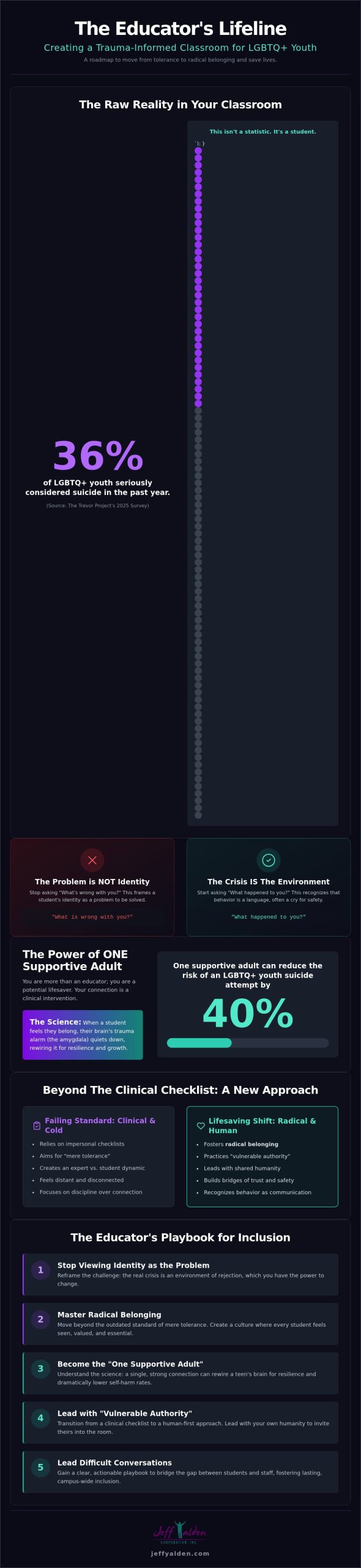
Right now, 36% of your LGBTQ+ students are seriously considering taking their own lives. That isn’t just a cold statistic from a report. It’s a child in your third-period class who feels like they’re drowning while the world debates their right to exist. You’re likely terrified of saying the wrong thing. You see the bullying in the hallways. You feel the crushing weight of rising self-harm rates, and you’re tired of feeling helpless. I get it. I’ve been there. But creating a trauma-informed classroom environment isn’t about clinical checklists or academic jargon. It’s about radical belonging.
You want a roadmap for inclusion that actually works. You want the confidence to lead real, messy conversations that save lives. This isn’t just another professional development session. It’s a mission. I’m going to show you how to turn your school into a place where vulnerability is a strength and connection reduces suicide risk. We’re going to dive into the raw strategies needed to transform your culture and provide the life-saving support your students are screaming for in 2026. Let’s stop the silence and start the healing.
Key Takeaways
- Stop viewing LGBTQ+ identity as the problem. The real crisis is an environment of rejection that we have the power to change right now.
- Master the raw strategies for creating a trauma-informed classroom environment where radical belonging replaces the outdated and failing standard of mere tolerance.
- Understand the science of the “one supportive adult.” You will see how a single connection can rewire a teen’s brain for resilience against high self-harm rates.
- Transition from a clinical checklist to a “vulnerable authority” approach. This means leading with your own humanity to invite theirs into the room.
- Gain a clear, actionable playbook to lead the difficult conversations that bridge the gap between students and staff for lasting campus-wide inclusion.
The Raw Reality: Why a Trauma-Informed Classroom Environment Cannot Wait
Education in 2026 has changed. It’s not just about test scores or college prep anymore. For many of our students, it’s about survival. When we talk about creating a trauma-informed classroom environment, we’re talking about a lifeline. We’re talking about the difference between a student feeling seen or feeling invisible. The reality is raw. It’s heavy. But we can’t look away. Our LGBTQ+ students are navigating a world that often feels like it’s designed to break them. We have to be the ones who refuse to let that happen.
The problem isn’t the student’s identity. That’s never the crisis. The crisis is the environment of rejection they walk into every single morning. We have to stop asking “What is wrong with you?” when a student disengages or acts out. We need to start asking “What happened to you?”. This shift is the heartbeat of trauma-informed care. It moves us from being disciplinarians to being anchors. It’s about recognizing that behavior is a language. Usually, it’s a cry for safety.
Understanding Minority Stress in the Modern Classroom
Minority stress isn’t just a buzzword. It’s a chronic, grinding tension. It’s the weight of being marginalized in a world that often feels hostile. In 2026, this stress is compounded by digital bullying that follows kids home. It never stops. It’s in their pockets. It’s on their screens. It’s everywhere. This constant state of alert drains their emotional reserves before they even sit down at their desks.
Micro-rejections happen in seconds. A look in the hallway. A snicker in the locker room. A teacher using the wrong name. These moments accumulate. They build into a wall that blocks learning. A student who doesn’t feel safe cannot learn. Their brain is stuck in survival mode. If you want better academic performance, you have to prioritize emotional safety first. You can’t teach a child who is busy trying to survive the period.
The Human Heart Behind the Data
The numbers are staggering. According to The Trevor Project’s 2025 survey, released in May 2026, 36% of LGBTQ+ young people seriously considered suicide in the past year. But we have to move from numbers to names. We have to see the human heart behind the data. These aren’t just figures on a spreadsheet. They’re the kids in your classroom who are wondering if they have a future.
Clinical approaches often fail because they feel cold. They feel like a checklist. Students don’t need another expert talking down to them. They need “vulnerable authority.” They need teachers who aren’t afraid to be real. Radical transparency is our greatest tool. When you share your own humanity, you give them permission to share theirs. This breaks down the expert versus student barrier. It builds a bridge. This is how we start creating a trauma-informed classroom environment that actually saves lives. It starts with your heart, not your lesson plan.
Building Protective Factors: The Power of Radical Affirmation
You might think you’re just a math teacher or a history coach. You’re wrong. You are a potential lifesaver. Research consistently points to a single, powerful truth: one supportive adult can reduce the risk of suicide for LGBTQ+ youth by 40%. Often, that person is you. You see them every day. You witness the struggle and you hear the whispers. When we focus on creating a trauma-informed classroom environment, we’re building a fortress of protective factors around our most vulnerable kids.
Affirmation isn’t some “soft” educational trend. It’s hard science. When a teenager feels like they truly belong, their brain chemistry shifts. The amygdala, that alarm bell for trauma, finally stops screaming. This rewires the brain for resilience. It’s about moving from a state of constant threat to a state of growth. This is why radical affirmation acts as a clinical intervention when creating a trauma-informed classroom environment. It’s not just being nice. It’s providing the psychological safety necessary for a traumatized brain to heal and learn.
Safe spaces are more than a rainbow sticker on your door. Stickers are easy. Culture is hard. It requires a system framework for trauma-informed schools that goes beyond surface-level displays. It’s about the air your students breathe in your room. It’s about the quiet confidence they feel when they walk through your door, knowing they don’t have to hide who they are just to survive the period.
The Role of Affirming Environments
Using a student’s correct name and pronouns is a non-negotiable act of care. It’s not a political statement. It’s a human one. When you integrate diverse voices into your curriculum, you’re telling every student that their existence is normal. It’s valid. GSA clubs aren’t just for the kids in the meeting. They change the entire campus vibe. They signal to every closeted student that this school is a place where they can eventually breathe. If your staff needs to lead these heart-centered shifts, my Teacher Professional Development programs help bridge that gap.
Developing Resilience Through Radical Support
Resilience isn’t about “toughening up.” Resilience is staying “Real” through the “Raw” moments. It’s the ability to face a crushing day and still find a reason to show up tomorrow. We help with building resilience in teens by validating their current struggle instead of dismissing it. Don’t tell them it gets better later. Tell them you’re with them right now. When students feel supported in their mess, they find the strength to keep moving forward.
Beyond the Clinical Checklist: Clinical vs. Radical Trauma-Informed Practices
Clinical checklists are great for filing paperwork. They are absolute garbage in the middle of a classroom crisis. If you think creating a trauma-informed classroom environment is just about checking boxes on a PDF, you are missing the heartbeat of the mission. Your students don’t need a clinician. They need a human being. Tolerance is a failing grade in my book. If you just “tolerate” an LGBTQ+ student, they know it. They feel the distance. They see the hesitation in your eyes. We have to move past the goal of mere survival. We want our kids to thrive.
This is the core of the Jeff Yalden approach. I don’t talk to you from a detached academic tower. I speak as someone who has been in the dark and found the way out. I use that lived experience to bridge the gap that clinical language leaves wide open. We have to address bullying at its root. Enforcement and suspension don’t change hearts; they just move the conflict to the parking lot or the digital world. Empathy is the only thing that beats enforcement. We need to make mental health a daily conversation, not a special assembly once a year. It should be as normal as checking the roll.
The Educator’s Energy Shift
You are the thermostat of your classroom. You set the temperature. If you are anxious or terrified of “saying the wrong thing,” your students will mirror that tension. They will retreat. They will shut down. This is why teacher wellness is a safety requirement. You have to be okay so they can be okay. Transparency is your superpower here. It is okay to be human. If you’re ready to lead with that kind of “vulnerable authority,” check out my trauma-informed teaching professional development. It is designed to move you from fear to confidence.
Creating a Postvention Culture
What happens after the unthinkable? A campus crisis can shatter a community, and without a solid postvention culture, the risk of contagion is real. Creating a trauma-informed classroom environment means building a long-term support network that doesn’t just rest on the shoulders of one “hero” teacher. That is a recipe for burnout. We need to encourage peer-to-peer support and student leadership. Sometimes, a student can reach a peer in a way an adult never could. When we empower students to look out for one another, we create a legacy of safety that lasts. We aren’t just reacting to trauma anymore. We are building a culture that prevents it.
The Educator’s Playbook: 5 Steps to Creating a Trauma-Informed Classroom Environment
Transformation doesn’t happen by accident. It happens by design. You’ve heard the theory. You’ve seen the data. Now, it’s time for the boots-on-the-ground tactics. Creating a trauma-informed classroom environment requires a shift from passive observation to active engagement. It’s about building a space where every student, especially those in the LGBTQ+ community, feels like they can finally drop their guard. Here is your playbook for making that shift a reality.
- Step 1: Lead with vulnerability. You can’t ask a student to be real if you’re hiding behind a mask of professional perfection. Share your own humanity. Talk about your bad days. When you’re honest about your struggles, you invite them to be honest about theirs.
- Step 2: Shut down the ‘Fix-it’ reflex. When a student opens up, your first instinct is to solve the problem. Don’t. Most of the time, they just need to be heard. Active listening means holding space without jumping to a solution.
- Step 3: Master immediate intervention. If a student mentions self-harm or suicide, don’t panic. Stay calm. Stay present. Use direct language. Ask the hard questions. This is a critical part of creating a trauma-informed classroom environment. You are the bridge to help.
- Step 4: Practice consistent follow-through. A single conversation isn’t a strategy. It’s a start. Check back in two days later. Show them that you didn’t forget what they shared. This “postvention” mindset builds the trust that saves lives.
- Step 5: Partner with the pros. You don’t have to carry the weight of an entire campus on your shoulders. Bring in experts to sustain the momentum. If you’re ready to bring this heart-centered approach to your entire staff, let’s talk about Teacher Professional Development.
How to Talk So LGBTQ+ Students Will Listen
LGBTQ+ youth have a high-definition radar for “fake.” If you approach them with fluff or academic jargon, they’ll shut you out. Use my ‘Real and Raw’ framework. No scripts. Just heart. Speak directly to their experience. You also need to recognize the silent warning signs. It’s not always a loud cry for help. Sometimes, it’s the student who stops participating or the kid who starts making “jokes” about not being around. These are the moments where my teen suicide prevention programs can give you the specific tools to intervene before the crisis peaks.
Practical Hallway Interventions
Connection doesn’t always need a 45-minute sit-down. Sometimes, it’s the 30-second check-in between classes. A simple, “I see you, and I’m glad you’re here today,” can change a student’s entire trajectory. When you see a trauma response, don’t meet fire with fire. Use calm, grounded authority to de-escalate. Your peace is contagious. Finally, empower the silent majority. Most students want to be kind but don’t know how. Give them the permission and the language to stand up for their LGBTQ+ peers. When the students take ownership of the culture, that’s when real change sticks.
Jeff Yalden: Bringing Radical Transparency to Your School
Clinical experts often fail in the gym or the auditorium because they talk at students from a distance. They have the degrees, but they don’t always have the scars. Students in 2026 have a built-in “fake” detector that is sharper than ever. If you want to move the needle on creating a trauma-informed classroom environment, you need a voice that resonates in the gut, not just the head. My “Vulnerable Authority” approach works because I lead with my own imperfections. I’m not a distant expert; I’m a lived-experience guide who has been in the trenches and found the way out.
Every campus has its own unique heartbeat. I don’t do “canned” speeches. We customize the message to ensure LGBTQ+ support is a core pillar of your campus resilience. This isn’t just about a one-hour talk. It’s about a cultural shift. We bridge the gap between the students’ raw reality and the staff’s desire to help. When students see an adult standing on stage being radically transparent about mental health, it gives them permission to do the same. This is the spark that ignites a true trauma-informed culture.
The Assembly Experience
Imagine a room with 1,000 students. We start with high-energy laughter because humor breaks down walls. But then, the room goes silent. You could hear a pin drop. That’s the moment of deep, life-changing reflection. We move from the noise of the day to the truth of the heart. By normalizing the struggle, we empower the student to finally seek help. This experience is the catalyst for high school assemblies that actually change lives. We stop the silence. We start the healing. We make it okay to not be okay.
Booking Your 2026 Transformation
One assembly creates a ripple effect that touches everyone. It empowers the teachers to lead with heart. It gives students the language to support their peers. It even gives parents a way to start the “real” conversations at home. I integrate seamlessly into your existing mental health and wellness plans to ensure the momentum doesn’t stop when I leave the stage. Creating a trauma-informed classroom environment is a long-term commitment, and I’m here to help you lay the foundation. The time for “someday” is over. Our kids are waiting. Invite Jeff to your campus today.
Lead the Change for a Safer 2026
You have the power to stop the silence. We’ve explored the raw reality facing our LGBTQ+ students and how radical affirmation acts as a life-saving intervention. Remember that identity is never the crisis; the environment of rejection is the crisis. By creating a trauma-informed classroom environment, you move from being a bystander to being a lifesaver. You provide the radical belonging that Gen Z is starving for right now.
Don’t do this alone. I’ve spent over 30 years delivering high-impact school assemblies and serving as a specialist in teen suicide prevention. I bring the radical transparency that actually connects with your students and bridges the gap between staff and kids. It’s time to move from “checking boxes” to saving lives. Let’s transform your campus culture together and give your students the hope they deserve. Book Jeff Yalden to Transform Your School Culture today. You’ve got this, and I’ve got you.
Frequently Asked Questions
How can teachers support LGBTQ students without getting involved in politics?
Supporting LGBTQ+ students is a matter of heart and safety, not a political stance. It’s about protecting a child’s life. When you focus on creating a trauma-informed classroom environment, you’re prioritizing a student’s ability to survive and learn. Use correct names and show up as a consistent, supportive adult. This simple human connection bypasses the noise of politics and focuses entirely on the human being sitting in front of you.
What are the biggest risk factors for LGBTQ+ student suicide in 2026?
The biggest risk factors in 2026 include the direct impact of anti-LGBTQ policies and a lack of access to affirming mental health care. According to The Trevor Project’s 2025 survey, 90% of LGBTQ+ youth reported stress from recent laws. Digital bullying and isolation also compound “minority stress.” When 36% of these young people are seriously considering suicide, the environment of rejection becomes the primary crisis we must address immediately.
How do I create a safe space for LGBTQ+ students in my classroom?
A truly safe space goes deeper than a rainbow sticker on your door; it’s about the air students breathe in your room. Start by using correct names and pronouns every single time. Integrate diverse voices into your curriculum so LGBTQ+ existence feels normal and valid. Creating a trauma-informed classroom environment means being the “one supportive adult” who listens without judgment and validates a student’s raw struggle before trying to teach a lesson.
What should I do if an LGBTQ+ student comes out to me in class?
If a student comes out to you, lead with gratitude and validation. Say something like, “Thank you for trusting me with that.” Don’t try to “fix” anything or offer unsolicited advice. Your job is to be a safe harbor. Keep their information confidential unless there’s a clear safety risk. Most of the time, they just need to know that their relationship with you hasn’t changed and that they’re still safe in your room.
How do school assemblies help improve LGBTQ+ mental health?
School assemblies serve as a powerful catalyst to break the silence and normalize mental health conversations. They move 1,000 students at once from high-energy laughter to deep reflection, creating a shared experience that makes it okay to talk about the hard stuff. High-impact assembly programs kickstart a culture of radical belonging. It gives students the language to ask for help and teachers the momentum to lead with heart and transparency.
What is the difference between tolerance and radical inclusion in schools?
Tolerance is a failing grade; it’s simply “putting up with” someone’s presence while maintaining emotional distance. Radical inclusion is about belonging. It’s the difference between a student feeling like they’re allowed in the room and feeling like the room would be incomplete without them. Tolerance keeps students in survival mode. Radical inclusion allows them to thrive because they no longer have to hide who they are to be accepted.
Can one motivational speaker really change a school’s culture?
One speaker can’t do the entire job for you, but they can be the spark that ignites a total cultural transformation. A speaker who leads with “Vulnerable Authority” can reach students in a way that clinical checklists never will. They break down walls and open doors that have been shut for years. This energy shift empowers your staff and students to continue the work of inclusion long after the assembly ends.
What resources are available for LGBTQ+ youth in crisis right now?
There are vital resources available for youth in crisis, including The Trevor Project and local mental health professionals. Encourage students to connect with school counselors who are trained in current trauma-informed practices. While I provide the spark through assemblies and teacher PD, these clinical resources provide the ongoing, specialized care students need. Never wait to act if you suspect a student is in immediate danger; connection is the first step toward safety.
