
What if the reason your students aren’t showing up has nothing to do with their alarm clocks and everything to do with the walls they’ve built around their hearts? You’re staring at empty desks while the national chronic absenteeism rate lingers at a staggering 23 percent. It’s frustrating. You want to know how to build school spirit in high school, but the old playbook of posters and pep rallies just isn’t cutting it in 2026. You’re tired of seeing teacher burnout and a clinical, disconnected culture that ignores the raw reality of teen mental health.
I get it. I’ve been in those hallways where the silence is deafening. We’ve tried the punitive measures and the legislative slogans, yet the desks stay empty. It is time to stop managing behavior and start building connection. You deserve a campus where students feel safe enough to be vulnerable and teachers feel empowered to lead with heart. I promise that radical transparency and vulnerable leadership can transform your school culture and bring your students back to the classroom. This article explores a radical approach to reducing absenteeism by prioritizing human connection over clinical distance, giving you a roadmap to a culture where every student feels they truly belong.
Key Takeaways
- Stop settling for posters and learn how to build school spirit in high school by turning your campus into a genuine safe harbor for student mental health.
- Tear down the clinical walls with “Vulnerable Authority,” a radical approach where leadership leads with heart to build immediate, raw trust.
- Ditch the failing compliance-first model for a connection culture that uses radical empathy to bring your chronically absent students back to class.
- Use our 5-step blueprint to audit your campus “vibe” and launch “Radical Welcome” protocols that ensure no student feels invisible.
- Harness the power of high-impact school assemblies to spark the cultural shift your teachers and students are starving for.
The Spirit of Connection: Redefining School Spirit to Combat Chronic Absenteeism
We’ve been lied to for decades. We were told that school spirit is measured by the brightness of the posters in the hall or the decibel level at a pep rally. That’s a hollow definition. In 2026, true spirit isn’t a marketing campaign; it’s the heartbeat of a positive school climate. It’s a safe harbor for a generation that feels more isolated than ever. If you’re searching for how to build school spirit in high school, you have to look past the surface. You have to build a culture where students feel seen before they feel pressured to perform.
The numbers don’t lie. National chronic absenteeism rates hit 23 percent in the 2024-2025 school year. That’s nearly one in four students missing 10 percent or more of their education. This isn’t just a scheduling fluke. It’s a clear sign that the “compliance culture” we’ve relied on is broken. Students aren’t just “skipping.” They’re opting out of an environment that feels clinical and disconnected. We need a radical shift toward a connection culture where belonging is the baseline, not a reward for good behavior. When a student feels they truly belong, their attendance isn’t a requirement; it’s a choice they’re excited to make.
The Failure of Traditional Classroom Management
A quiet room isn’t always an engaged room. Sometimes, it’s just a room where students have learned to be invisible. Rules-first environments create friction. They turn every interaction into a power struggle. When we prioritize strict compliance over human connection, we create a “rules-first” friction that drives students away. Traditional discipline often acts as a catalyst for absenteeism. If a student feels like a problem to be managed rather than a person to be known, they’ll find any excuse to stay home. We need flow, not friction, to keep our students engaged and present.
Absenteeism as a Cry for Connection
An empty desk is a message. It’s often a symptom of a deeper struggle with teen mental health. While sickness remains a factor, feelings of anxiety and a general lack of interest are keeping kids in bed. Students are making a calculated choice every morning: “Is it worth the emotional cost to show up?” When the answer is no, we have a crisis of connection. We must understand the “why” behind the absence to fix the “how” of the attendance. The Connection Gap is the primary driver of modern absenteeism.
To bridge this gap, we have to stop treating school like a clinical factory. We have to treat it like a community. This is how to build school spirit in high school that actually lasts. It starts with radical empathy and the courage to admit that the old way isn’t working for the kids sitting in our classrooms today.
Radical Transparency: Building a Culture Where Students Feel Safe to Show Up
Students in 2026 have a built-in radar for anything fake. They see right through the “perfect” teacher persona. If you want to know how to build school spirit in high school, you have to start by dropping the mask. We call this “Vulnerable Authority.” It is the moment you stop being the distant, untouchable expert and start being the lived-experience guide. When we show up as our raw, authentic selves, we give our students permission to do the same. This isn’t about oversharing; it’s about being real. It’s about showing them that resilience isn’t the absence of struggle, but the courage to keep moving through it.
Trust is the currency of the modern classroom. You can’t demand it; you have to earn it through radical transparency. Implementing evidence-based practices to increase student attendance starts with the person at the front of the room. When students feel that their teachers are “in the trenches” with them, the classroom stops being a place of judgment and starts being a place of safety. That safety is what brings them back to their desks day after day.
Leading with Vulnerability
Our students are starving for imperfect mentors. They don’t need another lecture from someone who seems to have it all figured out. They need to see how you handle a bad day. They need to hear how you manage stress. When staff members model resilience through transparency, they create a ripple effect across the entire campus. Remember, you can’t pour from an empty cup. Prioritizing staff wellness and being honest about those needs sets a standard for the entire student body. It transforms the “vibe” from a high-pressure boiler room to a supportive community.
Normalizing the Mental Health Conversation
Silence is the greatest ally of student apathy. We have to break that silence. Normalizing mental health conversations means talking about the hard stuff in a way that feels natural, not clinical. It means integrating “Real Talk” into the daily rhythm of school life. Whether it’s a quick check-in at the start of second period or a campus-wide initiative, the goal is to reduce the stigma of being “not okay.” Bringing in a teen mental health speaker can provide the external spark needed to ignite these internal conversations. If you are looking to deepen this impact, our Teacher Professional Development programs help staff master the art of leading with heart while maintaining professional boundaries. When we talk about struggle, we take away its power. We show our students that their mental health matters more than their test scores, and that is the ultimate way to build a spirit that lasts.
From Control to Connection: Shifting the Campus Vibe Beyond Compliance
Control is an illusion. We’ve spent decades trying to “manage” classrooms like they’re factory floors, but the 2026 high school student isn’t buying it. They don’t want a warden; they want a mentor. They don’t want a list of rules; they want a sense of purpose. If you’re still wondering how to build school spirit in high school, look at who holds the power on your campus. When we shift from a control model to a connection model, we stop fighting for compliance and start building community. This isn’t just about feeling good. It’s backed by research on positive school climate reducing absenteeism. When students feel respected, they show up.
Radical empathy is the bridge. It means active listening that doesn’t just wait for a turn to speak, but seeks to understand the “why” behind the behavior. It means letting students have a seat at the table when creating classroom norms. Some administrators fear this. They ask, “Won’t this lead to total chaos?” No. It leads to ownership. When students help build the house, they don’t want to burn it down. They protect the culture because it belongs to them, not just the adults in the front office.
Compliance vs. Connection Framework
The outcomes of these two worlds couldn’t be more different. Punishment-based environments create a “check-the-box” mentality where students do the bare minimum to avoid trouble. Connection-based environments foster psychological safety. This safety is the fuel for academic risk-taking. Students who feel they belong are more likely to raise their hands, try new things, and stay engaged even when the work gets hard. A restorative environment doesn’t just fix behavior; it builds people.
- Compliance: Fear of consequences, low trust, high friction.
- Connection: Desire for contribution, high trust, natural flow.
- Result: Connection environments naturally reduce disruptive behavior because students value their place in the group.
Empowering Student Leadership
True leadership isn’t just for the kids on the student council. It’s for every student who walks through your doors. We need to give them ownership of the campus culture in a way that feels raw and real. This starts by focusing on building resilience in teens as a core pillar of your environment. When students are equipped to handle setbacks, they become the primary drivers of a positive “vibe.”
A student-led culture is inherently more sustainable than a set of faculty-led rules because it thrives on peer-to-peer accountability rather than top-down enforcement. To master how to build school spirit in high school, you have to be willing to pass the microphone. Let them lead. Let them fail. Let them grow. That’s how you build a spirit that doesn’t just last until the next pep rally, but follows them for a lifetime.
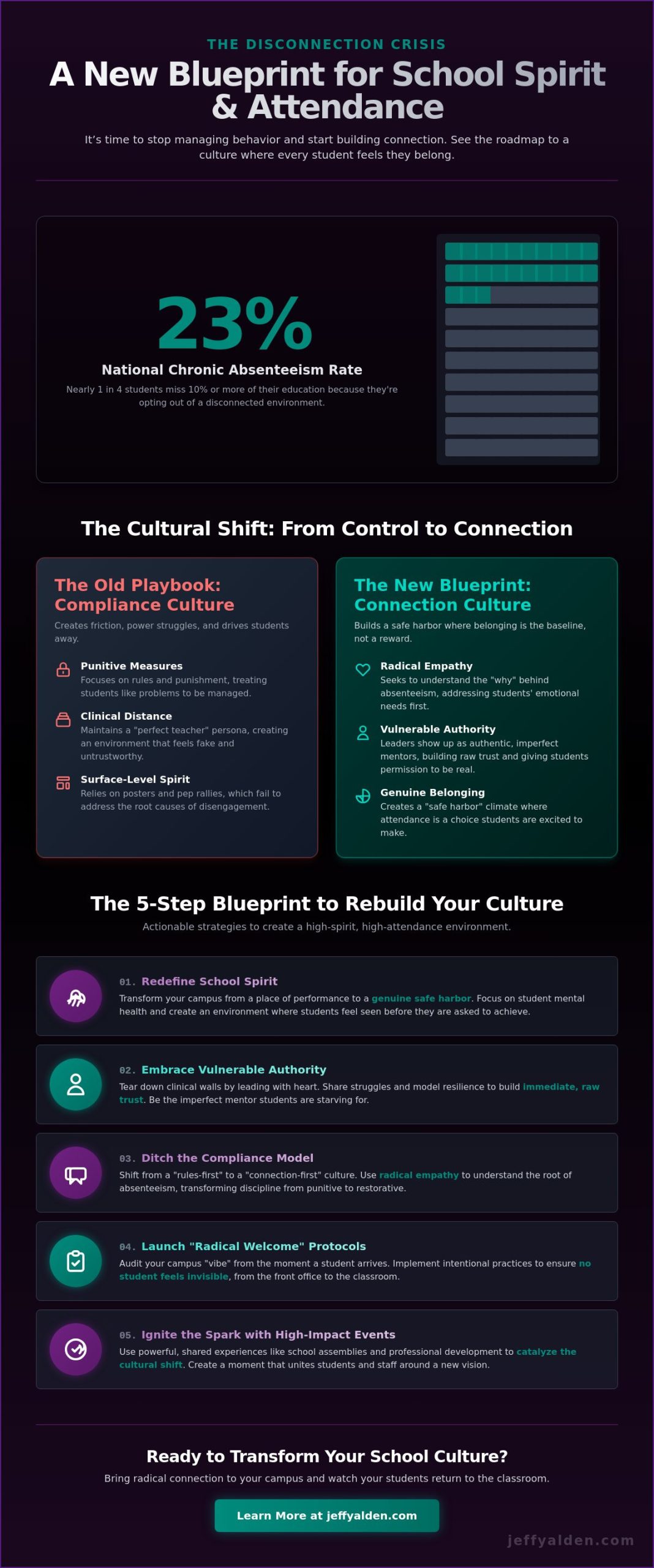
The 5-Step Blueprint for Creating a High-Spirit, High-Attendance Environment
Transformation doesn’t happen by accident. It requires a gut-check. If you’re ready to stop the bleeding of chronic absenteeism, you need a tactical roadmap that prioritizes the human heartbeat over the spreadsheet. Discovering how to build school spirit in high school requires a shift from administrative oversight to intentional human interaction. This blueprint is about changing the “vibe” of your campus so students don’t just show up; they belong.
- Step 1: Audit your “Vibe.” Walk through your front doors as if you were a lonely sophomore. Is the front office a welcoming space or a security checkpoint? The energy of your campus, from the cafeteria to the back of the gym, tells students if they are guests or inmates.
- Step 2: Implement “Radical Welcome” protocols. This is about making every student feel expected, not just present. It is the frontline of attendance.
- Step 3: Invest in your staff. You can’t lead with heart if you’re burnt out. Investing in trauma-informed teaching professional development gives your teachers the tools to handle the raw reality of 2026 without losing their own peace.
- Step 4: Create “Connection Hubs.” These are physical or metaphorical spaces where students can be seen and heard without the weight of judgment or grades.
- Step 5: Leverage high-impact events. Use a powerful moment, like a guest speaker or a community reset day, to draw a line in the sand and start a new chapter.
The Psychology of the “Radical Welcome”
Expectation is a powerful drug. When a student feels they are “expected” to be in a room, their internal value skyrockets. A simple, 30-second interaction at the door can be the difference between a student staying for the day or slipping out the back door after lunch. It reduces morning anxiety by providing an immediate, positive anchor. When staff members are intentionally present in the hallways, they aren’t just monitoring behavior. They are building a safety net. They are signaling that the student’s presence actually matters to the community.
Postvention as Prevention
How you handle the dark days defines your culture more than any pep rally ever could. Whether it’s a loss in the community or a mental health crisis, your response dictates the environment for years to come. Implementing teen suicide prevention programs that focus on post-crisis healing is vital. A culture that knows how to grieve together is a culture that knows how to grow together. Postvention isn’t just about picking up the pieces; it’s about building a foundation that is stronger than it was before the storm. It proves to your students that you won’t walk away when things get real.
If you’re ready to move from theory to transformation, book one of our High School Assembly Programs to kickstart this blueprint on your campus and bring your students back to the heart of the school.
Igniting the Spark: Why High-Impact Assemblies and PD Drive Cultural Shifts
Sometimes, the most powerful change comes from the outside in. You’ve done the work, you’ve audited the vibe, and you’ve tried the “Radical Welcome.” But student apathy can be a thick, reinforced wall. That’s where an external voice becomes the wrecking ball. A high-impact high school motivational speaker doesn’t just deliver a speech; they disrupt the status quo. They break through the “I don’t care” armor that students wear to protect themselves. This is how to build school spirit in high school that actually sticks. It’s about creating a moment so raw and real that it becomes impossible for students to stay disconnected.
The “Vulnerable Authority” approach is the bridge. It closes the gap between the staff standing in the back of the gym and the students sitting in the bleachers. When a speaker is willing to be transparent about their own imperfections, it gives everyone else in the room permission to do the same. It’s not a performance. It’s a shared human experience that resets the campus clock. It moves the needle from a “one-off event” to a sustained cultural transformation by proving that the adults in the building are on the same team as the kids.
The Power of the Shared Experience
A shared experience is the fastest way to reset a campus culture. We’ve all seen the assemblies that feel like a clinical lecture on “don’t do drugs.” Those are dead. In 2026, students need to know how to handle their hearts. They need to know how to navigate the noise of social media and the pressure of a world that never stops. High school assemblies should be the beginning of a conversation, not the end. When a whole school hears the same message of hope and resilience at the same time, the language of the campus shifts overnight. You stop being a collection of individuals and start being a community that knows how to show up for one another.
Professional Development That Sticks
Change can’t just be for the kids. Teachers are the architects of the environment, but they’re tired. They’re burnt out from managing disruptive behavior and staring at empty desks. They need permission to be human in the classroom. Real Teacher Professional Development isn’t about learning a new grading software. It’s about culture-building workshops that remind educators why they started this mission in the first place. When staff meetings transform from administrative checklists to heart-led strategy sessions, the entire school feels the shift. You’re not just managing a building; you’re leading a movement.
This is the moment to decide. Are you going to keep managing the decline, or are you going to ignite the spark? We’ve seen how to build school spirit in high school through radical transparency, and we’re ready to help you do it. The desks don’t have to stay empty. The halls don’t have to stay quiet. It’s time to take the next step, explore Coaching programs for your leadership team, and book a session to transform your campus culture. Let’s bring them back to the heart of the school together.
Ignite a Movement of Belonging on Your Campus
The empty desks in your hallways are not a data problem; they’re a connection problem. We’ve explored how shifting from a compliance-first model to one rooted in radical transparency can bridge the gap between staff and students. By auditing your “vibe” and implementing a radical welcome, you create a sanctuary where students feel safe enough to be seen. This is how to build school spirit in high school that moves the needle on chronic absenteeism and heals the heart of your community.
You don’t have to navigate this cultural reset alone. With 30+ years of high school assembly expertise and a specialized background in teen suicide postvention and crisis intervention, Jeff Yalden is the catalyst your school needs. Voted “Youth Motivational Speaker of the Year” multiple times, Jeff brings the “vulnerable authority” required to break through student apathy and empower your teachers. Bring Jeff Yalden to your school to ignite a radical shift in your campus culture.
The journey from a clinical environment to a connection culture starts with a single, courageous step. Your students are waiting for a reason to show up. Give them one. You have the heart and the tools to build a campus where every student knows they belong. Let’s get to work.
Frequently Asked Questions
What is the #1 factor in creating a positive learning environment?
Human connection is the single most important factor. It’s not about the physical space or the curriculum; it’s about whether a student feels seen and known by at least one adult on campus. When you prioritize these relationships, you’re doing the real work of how to build school spirit in high school. This sense of belonging is the foundation for every other academic success you want to achieve.
How does a positive learning environment reduce chronic absenteeism?
A positive environment reduces absenteeism by removing the psychological friction that makes students stay home. When school feels like a safe harbor rather than a clinical factory, students no longer feel the need to opt out to protect their mental health. If they feel expected and valued by their peers and teachers, they’ll make the choice to show up even on their hardest days.
Can one teacher change the environment if the whole school is toxic?
Absolutely. One teacher can create a micro-culture of safety even in a building that feels disconnected. Your classroom can be the one place where a student feels they can breathe and be themselves without judgment. That one hour of genuine connection can be the primary reason a student decides to show up to the building at all.
What is radical transparency in a high school setting?
Radical transparency is the practice of leading with “Vulnerable Authority” by being honest about your own challenges and resilience. It’s about dropping the “perfect expert” mask and showing students that you’re a real person who navigates real struggles. This authenticity builds immediate, raw trust. It proves to students that you’re a guide who has been in the trenches, not just a distant authority figure.
How do we measure the “vibe” or culture of a school?
Measuring the vibe requires a gut-check audit of daily interactions rather than just looking at data points. Walk through the front office and see if you feel like a welcomed guest or an intruder. Watch the hallways between periods to see if students are engaging with each other or just moving like ghosts. These informal observations tell you everything you need to know about your current culture.
Is it possible to be “too vulnerable” with students?
Yes, vulnerability must always have professional boundaries. You are their guide, not their peer. Share your “scars”-the lessons you’ve learned and the resilience you’ve built-but don’t share your “open wounds” that you’re still bleeding from. The goal is to model strength through transparency, not to seek emotional support from the students you are meant to lead.
How do we get “buy-in” from cynical staff members?
You get buy-in by addressing their burnout directly. Cynical staff members are usually just exhausted teachers who feel they’ve lost control of their classrooms. Show them how building connection reduces disruptive behavior and makes their daily workload manageable. When they see that learning how to build school spirit in high school actually saves their energy and restores their passion, they’ll stop resisting and start leading.
What should we do immediately after a student crisis to maintain a positive environment?
You must acknowledge the pain immediately through intentional postvention and grief work. Ignoring a crisis to get back to normal actually damages the environment by making students feel their reality is being erased. Hold space for the struggle, provide resources for healing, and let the community grow together through the storm. This transparency proves that the school is a safe place for the whole human experience.
