
What if the chaos in your hallways isn’t a discipline problem, but a desperate cry for a new kind of survival skill? You’re exhausted. I know because I’ve stood in those same hallways feeling that same heart-pounding urgency. You feel like a firefighter instead of an educator, constantly sprinting to douse the flames of social media drama and hallway aggression before they burn the whole campus down. It’s draining. It’s relentless. You see your students lacking the words to express their hurt, so they use their fists or their phones instead. You aren’t alone in this struggle. In fact, a 2026 survey revealed that most teachers haven’t seen student behavior improve over the last year. The weight of this tension is heavy on your shoulders.
I’m here to tell you there’s a better way. This isn’t about “classroom management” or another dusty handbook. We’re moving beyond the surface. I’m going to show you how to implement radical conflict resolution strategies for students that build deep emotional intelligence and, quite literally, save lives. We’ll explore how to give students ownership of their emotions and move from reactive policing to a culture of genuine resilience. By the end of this guide, you’ll have a roadmap to transform your campus into a place of calm, connection, and real growth.
Key Takeaways
- Stop treating student drama as a simple discipline problem. It’s a mental health signal that demands a shift from cold punishment to radical, restorative resilience.
- Learn to master the “Radical Pause” to shut down the amygdala hijack. This simple tool helps you and your students stop reacting out of fear and start responding with power.
- Unlock the anatomy of a raw conversation. By leading with your own vulnerability, you’ll create a safe space where students can finally voice the pain hidden behind their aggression.
- Implement conflict resolution strategies for students that replace empty “I’m sorry” moments with true restitution and win-win contracts that students actually respect.
- Discover why a single workshop isn’t enough. You’ll learn how to bake these transformative strategies into your school’s daily DNA for a lasting culture shift.
Why Conflict in 2026 is a Mental Health Priority
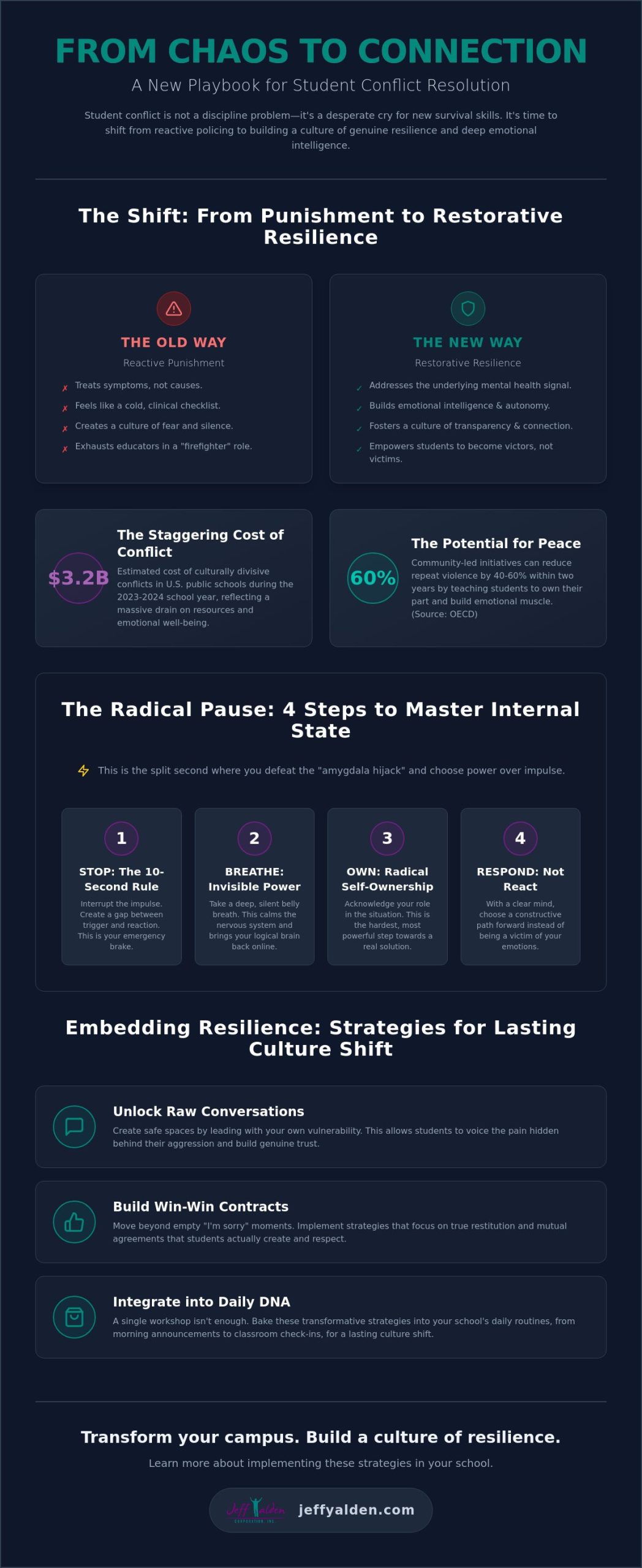
Let’s get real for a second. When you see two kids screaming in the hallway, your first instinct is usually to shut it down. You want quiet. You want order. But that “drama” isn’t just noise. It’s a mask. In 2026, we’re seeing that these explosions are often the only way a student knows how to signal they’re drowning. If we keep treating these moments as mere inconveniences, we’re missing the diagnostic window to save a life. Traditional conflict resolution often fails because it feels like a clinical exercise. It’s a cold checklist from an HR manual. It doesn’t touch the heart. It doesn’t address the fact that culturally divisive conflicts cost public schools an estimated $3.2 billion in the 2023-2024 school year. We’re paying a literal and emotional price for being too “polite” to get raw.
This is the shift from punishment to restorative resilience. We’re moving away from the old ways of just “managing” behavior. Recent federal policy shifts, like Executive Order 14280, have pushed the responsibility of discipline back to the local level. This means we can’t wait for a federal mandate to fix our culture. We have to do it ourselves. Implementing effective conflict resolution strategies for students requires us to look past the surface level behavior and see the human being underneath. If a student is lashing out, they’re likely hurting. These conflict resolution strategies for students aren’t just about peace; they’re about survival.
The Link Between Conflict and Crisis Intervention
Every disagreement is a data point. When a student’s reaction is wildly disproportionate to the event, that’s a red flag. It’s not just “teen angst.” It’s often a signal of deep trauma or even a cry for help regarding self-harm. We have to move from a “hush-hush” culture to one of radical transparency. This is where teen suicide prevention programs become a vital safety net. We don’t just wait for the crisis; we use the conflict as a way to intervene early. We talk. We listen. We save lives by being brave enough to ask the hard questions in the middle of the mess.
Reframing Conflict as a Resilience Workout
The Radical Pause: 4 Steps to Master Internal State
Conflict isn’t just about the words flying across the room. It is about what happens inside your chest before you even open your mouth. Most conflict resolution strategies for students fail because they focus on the script. They give kids a list of “I feel” statements that sound like they were written by a robot. We need to focus on the soul instead. Before the words come out, you need the Radical Pause. It is the split second where you decide if you are going to be a victim of your impulses or a victor over your environment. You can find more about managing these initial impulses in UC Merced’s Conflict Resolution Strategies, which highlights how internal control dictates external outcomes.
Stopping the Amygdala Hijack
When tension spikes, your brain literally stops thinking. Your prefrontal cortex, the part that handles logic, goes offline. Your amygdala takes over. This is the “lizard brain” screaming for survival. You can’t solve a problem when your brain thinks you are being chased by a predator. The 10-Second Rule is your emergency brake. You stop. You breathe. In a crowded hallway, you don’t need a yoga mat. You just need a deep, silent belly breath that looks like a frustrated sigh to everyone else. It is invisible power. The Radical Pause is the foundation of student autonomy because it proves you are in control of your reactions.
Radical Self-Ownership
Step two is the hardest pill to swallow. You have to ask, “What is my role in this mess?” Even if the other person is 99% wrong, you must own your 1%. This isn’t about being a doormat. It is about power. When you own your part, you unlock the ability to change the outcome. We have to move kids away from the “he said, she said” trap that keeps them stuck in a cycle of blame. This level of building resilience in teens starts with internal accountability. It is about realizing that your peace is more valuable than your pride.
Once the brain is calm and you’ve owned your part, you must label the emotion. “I’m mad” is lazy. Are you mad, or are you feeling disrespected? Are you mad, or are you embarrassed? Labeling the truth strips the emotion of its chaotic power. Finally, perform the Outcome Check. Ask yourself if you want to be “right” or if you want to be at peace. Being right is a lonely island. Peace is where the growth happens. If you are struggling to reach your students on this level, a Youth Life Coach can help bridge that gap between theory and real-world change.
The Anatomy of a Raw Conversation: Strategies for Real Talk
Let’s cut the fluff. Most conflict resolution strategies for students fail because they sound like a corporate HR manual. High schoolers have a world-class “fake” detector. If you walk into a conflict with a canned script, you’ve already lost the room. Real talk requires radical transparency. It means being brave enough to lead with your own vulnerability. You aren’t just a teacher or a student leader; you’re a human being who knows what it’s like to feel hurt, ignored, or disrespected. When you show up with your heart open, you give others permission to do the same. This is where the shift from “management” to “connection” actually happens.
This isn’t about being “polite.” It’s about being effective. Polite people stay on the surface while the resentment rots underneath. We need to go deep. We need to set boundaries that protect our peace without building walls that shut people out. This approach aligns with Cornell’s Guide to Managing Classroom Conflict, which emphasizes that resolving conflict isn’t just about stopping the noise; it’s about creating an environment where everyone can actually function and grow. No more surface-level fixes. We’re going for the root.
Beyond ‘I’ Statements: Radical Honesty
Standard “I” statements are cringey. They feel like a trap to most teens. Instead of the typical “I feel mad,” try a pivot to radical honesty: “The story I’m telling myself right now is that you’re trying to embarrass me.” This is a game-changer. It owns your perspective without attacking theirs. It invites them to see your internal reality. Being “real” works because it respects the intelligence of the students involved. You’re acting as a vulnerable authority, showing them that it’s okay to be imperfect as long as you’re honest about it.
Reflective Listening for High-Intensity Situations
When things get hot, people stop listening and start reloading. They’re just waiting for their turn to speak. You have to break that cycle. Use the “So what I’m hearing is…” technique. This isn’t about agreeing with their version of the facts. It’s about validating their pain. If a student is screaming, they’re usually screaming to be heard. Tell them, “I hear that you’re feeling completely betrayed right now.” Once they feel heard, the intensity drops. If they aren’t ready to talk yet, respect that. Give them space to cool down before you force a resolution.
Finally, move to the “Future-Focus” pivot. Stop litigating the past. You can’t change what happened five minutes ago. Ask, “What do we do now to make sure this doesn’t happen again?” This moves the energy from blame to solution. It turns a fight into a partnership. You’re no longer enemies. You’re two people trying to figure out a way forward. That’s how you build a culture where conflict resolution strategies for students actually stick. For those curious about how specialized behavioral science addresses similar social bonding and development challenges, you can read more about managing these complex dynamics.
From Victim to Victor: Restorative Solutions That Stick
Words are cheap. In the heat of a hallway blowout, “I’m sorry” is usually just a way to get the principal to stop talking. It’s a lie we’ve coached kids to tell just to keep the peace. But peace without repair is just a temporary truce. If we want conflict resolution strategies for students to actually transform lives, we have to move from the “Victim” mindset to the “Victor” mentality. A victim waits for a punishment to end. A victor takes responsibility and repairs the damage they caused. This is restorative justice in action. It is the only way to build a campus culture that breathes resilience instead of resentment.
We need solutions that have teeth. When a student feels like a solution was forced on them, they’ll break the contract the second you turn your back. But when they help write the rules, they have skin in the game. We’re talking about creating “Win-Win” contracts that address the root hurt. This isn’t about being soft; it’s about being effective. You’re giving them the tools to fix what they broke. You’re teaching them that their actions have weight, but their character has the power to make things right again.
True Restitution vs. Empty Apologies
An apology is the weakest part of conflict resolution. It’s often a get-out-of-jail-free card that requires zero change. We have to push further. We have to ask the terrifying question: “What do I need to do to make this right?” This shifts the focus from the past to the future. It moves the student from a place of shame to a place of action. We’re building a culture where mistakes are expected as part of the growth process, but repair is a non-negotiable requirement. Whether it’s restoring a reputation or fixing a physical mess, the act of repair is what builds the muscle of integrity.
Student-Led Mediation Programs
The real shift happens when the students lead. You need the influencers on your campus to be the peacemakers. When you train student leaders in trauma-informed communication, you’re creating a peer-to-peer safety net that adults simply cannot replicate. This is a core pillar of a high school assembly culture that values radical transparency over quiet compliance. By using an academic life coach for high school students approach, we empower these peer mediators to hear the pain beneath the noise. They become the first line of defense against escalating drama. Once they reach a resolution, give them space to succeed. Don’t hover. Trust the process you’ve built.
If you’re ready to bring this level of radical ownership to your school, it’s time to book a Teen Motivational Speaker who has been in the trenches and knows how to reach the heart of your campus.
Transforming Campus Culture: The Long-Term Play
A one-off workshop is a band-aid on a broken bone. It’s not enough to fix a culture that’s been hurting for years. If you want real change, you have to stop thinking about conflict as a “problem to solve” and start seeing it as the DNA of your school’s resilience. Real transformation happens when the bell rings and the students take these tools into the locker rooms and the lunch lines. We’re talking about a long-term play that moves your campus from reactive fire-fighting to proactive peace-building. This requires a commitment to conflict resolution strategies for students that aren’t just taught once but are lived every single day in every classroom.
This shift starts with the adults. You can’t ask students to be vulnerable if the staff is still hiding behind a clinical mask. Integrating these strategies into daily trauma-informed teaching professional development is non-negotiable. Educators need to be equipped to handle the “raw” moments without jumping straight to punishment. The Yalden Method is built on this foundation of radical transparency. It’s about being a vulnerable authority. When the entire student body sees that it’s okay to be imperfect, the pressure to “act out” starts to evaporate. We measure success not just by the absence of fights, but by the presence of genuine connection and peace.
Scaling Resilience Across the District
Change can’t happen in a vacuum. You need the staff, the students, and the parents all speaking the same language. We have to create a “language of resilience” that replaces blame with ownership. High-energy teen mental health speakers play a massive role here. They break the silence. They make it safe to talk about the hurt that fuels the aggression. When everyone is on the same page, the “unreachable” student suddenly has a community that understands their struggle. You’re no longer just managing behavior; you’re building a safety net that catches kids before they fall into a crisis.
Booking the Spark: Why Assemblies Matter
The assembly is the spark that ignites the engine of change. It’s the moment where the entire school stops to look each other in the eye. A powerful keynote normalizes the hard conversations about conflict, hurt, and mental health. It bridges the gap between clinical theory and the real-world chaos of high school life. Jeff Yalden has a unique ability to connect with the students who have checked out, the ones who feel like the system has already given up on them. He speaks their language. He hears their pain. If you’re ready to stop putting out fires and start building a culture of victors, take the first step. Book a School Speaker today and let’s start the work of saving lives through radical resilience.
Ignite a Culture of Radical Resilience Today
You’ve seen the cost of silence and the weight of unresolved pain in your hallways. We’ve moved past simple classroom management to a place of real, raw connection. By mastering the Radical Pause and choosing restitution over empty apologies, you’re giving your students the tools to be victors. Implementing these conflict resolution strategies for students isn’t just about a calmer campus. It’s about building the emotional muscle required for a lifetime of success. This work is heavy, but you don’t have to carry it alone.
I’ve spent over 30 years in the trenches as a youth motivational speaker, helping schools navigate the most difficult crises. As the author of ‘The 200% Life’ and a specialist in suicide prevention and crisis intervention, I know how to reach the hearts that others have labeled unreachable. Let’s stop managing the fire and start transforming the DNA of your school culture. Bring Jeff Yalden to your school for a life-changing High School Assembly and watch your students take ownership of their future. You have the power to change the narrative. Let’s do this together.
Frequently Asked Questions
What are the most effective conflict resolution strategies for high school students?
The most effective conflict resolution strategies for students are those that prioritize radical ownership and emotional regulation over simple compliance. Techniques like the 10-second rule and the “Future-Focus” pivot allow students to move from reactive anger to proactive problem-solving. It’s about giving them the vocabulary to express hurt without resorting to aggression or social media attacks. When they own their part of the mess, they gain the power to fix it.
How do I deal with a student who refuses to participate in mediation?
When a student refuses mediation, you have to stop pushing and start listening to the fear behind the refusal. They often feel like mediation is a trap or a performance for authority figures. Give them space to cool down. Build a foundation of trust through one-on-one “raw” conversations before you ever ask them to sit across from their peer. Respecting their boundaries now makes them more likely to engage later.
Can conflict resolution strategies help prevent teen suicide?
Yes, these strategies are a critical front line in teen suicide prevention because they teach students how to process overwhelming emotions. Peer conflict is a massive stressor that can push a vulnerable student toward a crisis. By teaching them how to navigate hurt and repair relationships, you’re giving them the resilience they need to survive their darkest moments. It’s about catching the pain before it turns into a catastrophe.
What is the ‘Radical Pause’ in student conflict management?
The Radical Pause is a deliberate 10-second break designed to stop the amygdala hijack before it leads to a blowup. It’s the moment where a student chooses to breathe and audit their own internal state. This split second of self-control is the difference between a hallway fight and a productive conversation. It proves to the student that they are in control of their reactions, not their impulses.
How do ‘I’ statements differ from radical transparency in communication?
Traditional “I” statements often feel like robotic scripts that kids reject, while radical transparency focuses on the raw truth of the internal experience. Instead of saying “I feel mad,” a student practicing radical transparency might say, “The story I’m telling myself is that you don’t respect me.” It owns the perspective without attacking the other person. This honesty builds a bridge instead of a wall between peers.
Why is peer mediation more effective than teacher intervention in many cases?
Peer mediation works because it removes the power struggle that often exists between students and authority figures. Students are more likely to listen to the “influencers” on campus who understand their social reality. When peers lead the conversation, the focus stays on repairing the relationship rather than avoiding a teacher’s punishment. It turns the resolution into a community-led act of growth rather than a top-down command.
How can I integrate conflict resolution into my existing curriculum?
You can integrate conflict resolution strategies for students by making them a part of your daily classroom rituals rather than a separate subject. Use the first five minutes of class for “resilience check-ins” or use literature and history lessons to analyze how famous figures handled high-stakes disagreements. It has to be baked into the school’s DNA. When students see these tools used in every subject, they start to speak the language of peace naturally.
What should I do if a conflict involves social media or cyberbullying?
If a conflict involves social media, you must bring the digital drama into the physical world to address the real human hurt. Cyberbullying thrives on the distance between the screen and the person. Force the “Radical Pause” by having the students sit face-to-face to discuss the impact of their digital footprint. When they see the pain their words caused in real life, the screen loses its power to shield them from accountability.
