
What if trust isn’t built in one perfect conversation, but in the small moments adults often rush past? Building trust with high school students can feel tough when they seem guarded, disengaged, or unsure whether an adult will really listen. With packed schedules, interactions are often brief. It’s natural to worry that one clumsy response could close a door you were trying to open.
That worry makes sense. You don’t need a flawless script or instant closeness to earn a student’s trust. You do need to show, again and again, that their voice matters and your actions match your words. Small choices count: listening without judgment, being clear about boundaries, and admitting when you don’t have an answer.
This article offers practical ways to build connection without pressuring students or making promises you can’t keep. You’ll learn how to respond to concerns with care, follow through reliably, and make brief interactions more respectful and useful. We’ll also look at how consistent adult behavior across a school can help create a culture where students feel safer speaking up. Trust takes time, but every honest, steady interaction gives it room to grow.
Key Takeaways
- Trust grows through repeated, respectful actions, not adult authority or one dramatic speech.
- Build credibility by listening carefully, being transparent, and following through on what you say you’ll do.
- Building trust with high school students doesn’t require personal disclosure. Give students room to choose when and whether to talk.
- Use a simple routine to guide conversations: notice, listen, respond honestly, agree on a next step, and follow up.
- Strengthen trust across the school by listening to student feedback, explaining decisions, and closing the loop on commitments.
What Building Trust with High School Students Really Means
Trust doesn’t come from authority, good intentions, or the right words in one conversation. Students assess it through repeated interactions. They notice what happens when they ask a question, make a mistake, disagree, or need help. Each moment offers evidence: does this adult treat me with respect, tell me the truth, and do what they said they would?
Trust in a school relationship is a student’s experience of an adult as consistently respectful, reliable, and honest. That’s the heart of building trust with high school students: don’t demand their faith. Make your behavior steady enough to be believed.
Trust also isn’t the same as being liked, getting compliance, or hearing a student disclose personal details. A student can trust an adult and still disagree with a decision, feel frustrated, or choose not to share. Respecting that distinction matters. The goal isn’t to win every exchange or become a student’s favorite adult. It’s to be someone they can approach without expecting ridicule, pressure, or rules that change without explanation.
What does trust look like from a student’s perspective?
It can look like having time to finish a thought without being mocked, rushed, or corrected before the adult understands. It can also mean knowing what happens next because expectations and responses are predictable. A student who receives a correction can trust the adult’s fairness even if they don’t like the consequence, especially when the adult explains the reason and applies expectations consistently.
For example, imagine a student turns in work late. An adult can calmly explain the class expectation, ask what got in the way, and agree on a next step. The point is that fairness and curiosity can exist alongside clear expectations.
Why does trust matter in everyday school relationships?
Trust can make ordinary moments feel less risky. A student may be more willing to ask for clarification, hear feedback, or say they need help when they expect a respectful response. That doesn’t guarantee a particular academic or mental-health outcome. It can, however, help a student feel that they belong in a community where adults take them seriously.
That sense of connection grows through everyday relationships, not only during major conversations. For a related look at how young people can respond to challenges, explore building resilience in teens. Trust doesn’t erase hard moments. It helps make room for honest ones.
How High School Students Learn an Adult Is Reliable
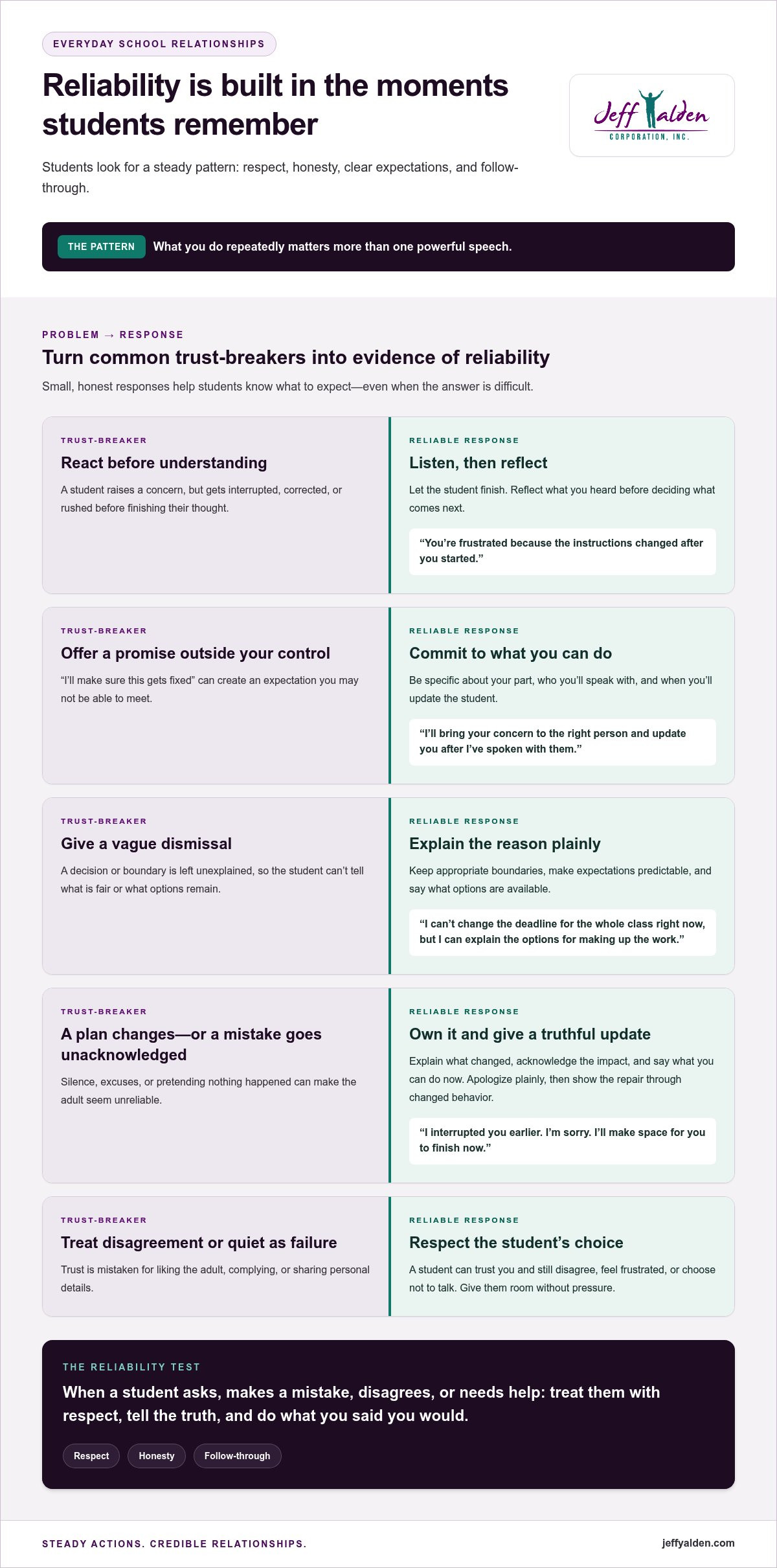
Students don’t decide an adult is reliable because of one powerful speech. They notice the pattern: whether you greet them with respect, listen before reacting, explain what you can, and return when you said you would. Those ordinary moments show students what to expect from you, especially when a conversation gets uncomfortable or a situation can’t be fixed quickly.
Trust grows when an adult’s actions match their words over time. That’s the practical work of building trust with high school students: keep your commitments, be clear about limits, and own it when you fall short. The American Psychological Association describes positive relationships between teachers and students as essential supports for learning, including adolescents’ motivation and engagement.
Which everyday actions help students feel respected?
Start with small signals. Use a student’s name appropriately, and leave sarcasm or public humiliation out of correction. If a student raises a concern, listen without interrupting. Before offering advice, reflect what you heard: “You’re frustrated because the instructions changed after you started.” You don’t have to agree with every detail. The reflection shows you’re trying to understand before deciding what comes next.
Be direct about classroom decisions, too. Explain the reason in plain language while keeping appropriate boundaries. “I can’t change the deadline for the whole class right now, but I can explain the options for making up the work” is clearer than a vague dismissal. Students may not like every answer, but they can still recognize fairness and honesty.
How can adults follow through when they cannot fix everything?
Promise only what’s yours to control. Instead of saying, “I’ll make sure this gets fixed,” try, “I’ll bring your concern to the right person and update you after I’ve spoken with them.” If you need time, say so and give a clear next step. If plans change, explain why, acknowledge the impact, and tell the student what you can do now. No grand speech required. Just a truthful update.
When you make a mistake, name it plainly: “I interrupted you earlier. I’m sorry. I’ll make space for you to finish now.” Don’t bury the apology in excuses or expect the student to reassure you. Repair begins with accountability, then continues through changed behavior. Jeff Yalden’s teacher professional development helps educators strengthen their support for student mental health and well-being across the school.
Building Trust with High School Students Without Forcing Disclosure
A student doesn’t have to share a personal story, agree with your decision, or answer every question to trust you. Trust isn’t a confession extracted from a conversation. It’s knowing an adult will respect a student’s choice, respond honestly, and remain steady even when the student says very little.
Guarded behavior isn’t automatically defiance, and it doesn’t prove the relationship has failed. A student may need time, may not know what to say, or may simply prefer not to talk right now. In building trust with high school students, patience is not passivity. It shows that connection won’t be demanded as the price of adult support.
How can adults invite conversation without pressure?
Offer a calm, simple invitation, then leave room for the student to choose. You might say, “I noticed you’ve seemed quieter today. Want to talk, or would you rather check in later?” Ask open, non-leading questions such as “What’s been on your mind?” Avoid stacking questions or treating a short answer as a puzzle to solve.
If the student says “I’m fine” or “I don’t want to talk,” accept the answer without interrogation. You can respond, “Okay. I’m here if you want to talk later.” Then make that offer real: greet them normally, avoid punishing them with coldness, and leave a reasonable opening for another conversation. Not every concern needs to be resolved in one sitting.
What boundaries keep trust honest and safe?
Be clear about your role and about privacy before a student shares something sensitive. Don’t promise that everything will stay between you. Instead, explain plainly that if you become concerned about someone’s safety, you may need to involve appropriate school support and follow school procedures. That honesty can feel difficult in the moment, but a clear boundary is more trustworthy than a promise you can’t keep.
If a serious concern comes up, listen calmly, avoid making guarantees, and take the next steps required by your school’s safeguarding procedures. Explain what you can about what happens next, without sharing details beyond your role. An educator or motivational speaker can offer respectful support and help connect a student with appropriate people, but that role is not a replacement for qualified clinical care.
Choice and boundaries belong together. A student can decline to talk and still be treated with care; an adult can be supportive without claiming to solve everything. That steady, honest response keeps the door open without pushing the student through it.
A Practical Routine for Earning Students’ Trust at School
Trust-building is easier to practice when you have a simple sequence to return to. Whether you’re a teacher, counselor, coach, or school leader, try this: notice, listen, respond honestly, agree on a next step, and follow up. It’s not a script that guarantees a particular response. It’s a way to make your care visible through your actions.
- Notice: Name what you’ve observed without turning it into an accusation. “I noticed you’ve been quiet during group work” leaves room for the student’s perspective.
- Listen: Give the student space to explain. Reflect the concern before moving to advice or a solution.
- Respond honestly: Explain what you know, what you don’t know, and any relevant limits.
- Agree on a next step: Choose an action that’s realistic and clear to both of you.
- Follow up: Do what you agreed to do, or tell the student honestly if something has changed.
What can an adult do before, during, and after a difficult conversation?
Before: Choose a private, appropriate setting and approach with curiosity. Instead of “Why didn’t you do the work?” try “I noticed the assignment isn’t in yet. What got in the way?” During: Listen, reflect the student’s concern, and explain any necessary next steps. After: Complete your part or provide an honest update. That sequence makes building trust with high school students a practical habit, not a one-time speech.
Use the routine in ordinary situations, too. When giving classroom feedback, point to one specific strength and one useful next step. If you miss a promised check-in, acknowledge it directly and say when you can reconnect. If a student declines to talk, respect the choice and let them know how to find you later. The details change. The reliability stays.
How can school teams make trust-building consistent?
Students encounter adults across classrooms, activities, and offices. A shared commitment to respectful communication and reliable follow-up can make those experiences feel less dependent on which adult they meet. Teams can invite voluntary student feedback through appropriate channels, then explain what they heard and what changed. Closing that loop shows students their input wasn’t collected just to disappear into a folder.
A weekly reflection can keep the work grounded: Whose voice did I hear this week, and where do my actions need to match my words? Staff learning can help teams develop consistent ways to listen and respond. To bring shared conversations about student well-being into your school, explore Jeff Yalden’s school programs.
How Schools Can Sustain Trust Beyond One Conversation
A single respectful conversation can matter. But students form a broader impression from what adults do across classrooms, offices, teams, and school events. Building trust with high school students becomes a shared school practice when adults communicate clearly, honor commitments, and respond to student concerns with consistent respect. It’s not about every adult using identical words. It’s about students not having to guess whether honesty and follow-through depend on who they meet.
How can schools tell whether trust-building is becoming more consistent?
Pay attention to patterns, not one moment or a single score. Schools can invite regular feedback from students and staff using approaches that fit their community, such as voluntary conversations or school-developed questions. If a school uses a formal survey framework, understand its purpose and limits before drawing conclusions from the results.
Feedback can guide better questions: Do students know where to raise a concern? Do adults explain what happens next? Are commitments being completed, or are changes communicated honestly? If students report that a concern went unanswered, treat that as a reason to listen and review the process, not as proof that a particular program did or didn’t work. Then close the loop: share what the school heard, what it can change, and what it can’t change right now.
How can a school create a shared starting point?
Staff development can help adults build common habits for listening and responding, while leaving room for the different responsibilities of teachers, counselors, coaches, and school leaders. A school assembly can also create a shared starting point for honest conversation. Neither is an instant fix. The real work continues in everyday interactions after the event, as students see whether the school’s actions reflect what adults said.
For a closer look at how an assembly can contribute to a broader campus conversation, explore high school assemblies that transform campus culture. Jeff Yalden delivers high school and middle school assembly programs and teacher professional development focused on student well-being. These programs can support schoolwide conversations alongside the daily choices that make trust tangible.
Start with one commitment your team can keep. Make it clear, follow through, and tell students what happened. To explore ways to support honest conversations in your school, explore Jeff Yalden’s school programs.
Make Trust a Daily Practice
Building trust with high school students isn’t about finding a perfect phrase or getting every student to open up. It’s the steady pattern they experience: adults listen without pressure, explain boundaries honestly, and follow through on what they say. Small actions, repeated across the school, can make respect feel real.
Start with one habit you can keep. Notice who hasn’t been heard. Make space for a student’s perspective. If plans change, explain what happened and what comes next. Trust grows through that kind of consistency, not through promises of instant change.
Schools can also create shared starting points for honest conversations. Jeff Yalden provides high school and middle school assembly programs, teacher professional development, and community programs that support conversations about student well-being. These efforts can complement the daily work adults do to build a more connected school culture.
Explore Jeff Yalden’s school programs and consider how your school can make respect, honesty, and follow-through part of everyday life. Every consistent interaction is a chance to strengthen connection. Start with the next one.
Frequently Asked Questions
Is building trust with high school students different from being their friend?
Yes. Building trust with high school students doesn’t mean acting like a peer or giving up appropriate boundaries. Students need adults who are warm, fair, honest, and dependable while staying clear about their role. Explain expectations respectfully, listen without ridicule, and do what you said you would. You can be approachable without promising secrecy, special treatment, or agreement with every choice a student makes.
How long does it take to build trust with a high school student?
There’s no fixed timeline. Trust develops through repeated interactions, and a student’s response may depend on their experiences and circumstances. Focus on reliable actions instead of expecting quick openness. Keep treating the student with respect, be honest if plans change, and let them choose when to engage. One positive conversation can be a meaningful start, but it doesn’t prove that trust is complete.
What should I do if a high school student does not trust me?
Don’t pressure the student to explain their distrust or reassure you. Stay calm, listen if they choose to speak, and keep small commitments, such as returning with an answer when you said you would. You might ask, “What would help our next conversation feel more respectful?” Give them room to answer. If a serious safety concern arises, follow school procedures and involve appropriate support rather than handling it alone.
Can teachers build trust without sharing personal stories?
Yes. Personal disclosure isn’t required for a trusting relationship. Teachers can show reliability by listening carefully, applying expectations consistently, explaining decisions, admitting mistakes, and respecting student boundaries. If you choose to share a relevant experience, keep the focus on what may help the student. Don’t make them responsible for supporting you or expect them to share in return. Trust grows from dependable conduct, not a particular storytelling technique.
What should I avoid when trying to build trust with students?
Avoid sarcasm that humiliates, forced personal disclosure, promises you can’t keep, and responses that dismiss a student’s feelings. Don’t claim a conversation is completely private if school procedures may require you to act. If you don’t know an answer, say so. Then explain what you’ll do to find out or when you’ll update the student. Clear, honest limits are more dependable than confident claims that later prove untrue.
How can a school build trust with students as a team?
Agree on shared expectations for respectful communication, reliable follow-through, and clear explanations of decisions. Give students appropriate, voluntary ways to offer feedback, then tell them what the school heard and what can happen next. Staff development can help adults strengthen consistent support, while an assembly may start a wider conversation. Neither replaces daily relationships. Students are more likely to experience trust as part of school culture when adults act consistently.
Can a school assembly help build trust with high school students?
Yes. A school assembly can create a shared moment for reflection and open an honest conversation, especially when adults carry its message into daily interactions. An assembly alone can’t create lasting trust or guarantee a particular outcome. Connect it to respectful classroom conversations, clear follow-through, and appropriate student support. Treat the event as one part of a broader effort to build trust, not a substitute for the steady work that follows.
