
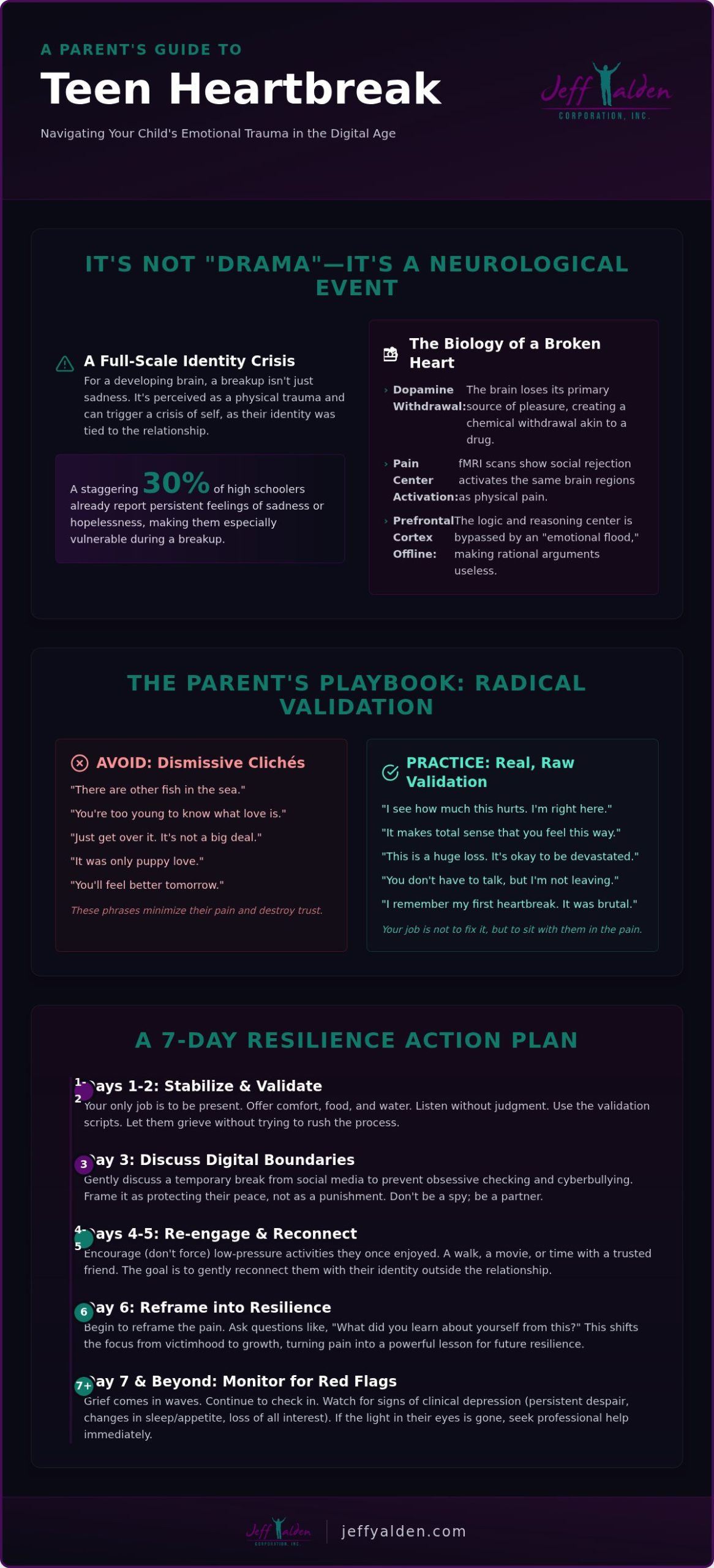
Your teen’s world just ended. It isn’t just “drama” or a simple rite of passage. For their developing brain, this heartbreak is a full-scale neurological earthquake. You’re watching them sob on the floor and you feel completely powerless. You’re terrified this sadness will spiral into depression, especially when you know that 30 percent of high schoolers already report persistent feelings of hopelessness. It’s heavy. It’s raw. And honestly, it’s exhausting. You need to know how to support a teen after a breakup without them pushing you away or spiraling further into the dark.
I’ve been there. I’ve stood in those trenches. This isn’t about finding a quick “fix-it” phrase. It’s about radical transparency and building resilience that lasts a lifetime. In this guide, we’ll navigate the 2026 landscape of digital heartbreaks, including new social media safety laws and the intensity of young love. You’ll gain the tools to prevent a mental health crisis and turn this agonizing pain into a breakthrough moment for your bond. Let’s get real about what your child needs to survive this and come out stronger on the other side.
Key Takeaways
- Stop calling it drama and understand why the adolescent brain treats rejection as a physical trauma that requires radical validation.
- Learn exactly how to support a teen after a breakup by ditching toxic clichés for a “real and raw” approach that builds trust.
- Master the 2026 digital landscape by implementing social media boundaries that protect your teen’s mental health without making you a “spy.”
- Reframe this heartbreak as a high-stakes training ground for resilience, turning a painful crisis into a breakthrough for their future relationship health.
- Follow a concrete 7-day action plan to stabilize your child’s emotions and move them from passive grieving to active, healthy coping.
Why Teen Heartbreak is a Critical Mental Health Priority
Don’t you dare call it “puppy love.” When your teen’s relationship ends, they aren’t just sad; they are experiencing a legitimate emotional trauma. We’ve got to stop treating this like a minor rite of passage. For an adolescent, a breakup is a full-scale identity crisis. To truly understand how to support a teen after a breakup, you have to acknowledge that their pain is real, visceral, and potentially dangerous. You aren’t just a shoulder to cry on anymore. You are a crisis manager standing on the front lines of their mental health.
The Biology of the Broken Heart
Their brain is literally under siege. During a romantic relationship, the teen brain is flooded with dopamine, the chemical responsible for pleasure and reward. When that connection is severed, the supply vanishes instantly. It’s a chemical withdrawal that feels like coming off a hard drug. Science tells us that the brain processes social rejection in the same areas that register physical pain. This is a volatile time in their psychological and social development, and their prefrontal cortex, the logic center, is currently offline. Logic won’t work here. Emotional flooding is when the intensity of the heartbreak completely bypasses their ability to reason, leaving them drowning in a sea of raw, uncontrollable feeling.
Breakups and the Risk of Crisis
This is where it gets heavy. A major breakup is one of the leading triggers for teen mental health emergencies. You have to be vigilant. Look for the red flags that go beyond typical moping. If they stop eating, stop sleeping, or start talking about how the world would be better without them, you are in a danger zone. I’ve spent 30 years working with teen suicide prevention programs, and I can tell you that the days following a split are high-stakes.
You need to distinguish between “normal” grieving and clinical depression. Normal grieving comes in waves; they might have moments of laughter followed by hours of tears. Clinical depression is different. It is a flat, unrelenting despair that doesn’t lift, even for a second. If the light in their eyes doesn’t just flicker but goes out completely, it’s time for professional intervention. Knowing how to support a teen after a breakup is about spotting the difference between a broken heart and a broken spirit before it’s too late. Your presence and your observation are the most powerful tools you have right now.
The Parent’s Playbook: Radical Validation vs. Dismissive Clichés
Clichés are the fastest way to lose your kid. When you say, “There are other fish in the sea,” you aren’t being helpful; you’re being dismissive. To a teenager, there is only one fish, and the ocean is currently a dark, empty void. If you want to know how to support a teen after a breakup, you have to start by killing the urge to “fix” their pain. Your job isn’t to make them feel better instantly. Your job is to sit in the trenches with them. This is called radical validation. It means acknowledging the absolute suck of the situation without trying to silver-line it. It’s about being real, raw, and present.
I’ve seen too many parents try to offer logic to a heart that is bleeding out. It doesn’t work. Instead, try sharing your own stories of heartbreak. Not the polished, “I got over it” versions, but the messy, “I couldn’t get out of bed for a week” versions. This creates a bridge of trust. It shows them that you aren’t some distant authority figure; you’re a human who has survived the same fire. We want to move them toward a victor mentality, but they can’t get there until they feel completely heard. You can find expert advice on the timing of these conversations, but the foundation must always be empathy.
What to Say When They Are Sobbing
When the tears are flowing, less is more. Your teen isn’t just mourning a person; they are mourning who they were in that relationship. Their identity was tied to that “we,” and now it’s gone. Instead of saying “It will be okay,” try these scripts: “I see how much this hurts, and I’m right here,” or “It makes total sense that you feel lost right now.” Sometimes, the most powerful thing you can do is just stay in the room in silence. Your active presence says more than a thousand empty promises ever could. If you’re struggling to find the right words, working with a Youth Life Coach can help you develop the communication skills needed to navigate these high-stakes moments.
Avoiding the “Puppy Love” Trap
Minimizing their relationship because they are young is a fatal mistake. If you treat their first love like a joke, they will treat your future advice the same way. You must respect this loss with the same gravity you would a divorce or the death of a friend. When you validate the depth of their feelings, you are actually building resilience in teens by teaching them that their emotions are valid and manageable. Don’t call it puppy love. Call it what it is: a major life event that they are brave enough to face. This respect is the fuel they need to eventually stand back up and move forward.
Navigating the Digital Aftermath: Social Media and Boundaries
In 2026, you can’t just burn a shoebox of old photos and move on. The ghost of a relationship lives in your teen’s pocket, vibrating 24/7. This digital haunting is why learning how to support a teen after a breakup is more complex than ever before. You aren’t just fighting memories; you’re fighting algorithms designed to keep them hooked on the pain. If they are doom-scrolling through an ex’s Instagram at 2 a.m., they are literally rewiring their brain to stay in a state of suffering. Every “like” or story view is a hit of a past life that keeps them from healing.
Meta’s 2026 regulations, including default “night mode” and two-hour daily limits for minors, provide some guardrails, but they aren’t a cure. Your teen needs a digital boundary plan that feels like a strategy for victory, not a punishment. They often feel a desperate need to “win” the breakup online by posting curated, high-energy content to prove they are fine. It’s a performance that drains their emotional battery. You can find expert advice on supporting teens through breakups to help guide these conversations without sounding like a “social media spy.”
The Post-Breakup Digital Hygiene Checklist
We need to get tactical. Start by muting or blocking the ex and their inner circle. It isn’t about being “petty”; it’s about protecting their peace. Cleaning up shared digital memories, like archived photos or shared playlists, stops the “emotional landmines” from exploding during a random scroll. The “Dopamine Loop” is a toxic cycle where a teen obsessively checks an ex’s location or status to get a momentary hit of connection that inevitably ends in a devastating emotional crash. We have to break that loop to start the recovery.
Privacy vs. Safety: When to Monitor
You have to balance respect for their privacy with the need to keep them safe. In an emotional crisis, teens often “vent” via public Stories or TikToks, leaving a digital footprint that can haunt their future. Talk to them about the “24-hour rule” before posting anything about the split. If you see digital cries for help, don’t ignore them. As for the ex’s parents, keep it professional and hands-off. Your focus is 100 percent on your child’s resilience. If you need a more structured approach to these high-stakes digital conversations, a Teen Life Coach can provide the “real and raw” guidance your teen might actually listen to.
From Heartbreak to Resilience: Turning Pain Into Power
Survival isn’t the goal. Transformation is. When you’re figuring out how to support a teen after a breakup, you have to help them reframe the wreckage. This isn’t just an end; it’s a high-stakes training ground for every relationship they will ever have. It’s where they learn what they value, where their boundaries are, and how to stand on their own two feet when the world feels shaky. We want them to move from passive grieving, where they just let the pain wash over them, to active coping. That means movement. That means routine. That means understanding “The Power of One.” In my work, that’s the reality that one single choice to get out of bed and move can change the entire momentum of their day.
Passive grieving is a dangerous trap. It looks like staying in bed for three days and waiting for the “sad” to disappear. It won’t work like that. Active coping is about taking control of the narrative. Encourage them to find a new purpose or a passion that has absolutely nothing to do with their ex. Maybe it’s the gym. Maybe it’s a new hobby. Physical movement is non-negotiable. It forces the brain to produce the endorphins it’s currently starving for. We need to fill that void with something that builds them up rather than lets them wither away.
Building the “Victor” Mentality
Real resilience isn’t about bubble baths and scented candles. It’s about mental discipline. You want your teen to see themselves as a survivor, not a victim of someone else’s rejection. This is about building the “Victor” mentality. It’s the realization that their worth isn’t up for debate based on someone else’s opinion of them. This kind of mindset shift is exactly what we focus on in academic life coaching for high school students. When they learn to apply this discipline to their personal life, they become unstoppable in every other area too.
When Traditional Parenting Isn’t Enough
Let’s be honest. Sometimes, you are the last person they want to hear from. Even if you have the best advice in the world, they might see you as “just mom” or “just dad.” That’s when they need a Mentor-Guide. There is a massive difference between clinical therapy and life coaching for teens. While therapy often looks backward at the “why,” coaching looks forward at the “how.” It’s about strategy, accountability, and real-world results.
Having a teen mental health speaker visit their school can also be a game-changer. It normalizes their struggle and shows them they aren’t alone in a room full of peers. If you’re seeing your teen struggle to find their footing, don’t wait for a crisis to occur. You can take a proactive step right now by looking into how a Youth Life Coach can provide the external voice they need to turn this pain into power.
Action Steps for Parents: A 7-Day Resilience Plan
You need a roadmap. When the world is crashing down around your child, “winging it” isn’t an option. This 7-day plan is designed to move your teen from the initial shock of a breakup into a state of active recovery. It isn’t about rushing the process; it’s about providing the structure they are currently too overwhelmed to build for themselves. This is how to support a teen after a breakup with a strategy that actually sticks.
Days 1-2: The Safety and Validation Phase. This is the time for listening and stabilizing. Your only goal is to make sure they feel heard and safe. Don’t offer advice. Don’t tell them it’s for the best. Just sit in the trenches. If they are sobbing, let them sob. Your presence is the stabilizer that prevents the emotional flooding from turning into a total mental health collapse.
Days 3-4: The Digital Boundary Phase. Now we get tactical with the social media plan we discussed earlier. Help them implement the digital hygiene checklist. Mute the accounts. Turn off the notifications. This is the hardest part because the dopamine withdrawal is at its peak. Be firm but empathetic. You aren’t taking away their phone to punish them; you’re doing it to stop the bleeding.
Days 5-7: The Routine and Resilience Phase. By day five, it’s time to reintroduce structure. Focus on “The Power of One,” the idea that one small, positive action can shift their entire momentum. Get them out of the house. Get them moving. This phase is about looking forward and reclaiming their identity as an individual, not just as someone’s “ex.”
Immediate Intervention Steps
While the 7-day plan moves forward, you need to handle the environment. Start by removing physical triggers from their room. You don’t have to throw things away, but put the hoodies and the gifts in a box and move it to the garage. It stops the constant visual reminders from triggering a fresh wave of grief. Establish a “Safe Word” for when they feel a panic attack or emotional flooding coming on. If they say the word, it means “I need you to sit with me, but I can’t talk right now.” This gives them a sense of control over their own recovery. Finally, plan a “New Memory” activity. Go somewhere they’ve never been with their ex. Break the geographical associations that keep them stuck in the past.
Long-Term Support and Mentorship
The work doesn’t end after a week. You have to keep the conversation open for the long haul. Weeks later, when everyone else has forgotten, ask them how their heart is doing. If you see them struggling to regain their confidence, it might be time to bring in an outside expert. Sometimes a teen needs a voice that isn’t yours to normalize their experience. Bringing Jeff Yalden to lead high school assemblies can transform an entire campus culture, making it safe for every student to talk about their mental health. Your teen is stronger than they know, and with your radical support, they will come out of this as a victor. If you need a partner in this mission, reaching out to a Youth Life Coach is the boldest move you can make for their future.
Build a Victor, Not a Victim
Heartbreak is a brutal fire, but it is also where the strongest steel is forged. You’ve learned that radical validation beats dismissive clichés every single time. You’ve seen how digital hygiene can break the toxic dopamine loop and how a structured 7-day plan can stabilize a crisis. Knowing how to support a teen after a breakup isn’t about having all the answers; it’s about being the steady, raw, and present guide they need to find their own way back to the light. This pain doesn’t have to be a dead end. It can be the exact moment your child discovers their own resilience.
If you want to bring this message of hope and mental discipline to your entire community, let’s make it happen. Jeff Yalden has redefined teen mental health for over 30 years, serving more than 4,000 schools worldwide. As a featured expert on MTV’s Made, he brings a level of radical transparency that cuts through the noise and saves lives. Book Jeff Yalden for a High School Assembly to Build Resilience on Your Campus. Your teen is stronger than they know. You are the partner they need to prove it. Let’s get to work.
Frequently Asked Questions
Is it normal for my teen to stay in bed for days after a breakup?
Yes, it is normal for a teen to experience a total physical and emotional shutdown for the first 24 to 48 hours. Their brain is dealing with a massive dopamine crash and social rejection that feels like physical pain. However, if this behavior persists beyond a few days without any improvement, you need to step in. Focus on how to support a teen after a breakup by encouraging small, active movements to break the cycle of passive grieving.
Should I reach out to the ex’s parents to see what happened?
Resist the urge to call the ex’s parents. Your priority is your child’s resilience, not gathering intel or seeking closure from the other side. Reaching out often creates more drama and makes your teen feel like you don’t trust them to handle their own life. Keep your focus 100 percent on your teen’s recovery. If you need to communicate for logistical reasons, keep it short, professional, and entirely hands-off regarding the emotional details.
How long does it typically take for a teenager to get over a first love?
There is no magic calendar for a broken heart. For some, the initial sting fades in weeks; for others, it takes months. The timeline depends on how quickly they move from passive grieving to active coping strategies. First loves are intense because the adolescent brain is still developing its emotional regulation centers. Instead of watching the clock, focus on the quality of their “New Memory” activities and their commitment to a daily routine that builds mental discipline.
What are the warning signs that a breakup has led to a mental health crisis?
You must watch for red flags that go beyond typical sadness. If your teen stops eating, experiences total insomnia, or expresses feelings of worthlessness, you are in a crisis zone. Nearly 1 in 3 high school students report persistent feelings of hopelessness; a breakup can be the tipping point. Look for a flat, unrelenting despair that doesn’t lift even for a moment. These are signs that it’s time to bring in professional support immediately.
My teen refuses to talk to me about the breakup; what should I do?
Stop pushing for a “talk.” If they are shut down, your “active presence” is more powerful than any question. Just sit in the room. Let them know you are there if they need you. Sometimes, a teen needs a voice that isn’t yours to break the silence. This is where a Youth Life Coach can bridge the gap. They provide a “real and raw” perspective that feels like a conversation between peers rather than a lecture from a parent.
How do I handle social media boundaries without being a “helicopter parent”?
Frame social media boundaries as a strategy for “winning” the breakup, not as a punishment. Use the digital hygiene checklist to mute or block triggers. Explain that “doom-scrolling” an ex’s profile is like picking a scab; it prevents the wound from healing. By setting these limits, you aren’t being a helicopter parent. You are acting as a crisis manager who is protecting their mental health from toxic algorithms designed to keep them stuck in suffering.
Is it okay to let my teen skip school for a day after a major heartbreak?
A single “mental health day” for immediate stabilization can be a powerful tool for validation. It shows your teen that you respect the gravity of their pain. However, structure is the enemy of depression. By day two, they need to be back in their routine. School provides a necessary distraction and a sense of normalcy. Letting them stay home for an extended period only allows them to sink deeper into the “dopamine loop” of isolation.
When should I consider hiring a youth life coach instead of a therapist?
Consider a Youth Life Coach when your teen needs forward-moving strategy rather than clinical analysis of the past. Therapy is vital for diagnosing and treating disorders. Coaching is about results, accountability, and building a “Victor” mentality. If your teen is physically safe but emotionally stuck, a coach provides the mentorship they need to turn their pain into power. Jeff Yalden’s approach focuses on radical transparency to help students navigate these exact life-defining moments.
