
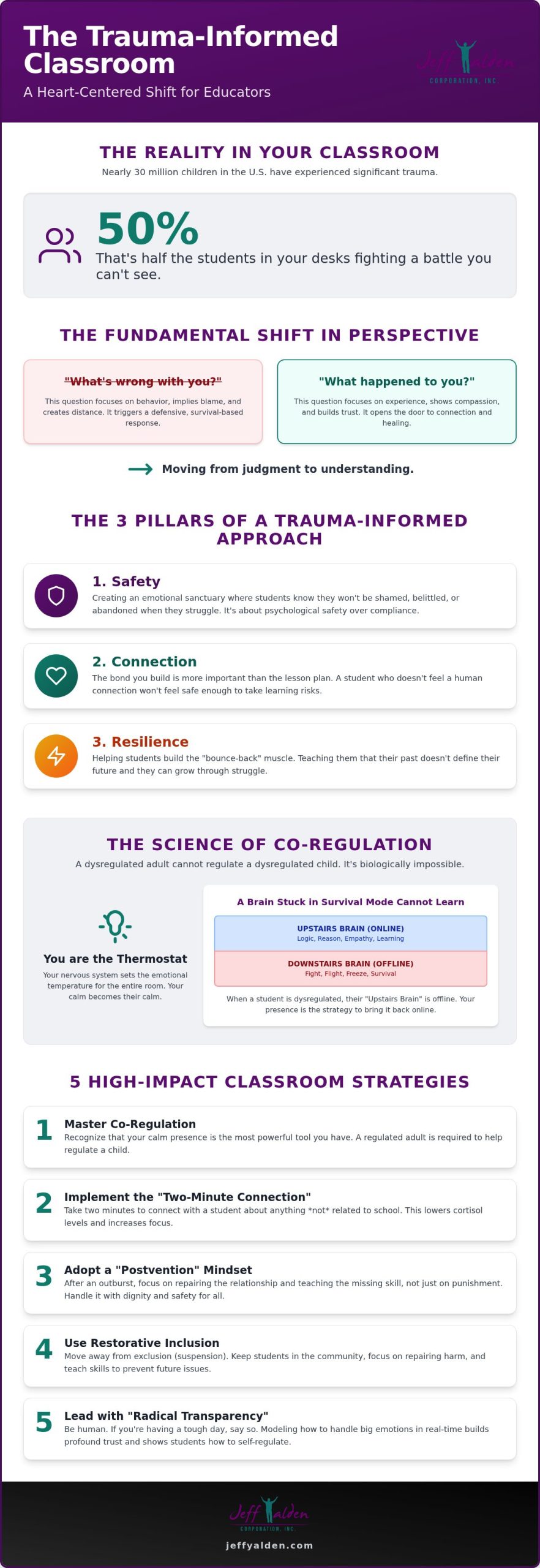
Nearly 30 million children in the United States have experienced significant childhood trauma, which means half the kids sitting in your desks right now are fighting a battle you can’t see. You feel it every single day. You walked into this profession to change lives, but lately, you feel more like a policeman than a teacher. It’s exhausting to manage explosive outbursts while your own heart is racing. I’ve been in those trenches. I know the weight of secondary traumatic stress. Implementing effective trauma-informed classroom strategies isn’t about checking boxes on a clinical form. It’s about radical resilience and shifting the lens from “what’s wrong with you” to “what happened to you.”
I agree that the constant cycle of conflict and burnout is unsustainable for any educator. You deserve to regain the joy of teaching. I promise to show you how to transform your room into a sanctuary of resilience using high-impact techniques that prioritize human connection over clinical checklists. We will dive into actionable de-escalation moves, the science of co-regulation, and how to build an environment where everyone feels safe enough to actually learn.
Key Takeaways
- Shift your perspective from asking “What’s wrong with you?” to “What happened to you?” to build immediate, life-changing trust with your students.
- Master the science of co-regulation to understand why your own calm presence is the most powerful tool you have for a dysregulated child.
- Implement high-impact trauma-informed classroom strategies like the “Two-Minute Connection” to lower student cortisol levels and increase focus.
- Learn the “Postvention” mindset to handle explosive outbursts with dignity while ensuring the classroom remains a safe sanctuary for everyone.
- Move beyond clinical checklists and lead a radical transformation of your school culture through vulnerability and authentic human connection.
What Are Trauma-Informed Classroom Strategies in 2026?
The world has changed, and our students are carrying the weight of that change every time they walk through our doors. When we talk about What Are Trauma-Informed Classroom Strategies?, we aren’t talking about a new set of rules or a clinical checklist. We’re talking about a radical, heart-centered shift in perspective. It’s the move from asking “What is wrong with you?” to “What happened to you?” In 2026, implementing trauma-informed classroom strategies requires more than just empathy; it requires a high-energy commitment to the human being in front of you. Trauma-informed teaching is a proactive commitment to psychological safety where the educator prioritizes the student’s internal stability over their external compliance.
Stop trying to manage behavior and start supporting a nervous system. A student who is screaming or shutting down isn’t trying to give you a hard time. They’re having a hard time. Their brain is stuck in survival mode, and no amount of traditional discipline will fix a physiological state of fear. We need to be the calm in their storm. This isn’t about being “soft.” It’s about being effective. It’s about recognizing that a dysregulated brain cannot learn.
The Three Pillars of the Trauma-Informed Approach
- Safety: This goes beyond locked doors. It’s about creating an emotional sanctuary where students know they won’t be shamed, belittled, or abandoned when they struggle.
- Connection: The bond you build is more important than the lesson plan you wrote. If a student doesn’t feel a human connection to you, they won’t feel safe enough to take the risks that learning requires.
- Resilience: We don’t just want kids to survive. We want to help them build the “bounce-back” muscle. We teach them that their past doesn’t define their future and that they have the power to grow through the struggle.
Why Traditional Discipline Is Failing Our Kids
Traditional discipline often relies on “Compliance vs. Connection.” When we use zero-tolerance policies or exclusionary practices like suspension, we often backfire. For a child who has experienced trauma, the brain is rewired to see authority as a threat. When you move toward them with a stern voice or a punishment, their survival brain screams “danger.” They don’t see a teacher; they see a predator.
We have to move from exclusion to restorative inclusion. Every time we push a kid out of the room, we’re reinforcing the idea that they’re “too much” or “unlovable.” Restorative practices keep the student in the community. They focus on repairing the harm and teaching the skill that was missing. It’s harder work, but it’s the only work that actually heals the culture of your school.
The Science of Co-Regulation: Your Presence is the Strategy
You cannot teach a child who is stuck in their “Downstairs Brain.” Think of the brain like a house. The downstairs is the survival center. It’s the basement where fight, flight, and freeze live. When a student is dysregulated, their “Upstairs Brain”—the part responsible for logic, math, and empathy—is completely offline. You can’t reason with a fire. This is why your presence is the ultimate tool. In the world of trauma-informed classroom strategies, your ability to stay centered is more important than your curriculum. If you’re not regulated, they won’t be either.
I’ve seen it a thousand times in schools across the country. A teacher gets frustrated, their voice rises, and the student’s behavior explodes. Why? Because a dysregulated adult cannot regulate a dysregulated child. It’s biologically impossible. Your students have “Mirror Neurons” that are constantly scanning you. They’re asking a silent question: “Are you safe?” If you’re on edge, they stay on edge. Your calm becomes their calm. This is the heart of effective Strategies for Trauma-Informed Teaching.
Jeff Yalden often talks about “Radical Transparency” as a bridge to trust. If you’re having a tough morning, admit it. Say, “Hey guys, I’m feeling a bit overwhelmed today, so I’m going to take a deep breath before we start.” That vulnerability doesn’t make you weak. It makes you human. It shows them how to handle big emotions in real time. It builds a level of trust that no clinical checklist could ever reach.
The Educator’s Nervous System
Your nervous system is the thermostat for the entire room. If you are red-lining, the room will be chaotic. This is why Preventing teacher burnout with real wellness strategies isn’t just a luxury; it’s a professional requirement. When the heat rises, use grounding techniques. Feel your feet on the floor. Use a slow, four-count breath. Regulate yourself first so you can be the anchor your students need to survive the day.
Neuroplasticity and the Hope for Healing
The brain is plastic. It changes. Every safe, predictable interaction you have with a student is a brick in a new foundation for their future. We look for “Islands of Competence”—those small areas where a student feels successful—and we build on them. Research confirms that because of neuroplasticity, consistent co-regulation and supportive environments allow the brain to form new neural pathways that can mitigate the toxic stress associated with the 63.9% of U.S. adults who report at least one Adverse Childhood Experience (ACE). If you want to see this culture shift happen for your staff, booking a Teen Mental Health Speaker can help ignite that spark of resilience.
5 Radical Trauma-Informed Strategies for Your Classroom
Strategies are not just tools. They are life rafts for the kids who feel like they are drowning. If we want to move the needle on student mental health, we have to move beyond theory and get into the practical, gritty work of the day-to-day. These trauma-informed classroom strategies are designed to lower the temperature in your room and create a space where resilience can actually grow. It starts with your willingness to be a “vulnerable authority” who prioritizes the human being over the grade book.
Predictability is medicine. When a student knows exactly what comes next, their cortisol levels drop. Their brain can finally focus on the lesson instead of scanning for threats. We also have to use the “Two-Minute Connection.” This is high-impact relationship building that doesn’t cost you a second of instructional time. Spend two minutes for ten days in a row talking to your most “difficult” student about anything except school. Watch how that connection transforms their behavior.
Strategy 1: The Predictable Environment
Anxiety thrives in the unknown. Use visual schedules and “no-surprise” transitions to give your students a sense of control. I love the “Soft Landing” start. Greet every student at the door by name. It sets the day’s trajectory before they even sit down. Also, create a physical “Calm Down Corner.” This isn’t a place for time-outs or punishments. It’s a sanctuary where a student can go to self-regulate before they hit a breaking point. It’s about teaching them to listen to their own nervous system.
Strategy 2: Empathetic Discipline
Stop seeing “attention-seeking” behavior. Start seeing “connection-seeking” behavior. When a student acts out, they’re often trying to tell you they don’t feel safe or seen. Use “I notice” statements instead of “You” accusations. Instead of saying “You’re being disruptive,” try “I notice you’re having a hard time staying in your seat; how can I help?” This shifts the energy from conflict to support. You are Building resilience in teens through radical truth by showing them that their struggle doesn’t make them “bad.”
Strategy 3: Collaborative Problem Solving
Invite the student to be part of the solution. When things are calm, sit down and talk about the “lagging skill” rather than the “bad behavior.” Maybe they don’t know how to ask for help when they’re frustrated. Work together to find a solution that works for both of you. This builds self-efficacy through small, achievable wins. Give them “Choice and Voice.” When kids who have felt powerless finally get a say in their environment, they stop fighting you and start joining you. “Change the channel” on de-escalation by avoiding the power struggle trap entirely. If the student wants to argue, don’t pick up the other end of the rope.
Handling the Crisis: When Strategies Aren’t Enough
Let’s be real. You can implement every proactive tool in the book, but crises will still happen. A student hits a boiling point, the room goes silent, and suddenly you’re in the middle of a storm. This is where your commitment to trauma-informed classroom strategies is truly tested. It’s not just about what you do to prevent the outburst. It’s about how you maintain dignity and safety when the environment feels like it’s falling apart. We have to normalize the conversation around mental health so that a “meltdown” isn’t seen as a character flaw, but as a nervous system reaching its limit.
I focus heavily on the “Postvention” mindset. Most people think the work ends when the student leaves the room or calms down. They’re wrong. What happens after the outburst is just as vital as the intervention itself. Postvention is the critical period of healing following a traumatic event. If we don’t handle this period with care, we risk permanent damage to the student’s sense of belonging. For schools facing the heaviest challenges, following established Youth suicide prevention programs and postvention guidelines is the difference between a community that heals and one that stays stuck in trauma.
De-escalation in the Heat of the Moment
When a student is red-lining, your goal is to be the anchor. Lower your voice. Slow your speech. Respect their personal space. Every aggressive move you make is fuel for their survival brain. I use the “Wait Time” strategy. Once you’ve given a directive or offered a choice, back off. Give their brain time to move out of fight-or-flight. It can take minutes for a triggered brain to process logic. We also have to get better at identifying “Triggers” before they become “Tantrums.” A tantrum is a performance for an audience; a trigger is a physiological survival response. Know the difference so you don’t punish a child for a biological reaction they can’t yet control.
The Power of the Re-Entry Process
The hardest part for many educators is the re-entry. How do you welcome a student back after they’ve disrupted your entire lesson? You do it without shame. If they walk back in and feel the weight of your judgment, the cycle will just repeat. The “Repairing the Relationship” conversation should happen when everyone is calm. Start with, “I’m glad you’re back. I missed having you here.” This isn’t about letting them off the hook for their behavior. It’s about confirming that they are still a valued part of the community. If your staff is struggling to find this balance, bringing in a Mental Health Speaker can provide the perspective shift needed to handle these crises with radical empathy.
Transforming Your School Culture with Jeff Yalden
One-off strategies fail. They just do. You can have the best list of trauma-informed classroom strategies in the world, but if they aren’t backed by a culture of radical transparency, they’re just words on a page. To truly change lives, we have to move from being “trauma-informed” to being “trauma-responsive.” That’s a collective mission. It requires every adult in the building to step up as a “vulnerable authority.” This means leading by example. It means being honest about our own struggles so our students feel safe being honest about theirs. When the culture shifts, the strategies actually stick.
Jeff Yalden has spent over 30 years in the trenches with schools during their darkest hours. He knows that a single speech doesn’t fix a school. A deep, systemic culture shift does. His approach isn’t about clinical checklists or detached theory. It’s about heart. It’s about visceral connection. When Jeff walks onto a campus as a High School Speaker, he bridges the gap between the front office and the back row. He makes the invisible visible. He gives students and staff the language they need to talk about the heavy stuff without fear or shame.
Professional Development for the Modern Educator
Modern education is a pressure cooker. We can’t talk about student mental health without talking about teacher wellness. Jeff’s Teacher Professional Development workshops focus on the “real” talk. We normalize the stress. We address the burnout. We give you the permission to be human again. These sessions aren’t just lectures. They are high-impact experiences that provide the emotional fuel you need to keep going. High school assemblies that transform campus culture start with a staff that feels supported, seen, and empowered to lead with empathy.
Booking Jeff for Your Campus
Bringing a Youth Motivational Speaker to your campus is about more than just a 45-minute program. It’s about igniting a movement of resilience. Jeff’s High School Assemblies are high-energy, raw, and deeply resonant. They don’t just talk at students. They speak to them. Whether you need a Teen Mental Health Speaker for a scheduled event or a specialist for crisis intervention and suicide prevention, Jeff customizes every program to meet your district’s specific needs. The impact on student morale is immediate. You’ll see the walls come down. You’ll see students start to reach out for help. This is how we save lives. Start the conversation for your school district today and let’s build a sanctuary of resilience together.
Lead the Change Your Students Need
You’ve seen the science. You know that your presence is the most powerful tool in the room. By shifting your perspective and prioritizing co-regulation, you aren’t just managing behavior; you’re healing nervous systems. Implementing these trauma-informed classroom strategies is a marathon, not a sprint. It’s about being a “vulnerable authority” who chooses connection over compliance every single day. You have the heart for this work, and now you have the plan to make it real.
Jeff Yalden has 30 years of experience in high school mental health and has been a transformational speaker for over 4,000 schools. As an expert in teen suicide prevention and crisis postvention, he’s ready to help your staff move from informed to responsive. Book Jeff Yalden for your next Teacher Professional Development or School Assembly to bring this radical shift to your campus. You have the power to change the trajectory of a student’s life. Keep showing up. Keep being the anchor. Your students need you, and you’ve got this.
Frequently Asked Questions
What is the most effective trauma-informed strategy for high school students?
Authentic human connection is the most effective tool for high school students because they are hardwired for autonomy. When you treat them with radical transparency and give them a voice in the classroom, you dismantle the power struggles that usually lead to conflict. High schoolers don’t want a clinical checklist; they want an adult who is real and respects their lived experience. This level of trust allows them to move from survival mode into high-level learning.
How do trauma-informed strategies differ from traditional classroom management?
Traditional management focuses on external compliance through rewards and punishments, while trauma-informed classroom strategies focus on internal regulation and the nervous system. Instead of asking why a student is breaking a rule, we look at what is driving that behavior. We move away from exclusionary discipline that shames kids and toward restorative practices that keep them in the community. It is the difference between controlling a student and connecting with them so they can thrive.
Can trauma-informed practices be used with students who haven’t experienced trauma?
These practices are essential for some but beneficial for everyone. Even students who haven’t faced significant Adverse Childhood Experiences (ACEs) benefit from a predictable environment, clear boundaries, and empathetic adult presence. Creating a classroom that prioritizes psychological safety reduces overall stress for the entire group. It builds a culture of emotional intelligence and resilience that helps every student navigate the normal pressures of high school life without feeling overwhelmed or unseen.
How can teachers prevent secondary traumatic stress while supporting students?
You have to prioritize your own nervous system to avoid burning out. Secondary traumatic stress is real, and it hits hard when you’re in the trenches with hurting kids. Practice radical self-care by setting firm emotional boundaries and using grounding techniques like box breathing during the school day. Seek out high-impact Teacher Professional Development that focuses on educator wellness. You cannot pour from an empty cup, and your students need you to stay healthy and resilient.
What should a teacher do immediately after a student has a traumatic outburst?
Prioritize dignity and safety above all else. Once the immediate danger has passed, give the student and the rest of the class significant “wait time” to let their cortisol levels drop. Don’t rush into a lecture or a punishment while their brain is still in fight-or-flight mode. Your goal is to be the anchor. Check in on the other students to restore the room’s sense of sanctuary before moving into the postvention and relationship-repair phase.
How do I explain trauma-informed discipline to parents who want ‘stricter’ rules?
Explain that being trauma-informed isn’t about being “soft;” it’s about being effective. Traditional “strict” rules often backfire with kids who have experienced trauma, leading to more outbursts and less learning. Show them the brain science. When a student feels safe, they can follow rules and learn. When they feel threatened, they can’t. We aren’t lowering the bar; we are building the bridge that allows the student to actually reach that bar successfully.
Is there a specific training required to implement trauma-informed strategies?
While you don’t always need a specific certification, high-impact training is vital for success. The “Supporting Trauma Informed Instructional Practices Act” of 2026 has pushed for more grants and support for this training. You can find specialized Teacher Professional Development workshops that help you implement trauma-informed classroom strategies. Learning from experts who have lived-experience helps you bridge the gap between theory and the visceral reality of your daily classroom life.
How long does it take to see results from trauma-informed teaching?
You will see an immediate shift in the room’s energy, but changing deep-seated behavioral patterns takes time and consistency. Trust isn’t built in a day. You might notice subtle wins within a few weeks, like a student using a “Calm Down Corner” instead of exploding. Stick with the process. Real transformation happens through the hundreds of small, safe interactions you have over a semester. Consistency is the key that unlocks long-term resilience and student growth.
