
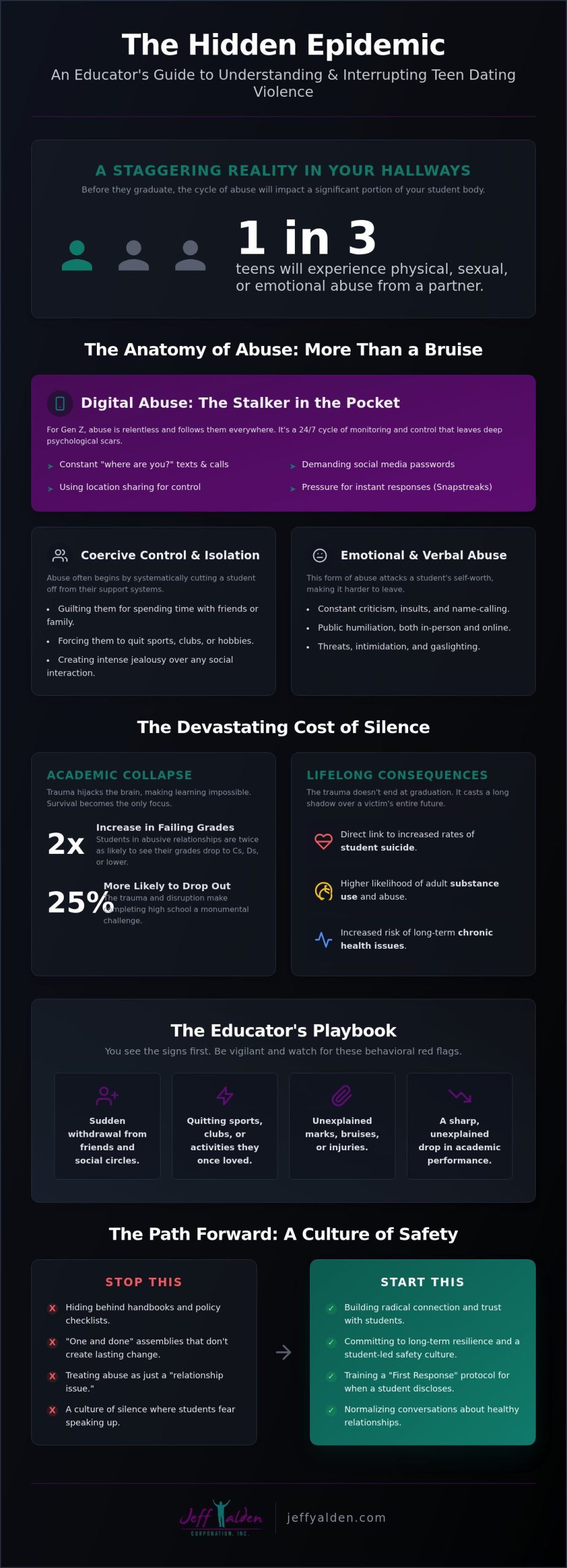
What if the greatest threat to your students isn’t coming from outside the building, but from the person sitting right next to them in the cafeteria? We know the heavy truth. One in three teens will experience physical, sexual, or emotional abuse from a partner before they graduate. That is a staggering weight for any educator to carry. When we talk about addressing teen dating violence in schools, we often hide behind dry policies and mandatory reporting checklists. But your students aren’t looking for a handbook. They’re looking for a lifeline. They’re hiding their pain behind digital screens, waiting for someone to notice the cracks in their relationships.
I know you’re tired of the clinical approach that feels more like a liability shield than a real solution. You want a campus where students feel safe enough to be honest. This article is your guide to moving beyond policy toward a culture of radical transparency that identifies, interrupts, and prevents abuse. We’ll look at how to break the silence of digital screens, empower every student to be an active bystander, and replace relationship trauma with a foundation of genuine respect. It’s time to stop just managing risks and start changing lives.
Key Takeaways
- Recognize that dating violence is often invisible, rooted in coercive control and digital harassment that happens right in your hallways.
- Stop hiding behind the handbook. Addressing teen dating violence in schools requires radical connection and a culture where students don’t feel afraid to speak up.
- Identify the specific isolation tactics abusers use to pull students away from their friends, sports, and support systems.
- Master a “First Response” protocol that prioritizes student safety and emotional support when a disclosure finally breaks the silence.
- Move past the “one and done” assembly mindset. True transformation happens when you commit to long-term resilience and a student-led culture of safety.
The Hidden Epidemic: Understanding Teen Dating Violence in 2026
Let’s get real. We walk through these halls every day, seeing the smiles and the hoodies, but we’re missing the war going on right under our noses. Teen Dating Violence (TDV) isn’t just about a physical altercation in the parking lot. It is a calculated, suffocating pattern of coercive control. It’s the “where are you?” texts at 2 AM. It’s the demand for social media passwords. For a comprehensive overview of teen dating violence, we see that it manifests as a relentless blend of physical, emotional, and digital warfare. One in three of your students will be trapped in this cycle before they ever toss their caps at graduation. This isn’t just a “relationship issue.” It’s a life-and-death crisis. There is a devastating, direct link between dating abuse and the skyrocketing student suicide rates we’re seeing. You, the educator, are the frontline. You aren’t just a teacher; you’re the ultimate bystander with the power to interrupt the cycle. We have to get loud about addressing teen dating violence in schools before another student slips through the cracks.
The Academic and Life-Long Cost of Silence
When a student is drowning in fear, Shakespeare doesn’t matter. The trauma of abuse hijacks the brain. We see a 2x increase in failing grades, specifically students dropping to Cs or Ds, because their focus is entirely on survival, not algebra. It doesn’t stop at the report card. Victims are 25% more likely to drop out of school entirely. This trauma follows them long after they leave your campus. There’s a direct correlation between teen abuse and adult substance use and chronic health issues. Addressing teen dating violence in schools isn’t just about safety today. It’s about protecting their entire future. If we don’t intervene now, we’re essentially watching them walk toward a cliff.
Normalizing the Conversation in the Hallways
Don’t think for a second that your district is immune. I’ve been in the most affluent schools in the country where the “perfect” couples are actually the most toxic. We have to move past the “it doesn’t happen here” mentality. It happens everywhere. You’ve got to spot that subtle shift where “young love” turns into “toxic control.” Is a student suddenly quitting the team? Are they withdrawing from friends to spend every second with one person? That’s not romance. That’s isolation. Bringing in a teen mental health speaker can be the spark that finally breaks that silence. It gives students the language to name their pain and the courage to walk toward help. We have to make these conversations as normal as talking about the weather. It’s time to stop being polite and start being protective.
The Anatomy of Abuse: Red Flags and Digital Stalking
Abuse doesn’t usually start with a physical strike. It starts with a comment. A look. A demand for a password. We have to understand the anatomy of this poison if we want to stop it. According to the latest CDC statistics, millions of teens are navigating these dangerous waters every year. But what the data doesn’t show is the “why.” Hurt kids hurt kids. I’ve seen this for 30 years in the hallways. When a student feels powerless in their own life, they often grab for power in their relationships. This isn’t an excuse for violence; it’s the root of the “vulnerable authority” perspective we must adopt when addressing teen dating violence in schools. We have to look at the brokenness on both sides to truly heal the culture. If we only focus on the punch, we’ve already lost the fight.
Digital Abuse: The Stalker in the Pocket
For Gen Z, the phone isn’t a tool; it’s an appendage. This makes digital abuse uniquely devastating. It’s the “stalker in the pocket.” Location sharing, once a safety feature, is now a tool for coercive control. I’ve talked to students who feel a physical weight of anxiety if they don’t respond to a “Snapstreak” or a text within seconds. The pressure to be “on” and monitored 24/7 is a form of electronic harassment that leaves no physical marks but creates deep psychological scars. For these kids, being blocked or shamed online is often more traumatic than a physical incident because their entire social world is digital. They are living in a fishbowl of monitoring that never sleeps. It’s a relentless cycle that requires us to be more than just educators; we have to be guides who understand their digital reality.
Behavioral Warning Signs for Educators
You see the signs before the students even realize they’re in trouble. We have to be vigilant in addressing teen dating violence in schools by watching for the subtle shifts. It’s the star athlete who suddenly quits the team. It’s the student who starts wearing long sleeves in 90-degree weather or changes their entire clothing style to “hide.” Watch their relationship with their phone. Are they checking it excessively during class? Do they look visibly panicked when a notification pops up? These aren’t just “distractions.” They are survival mechanisms. We also see frequent trips to the school nurse for somatic complaints like stomachaches or headaches that have no medical cause. These are the body’s way of screaming what the voice can’t say. If you’re seeing these cracks, it might be time to bring in a High School Speaker who can bridge the gap between “authority” and “connection.”
Policy vs. Culture: Why Your Handbook Isn’t Enough
Your handbook is a shield for the school, not a sword for the student. We love our policies. We love our “Code of Conduct.” But when a student is terrified, they aren’t thinking about Section 4, Paragraph B. They’re thinking about survival. If our strategy for addressing teen dating violence in schools starts and ends with a legal checklist, we’ve already failed. Students often fear the administrative fallout—the mandatory reporting, the parent calls, the police involvement—more than the abuse itself. They stay silent to protect themselves from our “help.” They don’t want a protocol; they want a person who actually gives a damn.
We need a radical shift in how we train our staff. This starts with a trauma-informed teaching professional development framework that teaches educators how to be humans first and reporters second. Yes, you have to follow the law. Yes, you have to stay compliant. But if you lead with a clipboard, you’ll never see the truth. We have to build a culture where transparency is the default, not a risk.
Moving Beyond Compliance to Connection
A clinical response is a conversation killer. When a kid finally finds the courage to open up and you immediately reach for a formal reporting form, you’ve closed the door. They need to see a “Vulnerable Authority”—someone who can sit in the mess with them without panicking. Effective teen dating violence prevention isn’t about being a detective; it’s about being a safe harbor. You can remain compliant with state laws while still offering a “Real Talk” space where radical transparency isn’t punished, but supported. This is how you bridge the gap between “reporting an incident” and “saving a life.”
The Role of Student Leadership
You can’t police your way into a safe campus. You have to lead your way there. The real change happens in the locker rooms and the group chats where teachers aren’t invited. We need to empower our student athletes and influencers to be “Culture Guardians.” These are the kids who have the social capital to call out toxic behavior when they see it. When we use high school assemblies to set a new standard of respect, we aren’t just giving a speech. We are deputizing the student body to protect one another. Addressing teen dating violence in schools becomes a shared mission, not just a staff directive. It’s about building a tribe that refuses to let its members be hunted.
The Educator’s Playbook: Responding to Dating Violence
When a student finally breaks the silence and trusts you with their pain, the clock stops. You are no longer just a teacher or an administrator; you are a first responder. Addressing teen dating violence in schools requires you to move fast, but with an intentionality that prioritizes the student’s heart over the school’s paperwork. This is the moment where your “vulnerable authority” matters most. They aren’t looking for a detective. They’re looking for a safe harbor. If we handle this moment with clinical detachment, we risk sending them right back into the arms of their abuser. We must integrate these responses into our broader teen suicide prevention programs because the trauma of a toxic relationship is often the silent engine driving self-harm and ideation.
Step 1: Validate and Listen Without Judgment
I believe you, and I am so proud of the courage it took for you to tell me this. This single sentence is the most powerful tool in your playbook. It anchors the student and signals that they are no longer alone in the dark. You must resist the urge to ask, “Why didn’t you tell me sooner?” That question is a poison that shifts the weight of the abuse onto the victim’s shoulders. Your presence is a radical act. Sometimes, the best thing you can do is sit in the silence with them, letting them breathe without the pressure of an immediate interrogation. You are building a bridge of trust that has likely been burned down by everyone else in their life.
Step 2: Safety Planning in the School Building
Once the heart is stabilized, we have to secure the environment. We need to identify the “hot spots” where the student feels most exposed, like stairwells, the back of the gym, or the parking lot after practice. Addressing teen dating violence in schools means being willing to disrupt the status quo for the sake of safety. This might look like adjusting locker assignments, changing a class schedule, or ensuring they have a “safe person” in every wing of the building they can go to at any time. We aren’t just managing a schedule; we are reclaiming their right to feel safe in their own school.
Interrupting the cycle also means dealing with the “perpetrator” with a mix of firm boundaries and radical empathy. Remember, hurt kids hurt kids. We must hold them accountable with ironclad consequences while acknowledging the brokenness that led to their behavior. Collaborate with your School Resource Officers (SROs) and counselors to ensure the response is protective, not just punitive. If you want to transform your staff into a team of confident, connected leaders, it is time to invest in Teacher Professional Development that actually addresses the raw reality of campus life. We have to be ready before the crisis hits, not just after.
Transforming Campus Culture: The Path Forward
Change isn’t a checkmark on a calendar. It’s a pulse. You can’t just host one “safe dating” assembly and think you’ve solved the problem. Addressing teen dating violence in schools is a daily, relentless commitment to radical connection. It requires a total shift from “managing behavior” to building a community that values every heart in the building. We have to move past the surface and dive into ongoing building resilience in teens initiatives. This means teaching them that their worth isn’t tied to a partner’s approval or a notification on a screen. We also have to get the parents involved. Many of our students are watching a “toxic normal” play out in their own living rooms. If we don’t engage the families and break those cycles at home, we’re only fighting half the battle. We’re playing for keeps here.
The Power of a Shared Narrative
A high-energy, raw assembly is the catalyst. It’s the moment the air in the room changes. Students don’t want to hear from a clinical expert in a suit. They want someone who has walked through the fire and come out on the other side. When they see lived experience, the walls come down. This shared narrative creates a common language for the entire campus. One student choosing self-respect over a toxic relationship has a massive ripple effect. It gives every other kid in that room the permission to do the same. Addressing teen dating violence in schools starts with a spark, but it’s sustained by the students themselves. They become the guardians of their own culture.
Investing in Teacher Wellness and PD
You can’t pour from an empty cup. We have to get real about teacher wellness. Our educators are exhausted. They’re carrying the weight of their students’ trauma on top of their own. The intersection of staff wellness and student safety is undeniable. A burnt-out teacher misses the red flags. A healthy, connected teacher saves lives. Booking a Teacher Professional Development day with me isn’t just about learning new strategies. It’s about a total culture reset. We’ll get honest about the struggles and find the path back to your purpose. When you are empowered, your students are protected. It’s time to bring this movement to your campus and start the healing process for real.
Reclaim Your Campus Culture Today
We’ve torn down the clinical walls and looked at the raw reality of your hallways. You know now that a handbook isn’t a shield and silence is a slow-motion tragedy. Addressing teen dating violence in schools requires you to be more than a reporter; it demands you be a person who actually cares. We’ve covered how to spot the digital red flags and how to lead with a “vulnerable authority” that wins back student trust. Now, the next step is yours. You have the tools to move from managing risk to saving lives.
I’ve spent over 30 years in the trenches of high school assemblies, specializing in suicide prevention and crisis postvention. I don’t do boring, and I don’t do fake. My radically transparent approach creates an immediate connection that students actually trust. Bring Jeff Yalden to your school to transform your campus culture. Together, we can create a movement of resilience that replaces relationship trauma with radical respect. You have the heart for this mission. I have the roadmap. Let’s go change the narrative for your students right now.
Frequently Asked Questions
What are the most common red flags of teen dating violence for teachers?
Watch for sudden withdrawal from friends, dropping out of sports, and visible anxiety when phone notifications go off. You might notice a student who used to be vibrant suddenly becoming a shadow, checking their phone every thirty seconds. Somatic complaints like frequent headaches or stomachaches often mask underlying trauma. Addressing teen dating violence in schools starts with noticing these behavioral shifts before they escalate into physical harm. Stay alert to the subtle changes.
How does teen dating violence impact a student’s mental health and suicide risk?
Teen dating violence is a major driver of depression, anxiety, and self-harm. When a student’s primary support system becomes their primary source of pain, they feel trapped and hopeless. This isolation is a direct catalyst for suicidal ideation. We have to treat relationship trauma as a critical mental health crisis. If we don’t address the abuse, our suicide prevention efforts are only treating the symptoms instead of the root cause.
Can schools be held liable for dating violence that happens off-campus but affects the school day?
Schools can be held liable if off-campus violence creates a hostile environment that interferes with a student’s right to an education. Under Title IX, if the school knows about the harassment and it impacts the student’s ability to learn on campus, you have a legal obligation to act. Don’t wait for a police report to start protective measures. Your responsibility is to ensure every student feels safe while they’re in your building.
What is the best way to introduce dating violence prevention into a high school assembly?
Lead with a raw, lived-experience narrative that cuts through the “safe dating” noise. Students tune out clinical lectures, but they lean in when they hear a real story about power, control, and resilience. Use high-energy assembly programs to normalize the conversation. When you speak their language and acknowledge their digital reality, you give them the courage to look at their own relationships through a much sharper, more honest lens.
How should a teacher respond if a student denies abuse but shows clear signs of being controlled?
Stay in the “vulnerable authority” role by offering a safe place without forcing a confession. Say, “I’m noticing some changes in you, and I want you to know I’m here if things ever feel heavy.” Don’t push for a disclosure they aren’t ready to make. Your goal is to plant a seed of trust so that when the crisis peaks, you are the person they feel safe running toward.
Are boys also victims of teen dating violence, and how do we support them?
Yes, boys are victims of teen dating violence, but they often stay silent due to social pressure to be “tough.” Support them by breaking the stigma that abuse only happens to girls. We need to create spaces where boys can talk about emotional manipulation and coercive control without feeling weak. Addressing teen dating violence in schools means protecting every student, regardless of gender, from the poison of a toxic partner.
What role does social media play in modern teen stalking and harassment?
Social media is the primary tool for 24/7 electronic monitoring and psychological warfare. Abusers use location sharing, “Snapstreak” pressure, and constant digital checking to maintain total control. This digital stalking makes the abuse inescapable, following the victim into their bedroom at night. We have to teach students that “checking in” isn’t love; it’s a digital leash designed to strip away their independence and their peace of mind.
How can we involve parents in our school’s dating violence prevention efforts?
Host “Real Talk” workshops that educate parents on the digital red flags they might be missing at home. Many parents mistake controlling behavior for “intense young love” because they don’t understand the digital nuances of modern stalking. We need to bridge the gap between school and home by giving parents the language to talk about healthy boundaries. When we are all on the same page, the abuser has nowhere left to hide.
