
You cannot fix a broken home with a textbook, and pretending the trauma isn’t in the room only makes the classroom walls feel thicker. It is heartbreaking to watch a bright student’s grades tank while their behavior spirals, especially when you are terrified that saying the wrong thing will make everything worse. I know that feeling of helplessness. I know the weight of carrying their crises home with you until you are bone-tired and burnt out. You are not just a teacher; you are on the front lines of a mental health battle you never signed up for. But here is the truth: supporting students with family problems does not require a clinical degree. It requires radical transparency and a willingness to be a “real” human in a space that often feels too rigid.
We are going to bridge the gap between classroom learning and the heavy reality of home-life trauma. I will show you how to use resilience-building strategies that turn your classroom into a sanctuary without sacrificing your own well-being. This guide provides a clear framework for building a more resilient school culture where engagement thrives despite the chaos at home. We are moving from feeling helpless to becoming the steady, grounded advocates our students desperately need right now. Let’s get to work.
Key Takeaways
- Unpack the “invisible backpack” students carry every day. Understand why family instability has become the biggest predictor of student disengagement in 2026.
- Spot the silent warning signs that often hide in plain sight. Learn why perfect grades or high energy can be a mask for a student’s crumbling home life.
- Master the art of supporting students with family problems by ditching clinical distance. Use radical transparency and your own story to build a bridge of shared humanity.
- Turn your classroom into a predictable sanctuary through routines that calm chaotic minds. Implement “soft landings” for students who arrive at school after a high-stress morning.
- Move beyond one-off assemblies to create a lasting culture of care. Learn why teacher professional development is the key to responding to trauma without hitting burnout.
The Invisible Backpack: Understanding the Weight of Family Problems
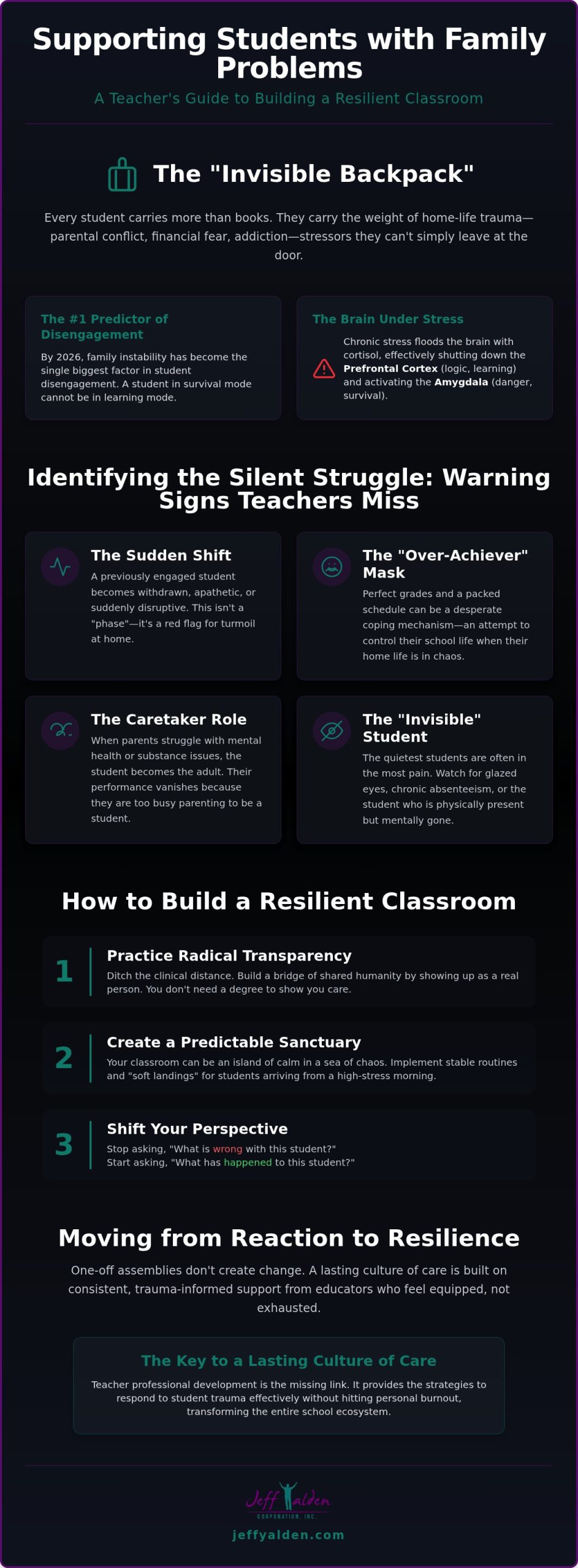
Every morning, your students walk through the door carrying more than just ChromeBooks and notebooks. They are lugging around an “Invisible Backpack.” Inside isn’t homework. It’s the sound of parents screaming at 2 AM. It’s the crushing weight of a sibling’s addiction. It’s the cold fear of an eviction notice taped to the front door. By 2026, family instability has officially become the number one predictor of student disengagement. You see it in the glazed eyes and the sudden outbursts. You see it when a top student suddenly stops turning in work. Supporting students with family problems starts with acknowledging that this weight is real. It’s heavy. And they can’t just “leave it at the door.”
When a student is in the middle of home turmoil, their brain isn’t wired for algebra. The science is brutal. Chronic stress floods the system with cortisol. This effectively shuts down the prefrontal cortex, the part of the brain responsible for logic, reasoning, and learning. They aren’t being “difficult” or “lazy.” They are literally in survival mode. Their amygdala is screaming “danger” while you are trying to teach Shakespeare. We have to stop asking, “What is wrong with this kid?” and start asking, “What happened to this kid?” This shift in perspective is the foundation of School-Based Family Counseling and trauma-informed education. It’s about seeing the human behind the behavior.
Common Family Stressors Impacting 2026 Students
The pressures on families today are different than they were a decade ago. Financial instability isn’t just about poverty; it’s about the “new” economic anxiety of 2026 where even middle-class homes feel the squeeze. We also see a beautiful rise in non-traditional family structures, but these students often face a lack of radical inclusivity in school systems that still operate on 1990s models. Then there is the silent killer: parental mental health and substance issues. When the adults at home are struggling, the student becomes the caretaker. Their performance doesn’t just slip. It vanishes. They are too busy being the “parent” to be the student.
The Long-Term Cost of Unaddressed Home Trauma
If we don’t catch these issues early, the price is devastating. There is a direct, undeniable link between early family problems and chronic absenteeism in high school. These kids don’t just “get over it.” Home-life stress is the fuel for the current teen mental health crisis. Adverse Childhood Experiences (ACEs) are traumatic events occurring before age 18 that, in 2026, remain the strongest indicators of a student’s lifelong struggle with health and opportunity. Supporting students with family problems is a long game. It’s about saving a future, not just a grade. It’s about showing them that their home life doesn’t have to be their whole life.
Identifying the Silent Struggle: Warning Signs Teachers Often Miss
Trauma is a master of disguise. Sometimes it looks like a kid who won’t stop talking, and other times it looks like a kid who has disappeared while sitting right in front of you. When you are supporting students with family problems, you have to look past the surface. We often wait for the “big” explosion to intervene, but the quietest students are often the ones in the most pain. Watch for the sudden shift. That student who used to be the class clown but is now withdrawing into a hoodie? That’s not just a phase. That’s a red flag. Their world is shrinking because they are trying to protect themselves from the chaos at home.
Then there is the “Over-Achiever” mask. This one is dangerous because it looks like success. These students have perfect grades, are in every club, and never miss a day. But look closer. Are they driven by passion or by a desperate need for control? For many, school is the only place where they feel safe and capable. If their home life is a wreck, they might cling to academic perfection as a life raft. It’s a coping mechanism, not just a work ethic. We need to focus on building resilience in children by recognizing that high performance doesn’t always mean high well-being. Sometimes, a 4.0 GPA is a scream for help.
Your body keeps the score of what’s happening at home. Pay attention to the physical signs. Chronic fatigue, frequent headaches, or sudden changes in hygiene are loud signals. If a student is sleeping in class, don’t just wake them up and hand them a detention. Ask yourself why they didn’t sleep at home. Look for hyper-vigilance. If a slammed door or a dropped book makes a student jump out of their seat, that’s a startle response. Their nervous system is primed for an attack because that’s what they experience outside these walls. Mastering the art of supporting students with family problems means looking beyond the grade book to see the human being struggling to stay afloat.
Behavioral Red Flags vs. Typical Teen Angst
It’s easy to dismiss defiance as “typical teen angst.” But there is a line between normal rebellion and crisis-driven behavior. Normal angst is about testing boundaries; crisis is about survival. Look for “numbing” behaviors. Is a student suddenly obsessed with their phone to the point of total disconnection? Are they using substances to escape? These aren’t just bad habits. They are attempts to drown out the noise of family problems. Tracking these patterns helps you see the person, not just the problem. If you feel your staff needs better tools to spot these shifts, teacher professional development can provide the framework your team needs to act with confidence.
Social Indicators in the Digital Age
In 2026, a student’s social media is their heartbeat. A sudden change in their online presence, either a total blackout or a flood of dark, cryptic posts, is a massive indicator. When they start isolating from peer groups or lose interest in the sports and clubs they used to love, the alarm should go off. This isolation is a precursor to deeper issues. We have to be proactive because these signs often overlap with teen suicide warning signs. Don’t wait for them to ask for help. They might not know how. You are the one who sees them every day. You are the one who can bridge that gap.
Radical Transparency: The Key to Supporting Students with Family Problems
Forget the “clinical distance” they taught you in college. It’s a wall. It’s a safety net for your ego, but it’s a cage for a kid who is already feeling isolated at home. When you are supporting students with family problems, they don’t need a robot in a blazer. They need a human being who isn’t afraid to be real. This is where radical transparency changes the game. I call it being a “Vulnerable Authority.” It’s about leading by example. It’s about sharing your own imperfections so they feel safe sharing theirs. You don’t have to be perfect to be a pillar. In fact, your imperfections are exactly what make you approachable.
We have to shift from the “Check-Up” to the “Check-In.” A check-up is about compliance; it’s about grades, deadlines, and behavior. A check-in is about the heart. It’s asking, “How are you doing today, really?” and actually waiting for the answer. It’s prioritizing the human over the student. When a kid knows you care more about their soul than their test score, they will move mountains for you. That trust isn’t built in one big speech. It’s built in a thousand small, consistent moments of presence.
The Art of the Vulnerable Conversation
Opening up doesn’t mean oversharing. You don’t need to tell them your life story to build a bridge. You just need to validate their “real and raw” experience. Use the “I see you” method. It can be a quiet word after class or a simple “I’m glad you showed up today.” These small gestures create massive psychological safety. When you listen, don’t listen to fix. Listen to validate. Let them feel the weight of their own story without you trying to rush them to a happy ending.
Establishing Boundaries That Actually Support
You are a mentor, not a parent. That is a critical distinction. Supporting students with family problems means finding that sweet spot where you are a steady anchor without getting pulled under the waves yourself. You have to know when to hand off. If a crisis exceeds your training, you must involve a professional Youth Life Coach or school counselor. You cannot pour from an empty cup. Maintaining your own mental health isn’t selfish; it’s a prerequisite for being the advocate your students need.
Practical Classroom Strategies for Resilience and Stability
If a student’s home life is a storm, your classroom must be the lighthouse. We talk about supporting students with family problems like it’s a theoretical concept, but it happens in the trenches of the first five minutes of class. You create a “Predictable Sanctuary” by making your routine bulletproof. When everything else in their world is shifting, they need to know exactly what happens when they sit down in your room. Consistency isn’t about being a drill sergeant. It’s about providing a psychological floor that won’t give way. When they know what to expect from you, their nervous system can finally stop scanning for threats.
Implement “Soft Landings” for the kids who walk in late or look like they’ve already lived a full day before 8:00 AM. Some students come to school after a morning of screaming matches, police visits, or skipped meals. They are vibrating with stress. Instead of jumping straight into a high-stakes quiz, give them five minutes of low-stakes transition. Let them breathe. This isn’t “wasting time.” It’s regulating a brain so learning can actually happen. We also need to reframe our view on deadlines. Flexible “Grace Periods” aren’t about being soft; they are about equity. A kid who spent all night at the hospital with a parent doesn’t have the same “working hours” as their peers. When we teach building resilience in teens, we are teaching them how to navigate life’s hits without losing their future.
Trauma-Informed Classroom Management
When a student is triggered, de-escalation is your only goal. Forget “winning” the argument. If a student is acting out because of family stress, they are likely in a shame spiral. You don’t help a drowning person by yelling at them for getting wet. Creating a designated “Safe Zone” in the corner of your room allows them to self-regulate without the audience of their peers. This radical shift in discipline is at the heart of trauma-informed teaching professional development. It’s about responding to the pain, not just the behavior.
Empowering Students Through Agency
Trauma steals power. To fight back, you have to give it back. Offer choices in how they demonstrate mastery. Let them pick between a written essay or a recorded presentation. This agency counteracts the total powerlessness they feel at home. We want to move them toward “victor” thinking through clear, bite-sized goal-setting. Academic Life Coaching provides a roadmap for success by helping students see that their current circumstances don’t define their ultimate destination. If you want to transform your school’s approach to these crises, bring in a Teen Mental Health Speaker who has lived it and can show your staff how to lead with heart.
Transforming School Culture: Why Professional Development is the Missing Link
A one-day event is a spark. But a spark without fuel just flickers and dies. If you want to move the needle on supporting students with family problems, you have to move beyond the “one and done” mentality. We see it all the time. A school brings in a speaker, the energy is high for forty-eight hours, and then everyone slides back into the old, clinical routines. That doesn’t cut it in 2026. Real transformation requires a sustained culture of care that lives in the hallways, the cafeteria, and the front office. It’s about changing the very DNA of how your campus breathes.
This is where high school assemblies play a massive role. They aren’t just a break from class; they are a campus-wide permission slip to be human. They normalize the heavy conversations and break the silence that family trauma thrives on. When you bring the whole school together to hear a message of radical transparency, you aren’t just talking to the kids. You are signaling to the entire community that this is a safe place to struggle. But for that safety to last, your staff needs the tools to handle what comes next when the assembly ends and the real work begins.
Investing in Teacher Wellness and PD
You cannot pour from a cracked pitcher. Educators are facing secondary traumatic stress at record levels because they are carrying the weight of their students’ crises. If we don’t support the teachers, we can’t support the kids. The “Jeff Yalden Approach” to professional development isn’t about boring PowerPoints or academic theory. It is real, raw, and immediately actionable. We focus on creating a “Resilience-First” campus where staff members have their own support systems in place. When teachers are grounded and regulated, they become the steady anchors that students with family problems desperately need to find their way back to shore.
Taking the Next Step for Your Campus
Change starts with a unified message from leadership down to the classroom. When students see that the adults are on the same page, the “Invisible Backpack” starts to feel a little lighter. It begins with bringing in a teen mental health speaker who can bridge the gap between the administration and the student body. This isn’t just about inspiration; it’s about intervention. It’s about showing your students that you see them, you hear them, and you are willing to do the work alongside them. Don’t wait for the next crisis to act. Book Jeff Yalden for your next assembly or PD workshop and start building the resilient culture your students deserve.
Be the Anchor Your Students Desperately Need
You have the power to change the narrative right now. We have explored the “Invisible Backpack” and the silent warning signs that hide in plain sight. We have looked at how radical transparency and soft landings can turn a chaotic classroom into a predictable sanctuary. But supporting students with family problems isn’t just a set of techniques; it’s a commitment to being a “vulnerable authority” who leads with heart. It’s about showing up as a real human being every single day. Your students don’t need you to be a therapist. They need you to be the one adult who sees them, hears them, and refuses to give up on them.
This work is heavy, and you don’t have to carry it alone. With over 30 years of high-impact motivational speaking, I’ve spent my life in the trenches of crisis intervention and postvention. I use radical transparency to create an immediate connection with Gen Z and Gen Alpha that the clinical world just can’t reach. If you are ready to move from survival mode to cultural transformation, let’s make it happen. Bring Jeff Yalden to your school to transform your campus culture. You are doing the most important work on the planet. Keep fighting for these kids. They are worth it, and so are you.
Frequently Asked Questions
How can I support a student with family problems without overstepping my role as a teacher?
Focus on being a steady mentor rather than trying to be a surrogate parent or a clinical therapist. Your job is to provide a “Predictable Sanctuary” by offering consistent emotional support and academic flexibility while maintaining professional boundaries. When you stay in your lane as a vulnerable authority, you provide a safe space for them to breathe without taking on the burden of fixing their home life.
What are the most common signs of a student struggling with home-life issues?
Look for sudden personality shifts, like a class clown becoming silent or a top student suddenly missing deadlines. Physical signs include chronic exhaustion, headaches, or a noticeable drop in hygiene. Don’t ignore the “Over-Achiever” mask either. A student who is obsessively perfect might be using school as the only place they can control, hiding a crumbling world behind a high GPA.
How do family problems specifically affect a student’s academic performance?
Supporting students with family problems means understanding that a stressed brain cannot prioritize algebra. When home life is in turmoil, the prefrontal cortex essentially shuts down to focus on survival. This leads to poor memory, decreased focus, and an inability to process complex information. They aren’t lazy; they are literally cognitively overloaded by the trauma they carry in their invisible backpack.
What should I do if a student reveals a dangerous or abusive situation at home?
Follow your state’s mandatory reporting laws immediately and without exception. You are a reporter, not an investigator. While you should offer the student a soft landing and validate their courage for speaking up, you must hand the situation off to your administration and child protective services. Your role is to keep the student safe by ensuring the right professionals are involved the moment danger is disclosed.
How can I build resilience in students who come from dysfunctional families?
Empower them through agency by giving them choices in how they learn and show mastery. Resilience is built when a student moves from a “victim” to a “victor” mentality. Use goal-setting to help them see a future beyond their current circumstances. Showing them that their home life is a chapter, not the whole book, helps them develop the grit needed to bounce back from adversity.
Is it helpful to talk to a student’s parents about the problems I’m seeing in class?
Proceed with extreme caution because sometimes contacting a parent can escalate the trouble for the student at home. Always check with your school counselor or administration before making that call. If you do reach out, focus on the student’s behavior and performance in class rather than accusing the parents of causing the issues. Your priority is always the student’s safety and emotional well-being.
How can our school create a more trauma-informed environment for all students?
Start by normalizing mental health conversations through high school assembly programs that use radical transparency to break the stigma. Create a resilience-first culture where routines are predictable and staff are trained to look for what happened to a kid rather than what’s wrong with them. A trauma-informed environment is one where every adult on campus is an advocate for the student’s heart, not just their grades.
Why is professional development critical for teachers supporting students in crisis?
Supporting students with family problems is emotionally draining and can lead to secondary traumatic stress and total burnout. Professional development gives you the real and raw tools to handle these complex emotional landscapes without losing yourself in the process. It provides a shared framework for the entire staff, ensuring that the support for students is consistent, effective, and sustainable for the long haul.
