
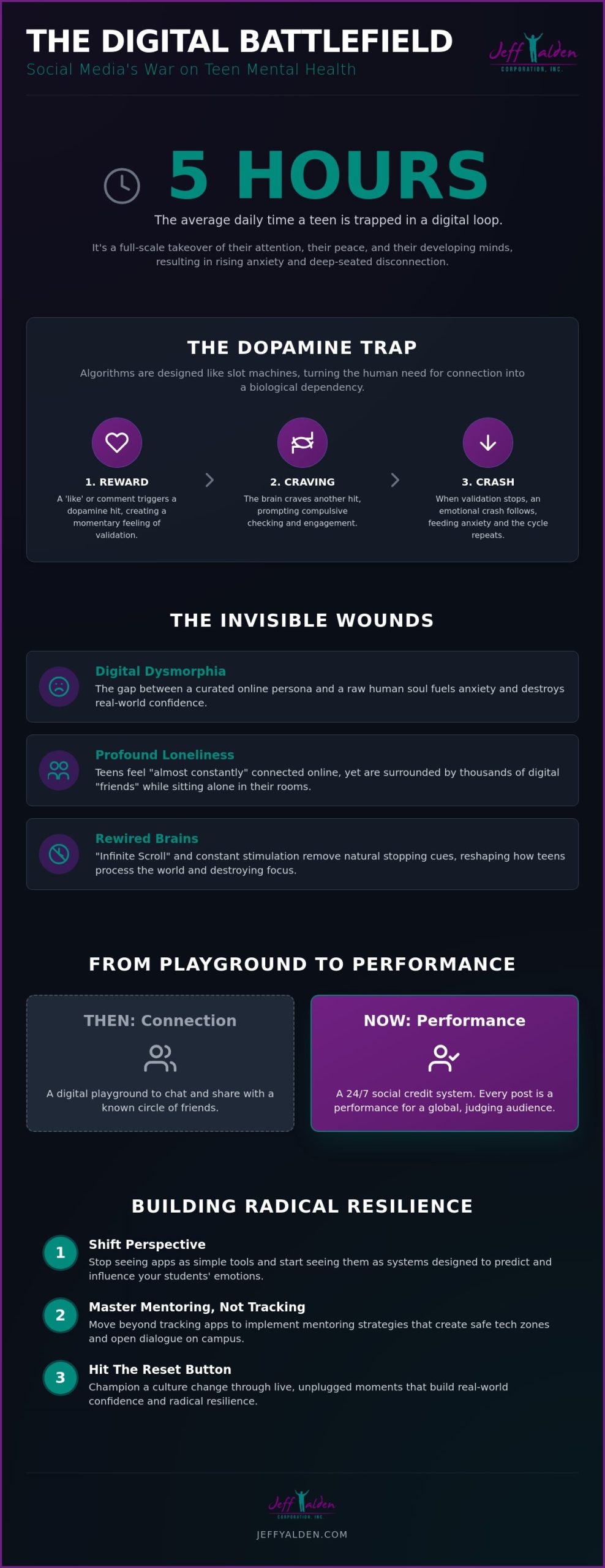
Five hours. That’s the average time a teenager spends trapped in a digital loop every single day. It isn’t just a habit; it’s a full-scale takeover of their attention and their peace. You see the results in your hallways and classrooms every morning. The rising anxiety, the deep-seated disconnection, and the constant hum of distraction aren’t just “teen phases” anymore. We have to face the radical truth about social media’s effect on teen mental health if we want to save this generation from drowning in their own feeds.
I know you’re tired of feeling like you’re losing the battle for their minds. You want to bridge that gap and understand why a screen has more pull than a real-life conversation. I promise to show you the raw reality of how these digital landscapes are wired and how we can fight back. We’re going to dive into the mechanics of the dopamine loop, explore the impact of 2026’s new COPPA regulations, and equip you with the tools to build a culture of radical resilience on your campus. It’s time to stop managing the symptoms and start leading the change.
Key Takeaways
- Stop viewing apps as simple tools and start seeing them as a 24/7 social credit system that predicts your students’ emotions.
- Break the cycle of the “Dopamine Trap” by understanding how algorithmic rewards hijack the developing teen brain.
- Uncover the raw reality of social media’s effect on teen mental health and the way digital dysmorphia destroys real-world confidence.
- Move beyond tracking apps to master mentoring strategies that create safe tech zones on your campus.
- Learn how to hit the reset button on school culture through live, unplugged moments that build radical resilience.
The 2026 Digital Battlefield: Defining Social Media’s Effect on Teen Mental Health
It is 2026. The smartphone in your student’s pocket is no longer just a tool for communication. It is a scoreboard. It is a 24/7 social credit system that never sleeps. Every like is a vote of worthiness. Every ignored post is a public rejection. When we talk about social media’s effect on teen mental health, we have to stop treating it like a hobby. This is a digital battlefield. We are seeing a reality where AI algorithms don’t just react to what a teen likes; they predict teen emotions before they even feel them. The algorithm knows the sadness is coming, so it serves up content to keep them anchored in that headspace.
This is why our kids feel “almost constantly” connected but are dying of loneliness. They are surrounded by thousands of digital “friends” while sitting alone in their rooms. The pressure to maintain the image is suffocating. Digital dysmorphia is the gap between an online persona and a raw human soul. That gap is where the anxiety grows. It’s where the depression takes root. We cannot ignore the intensity of this environment any longer. Understanding digital media’s impact on mental health requires us to look past the screen and into the heart of the struggle.
The Shift from Connection to Consumption
Social media used to be about chatting. It was a digital playground. Today, it has evolved into a stage where every teen is forced to be a performer. They aren’t just sharing their lives; they are performing for an audience that is always watching and always judging. The psychological weight of being “always on” is a burden no previous generation has had to carry. Traditional “internet safety” talks are failing because they focus on “stranger danger.” In 2026, the danger isn’t just a person; it’s an algorithm designed to exploit social media’s effect on teen mental health for profit. We have to change the conversation from “stay safe” to “stay human.”
Why Educators and Parents See Different Realities
There is a massive communication chasm between adults and students. The Pew 2025 data revealed a sharp divide. Parents see the screen as the enemy, while teens see it as their only lifeline to community. Both are right, but they are speaking different languages. We bridge this gap through radical transparency. We stop lecturing from a distance and start standing in the gap with them. Sometimes, bringing in a teen mental health speaker is the only way to break the silence. It takes a lived-experience guide to validate their pain and offer a path toward resilience. We need to create a space where the person is more important than the profile.
The Dopamine Trap: How Algorithms Hijack the Teen Brain
The algorithm isn’t your friend. It’s a slot machine. Every time a teen opens an app, they’re pulling the lever. They aren’t looking for news; they’re looking for a hit. This is the dopamine loop. It starts with a reward, like a heart or a comment. That hit feels good for a second. Then comes the craving. They check again. And again. When the likes stop, the crash hits. Hard. This cycle is at the heart of social media’s effect on teen mental health because it turns a human need for connection into a biological dependency.
Why is this so dangerous for teenagers? Their prefrontal cortex is still under construction. This is the part of the brain that handles impulse control and long-term consequences. It’s like putting a Ferrari engine in a car with bicycle brakes. The AI is designed to bypass those brakes. It uses the “Infinite Scroll” to remove every natural stopping cue in life. There is no “end” to the feed. No “bottom” of the page. The Surgeon General’s Advisory on Social Media warns that this constant stimulation is reshaping how our kids process the world. They can’t just “turn it off” because their brains are being rewired to stay on.
This struggle is often amplified for students with neurodivergent traits, where the pull of digital rewards meets a brain already wired for high stimulation. Understanding these clinical nuances is key, and professionals like Dr Nancy Allen provide essential insights into how ADHD and other factors influence a teenager’s ability to navigate the digital world.
The Science of the ‘Like’
A “like” isn’t just a pixel. It’s social validation. It triggers the same neural pathways as substance use. When that validation is withheld, it feels like physical pain. We call it “ghosting,” but for a fifteen-year-old, it’s digital rejection that feels like a trauma. A simple digital detox isn’t a silver bullet. You can’t fix a rewired brain with a weekend away from the phone. It takes deeper work. If you see a student struggling to break this loop, a teen life coach can help them find their worth outside of the screen.
Sleep Disruption and the Mental Health Spiral
Let’s talk about the midnight scroll. It isn’t just about blue light. It’s about “revenge bedtime procrastination.” Teens feel so out of control during the day that they steal back their time at night. They stay up until 2:00 AM chasing one last hit of dopamine. This leads to the massive sleep deprivation I see every time I lead high school assemblies. A tired brain is an anxious brain. social media’s effect on teen mental health is amplified when they haven’t slept. We need to implement digital sunsets that actually work. No phones in the bedroom. No exceptions. It’s about protecting their peace so they can show up for their lives the next day.
Comparison vs. Connection: The Identity Crisis of 2026
Comparison is the thief of joy. In 2026, it’s also the thief of identity. Our kids are constantly comparing their messy, raw reality to someone else’s curated highlight reel. It’s a losing game. This relentless pressure is a massive factor in social media’s effect on teen mental health. When a student sees a filtered version of “perfection” every three seconds, their own human soul feels like a failure. We have to start building resilience in teens by teaching them that the reel is a performance, not a life. It’s a lie designed for clout. It isn’t real.
Digital dysmorphia has taken this to a dangerous new level. AI-enhanced filters are now so seamless that teens don’t even know what a real human face looks like anymore. They are chasing a standard of beauty that doesn’t exist in the physical world. This creates a massive disconnect between who they are and who they think they should be. Even the concept of FOMO has evolved. It’s no longer just about missing a party on Friday night. It’s about missing a digital existence. If they aren’t posting, do they even exist? Yet, we have to acknowledge the nuance. The Pew Research Center report on teens and social media shows that many students still find a sense of “home” in niche online communities. They find their tribe. We can’t just burn the house down; we have to teach them how to live in it without getting burned.
The Erosion of Character Education
Digital anonymity is a poison for character. It’s easy to be cruel when you’re hiding behind an avatar. Cyberbullying and cancel culture have turned our campuses into minefields where one wrong post can end a reputation. But the deepest loss is “boring time.” Teens don’t reflect anymore. They only react. They’re so busy managing their digital clout that they’ve forgotten how to build their personal integrity. We are seeing a generation that is always connected but rarely present. They are losing the ability to sit with their own thoughts because they are too busy consuming everyone else’s.
The ‘Vulnerable Authority’ Approach
I believe in leading through radical transparency. I tell teens about my mistakes. I talk about my own struggles. Why? Because sharing our imperfections is the only antidote to digital perfection. We have to lead our students toward being a “victor” instead of a victim of the feed. It starts with curation. I tell them to curate their feed with the same intensity they curate their friends. If an account doesn’t make you better, unfollow it. If a community doesn’t lift you up, leave it. We’re teaching them to reclaim their power from the algorithm. We’re teaching them to be real in a world that’s increasingly fake.
Building Digital Resilience: Actionable Strategies for Schools
Monitoring apps are a band-aid on a bullet wound. They don’t build character; they build resentment and better ways to hide. If we want to combat social media’s effect on teen mental health, we have to move from monitoring to mentoring. Character is built in the gaps between the screens. It is built through radical transparency and trust. Schools that succeed in 2026 are the ones creating “Safe Tech” zones. These are physical spaces on campus where the device is secondary to the human being sitting across from you. It’s about reclaiming the hallway for real conversation. We have to stop policing the phone and start coaching the person.
We also need to implement teen suicide prevention programs that specifically target digital triggers. It isn’t enough to talk about general wellness. We have to talk about the “cancellation” that happens in a group chat at 2:00 AM. We have to talk about the digital isolation that leads to hopelessness. Empower your student leaders to be the “digital mentors” for your younger students. A freshman will listen to a senior long before they listen to a lecture. When peers lead the way, the culture shifts from the bottom up.
Professional intervention is also a critical component of a school’s support network; for students in need of clinical care, Thrive Teen Therapy Alberta offers specialized mental health services tailored to the unique challenges of the digital age.
The Educator’s Toolkit for 2026
Your staff needs to recognize the signs of digital withdrawal. It looks like irritability, a sudden drop in focus, or physical agitation when the phone is away. This is a biological response, not just a behavioral one. Integrate mindfulness moments into the school day to counter the digital overstimulation. Give them five minutes of silence to reset their nervous systems. You also need a plan for a social media crisis. Don’t wait for a post to go viral before you decide how to respond. Be proactive. Be transparent. Be the calm in their digital storm.
Parent Seminars: Bridging the Digital Divide
Parents need real talk, not a list of apps to download. I tell them straight: it isn’t about the phone; it’s about the heart. If the relationship is broken, the phone becomes a weapon. We need digital contracts that focus on trust rather than just “screen time” limits. Sometimes, the parent-child dynamic is too strained for this conversation to happen at home. That’s where a youth life coach comes in. A neutral third party can bridge that gap and help the teen find their own reasons for digital wellness. If you want to start this transformation on your campus, it’s time to bring in High School Assembly Programs that speak the truth.
Normalizing the Noise: Why a Mental Health Reset is Critical
The noise is deafening. It is a 24/7 assault of notifications, expectations, and algorithmic judgment. After a full year of digital saturation, your school culture doesn’t just need a “talk.” It needs a total reset. We have spent this article dissecting social media’s effect on teen mental health, but now we have to talk about the cure. The cure isn’t found in another video or a digital module. It is found in the power of the “unplugged” moment. There is a visceral shift that happens when a thousand students sit in a room together, phones away, listening to a human being who isn’t afraid to be real. That is the reset button.
My mission is simple. I bring radical transparency to a generation that is suffocating under the weight of digital perfection. I don’t speak as a distant expert. I speak as a lived-experience guide who has walked through the fire and come out on the other side. When we acknowledge the struggle, we take away its power. We normalize the noise so we can finally start to quiet it down. Take the first step toward a resilient campus culture. Let’s get real together.
Beyond the Assembly: Long-term Impact
A single day of real talk can change the entire trajectory of a student’s life. It isn’t just about the hour on the stage. It’s about the conversations that happen in the hallways afterward. It’s about the student who finally feels seen and the teacher who finally understands the “why” behind the distraction. In a digital-first world, postvention and follow-up are critical. We don’t just walk away after the assembly. We provide the framework to transform “victims” of the feed into “victors” of their own lives. We give them the tools to build a life that is bigger than their screen.
Booking the Reset
Bringing this level of change to your school requires more than just a speaker. It requires a 360-degree approach to mental health. I work with your staff through professional development to ensure they can sustain the momentum. I talk to parents to help them bridge the divide at home. This is about creating a community of resilience that surrounds the student from every angle. If you are ready to hit the reset button on your campus, let’s make it happen. You can Book Jeff Yalden for Your 2026 High School Assembly today. Let’s give your students the radical truth they deserve.
Reclaim the Human Connection
The digital battlefield is real, but it doesn’t have to be a losing fight. We’ve unmasked the dopamine loop and the identity crisis fueled by digital dysmorphia. We’ve seen that building radical resilience means moving beyond tracking apps and stepping into real, raw mentorship. Addressing social media’s effect on teen mental health requires more than just a policy change; it requires a heart change. It’s time to hit the reset button on your campus culture and give your students the “unplugged” moment they’ve been waiting for.
I’ve spent over 30 years in high school hallways as a specialist in crisis intervention and postvention. Voted the #1 Youth Motivational Speaker multiple times, I don’t just speak “teen”; I live the mission of radical transparency. We can transform this generation from victims of the algorithm into victors of their own lives. Bring Jeff Yalden to your school to start the conversation today. Let’s stop the noise and start the healing. You aren’t alone in this, and your students are worth the fight. Let’s get to work.
Frequently Asked Questions
How much social media use is ‘too much’ for a teenager in 2026?
Spending more than three hours a day on social media is the tipping point where mental health risks begin to double. While the average teen currently spends nearly five hours daily on these platforms, the clock matters less than the content. If their digital life is stealing sleep, replacing physical activity, or causing them to withdraw from real-world friendships, it has officially become too much. Focus on the quality of their connection rather than just the minutes.
Can social media actually cause teen depression and anxiety?
Yes, social media’s effect on teen mental health is a primary driver of the current anxiety and depression crisis among adolescents. The constant pressure of the “dopamine loop” and the relentless comparison to curated perfection creates a cycle of inadequacy. When the algorithm predicts and feeds a teen’s negative emotions before they even realize they are struggling, it anchors them in a headspace of hopelessness. This isn’t just a phase; it is a biological reaction to a high-intensity environment.
What are the early warning signs that social media is hurting my student?
Watch for “revenge bedtime procrastination” where students stay up until 2:00 AM chasing one last hit of digital validation. You might also notice sudden irritability when they are away from their device or a total loss of interest in hobbies that don’t offer “clout.” If a student seems physically agitated by a lack of notifications or displays signs of digital dysmorphia, it’s a clear signal that the digital noise is overwhelming their ability to cope.
Is it better to ban phones in schools or teach digital citizenship?
The most effective approach is to combine clear boundaries with a culture of radical resilience and digital wellness. A ban might stop the distraction in the moment, but it doesn’t teach a student how to survive the algorithm once they leave the building. We need to create “Safe Tech” zones on campus where students learn to value human connection over digital consumption. We have to mentor them through the struggle rather than just monitoring their screens.
How do I talk to a teen about their social media use without them shutting down?
Lead with your own imperfections and digital struggles instead of starting with a lecture. Ask them how they feel after an hour of scrolling and listen to the answer without immediate judgment. When you use a “vulnerable authority” approach, you build a bridge of trust that allows them to be honest about their own addiction. Treat the conversation as a shared mission to reclaim peace and focus rather than a battle over a device.
Does social media contribute to teen suicide rates?
There is a devastating correlation between the rise of social media and the 52% increase in youth suicide rates documented between 2000 and 2021. While social media is rarely the sole cause, it amplifies the triggers of isolation, cyberbullying, and public rejection that lead to a crisis. This is why suicide prevention programs must address the 24/7 nature of digital trauma. We have to give them a reason to unplug and find hope in the real world.
What is the ‘Z-generation’s’ view on social media according to recent surveys?
Nearly half of all teens now believe that social media has a negative impact on people their age, which is a significant increase from just a few years ago. While they still use these platforms for niche communities, about 39% feel completely overwhelmed by the constant drama and digital noise. They are starting to recognize that they are being manipulated by design, but many feel they lack the personalized strategies needed to break the cycle of consumption.
How can a motivational speaker help with social media addiction in schools?
A motivational speaker serves as a “reset button” by creating an unplugged moment that breaks through the digital fog. By sharing raw, transparent stories of lived experience, a speaker can validate a teen’s pain in a way that feels real and accessible. This shifts the entire school culture toward radical resilience. It moves students from being “victims” of their feeds to being “victors” who are empowered to curate their own digital wellness and character.
