
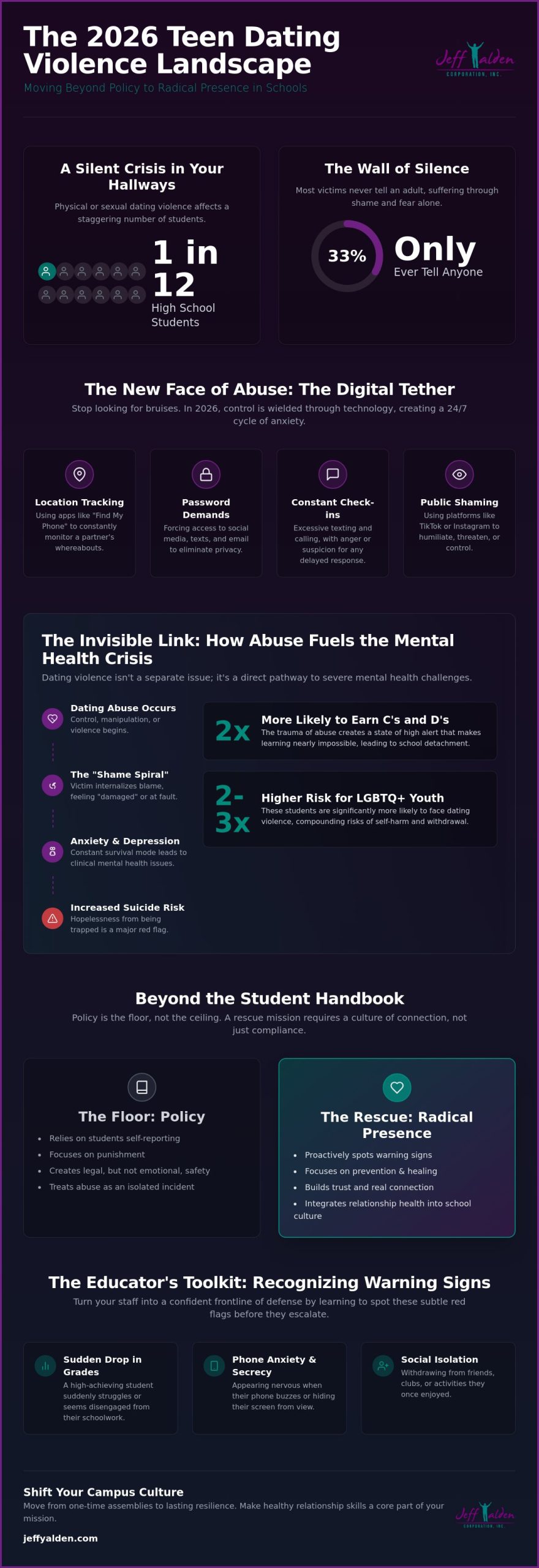
What if your school’s policy handbook is actually a wall? We write the rules. We post the posters. Yet, 1 in 12 high school students still experiences physical or sexual abuse in a dating relationship. Only 33% of victims ever tell an adult about the pain they’re carrying. It’s a gut punch. You’re likely terrified of missing the digital red flags or simply exhausted by the weight of it all. Addressing teen dating violence in schools shouldn’t feel like a legal obligation. It’s a rescue mission.
I know the pressure you’re under to keep every kid safe while they’re barely looking up from their phones. It’s heavy. This is about moving beyond policy and into radical transparency. You’ll learn exactly how to identify, interrupt, and prevent abuse on your campus through real connection. We’re diving into the raw truth of the 2026 landscape to help you lead with confidence and turn your school into a true sanctuary.
Key Takeaways
- Stop looking for bruises and start watching the “digital tether”—learn how cyberstalking and digital control have redefined the 2026 dating landscape.
- Break the shame spiral by connecting dating abuse to the broader mental health crisis, giving students the language they need to ask for help.
- Move beyond the “floor” of your student handbook; addressing teen dating violence in schools demands radical presence and meaningful connection over simple mandated reporting.
- Spot the subtle warning signs of isolation and partner-driven anxiety before they escalate, turning your staff into a confident frontline of defense.
- Shift your campus culture from one-time assemblies to lasting resilience, making healthy relationship skills a core part of your school’s mission.
The Raw Reality: Why Addressing Teen Dating Violence in Schools is a 2026 Priority
Let’s get real. We need to stop pretending that teen dating violence is just a “messy breakup” or a rite of passage. It isn’t. It is a systematic, calculated pattern of controlling behavior designed to strip a young person of their autonomy. Addressing teen dating violence in schools has become our most urgent mission in 2026 because the hallways are no longer just for learning; they are the primary battleground where these cycles are either reinforced or broken. Our students are watching us. They don’t need a clinical expert. They need a vulnerable authority who is brave enough to look them in the eye and say, “I see what’s happening, and it’s not okay.”
The digital landscape has shifted the stakes. In 2026, an abuser doesn’t need to be in the same room to exert control. They use location tracking, “find my phone” features, and constant social media surveillance to keep their victims in a state of perpetual anxiety. This 24/7 digital leash means the trauma follows them into every classroom and every study hall. If we aren’t proactive, we are essentially leaving our students to navigate a minefield alone while they’re supposed to be focusing on their future. We have to be the ones to interrupt the signal.
The High Cost of Silence in the Hallways
The numbers don’t lie. When a student is drowning in a toxic relationship, their education is the first thing to go under. Research shows that students experiencing dating abuse are twice as likely to earn Cs and Ds compared to their peers. It’s a direct pipeline to school detachment and, eventually, the dropout list. We aren’t just losing their focus; we’re losing their potential. Teen dating violence is an Adverse Childhood Experience (ACE) that creates a neurological state of high alert, making traditional learning nearly impossible without immediate, school-wide attention.
Beyond the Physical: Recognizing Psychological Aggression
We have to look past the bruises. In the social media era, psychological aggression is the primary weapon of choice. It’s the constant “check-ins,” the demand for passwords, and the public shaming on TikTok or Instagram. This isn’t just “bad behavior” or teen drama. These experiences create deep neural pathways of shame that can last a lifetime. We must shift our perspective from punishing a student for being “distracted” to recognizing the unresolved trauma that’s actually driving their behavior. When we see the control, we see the crisis. It’s time to stop looking for marks on the skin and start looking for the weight in their eyes.
The Invisible Link: How Dating Abuse Fuels the Teen Mental Health Crisis
We cannot effectively talk about the teen mental health crisis without directly addressing teen dating violence in schools. These aren’t separate issues. They are deeply intertwined. When a student is being tracked, belittled, or pressured by a partner, their brain enters a state of constant survival. This isn’t just stress. It’s a physiological hijacking. The “shame spiral” that follows is devastating. Victims often feel that the abuse is their fault or that they are “damaged goods.” This belief system feeds directly into clinical anxiety and depression, creating a cycle that’s nearly impossible to break without outside intervention. If we want to be serious about building resilience in teens, we have to teach them how to protect their peace from toxic partners.
The statistics from 2026 are sobering. With 1 in 12 high schoolers experiencing physical or sexual dating violence, the impact on campus-wide mental health is massive. For LGBTQ+ youth, who are two to three times more likely to face this abuse, the risk of self-harm and withdrawal is even higher. We have to stop treating these incidents as isolated discipline problems. They are mental health emergencies. Relationship health is not a “soft skill.” It’s a survival skill. It’s a fundamental pillar of any holistic approach to student well-being. When students feel safe in their personal lives, they can finally show up fully in their academic lives.
Dating Violence as a Suicide Risk Factor
The loss of a “first love” is intense, but when that relationship is defined by control, the emotional fallout can be lethal. We see a direct link between dating abuse and increased suicidal ideation. The sense of “hopelessness” that stems from being trapped by a partner is a major red flag that must be integrated into teen suicide prevention programs. Preventing teen dating violence means recognizing that a toxic breakup can be a critical crisis point. Professional teen mental health speakers provide a unique bridge here. They can normalize these raw emotions and give students the permission they need to speak their truth before it’s too late.
Trauma-Informed Responses for Educators
Educators are often the first to notice when a student’s light starts to dim. That’s why trauma-informed teaching professional development must include specific training on dating dynamics. We need to move from a culture of “What is wrong with you?” to a culture of “What happened to you?” When you create a safe harbor in your classroom, you aren’t just teaching a subject. You’re providing a lifeline. If your team needs a roadmap to start these hard conversations, booking a mental health speaker for your next staff day can provide the tools and the heart needed to lead this change.
Beyond the Student Handbook: Policy vs. Radical Presence
Your student handbook is not a shield. It’s a piece of paper. Too many districts think they’ve checked the box because they have a policy on the books. But addressing teen dating violence in schools isn’t about compliance. It’s about connection. Policy is the floor. It’s the bare minimum required by law to keep the lights on and the lawyers happy. Radical presence is the ceiling. It’s the intentional, gut-level commitment to being the kind of adult a student actually trusts when their world is falling apart. If we stop at the handbook, we leave our kids in the dark.
I hear the pushback already. “We don’t have time for this.” My response is simple. You don’t have time not to do this. You can spend ten minutes now building a bridge of trust, or you can spend ten months later dealing with the fallout of a tragedy that could have been prevented. We have to move past the clinical “Mandated Reporting” mindset and embrace “Meaningful Connecting.” Reporting is a legal transaction. Connecting is a human transformation. When we lead with radical transparency, we give students the permission they need to be honest about their own struggles.
The Limits of Administrative Compliance
Students don’t report to policies; they report to people. If your first reaction to a student in crisis is to flip to page 42 of the code of conduct, you have already lost them. A purely clinical response to an emotional crisis feels like a betrayal to a kid who is already feeling disposable. Authenticity is the only currency that works with Gen Z and Gen Alpha. They can smell a script from a mile away. They don’t want a perfect administrator. They want a real human being who isn’t afraid to acknowledge the messiness of life.
Cultivating Radical Presence in High Schools
Being a vulnerable authority means leading with your heart, not just your credentials. It’s about showing up as a mentor who has been through the fire and isn’t afraid to stand in the heat with a student. You don’t have to break professional boundaries to be real. You just have to be present. Sometimes, a simple “I see you, and I’m here” is the most powerful prevention tool in your arsenal. This is the core of what we cover in our trauma-informed teaching professional development. We teach your staff how to be the anchor in the storm so that students feel safe enough to speak up before the situation turns lethal.
The Educator’s Toolkit: Recognizing Warning Signs and Starting Conversations
You are on the front lines. Every day, you see the subtle shifts that parents and even close friends might miss. Addressing teen dating violence in schools isn’t just about responding to the loud, explosive moments. It’s about catching the quiet ones. In 2026, the signs have evolved. Control doesn’t always look like a raised voice in the hallway. Often, it looks like a student who is physically present but mentally miles away, trapped in a digital cage. You have the power to be the person who notices the cracks before the whole foundation crumbles. It’s time to sharpen your intuition and lead with heart.
Isolation is an abuser’s most effective weapon. Watch for the students who suddenly drop out of the clubs they loved or stop sitting with their usual friend group. This isn’t just “growing apart.” It is often a strategic move by a partner to ensure they are the only voice the victim hears. When a once-confident student becomes hyper-vigilant, constantly checking their surroundings or jumping when their phone vibrates, they are telling you a story. Pay attention. Your classroom might be the only place where they feel safe enough to let that mask slip, even for a second.
Subtle Signs You Might Be Missing
The “Digital Tether” is the most common red flag in 2026. Research shows that roughly 1 in 3 teens experience cyber dating abuse. It’s not just a distraction. It’s a leash. Look for these specific behaviors:
- Panic over phone battery: Extreme anxiety when their phone dies or is taken away, fearing a partner’s reaction to an “unanswered” text.
- Instructional time texting: Excessive “checking in” or arguing via text during your lesson.
- Grooming shifts: Sudden, drastic changes in how they dress or do their hair, often to meet a partner’s specific demands or to hide marks.
- Hallway volatility: Visible distress, crying, or shaking immediately after a brief encounter with their partner between classes.
How to Start the Conversation (The 2026 Script)
You don’t need to be a therapist to make a difference. You just need to be real. If you suspect something is wrong, don’t wait for them to come to you. They likely won’t. Use this four-step approach to open the door:
Step 1: Observation without judgment. Say, “I’ve noticed you’ve been a bit quiet lately, and I wanted to check in.” Avoid accusing the partner. Just focus on the student.
Step 2: Validating the pressure. “Dating is tough right now, isn’t it? There is so much pressure to be ‘on’ all the time.” This builds a bridge of shared understanding.
Step 3: Opening the door. “If you ever feel like things are getting too heavy, my door is open. No judgment, just a safe space.”
Step 4: Broader Impact. When you see these patterns across your campus, it’s time to bring in the high school assemblies team to address these toxic dynamics head-on.
If you feel overwhelmed by these hard conversations or don’t know where to start, booking a High School Speaker can break the ice for your entire student body and give your staff the confidence to lead.
Transforming Campus Culture: Moving from Crisis to Lasting Resilience
Culture isn’t a poster on the wall. It’s the pulse of your building. It’s what happens in the locker rooms and the parking lots when the adults aren’t looking. Addressing teen dating violence in schools requires more than just a reactive stance; it demands a proactive shift in the very air your students breathe. We have to move from a “crisis management” mindset to a “culture of resilience” mindset. This isn’t a box to check. It’s a mission to live. When your campus culture prioritizes emotional safety, abuse has no place to hide.
A one-day event is a spark, but it isn’t the whole fire. You need to keep the wood on the pile every single day. High School Assemblies serve as the critical catalyst for this change. They break the silence. They normalize the act of asking for help. When a speaker stands on that stage and shares their own raw truth, it gives your students permission to do the same. It turns “snitching” into “saving,” and it transforms bystanders into upstanders. Your student leaders are your true first responders. They see the toxic texts and hear the controlling comments long before they reach an administrator’s office. Empower them to lead the charge.
Building a Culture of Resilience
Resilience starts with a fundamental truth: a student’s value is never tied to their relationship status. We have to teach our kids that they are enough, exactly as they are. This requires creating a “no-shame” zone on your campus. When a victim feels judged, they retreat. When they feel supported, they recover. Jeff Yalden’s high-energy approach works because it completely bypasses the “eye-roll” factor of traditional, clinical presentations. It’s real. It’s raw. It’s the kind of radical transparency that actually sticks because it speaks to the heart, not just the head.
Next Steps for School Leaders
It’s time for an honest audit of your environment. Take a look at your current strategy and ask the hard questions. Is your staff training just a series of clinical slides, or is it a real conversation about human connection? Who are the trusted adults on your campus that a kid would actually run to at 2:00 PM on a Tuesday? If you don’t know the answer, that’s where we start. You can’t lead where you won’t go yourself. Take the first step toward a safer campus today. Book Jeff Yalden to bring this radical transparency to your next staff PD or student assembly and start building the resilience your students deserve.
Lead Your Campus into a New Era of Safety
We’ve moved past the “floor” of policy and into the “ceiling” of radical presence. You now have the tools to spot the digital red flags and the scripts to start those life-saving conversations. Addressing teen dating violence in schools isn’t just another item on your to-do list. It is the defining rescue mission for 2026. Your students are looking for an anchor in the digital storm. They are waiting for someone to be real enough to stand in the gap with them.
I’ve spent over 30 years on school stages; I know that Gen Z only trusts what is raw and authentic. As an expert in crisis intervention and postvention, I’ve seen how one moment of radical transparency can break a decade of silence. You don’t have to do this alone. It’s time to move from crisis management to lasting resilience. Bring Jeff Yalden to Your School to Address Teen Mental Health and Dating Violence and let’s start this transformation together. You have the heart to lead this change. Your kids are worth every second of the effort.
Frequently Asked Questions
How do I know if a student is in a toxic relationship or just a normal “teen drama” phase?
You can tell it’s toxic when one partner uses fear, isolation, or digital surveillance to control the other. Normal teen drama involves equal conflict between peers. Abuse involves a clear power imbalance where one student is consistently belittled, monitored, or pressured. If a student seems afraid of their partner’s reaction to a simple text or a grade, you’re looking at a pattern of control; not just a bad day.
What is the most effective way to address dating violence in a high school assembly?
The most effective way is to skip the clinical lectures and lead with radical transparency. Students in 2026 have a high “BS meter” and won’t listen to a dry list of rules or definitions. You need a speaker who shares lived experience and treats them like adults. When a speaker is vulnerable on stage, it breaks the silence and makes help-seeking behavior feel like a strength rather than a weakness.
Are male students also victims of teen dating violence?
Yes, male students are absolutely victims, and they are often the least likely to report it due to social stigma. Recent FBI data from 2020 to 2024 shows that while 80% of reported victims are female, nearly 20% are male. These young men often face psychological aggression and digital control that they don’t even recognize as abuse because they’ve been taught to “tough it out” or stay silent.
How can I support a student who refuses to leave an abusive relationship?
Stay present and keep your door open without judging their choices. Leaving an abusive relationship is a process; it is rarely a single event. If you push too hard, the student might retreat back to the abuser for comfort. Focus on building their self-worth and identifying safety resources. Your job is to be the one stable adult they can trust when they are finally ready to walk away for good.
What role do social media and cell phones play in modern teen dating violence?
Technology acts as a digital leash that allows abusers to maintain control 24/7. Modern teen dating violence often involves “location sharing” demands, password theft, and constant surveillance through social media. This digital control creates a state of perpetual anxiety for the victim. It’s no longer just about what happens in the hallways. The abuse follows them into their bedrooms at night through their screens.
How can I talk to parents about their child being an abuser?
Be direct and focus on the specific behaviors you’ve observed rather than using labels. Parents will naturally be defensive. Frame the conversation around the long-term impact on their child’s future and the safety of the school community. Addressing teen dating violence in schools requires holding everyone accountable. Help parents understand that intervening now prevents more serious legal trouble or a lifetime of toxic patterns later.
Does addressing dating violence actually improve academic performance?
Yes, addressing teen dating violence in schools directly improves academic outcomes. Students in toxic relationships are twice as likely to earn Cs and Ds because their brains are stuck in a state of survival. When you remove the weight of trauma and fear, their cognitive bandwidth returns to learning. Safety is the foundation of every high GPA and successful graduation rate on your campus.
What should I do if a student discloses abuse but begs me not to tell anyone?
You must be honest about your role as a mandated reporter from the very start of the conversation. If a student begs for a secret, tell them, “I care about you too much to keep you in danger.” Explain exactly what will happen next so they don’t feel blindsided by the process. Your transparency in that moment is what keeps the trust alive even when the “secret” is broken for their safety.
