
What if the most expensive hour on your school calendar wasn’t a mandatory waste of seat-time, but the exact moment your campus culture finally started to heal? You know the feeling of watching seven hundred students “tune out” while a speaker drones on. Or worse, the pit in your stomach when you realize you’ve hired a “dud” with your limited budget. It’s frustrating. It’s exhausting. Most importantly, it’s a missed opportunity to address the rising mental health crises and suicide risks that keep you up at night. You want your students to feel seen and heard, not just managed.
We’re here to change that narrative. This school assembly planning guide for principals is your roadmap to transforming a one-off event into a strategic catalyst for radical change. I’ve been in those gyms since 1992, and I know that a real connection requires more than a microphone; it requires transparency and heart. In this guide, we’ll break down how to vet for “vulnerable authority,” maximize your budget for long-term impact, and provide your staff with the practical tools they need to keep the conversation alive long after the bleachers are empty. Let’s move from a moment to a movement.
Key Takeaways
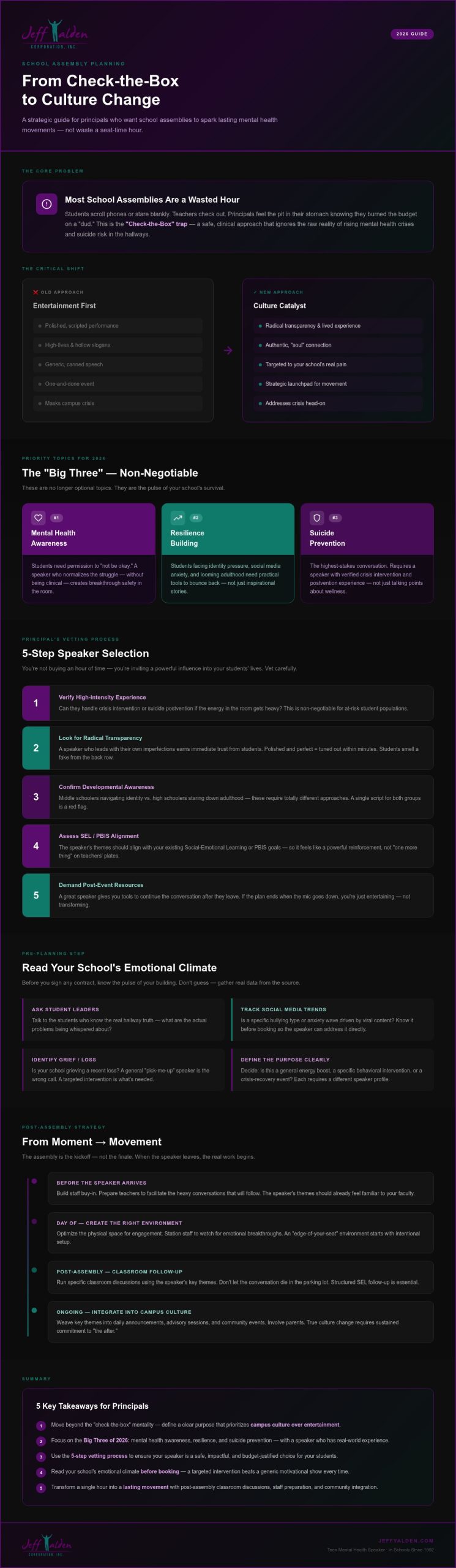
- Move beyond the “check-the-box” mentality by defining a clear purpose that prioritizes campus culture over simple entertainment.
- This school assembly planning guide for principals helps you navigate budgets and vetting to ensure your speaker is a safe, impactful choice for your students.
- Focus on the “Big Three” of 2026: mental health, resilience, and suicide prevention, by choosing a guide with real-world experience.
- Create an “edge-of-your-seat” environment by optimizing the physical space and preparing your staff to handle emotional breakthroughs.
- Transform a single hour into a lasting movement with specific strategies for post-event classroom discussions and community involvement.
Rethinking the School Assembly: Why Culture Trumps Entertainment
Let’s be real. Most school assemblies are a total waste of time. You know it. Your teachers know it. Your students definitely know it. They sit in the bleachers, scrolling on their phones or staring blankly at a “performer” who hasn’t been in a classroom since the 90s. This is the “Check-the-Box” trap. It’s the safe, clinical approach to motivation that ignores the raw reality of what’s happening in your hallways. If you want to change student behavior, you have to stop looking for entertainment and start looking for a cultural catalyst.
In 2026, students don’t want a polished, scripted presentation. They want the truth. They crave radical transparency. When you use this school assembly planning guide for principals, you aren’t just booking a date on a calendar; you’re building a foundation for high school assemblies that actually stick. You’re choosing to address the campus crisis head-on rather than masking it with high-fives and hollow slogans. It’s about moving from a mandatory hour of seat-time to a strategic moment of connection.
Identifying Your School’s Current Emotional Climate
Before you sign a contract, you need to know the pulse of your building. Is your school grieving a recent loss? Are social media trends driving a wave of anxiety or a specific type of bullying? You must differentiate between a general “pick-me-up” and a targeted intervention. Don’t just guess. Talk to your student leaders and find the “pulse” of the hallways. Ask them what the real problems are. This data ensures your speaker addresses the specific pain points of your community rather than delivering a generic, canned speech that students will tune out within five minutes.
Moving Beyond the “One-and-Done” Mentality
An assembly shouldn’t be the end of the conversation; it should be the kickoff. To make the impact last, you need staff buy-in before the speaker even arrives. Align the event with your current SEL or PBIS goals so it doesn’t feel like “one more thing” on a teacher’s plate. This school assembly planning guide for principals is about creating a movement, not just a moment. Consider these steps to ensure longevity:
- Treat the assembly as a strategic launchpad for new initiatives rather than a standalone show.
- Ensure your staff is prepared to facilitate the “heavy” conversations that inevitably follow a raw, honest session.
- Integrate the speaker’s key themes into your daily announcements and classroom culture to keep the momentum alive.
When the speaker leaves, the work is just beginning. If you aren’t prepared to follow up, you’re just entertaining the students for an hour. True culture change requires a commitment to the “after,” turning a single speech into a lasting shift in how your students treat themselves and each other.
Choosing the Right Message: From Motivation to Mental Health
Motivation is cheap. Inspiration is fleeting. What your students actually need in 2026 is a lifeline. The “Big Three”-mental health awareness, resilience, and suicide prevention-are no longer optional topics. They are the pulse of your school’s survival. When using this school assembly planning guide for principals, you have to decide: do you want a “performer” who tells jokes and does tricks, or a lived-experience guide who has walked through the fire? Students can smell a fake from the back row of the bleachers. They need someone who normalizes the struggle and speaks their language without being clinical, detached, or boring. It’s about moving from a “show” to a “soul” connection.
Middle schoolers need a different approach than high schoolers. One group is navigating the first waves of identity and social pressure; the other is staring down the barrel of adulthood and heavy expectations. Your speaker must understand these developmental nuances. By prioritizing teen mental health speaker programs that focus on the “real” and “raw,” you give your students permission to drop the mask. You create a space where it’s okay to not be okay, provided we don’t stay there.
The 5-Step Speaker Selection Process
Choosing a speaker is a high-stakes decision. You aren’t just buying an hour of time; you’re inviting a powerful influence into your students’ lives. Follow this process to ensure they are the right fit for your specific culture:
- Verify high-intensity experience: Can they handle crisis intervention or suicide postvention if the energy in the room gets heavy?
- Look for radical transparency: A speaker who leads with their own imperfections earns immediate trust and breaks down walls.
- Watch unedited footage: Don’t trust a slick highlight reel. See how they handle a restless crowd or a technical glitch in real-time.
- Check specific references: Ask other principals how the speaker handled the “aftermath” of the message. Did they stay to talk to kids?
- Prioritize depth over hype: Ensure the message offers more than just a temporary emotional high that fades by lunch.
The Role of Resilience in 2026
We used to talk about “bouncing back.” That’s old news. In the current climate, bouncing back implies returning to the state you were in before the trauma. We want more for our kids. We want them “bouncing forward”-taking the pain and turning it into a new kind of strength. This is why building resilience in teens must focus on the “victor” mentality. It’s about teaching them that their struggle isn’t their identity; it’s their training ground. If you’re looking for a teen motivational speaker who understands these nuances and isn’t afraid to go there, let’s make sure the message matches the moment.
The Principal’s Logistics Checklist: Vetting and Budgeting
Logistics aren’t just paperwork. They’re the guardrails for your students’ safety. When you’re using this school assembly planning guide for principals, vetting isn’t optional. It’s a moral obligation. You need to ensure your speaker follows the latest teen suicide prevention programs guidelines. This isn’t about being clinical. It’s about being responsible. If a speaker can’t explain their safety protocol, walk away. Don’t risk hiring someone who might trigger a crisis without a plan to manage the aftermath. Safety is the foundation of every successful event.
Let’s talk money. It’s often the biggest hurdle, but you aren’t just paying for a speech. You’re investing in a transformation. To maximize your budget, look for block-booking discounts. Team up with other schools in your district to split travel and lodging costs. Many principals find success using Title I funds or PTA grants specifically earmarked for mental health. Community partners are often looking for ways to support local youth; they just need a clear vision to get behind. Don’t let a “no” from the district office be the end of the story. Find a way because your kids are worth it.
Watch out for red flags. If a speaker has a vague fee structure with hidden “travel expenses,” that’s a problem. If they can’t provide references from schools that have faced real challenges, keep looking. A “dud” speaker doesn’t just waste money. It damages your credibility with your students. They’ll remember the time you wasted an hour of their lives, and they won’t be as open the next time you try to reach them.
Contracting and Clear Expectations
Get every detail in writing. Define the exact duration, the Q&A format, and the boundaries for student interaction. Most importantly, your contract should include a “crisis clause.” This ensures the speaker stays on-site for a set time after the assembly to support students who may have been triggered by the message. Discuss your technical needs like audio, lighting, and stage setup at least 30 days out. A bad sound system can kill the energy of even the most powerful message. Don’t let a faulty mic ruin your investment.
Funding a High-Impact Assembly
Leverage “Safe and Drug-Free Schools” funds or specific mental health grants. These pots of money are often underutilized. Consider a community-wide event where you split the costs with neighboring middle or high schools. This makes the ROI undeniable. Think about the math: what’s the cost of “doing nothing” compared to the cost of one life-saving intervention? Prevention is always more cost-effective than a post-crisis cleanup. Position the assembly as a strategic investment in campus safety, and the funding usually follows.
Day-of Execution: Maximizing Engagement and Safety
The day has arrived. The gym is buzzing, and the stakes couldn’t be higher. This isn’t just another item on your to-do list. It’s the moment the air in your building finally starts to shift. To make this work, you have to be obsessed with the environment. Energy is dictated by proximity. If your students are scattered across the top bleachers like they’re watching a bad JV game, you’ve already lost. This school assembly planning guide for principals is about creating an “edge-of-your-seat” experience, and that starts with the physical setup. Bring them close. Kill the house lights. Make the sound crisp and undeniable. If they can’t hear the heart behind the words, they won’t feel the weight of the message.
Teachers, you have a role here that goes way beyond “hall monitor.” You’re participants. If your students see you in the back row scrolling on your phone or grading papers, you’re telling them that their mental health isn’t worth sixty minutes of your time. Your presence validates the speaker’s authority. This is exactly why trauma-informed teaching professional development is the perfect companion to a student assembly. It gives your staff the permission and the tools to sit in the “heavy” with these kids instead of just watching for rule-breakers. When the staff is “all in,” the students follow.
Creating the Right Environment
Tactics matter. You want to shrink the room to expand the energy. Follow these non-negotiables for a high-impact session:
- Close the bleachers: Force the students toward the stage. Physical closeness creates emotional intimacy.
- Kill the distractions: No phones. No backpacks. No teacher laptops. This is a sacred hour of connection.
- The Warm Intro: Don’t just read a dry bio. Introduce the speaker with heart. Tell the kids why you personally brought this person to their school. Validate the “vulnerable authority” before they even speak.
Crisis Support Protocols
Radical transparency triggers real emotional releases. You must be ready for the “heavy” moments. Set up a “Safe Room” with your counseling team ready to go the second the assembly ends. Identify your “at-risk” students before the first word is spoken. Watch their reactions. If a student needs to step out, let them go with a staff member who knows how to listen. Brief your entire team on how to handle a student who self-discloses after the bell. This is where the healing starts. If you’re looking for a high school speaker who can navigate these intense emotional waters with safety and heart, you’ve found the right partner.
Post-Assembly Integration: Turning a Speech into a Movement
The high-fives are over. The gym is empty. The speaker has packed up the microphone and headed to the airport. Now comes the most dangerous part of the entire process: the silence. If you let the energy of the event evaporate by the time the final bell rings, you haven’t held an intervention; you’ve just hosted a performance. This school assembly planning guide for principals is designed to ensure that the “raw” and “real” conversations started on the stage continue in the hallways, the classrooms, and the kitchen tables. You’re not just looking for a moment of inspiration. You’re building a movement of resilience. To see how leading international institutions prioritize this type of holistic student growth, visit Oak Meadow International School Phuket.
The first 24 hours are critical. If teachers don’t follow up in the classroom, the message starts to fade. You need to provide your staff with the vocabulary to keep the radical transparency alive. Use academic life coach for high school students resources to bridge the gap between emotional breakthroughs and daily academic success. It’s about turning that temporary spark into a permanent shift in how your students navigate their struggles. Don’t forget the parents. If the home-life doesn’t reflect the campus-life, the student stays stuck in an emotional tug-of-war. Host community seminars that give parents the same tools you gave your staff.
Your teachers are the front lines. They need a post-assembly workshop to process their own mental health and any “heavy” moments triggered during the session. If the event followed a recent crisis, focus on specific “Postvention” strategies that prioritize safety and healing. Equip your educators with the confidence to handle a student’s vulnerability without feeling like they need to be clinical therapists. They just need to be human. When your staff feels supported, they can better support the kids.
Student-Led Character Initiatives
Let the kids take the lead. Empower your student council or leadership groups to launch a “Resilience Week” that reinforces the speaker’s key themes. Create “Safe Space” zones in the school where the speaker’s message is visible and the culture of “it’s okay to not be okay” is reinforced daily. Consider inviting the speaker back for virtual check-ins or student leadership coaching to keep the momentum from stalling. Finally, measure the impact. Use surveys to track campus climate shifts over the following semester. Don’t just rely on “vibes.” Look for the data that proves your culture is becoming safer, stronger, and more connected.
Lead the Movement on Your Campus
Your students don’t need another “check-the-box” speaker. They need a lifeline. You now have the strategic tools to move beyond the traditional motivational speech and spark a radical cultural shift. Remember that a successful event requires more than just a date on the calendar. It demands heart, a focus on the “Big Three” of mental health, and a commitment to follow through long after the gym is empty. This school assembly planning guide for principals is your blueprint for turning a single hour into a lasting legacy of resilience.
I’ve spent over 30 years in the trenches, specializing in crisis intervention and postvention. I lead with radical transparency because I’ve lived through the struggles your kids are facing right now. We don’t do “duds.” We do transformation. It’s time to redefine resilience on your campus and show your students that they are seen and heard. You have the plan. You have the passion. Now, let’s go change the world together.
Bring Jeff Yalden to Your Campus: Book Your 2026 Assembly Now
Frequently Asked Questions
How far in advance should a principal book a school assembly speaker?
Ideally, you should book your speaker 6 to 12 months in advance. This lead time ensures you secure your preferred dates, especially during high-demand periods like Mental Health Awareness Month. Last-minute bookings can happen, but they often limit your options for specialized experts. Use this time to align the event with your 2026 strategic goals and ensure your funding is locked in before the speaker’s calendar fills up entirely.
What are the best funding sources for high school mental health assemblies in 2026?
Don’t rely solely on the general fund. Title I funds, PTA/PTO grants, and “Safe and Drug-Free Schools” allocations are excellent primary sources for 2026. Many principals also find success by partnering with local service clubs like the Rotary or Lions Club. These organizations often have specific budgets for youth mental health and suicide prevention initiatives. They are usually just waiting for a clear, impactful vision to support.
How can I ensure students don’t just “tune out” during the assembly?
Proximity and radical transparency are your best defenses against apathy. As noted in this school assembly planning guide for principals, bringing students close to the stage and dimming the house lights creates an immediate sense of intimacy. Most importantly, choose a speaker who leads with their own imperfections rather than a polished lecture. Students stop scrolling when they feel the person on stage is being real, raw, and vulnerable with them.
What should I do if a student has an emotional crisis during a high-intensity assembly?
Pre-stage a “Safe Room” with your counseling team ready to go. If a student becomes overwhelmed, a designated staff member should quietly escort them to this space for immediate support. Ensure your speaker is a “vulnerable authority” with specific experience in crisis intervention. They should know how to read the room and pivot the message if the emotional weight becomes too intense for the collective group to handle safely.
Is it better to have one large assembly or several smaller, grade-level sessions?
Smaller, grade-level sessions are almost always more impactful for sensitive topics. While one large assembly is easier to schedule, smaller groups foster a greater sense of safety and intimacy. This allows the speaker to tailor the message to specific developmental needs. Seniors facing graduation have different pressures than freshmen navigating new hallways. Smaller sessions also lead to more honest Q&A moments and higher rates of student self-disclosure afterward.
How do I vet a speaker to ensure they are safe for a trauma-informed campus?
Request specific references from schools that have navigated recent tragedies. Ask how the speaker handled the “heavy” moments and if they followed recognized suicide prevention protocols. A safe speaker won’t just tell sad stories; they’ll provide a framework for resilience and growth. Ensure they have a proven track record in suicide postvention and crisis intervention. You need a guide who has walked through the fire, not just a performer.
What kind of follow-up activities should teachers do after a motivational speaker leaves?
Facilitate small-group classroom discussions within 24 hours of the event. This school assembly planning guide for principals emphasizes that the assembly is just the kickoff for a larger movement. Teachers should use the vocabulary introduced by the speaker to keep the conversation going. Provide staff with open-ended prompts that encourage students to process their feelings. This ensures the message doesn’t stay in the gym but becomes part of your daily culture.
Can a school assembly really impact student suicide rates?
An assembly is a powerful catalyst, but it isn’t a standalone cure. When a lived-experience guide normalizes the struggle, it breaks the silence that often surrounds teen suicide. By giving students permission to ask for help and equipping staff with postvention tools, you create a stronger safety net. It’s about building a culture where “bouncing forward” is the norm and every student feels seen, heard, and valued by their community.
