
A parent’s complaint deserves a calm, clear response, not a defensive one. Knowing how to handle a parent complaint about mental health support starts with listening carefully, clarifying what the parent is asking for, and responding with empathy while respecting the young person’s privacy. Clear records and thoughtful professional input help keep the conversation focused on support.
When a parent is upset, you may feel pressure to explain everything at once or fix the situation immediately. You don’t have to. A steady, respectful conversation makes room for the parent’s concerns while keeping the young person’s needs in view. These practical steps cover setting expectations, recording concerns, involving mental health professionals, choosing when to talk, and responding when a parent feels hurt or disappointed. Each can help move a difficult exchange toward a constructive next step.
Key Takeaways
- Listen to the parent’s concern without becoming defensive, and clarify what outcome they’re hoping for.
- Keep communication clear and document concerns, responses, and agreed next steps while respecting the young person’s privacy.
- When more support is needed, help the young person ask to speak with a mental health professional.
- Choose a calm time and respond to sadness or disappointment with empathy, not blame.
1. Preventing complaints through clear communication and documentation
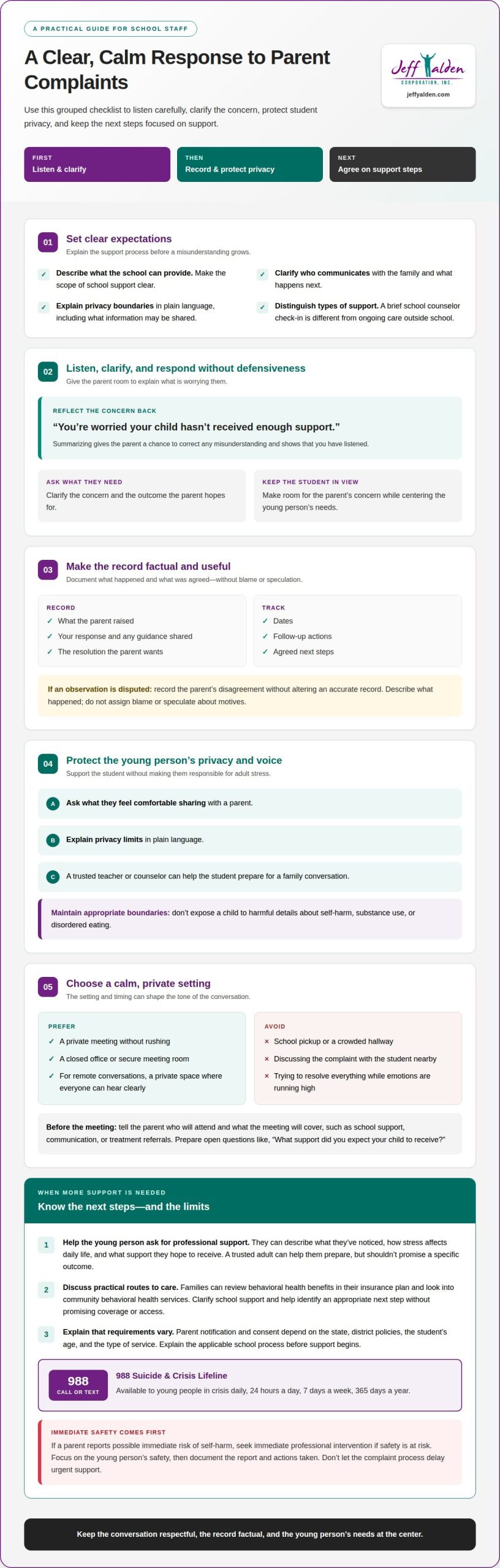
Clear expectations can prevent a misunderstanding from becoming a complaint. At the start of support, explain what the school can provide, who will communicate with the family, how privacy is handled, and what happens next. For example, distinguish a brief check-in with a school counselor from ongoing care outside school. Invite the parent to explain their concern, then summarize it: “You’re worried your child hasn’t received enough support.” This shows you have listened and gives them a chance to correct any misunderstanding.
A practical first step in how to handle a parent complaint about mental health support is to document the concern clearly. Note what the parent raised, your response, any guidance shared, and the resolution they want. Record dates and follow-up actions as well. If a parent disputes an observation, record their disagreement without altering an accurate record. Notes should describe what happened, not assign blame or speculate about motives.
Speak with the student without making them responsible for managing adult stress. Ask what they feel comfortable sharing with a parent, and explain privacy limits in plain language. A trusted teacher or counselor can help the student prepare for a family conversation. Maintain appropriate boundaries: communication can help, but don’t expose a child to harmful details about self-harm, substance use, or disordered eating.
When a family needs more support, discuss practical paths. They can review their insurance plan’s behavioral health benefits and look into community behavioral health services. A school can clarify what its own support includes, then help identify an appropriate next step without promising coverage or access. Staff learning how to handle a parent complaint about mental health support should also know that the 988 Suicide & Crisis Lifeline can be reached by calling or texting 988. According to the 988 Suicide & Crisis Lifeline, it is available to young people in crisis daily, 24 hours a day, 7 days a week, 365 days a year.
When must schools notify parents or get consent for student mental health services? There is no universal answer. Requirements depend on the state, district policies, the student’s age, and the type of service. Explain the applicable school process before support begins, including what information may be shared with a parent.
2. Asking to speak with a mental health professional
If a parent dismisses a student’s concerns, help the young person make a direct, honest request to speak with a mental health professional. They can describe what they’ve noticed, how stress affects daily life, and what support they hope to receive. For example: “I’m having trouble sleeping and concentrating, and I’d like to talk with someone.” A trusted adult can help them prepare, but shouldn’t promise a specific outcome.
Parents can also be encouraged to seek professional care if their own mental health is affecting family life. Listen without blame, raise the concern gently, and suggest a practical next step, such as discussing therapy or counseling with a qualified professional. Talk therapy can give a young person space to discuss a parent’s mental illness when that feels difficult at home. A supportive conversation matters, but it doesn’t replace treatment when treatment is needed.
What are parents’ rights regarding school counseling and mental health support in the United States? The answer depends on the state, district policies, the student’s age, and the type of service. Schools should explain relevant privacy, consent, and communication procedures clearly, rather than treating every counseling situation as the same.
What federal and state laws govern school mental health support and parent complaints? More than one law or policy may apply, and requirements vary by service and circumstances. Schools should follow the rules that apply, explain the complaint process, and protect student privacy while addressing the parent’s concern.
If a parent reports that their child may be at immediate risk of self-harm, treat the report as urgent and seek immediate professional intervention if safety is at risk. Focus first on the young person’s immediate safety, then document the report and actions taken. Don’t let the complaint process delay urgent support.
For a complaint involving a professional regulator, respond carefully. Regulated professionals should seek legal advice before replying, even if they believe their conduct was appropriate. Provide the regulator only the information and documents it requests. If the student still needs ongoing support, continue addressing that need while the complaint process proceeds.
3. Choosing the time and setting for a conversation
Timing can affect the tone of a difficult conversation. Don’t raise a parent’s complaint during school pickup, in a crowded hallway, or with the student nearby. Instead, offer a private meeting when the parent and school staff can focus without rushing. If emotions are running high, agree on a calmer time rather than trying to resolve every concern immediately.
Choose a setting that protects privacy and limits interruptions. A closed office or secure meeting room is usually more suitable than a public reception area. For a remote conversation, find a private space and make sure everyone can hear clearly. Tell the parent who will attend and what the meeting will cover, such as school support, communication, or treatment referrals.
Before the conversation, identify its purpose and prepare a few open questions. For example, ask, “What support did you expect your child to receive?” and “What would you like us to address today?” If a young person plans to talk with a parent about their mental health, they can choose a calm moment and bring notes about their concerns and the help they want. A written outline can help them stay grounded.
Give everyone room to speak without interruption. If the parent becomes upset, pause, acknowledge their feelings, and ask whether they need a short break. Don’t push for a quick decision while anyone feels overwhelmed. A school representative can summarize what they heard and check that the parent agrees before moving on.
Some conversations work better in writing or over more than one meeting. A student who feels pressured speaking face to face might write a letter, while a parent may prefer to send concerns before a scheduled discussion. Agree on a practical next step, such as arranging another conversation with relevant staff. A thoughtful setting helps everyone focus on the student’s needs, not the strain of the moment.
4. Responding to parental sadness or disappointment
A parent may feel hurt, frightened, or let down when discussing a child’s mental health. Start by naming the feeling without judging it: “I hear how worried and disappointed you are.” Then pause and let them respond. Don’t rush into explaining school decisions before you understand what they’re struggling with. Parents deserve to feel heard, even when you don’t agree with every conclusion.
Answer questions plainly, separating confirmed details from next steps. If a parent asks why a student wasn’t referred sooner, explain what actions were taken and what options are available now. Don’t promise a particular outcome. Offer practical guidance, such as arranging a follow-up meeting or discussing how the family can seek professional care.
For an informal complaint, clarify the specific concern and the resolution the parent wants. Ask, “Would an explanation, a meeting, or a change in communication help address this?” Agree on who will follow up and what they will do. A clear, timely response can resolve a misunderstanding without becoming defensive or blaming the parent.
If a parent doesn’t believe your account, don’t argue or criticize them. Return to verifiable details, such as call dates, the support discussed, and agreed actions. Ask what information they believe is missing. If you discover an error, don’t conceal it or alter the record. Seek appropriate advice about how to correct the issue, and consider whether notifying an insurer is required.
Handle privacy concerns with the same care. If information reached the wrong person, preserve relevant records, limit further sharing, and promptly follow the organization’s privacy process. A privacy breach may require notifying the affected person and, in some circumstances, a privacy regulator. Keep the parent informed about the response process without disclosing another student’s confidential information. Calm, honest communication can help rebuild trust while keeping the young person’s needs central.
Jeff Yalden
Jeff Yalden helps schools build open, thoughtful conversations about teen mental health. When a parent’s complaint points to a broader need for student awareness or connection, a school assembly can create space to discuss resilience, seeking help, and supporting one another. His Teen Motivational Speaker work and High School Assembly Programs can complement a school’s ongoing efforts to make mental health easier to talk about.
An assembly can be a meaningful next step when school leaders want to address concerns constructively and encourage students to speak up. It supports broader conversation, not a quick fix for an individual complaint. To explore support for your school community, contact Jeff Yalden.
Make room for a stronger conversation
A parent’s complaint can become a turning point, not because every concern disappears, but because the school keeps listening. Carry that care into everyday school life: make it easier for students to speak honestly, help families understand available support, and keep conversations open when feelings run high. That is how to handle a parent complaint about mental health support: stay present, protect trust, and keep the young person’s wellbeing in view.
Jeff Yalden supports schools through High School Assemblies, High School Assembly Programs, and his work as a Teen Motivational Speaker. These offerings can help schools create meaningful opportunities to talk about mental health and resilience. If you’re ready to explore what could support your school community, contact Jeff Yalden. Keep moving forward with care, clarity, and hope.
Frequently Asked Questions
How should a school respond to a parent complaint about a student’s mental health support?
A school should acknowledge the concern, identify the student’s immediate needs, and explain the next step. For example, if a parent says a student missed a scheduled check-in, staff can establish what happened, whether support is needed now, and who will follow up. Keep the discussion focused on the student’s wellbeing, and don’t treat the complaint as proof of misconduct before reviewing the facts.
What steps should staff take to document and investigate a parent complaint about mental health services?
Create a clear record of the complaint, including when it was received, the parent’s main concern, and the outcome they want. Gather relevant records and speak with the staff involved, distinguishing firsthand observations from assumptions. For example, separate a missed appointment recorded in a calendar from a parent’s report that no one contacted them. Record your findings and follow-up actions in the appropriate secure system.
How should schools handle confidentiality when responding to a parent’s mental health complaint?
Share only information the school is permitted to disclose, and keep the response focused on the parent’s child. A parent may ask what another student said or did during a shared classroom incident; staff should not reveal that student’s private information. Explain what you can and cannot discuss, and use approved communication channels rather than personal email or informal messages.
How can schools resolve disagreements with parents about a student’s mental health care plan?
Bring the parent and relevant school staff together to pinpoint the disagreement, such as the timing of check-ins or how progress is communicated. Distinguish school-based support from treatment decisions made outside school, then agree on what the school can do and how the family can raise concerns. Put responsibilities in writing and set a time to review whether the plan is working.
What complaint or grievance processes are available for school mental health services?
Start with the school’s published complaint procedure, which may direct families to a principal, student-support administrator, or district office. The right route depends on the concern and the school system’s process. A parent can request the complaint steps in writing, including how to submit supporting information and how the school will communicate its response. Keep copies of submitted materials and the school’s replies.
When should a school refer a parent complaint to a district administrator, licensing board, or outside agency?
Escalate concerns involving immediate safety, a possible serious privacy breach, unresolved conduct issues, or matters beyond the school’s authority. A district administrator can address school-level process concerns; a regulator may handle conduct by a regulated professional. In urgent situations, prioritize immediate safety and professional intervention instead of waiting for a routine complaint review.
