
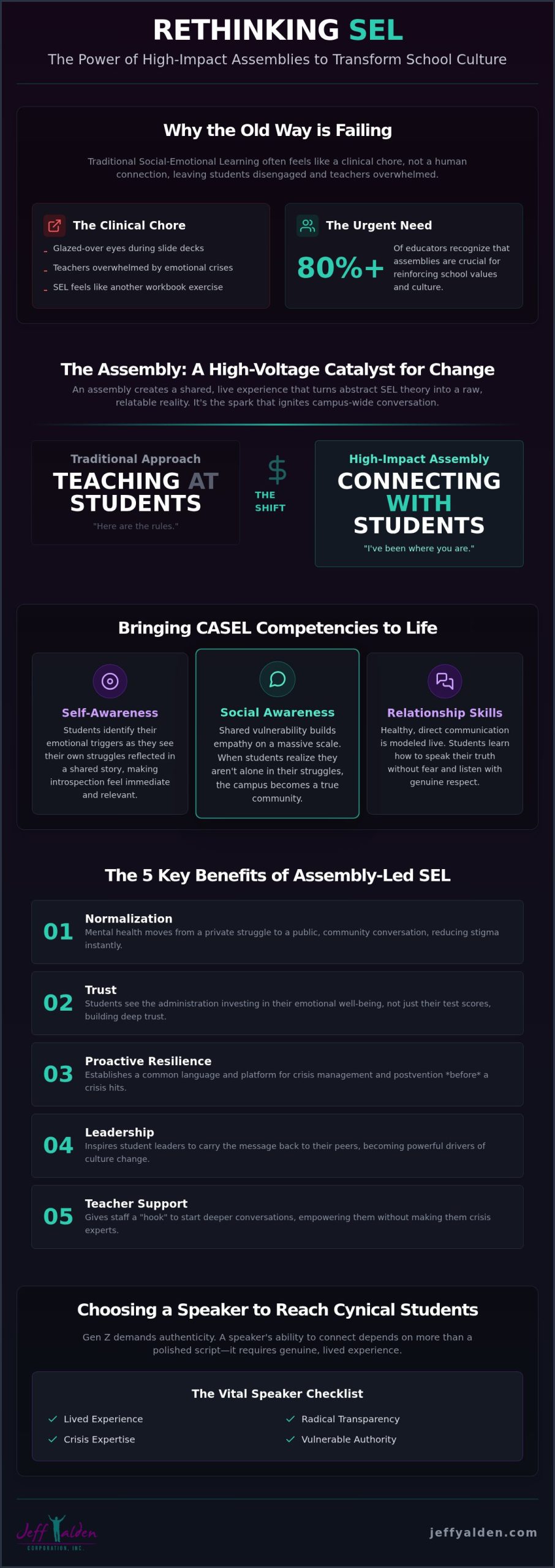
Most Social Emotional Learning programs are dying in the classroom because they feel like a clinical chore rather than a human connection. You see the glazed-over eyes during the mandatory morning slide decks. You feel the crushing weight on your teachers who are drowning in student emotional crises they just aren’t equipped to handle. It’s frustrating. It’s draining. And quite frankly, the old way isn’t working anymore. With over 80% of educators now recognizing that these gatherings are crucial for reinforcing values, the role of school assemblies in social emotional learning has never been more urgent.
I’ve been in those trenches. I know that when you trade the academic scripts for radical transparency, students finally stop performing and start listening. This article will show you how high-impact assemblies bridge the gap between clinical SEL theory and the raw reality of teen mental health to actually transform your campus culture. We’re laying out a framework to turn a one-time event into a long-term catalyst for change. You’ll learn how to create a measurable reduction in mental health stigma and foster the deep student-teacher connections that your school is starving for right now.
Key Takeaways
- Stop treating SEL as a workbook exercise and start using high-impact assemblies as the catalyst for real culture change.
- Discover the unique role of school assemblies in social emotional learning to bridge the gap between classroom theory and the raw reality of teen mental health.
- Learn how to instantly normalize difficult conversations on campus to build a foundation of trust that helps students feel seen and safe.
- Identify why choosing a speaker with lived experience and crisis expertise is vital for reaching a cynical Gen Z audience.
- Get a framework for integrating these programs with your staff development to ensure the momentum lasts long after the assembly ends.
What is the Role of School Assemblies in Social Emotional Learning?
High school students are cynical. They’ve seen the posters. They’ve sat through the mandatory videos and the awkward morning slide decks. If you want to reach them in 2026, you have to stop teaching at them and start connecting with them. The true role of school assemblies in social emotional learning isn’t just to fill a time slot or check a compliance box. It is to serve as the high-voltage catalyst that humanizes every single theory your curriculum tries to teach. It is the spark that makes the culture catch fire.
While K-6 assemblies often focus on basic behavioral expectations like walking in lines or sharing toys, high schoolers need a different beast. They need resilience. They need truth. They need what I call radical transparency. An assembly is the one moment where the entire campus stops. It creates a shared language. It takes Social-Emotional Learning (SEL) out of the textbook and puts it into the room. It makes it real. It makes it raw. It makes it okay to talk about the things that are actually happening in their lives, from anxiety to the pressure of performance.
Breaking the Silence: The Emotional Catalyst
Students don’t ignore SEL lessons because they don’t care. They ignore them because they don’t see themselves in the clinical language. When a speaker stands on that stage with 30 years of experience and says, “I’ve been where you are,” the walls come down. This is the power of vulnerable authority. It transforms SEL from a school subject into a lived experience. You aren’t just talking about “coping mechanisms” anymore. You’re talking about survival. You’re talking about hope. You’re showing them that their struggles don’t define them, but their response to those struggles does. That’s a shift that happens in an hour, not a semester.
Aligning Assemblies with CASEL Competencies
A high-impact assembly doesn’t just feel good. It hits the core of the CASEL framework in ways a worksheet never could. We aren’t just checking boxes; we’re changing hearts. This isn’t just about a speech. It’s about redefining the role of school assemblies in social emotional learning for a generation that demands authenticity over everything else.
- Self-Awareness: Students identify their own emotional triggers in real-time as they hear their struggles reflected back to them. They see their own reflection in someone else’s story.
- Social Awareness: Shared stories build empathy on a massive scale. When 1,000 students realize they’re all carrying something heavy, the “us vs. them” mentality dies. The campus becomes a community.
- Relationship Skills: I model healthy, direct communication. I show them how to speak their truth without fear and how to listen with respect. This is where the culture shifts from isolation to connection.
The 5 Key Benefits of Integrating Assemblies into Your SEL Strategy
High school students can smell “fake” from a mile away. If you try to teach empathy through a PowerPoint, you’ve already lost. You need something that hits harder. The role of school assemblies in social emotional learning is to provide a high-octane delivery system for CASEL’s five core competencies. It is the difference between reading a map and actually driving the car. When you bring the entire student body together, you aren’t just sharing information. You’re creating a shared moment of truth that changes the cellular level of your campus culture.
There are five massive wins when you move beyond the classroom and onto the stage:
- Normalization: Mental health stops being a “closet” issue and becomes a community conversation.
- Trust: Students see the administration investing in their emotional well-being, not just their test scores.
- Proactive Resilience: You build a platform for postvention and crisis management before the crisis ever hits.
- Leadership: Student leaders get fired up to take the message back to their peer groups, becoming the primary drivers of change.
- Teacher Support: You give your staff a “hook” to start deeper, more meaningful conversations in the classroom without them having to be the “expert” on every emotional trauma.
If you’re ready to see this shift happen in your gym or auditorium, consider bringing a teen mental health speaker who understands this radical transparency.
Normalizing the Mental Health Conversation
Stigma thrives in silence. It dies when we speak up. By bringing these topics into the light in front of 1,000 peers, you reduce the shame of asking for help. A single 60-minute assembly can save months of clinical outreach effort by giving students the permission they’ve been waiting for to finally say, “I’m not okay.” This isn’t just a speech. It is a massive check-in for the entire school. It identifies the kids who are struggling in silence and gives them a bridge to your counseling office.
Empowering Student Voice and Resilience
We have to stop treating students like passive recipients of SEL. They are the ones living it. Assemblies shift the power dynamic. They turn students into active participants in their own healing and culture change. This is about building resilience in teens through high-intensity storytelling that honors their struggle. I don’t want them to feel like victims of their circumstances. I want them to see themselves as victors. When they hear a real story of survival and bounce-back, they realize they can do it too. That is how you build a resilient campus.
Curriculum vs. Connection: Why Your High School SEL Needs Both
Workbooks don’t cry. Videos don’t look a struggling teen in the eye and say, “I see you.” This is the clinical gap that is killing your school culture. Most districts have the “How” figured out. You have the curriculum. You have the slide decks. But you’re missing the “Why.” The role of school assemblies in social emotional learning is to provide that missing emotional heartbeat. You can’t teach a kid to manage their emotions if they don’t believe their life is worth the effort in the first place. The assembly is the connection that makes the curriculum relevant.
I hear the objection every single day. “Jeff, we don’t have time to take students out of class for an hour.” My response is always the same. You can’t afford not to. A student who is drowning in anxiety or contemplating self-harm isn’t learning calculus. They’re just surviving. When we prioritize emotional engagement, we see a direct ROI in academic achievement. A connected student is a higher-achieving student. It’s that simple. By grounding our approach in the five core competencies of SEL, we move past academic theory and into real-world survival skills.
The Problem with ‘Check-the-Box’ SEL
SEL fatigue is real. Your teachers feel it. Your students definitely feel it. When Social Emotional Learning becomes just another “check-the-box” requirement, it loses its soul. Students become cynical. They stop listening because it feels fake. Radical transparency is the only antidote to that cynicism in 2026. We have to move from providing mere information to facilitating actual transformation. That doesn’t happen through a screen. It happens through shared vulnerability in a room full of peers.
Bridging the Gap with Professional Development
A high-impact assembly is a massive spark, but your teachers are the ones who have to keep the fire burning. If you light the match and walk away, you’re doing your staff a disservice. This is why the assembly message must be mirrored by trauma-informed teaching professional development. We have to equip our educators to handle the “after-effects” of these raw conversations. When a student finally opens up, the teacher needs to know how to respond with confidence and empathy. Long-term sustainability requires total staff buy-in; otherwise, the assembly is just a one-day event instead of a culture-shifting movement.
How to Choose a Speaker That Actually Drives SEL Outcomes
Picking the wrong speaker is worse than picking no speaker at all. If you bring in a “hype man” who ignores the deep-seated pain in your hallways, you’ve just told your students that their reality doesn’t matter. The role of school assemblies in social emotional learning is too critical to leave to chance or low-bid entertainment. You need a guide, not a performer. Gen Z is the most therapy-literate generation in history. They don’t want academic theory from someone who hasn’t lived it. They want truth. They want grit. They want someone who has walked through the fire and come out the other side.
When you’re vetting, look for crisis intervention expertise. Can they handle it when a student breaks down during a talk? Do they integrate with your existing teen suicide prevention programs? If they just drop a speech and run to the airport, they aren’t an SEL partner. They’re a tourist. True impact happens when the speaker sticks around to talk to the kids who stay after. It happens when they provide resources for your staff to bridge the gap between the auditorium and the classroom the next morning.
Vetting for Safety and Impact
Watch out for the toxic positivity trap. If a speaker’s message is “just smile more,” run the other way. That message is dangerous for a kid in the middle of a clinical depression. You need a teen mental health speaker who respects school law and ethics. Ask the hard questions during booking: How do you handle a disclosure of self-harm? What is your protocol for working with our counselors? The role of school assemblies in social emotional learning must be grounded in safety first, inspiration second.
Planning for Maximum Engagement
Timing is everything. Don’t bury your assembly in the middle of testing week. Use it as a “Back to School” culture setter or a “Crisis Recovery” tool when the campus is hurting. Logistics matter too. If the sound system is crackling or the room is too bright, the intimacy is gone. But the biggest piece of planning? Prepare your counseling team. A great speaker will trigger help-seeking behavior. You will have a line at the guidance office after the assembly. That’s not a problem; it’s a success. It means the walls finally came down.
Ready to bring a speaker who actually moves the needle on your campus culture? Book a high school motivational speaker who brings 30 years of radical transparency to your students.
Jeff Yalden: Bringing Radical Transparency to Your School Assemblies
I don’t just talk. I connect. After 30 years on the stage, I’ve learned that the role of school assemblies in social emotional learning isn’t about being perfect. It’s about being real. My “Vulnerable Authority” approach is built on the fact that I’ve been in the dark places your students are navigating right now. I don’t stand above them. I stand with them. This radical transparency is why I can walk into a gym and earn the trust that a workbook never will. It’s about showing them that imperfections aren’t a death sentence; they’re a starting point for resilience.
But the work doesn’t end when I step off the stage. I integrate directly with your counseling and leadership teams to ensure the momentum sticks. We’re shifting the entire student mindset from a “victim” mentality to a “victor” philosophy. When we change the internal narrative, we change the external environment. The lasting impact of high-impact High School Assemblies is a measurable shift in campus safety and a total transformation of your school culture.
A Practitioner’s Approach to Suicide Prevention
Suicide prevention isn’t just about a 1-800 number. It’s about postvention strategies and normalizing the “ugly” parts of mental health that people are too afraid to mention. I speak the words they’re thinking but too scared to say. There is a specific, heavy power in my ability to hold an auditorium of 2,000 students in total, pin-drop silence because they finally feel understood. We build real resilience by facing the truth together. We stop the silence that leads to tragedy.
Your Next Steps for a Culture Shift
Don’t let this be a “one and done” event. Integrate this message into your year-long SEL calendar to keep the conversation alive. Whether it’s a kick-off for the new year or a mid-semester culture reset, the timing matters. As we look toward 2026, early planning is essential to secure the high-impact dates that fit your school’s schedule. You have the power to change the trajectory of your students’ lives right now. Book Jeff Yalden for your next high school assembly and start the culture shift today. Let’s get to work.
Ignite the Heartbeat of Your Campus
Your students are tired of performing. They’re tired of the “check-the-box” lessons that don’t touch their reality. We’ve explored how the role of school assemblies in social emotional learning is to bridge that gap between academic theory and the raw, human experience of being a teenager in 2026. It’s about moving from passive information to active transformation. By humanizing the core competencies and choosing a speaker who leads with lived experience, you aren’t just following a mandate; you’re building a lifeline.
I’ve spent over 30 years in the trenches. With more than 4,000 schools served worldwide, I know what it takes to reach the kids who have checked out. As a specialist in crisis postvention and suicide prevention, I don’t just deliver a speech; I partner with your team to create a lasting culture shift. You have the power to turn your auditorium into a space where students finally feel seen, safe, and empowered to become victors. Don’t wait for a crisis to act. Bring Jeff Yalden to your campus for a radical SEL transformation and let’s start this journey together. Your students are worth it. You’ve got this.
Frequently Asked Questions
Can a one-hour school assembly really impact long-term SEL goals?
A high-impact assembly serves as the emotional spark that makes long-term curriculum stick. It isn’t a replacement for your daily lessons; it’s the human connection that workbooks lack. The role of school assemblies in social emotional learning is to provide the “why” behind the “how,” giving students a visceral reason to engage with the material you teach every day.
How do assemblies support the CASEL framework for social emotional learning?
Assemblies hit the core competencies by modeling vulnerability and healthy communication in real time. When a speaker shares a raw story of resilience, they are teaching social awareness and self-management through empathy. It is about seeing the framework lived out on stage rather than just reading about it in a textbook or watching a clinical video.
Are school assemblies effective for high school students who are often cynical?
High schoolers respond to authenticity, not “hype.” If a speaker is raw and leads with vulnerable authority, the cynicism disappears almost instantly. They don’t want to be lectured; they want to be understood. Radical transparency is the only way to break through the walls that older students build to protect themselves from “fake” adults.
What topics should a high school SEL assembly cover in 2026?
In 2026, topics must include digital wellness, resilience in the face of anxiety, and suicide prevention. With new legislation targeting social media use and digital wellness, students need to understand the emotional impact of their online lives. We focus on turning “victims” into “victors” by addressing the raw reality of teen mental health today.
How do we handle students who might be triggered by sensitive mental health topics?
Safety is the priority, so we work with your counseling team to establish safe zones and clear exit protocols before the talk begins. It’s normal for students to feel a range of emotions during a high-impact session. We ensure that support staff are visible and ready to handle disclosures or emotional needs immediately after the microphone is turned off.
How much does a high-impact SEL speaker for a high school typically cost?
Costs vary based on the speaker’s years of experience, travel requirements, and the level of post-assembly support provided. Schools should budget for a professional who offers more than just a speech, including teacher development or follow-up resources. Contacting providers for a custom quote ensures the program fits your specific goals and campus needs.
What is the difference between a motivational speaker and an SEL assembly speaker?
Motivational speakers often focus on temporary hype, while SEL speakers focus on deep cultural transformation. Motivation is often a “sugar high” that fades by lunch. An SEL-focused program addresses the underlying role of school assemblies in social emotional learning by building resilience and providing tools for long-term emotional growth and stability.
How can we measure the success of an assembly on our school culture?
Success is measured by an increase in help-seeking behavior and a reduction in campus mental health stigma. You can track this through counselor visit logs, student climate surveys, and a decrease in disciplinary incidents. When students feel seen and safe, the entire campus culture shifts in a way you can actually feel in the hallways.
