
Right now, in your hallway, one in every 28 children is carrying the silent weight of a parent behind bars. That is at least one student in almost every classroom in America. It is a heavy, jagged burden that most educators never see because it is wrapped in layers of shame. You might feel totally overwhelmed by this secret trauma. You are likely terrified of saying the wrong thing or overstepping a boundary you don’t fully understand. I’ve been there. I know that knot in your stomach when you realize a student is drowning and you don’t have the life jacket ready.
Supporting students with incarcerated parents isn’t about clinical perfection. It is about radical transparency and human connection. This guide is your roadmap to breaking the silence and removing the stigma that keeps these kids isolated. We’re going to build your confidence in addressing sensitive topics and provide actionable classroom strategies that actually work. We will explore how to transform your school into a sanctuary of trust and resilience, moving from a place of fear to a position of fierce advocacy for every child in your care.
Key Takeaways
- Recognize the hidden trauma of ambiguous loss and how it creates a wall of shame between you and your students.
- Shift your perspective from asking what is wrong with a student to understanding what happened to them to build immediate safety.
- Implement the “Stop, Drop, and Listen” technique as a core strategy for supporting students with incarcerated parents in a way that validates their pain.
- Move beyond one-off training by using radical transparency to build a systemic culture of resilience across your entire campus.
Understanding the ‘Invisible’ Crisis of Parental Incarceration in Schools
We need to talk about the ghost in your classroom. It is not a literal spirit, but the heavy, haunting presence of a parent who is physically gone but emotionally everywhere. In the world of trauma-informed care, we call this “ambiguous loss.” Unlike a death, where there is a funeral and a clear ending, incarceration is a living absence. The student is grieving someone who is still alive, stuck in a cycle of hope, disappointment, and profound confusion. This is why supporting students with incarcerated parents is so difficult. You aren’t just managing a “behavioral issue”; you are navigating a child’s fractured heart.
The Statistics Behind the Secret
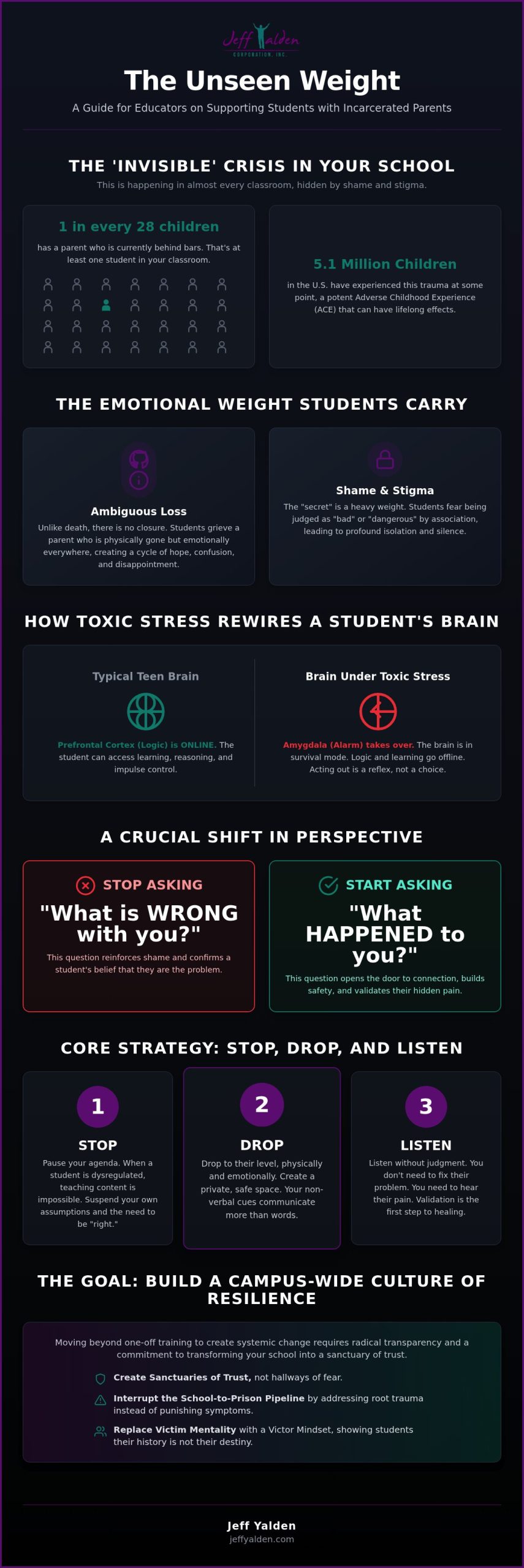
The numbers are staggering. According to the National Education Association, approximately 1 in 28 children in the U.S. has a parent who is currently incarcerated. When you look at the broader statistics on incarceration in the U.S., you see a system that leaves millions of families in its wake. Over 5.1 million children have experienced this trauma at some point in their lives. In 2026, the invisible crisis of parental incarceration remains a primary driver of the school-to-prison pipeline, as these students are significantly more likely to face suspension or expulsion than their peers. We have to interrupt this cycle now. We cannot keep punishing kids for the trauma they didn’t ask for and can’t control.
Why Stigma is the Primary Barrier
Shame is a liar, and it is incredibly loud. For a student, the “secret” of a parent in prison feels like a lead weight. They live in constant fear that if their peers or teachers find out, they will be labeled as “bad” or “dangerous” by association. This isolation is amplified in the social media age, where one viral post or news clip can expose a family’s darkest moment to the entire school. Implicit bias plays a massive role here, too. If we look at a student and see a “future inmate” instead of a hurting child, we’ve already failed them. We must strip away the labels and see the human being underneath the history.
Traditional discipline is a blunt instrument for a delicate problem. When these students act out, it is often a desperate cry for agency in a life where they have none. Suspensions don’t teach resilience; they only confirm the student’s belief that they don’t belong. We need to stop asking “What is wrong with you?” and start asking “What happened to you?” Supporting students with incarcerated parents requires us to move past the grade book and into the messy, raw reality of their daily lives. That is where real change starts.
The Emotional Weight: How Parental Incarceration Impacts Student Mental Health
When a parent is taken away, a child’s world doesn’t just stop. It shatters. I have looked into the eyes of students who are trying to process the raw pain of separation while sitting in a geometry class. It is impossible. Supporting students with incarcerated parents requires us to acknowledge that this isn’t just a difficult home life. It is a catastrophic emotional event. These kids are operating from a place of deep, unaddressed grief. They often build a thick, protective shell of anger or total withdrawal just to survive the day. If you see a student who is suddenly explosive or completely silent, don’t look for a discipline referral. Look for the trauma.
ACEs and the Developing Teen Brain
Parental incarceration is one of the most potent Adverse Childhood Experiences (ACEs) a person can endure. This isn’t just about feelings. It is biological. When a teen lives in a state of constant, toxic stress, their brain stays in survival mode. The prefrontal cortex, which handles logic and learning, goes offline. Meanwhile, the amygdala, the brain’s alarm system, is screaming all day. This is why acting out isn’t a choice. It’s a reflex. As a teen mental health speaker, I see this every day. We have to stop punishing the symptoms and start healing the source of the stress.
The Fear of ‘Like Parent, Like Child’
There is a terrifying internal narrative that haunts these students. They look at their parents’ situation and think, “Is this my future, too?” This fear of generational incarceration can paralyze their motivation. Why try in school if you think your path ends in a cell? We have to aggressively challenge this victim mentality. We need to replace it with a victor mindset. This starts by normalizing the conversation. When we talk about these hard topics openly, we lower the student’s cortisol levels. We give them permission to breathe. We show them that their history is not their destiny. Supporting students with incarcerated parents means showing them they are more than their family’s mistakes. When we bring these conversations into the light through high school assemblies, we start the process of collective healing.
Moving Beyond Silence: Creating Radical Safety in the Classroom
Silence is where shame breathes. When a student carries the secret of an incarcerated parent, they are living in a fortress of isolation. To start supporting students with incarcerated parents, you have to be the one to pick up the sledgehammer and break that wall down. This isn’t about a clinical intervention or a fancy new curriculum. It is about a fundamental shift in your soul. You have to stop looking at their behavior and asking “What is wrong with you?” and start looking at their heart and asking “What happened to you?” This isn’t a “special project” for a Tuesday afternoon. It has to be the air your classroom breathes.
The Power of Radical Transparency
Trust is not given; it is earned in the trenches of shared vulnerability. I don’t walk into a school as a distant expert with all the answers. I lead with my own imperfections. I talk about my own struggles and my own “junk.” Why? Because radical transparency is the only thing that invites a student to be honest about their own life. If you want them to stop hiding, you have to stop pretending you’ve got it all together. You create an affirming space when you treat them as a partner in a mission, not a “case” to be solved. This is the bedrock of building resilience in teens. They need to see that you are a “vulnerable authority” who isn’t afraid of their reality.
Representation and Storytelling
If the only time a student sees the justice system mentioned in class is through a “hero vs. villain” lens, you are alienating the kid whose father was just taken away in handcuffs. We have to be intentional. Use literature that features families like theirs. Bring in guest speakers who have lived through the system and came out as victors. This isn’t about being political. It’s about being real. When a student sees their story represented without judgment, they start to realize they don’t have to be owned by their past. They can own their story. They can decide that their parent’s mistake is a chapter in their book, not the whole ending. You are there to help them turn the page.
Actionable Strategies for Supporting Students Impacted by Incarceration
You don’t need a clinical degree to save a life. You just need to be a human being who is willing to stand in the gap. Supporting students with incarcerated parents often feels like walking through a minefield, but it doesn’t have to be that way. When a student finally decides to drop their guard, you have a massive responsibility to honor that moment. It’s about moving from a place of “What do I do?” to “How can I be present?” These kids don’t need your pity; they need your partnership.
- Step 1: Stop, Drop, and Listen. When a student discloses, drop the lesson plan. Put down your phone. Listen with your whole heart. This is the moment they’ve been terrified of, and your reaction will define their safety.
- Step 2: Validate the emotion. You don’t have to validate the parent’s crime to validate the child’s pain. Use phrases like, “It makes total sense that you’re feeling this way.”
- Step 3: Guard their privacy. Never broadcast their story in the teachers’ lounge. Connect them with resources quietly and only with their consent.
- Step 4: High expectations, high support. Pity is a poison that tells a student they aren’t capable. Keep the bar high, but build a massive ladder of support to help them reach it.
- Step 5: The consistent check-in. Don’t let the disclosure be a one-time event. Check in next week. Ask how they’re doing on Tuesday. Show them you haven’t forgotten.
The Disclosure Script: What to Say
The moment a student says, “My dad is in jail,” your brain might freeze. Don’t panic. Use simple, powerful phrases like, “I appreciate you trusting me with that,” or “I’m so glad you told me. How can I support you today?” Avoid toxic positivity. Never say “At least you have your mom” or “He’ll be out soon.” You don’t know that, and false hope is just another form of betrayal. The Golden Rule of Disclosure is to honor the student’s bravery with absolute presence and zero judgment.
Collaborating with School Counselors
You are the first line of defense, but you aren’t the only one. When a student opens up, you need to facilitate a “warm handoff” to the school counselor. Don’t just send them down the hall with a pass. That feels like a rejection. Instead, say, “I’d love for us to talk with the counselor together so we can make sure you have everything you need.” This preserves the trust you’ve built while getting them professional support. If your team needs more help with these transitions, my trauma-informed teaching professional development provides the exact framework schools need to handle these sensitive moments with confidence and care. Let’s stop guessing and start leading.
Ready to transform your staff’s approach? Inquire about Teacher Professional Development today.
Building Long-Term Resilience: Transforming Campus Culture
A one-off seminar is a band-aid on a bullet wound. It doesn’t work. If you want to change the trajectory for these kids, you have to change the energy of the entire building. Supporting students with incarcerated parents isn’t a box to check. It’s a commitment to systemic resilience. This means moving from crisis intervention to character education. We’re not just looking for a solution for today; we’re building a foundation for a lifetime. When we shift the campus culture, we remove the shadows where shame grows. We replace isolation with a community that refuses to let any child fall through the cracks.
This transformation starts from the stage. My high school assemblies are designed to do the heavy lifting of shifting peer perception. When I stand in front of a thousand students and lead with radical transparency, the atmosphere changes. We normalize the “hard” conversations. We make it safe for the student with a parent in prison to breathe. When the student body hears a message of empathy and shared struggle, the stigma begins to melt away. This isn’t just about a speech. It’s about a collective exhale that allows every student to feel seen and valued.
Staff Training: The Radical PD Shift
Teachers are the heartbeat of the school, but they’re often bleeding too. Supporting students with incarcerated parents is emotionally draining work. Secondary traumatic stress is a real threat to your staff’s well-being. If your educators are burnt out and overwhelmed, they can’t provide the sanctuary these students need. My professional development workshops focus on creating a unified front. We tackle the hard truths about trauma together. We give teachers the resilience training they need to stay in the fight. When the staff is healthy and aligned, the entire support system becomes unbreakable.
The ‘Victors’ Culture
We are building a campus of victors, not victims. A victor mindset is the belief that your history does not define your destiny. In a “Victors” culture, we celebrate growth moments with as much intensity as we celebrate academic achievement. We empower students to become fierce advocates for their own mental health. We show them that their struggle is a source of strength, not a reason for shame. Every student, regardless of their family background, needs to feel they can win at your school. This is the radical approach. It’s real, it’s raw, and it’s the only way to effect lasting change. Bring this movement to your school and watch your students rise.
Lead the Shift Toward Radical Resilience
We’ve walked through the raw reality of the invisible crisis. You now know that supporting students with incarcerated parents isn’t about clinical perfection; it’s about being a “vulnerable authority” who refuses to let shame win. We’ve covered how to move from asking “What’s wrong?” to understanding “What happened?” and how a single moment of judgment-free listening can rewrite a student’s entire future. This work is heavy. It’s fast-paced. It requires a heart that’s willing to be real and a commitment to systemic change.
I’ve spent 30 years in the trenches, serving over 4,000 schools worldwide as a Hall of Fame Youth Speaker and author of ‘The 24-Hour Rule’. I’m here to help you turn your campus into a sanctuary of hope where every child feels they can win. Don’t wait for another crisis to act. Book Jeff Yalden for a High School Assembly or Teacher PD Workshop and let’s start building a culture of victors together. You have the power to break the cycle starting right now. Let’s get to work.
Frequently Asked Questions
How common is it for students to have incarcerated parents?
It’s more common than most educators realize. Approximately 1 in 28 children in the U.S. has a parent currently incarcerated. This means in an average classroom of 28 students, at least one is carrying this secret burden. Over 5.1 million children have experienced this trauma at some point. These numbers highlight the urgent need for supporting students with incarcerated parents through proactive, trauma-informed strategies that break the silence.
What are the first signs that a student might be struggling with a parent’s incarceration?
Look for sudden, drastic shifts in behavior. A student might become uncharacteristically aggressive or retreat into a silent, “protective” shell. You’ll see a decline in academic engagement or a hyper-vigilance that looks like anxiety. These aren’t just “bad attitudes.” They are survival mechanisms for a child navigating ambiguous loss. When you spot these red flags, it’s time to stop the discipline track and start the connection track.
Should I tell the whole class if I find out a student’s parent is in prison?
Absolutely not. Privacy is the foundation of trust. Disclosing a student’s family situation without their explicit consent is a massive betrayal that can destroy your relationship and the student’s safety. Instead, focus on creating a classroom culture where “hard” topics are normalized generally. If a student chooses to share their story, honor that bravery, but keep the information strictly between you and the necessary support staff.
How can I help a student stay connected to an incarcerated parent?
You can provide a safe space for them to express their feelings about the separation. Help them navigate the logistics of communication, like writing letters or managing phone call schedules, if appropriate. Validate their desire to stay connected, even if the parent’s actions were harmful. Your role is to support the child’s emotional needs, not to judge the parent’s history or the legal system’s decisions.
What is the difference between trauma-informed teaching and clinical therapy?
Trauma-informed teaching is about the environment and the approach, not clinical treatment. As an educator, you are creating a “sanctuary” where students feel safe enough to learn. You are identifying triggers and providing emotional regulation tools. Clinical therapy, which I don’t provide, involves a medical diagnosis and long-term treatment plan. We are the first responders who build the bridge to that professional support when it’s needed.
Can a school assembly really help students with incarcerated parents?
Yes, because it changes the energy of the entire building. A high-impact assembly doesn’t just target one student; it shifts peer perception for everyone. When I lead with radical transparency, I make it safe for every student to own their “junk.” This breaks the isolation that comes with supporting students with incarcerated parents. It turns a “secret” trauma into a shared mission of resilience and collective growth.
How do I handle my own biases about the criminal justice system as a teacher?
Start by practicing radical transparency with yourself. Acknowledge your biases so they don’t leak into your interactions. Remember that the child is not the crime. Your job isn’t to litigate the justice system; it’s to advocate for the human being in front of you. Shift your focus from the parent’s mistake to the student’s potential. Being a mentor-guide means leading with empathy, even when the situation is messy.
What resources are available for families of incarcerated individuals?
Many states are now implementing action plans that include child-friendly visiting spaces and affordable communication. Look for dedicated mentoring programs that specialize in supporting youth with incarcerated parents. Schools can also partner with local community organizations to provide holistic support. Your school counselor is a vital link here, helping families navigate the complex web of social services while maintaining the student’s dignity and academic focus.
