
A powerful senior class motivational speaker is booked by matching the message to students’ needs, then giving the speaker clear direction about the event and what students should take away. Live and virtual fees depend on the event’s format and requirements, with pricing provided after a quote request. The right choice isn’t just a big moment on stage. It’s a message seniors can carry with them.
You want students to leave feeling seen, steadier, and more confident about what comes next. You also need a program that fits your school, schedule, and budget. This guide explains how to book a speaker, compare live and virtual event costs, and choose a presentation focused on student motivation, confidence, and wellness.
We’ll cover what to share when booking, what shapes an event fee, and how to prepare the room so students can engage with the message. You’ll also learn how a high school assembly speaker can support seniors as they face change, pressure, and the next chapter.
Key Takeaways
- Give the speaker a clear brief about your seniors, event goals, and the message you want students to carry forward.
- Compare live and virtual formats by considering the event setup, audience experience, and presentation requirements that shape the quote.
- Choose a message that connects motivation and confidence with the real pressures students face as they prepare for what comes next.
- Look for a speaker who can communicate with teens, hold students’ attention, and handle sensitive topics with care.
- Prepare the event space and audience so students can hear, engage with, and reflect on the presentation.
Booking a motivational speaker
A successful booking starts with a clear purpose, not a famous name. Define what seniors need, then give the speaker practical direction to shape a focused, actionable presentation.
Speaker Selection and Qualifications
Choose a speaker who understands high school audiences and connects inspiration to students’ everyday choices. Look for clear communication, relevant experience with teens, and a grounded approach to emotional subjects. Ask how the speaker adapts examples for graduating seniors. A strong fit can discuss confidence and change without assuming every student shares the same experience.
Use a short research process before choosing a senior class motivational speaker. Review a full talk or substantial recording, not just a highlight reel. Notice whether the speaker holds attention and makes ideas easy to understand. Then share the school’s goals, audience, event format, and themes to address. Give the speaker clear direction about what to prepare for the presentation.
Make the booking process actionable with these steps:
- Write down the purpose, such as transition planning or student connection.
- Describe the senior class, including relevant interests and school context.
- Share the event schedule, room setup, and audience size.
- Identify subjects that need careful handling and the message students should remember.
Before the event, assign one staff lead to coordinate details. Keep group business to a minimum during the presentation, or handle it afterward. Check that everyone can hear, and encourage microphone use for a large audience. A clear introduction and thank-you also signal when the presentation begins and ends.
Alternatives include an alumni panel, a student-led discussion, or a teacher-facilitated reflection activity. Choose the format that best fits the class’s goals, available speakers, and appetite for peer conversation or outside inspiration.
Assembly Length and Scheduling
There’s no single ideal length for every senior assembly. Set the presentation time around the school schedule, the speaker’s message, and students’ capacity to participate. Leave room for an introduction, the main talk, and questions or reflection if included. Share the available time before booking so the speaker can shape a complete session rather than rush the final point.
A session built around one central message may need a different schedule from one that includes student questions. Place it where seniors can arrive, settle, and hear clearly. Avoid competing announcements or routine group business. Ask the speaker which transitions need time, then coordinate the run of show with staff.
Discuss sensitive topics before the event, including mental health, suicide, trauma, and personal stories that could affect students. Agree on language and boundaries, and explain the school’s process for responding if a student asks for support. This preparation helps the speaker address difficult realities with care while keeping the event focused and respectful.
Motivational speaker fees for live and virtual events
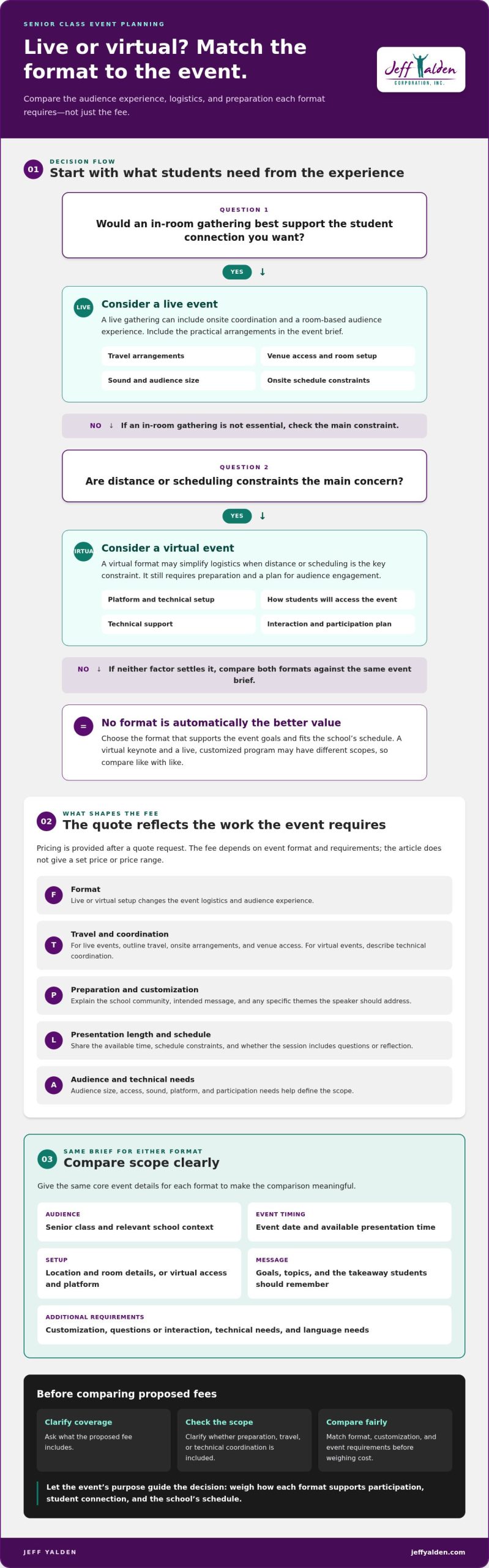
Live and virtual bookings are priced around the work each event requires. Format matters, as do travel, preparation, presentation length, and the message the school needs. A live senior class event may involve travel and onsite coordination. A virtual session changes those logistics but still calls for thoughtful preparation and clear audience engagement.
Compare event formats by listing what each requires. For a live gathering, account for travel arrangements, venue access, sound, and presentation time. For a virtual event, consider the platform, technical setup, audience access, and how students will participate. Neither format is automatically the better value. Choose the one that supports your goals and fits your school’s schedule.
For a useful comparison, describe the same event details for each format: the senior audience, event date, location or virtual setup, presentation length, and topics. Explain whether the speaker should tailor the message to a particular school community. Clear details show whether the event is a straightforward presentation or requires substantial customization.
The price of a speaker booking depends on the event and is provided after a quote request. Cost factors include format, travel, preparation, presentation length, and technical or scheduling needs. A school’s requirements may differ from those of a college, association, or community organization. Don’t compare a virtual keynote with a live, customized program as if they have the same scope.
- Live event: Include travel, onsite arrangements, room setup, and any schedule constraints.
- Virtual event: Describe the platform, audience access, technical support, and interaction plan.
- Either format: Share the audience, topics, message, and language needs before requesting a quote.
Before choosing, ask what the proposed fee covers and how the format affects the session. Clarify whether preparation, travel, or technical coordination is part of the quoted scope. For example, a school planning an online senior event can explain how students will join and whether questions are part of the program. These details create a practical basis for discussing fit.
Budget decisions should follow the event’s purpose, not a fee alone. If direct student connection is central, weigh how each format supports participation. If scheduling or distance is the main constraint, a virtual event may simplify logistics. Explore senior event planning details as you shape the format and scope.
Student motivation and confidence
A strong presentation connects motivation to the choices seniors face after graduation. Give students a purpose they can act on, not just a burst of energy.
Motivation and Confidence Themes
Look for themes that help students recognize strengths, handle setbacks, and ask for support. Practical examples can make confidence more tangible: naming a goal, identifying a barrier, and choosing a next step. A speaker can offer perspective without suggesting one story fits every student. That balance makes inspiration relevant to a school’s varied experiences.
Real examples can make persistence tangible without promising identical results. Chris Nikic became the first person with Down syndrome to complete an Ironman triathlon at age 21 in 2020. Ryan Shazier was told he had a 20% chance of ever walking again after his injury. These stories can open discussion about resilience, while making room for different paths and needs.
Topics for Graduating Seniors
Graduating seniors may be weighing college, work, military service, family responsibilities, or another path. A relevant talk can address decision-making, self-advocacy, belonging, uncertainty, and supportive relationships. The focus should be the transition students are entering, not a distant life stage. Ask which topics fit your class rather than treating every senior audience as identical.
Graduating classes bring different communities and expectations into the same room. Students heading to college, for example, may be thinking about independence, while those entering work may be focused on asking for help and adapting to new routines. A useful presentation respects both experiences and doesn’t rank one path above another. The goal is a message students can apply to their own next step.
Talks Tailored to Senior Students
Speakers tailor talks using the school’s goals, students’ transition plans, and relevant local examples. Share themes students are already discussing, along with language that feels respectful and accessible. The speaker can then shape stories and activities around the audience instead of delivering a generic graduation speech. Ask for one clear takeaway students can remember and use.
To tailor a talk, provide the event’s purpose, audience context, topics to emphasize, and any sensitive subjects that require care. How do motivational speakers tailor talks to graduating seniors? They connect stories and practical steps to students’ real transitions, then adapt examples and language for the school community.
Plan how to assess the presentation before and after the event. Ask students to name one idea they remember, one next step, or one question they still have. Staff can review responses for patterns and use them to guide follow-up discussions. How can schools measure the impact of a senior class motivational speaker? Compare student reflections with the event’s stated goals, without treating a single assembly as proof of lasting change.
What topics do motivational speakers cover for high school seniors?
Useful talks connect big ideas to situations seniors may recognize, from choosing a next step to handling pressure. The strongest topic is one students can discuss and use afterward.
Making Choices After Graduation
Graduation can lead to different paths, and a presentation can help students think through decisions without ranking them. A speaker might ask students to compare what matters in a college choice, a first job, or a gap year. The discussion can focus on values, available support, and questions to ask before committing.
Purpose can also take shape through everyday actions. A student who wants to support family might connect that value to training, employment, or asking a counselor about options. A speaker can encourage students to define success for themselves, then identify a next step they control. That makes purpose less abstract and more useful after the assembly.
Handling Setbacks and Pressure
Speakers may address disappointment, fear of failure, and pressure to appear certain. A practical example could show how to respond after a rejected application: pause, seek feedback, and decide what to try next. Not every setback has an easy answer. The point is that students can consider their choices and reach for support.
Social pressure deserves direct, respectful discussion. Students may feel pulled to follow friends, hide uncertainty, or present a polished version of themselves online. A talk can invite them to notice those pressures and practice setting boundaries. For instance, students might rehearse saying, “That’s not right for me,” without criticizing someone else’s choice.
Belonging, Relationships, and Wellbeing
A senior audience includes students with different responsibilities and experiences. Topics can include changing friendships, asking for help, healthy communication, and staying connected during transitions. One concrete activity might ask students to name a trusted adult or peer they could approach. For sensitive mental health subjects, align the discussion with the school’s support procedures.
Some talks also explore leadership and community responsibility. Seniors can consider how they want to contribute, whether by mentoring younger students, joining a local group, or showing respect during disagreement. These examples make social responsibility visible through everyday choices. They also show that leadership isn’t limited to students with formal roles—a principle central to personal development practices like Charlie Whalley Coaching, which support individuals and emerging leaders through major life transitions.
Before selecting topics, staff can gather student questions through a class discussion or anonymous prompt. Group those questions into themes, such as independence, relationships, or handling change. Then share the themes with the speaker and agree on the central takeaway. This simple preparation helps the presentation meet students where they are, rather than delivering a generic graduation message.
Keep the scope clear. A motivational presentation can open a conversation and offer reflection, but it should not be presented as individual clinical care. If the session includes mental health or personal hardship, coordinate the language and follow-up with school staff. That boundary protects the event’s purpose while making room for honest, human discussion.
What qualifications should a high school senior motivational speaker have?
A strong speaker needs more than a polished story. Evaluate how they connect with teenagers, handle sensitive subjects, and turn ideas into practical choices. For a senior class, relevance is key: students should recognize their own questions in the speaker’s examples, even when their plans differ.
Start with evidence of live presentation skill. Watch original footage showing the speaker addressing a live room, including a full-length talk or substantive segment from the last 18 months. Notice whether students stay engaged, the speaker communicates clearly, and the message suits a school setting. A short highlight reel can show energy, but it may not reveal how a full presentation develops.
Experience with teen audiences matters because examples and language need to fit students’ lives. Look for talks that address young people directly, rather than a corporate speech with only superficial changes. For example, a speaker discussing setbacks should connect the story to choices seniors can make, such as seeking feedback or asking a trusted adult for support.
Assess how the speaker approaches emotional and mental health topics. A responsible presentation avoids shame, simplistic advice, and pressure to disclose personal experiences in front of classmates. Ask how the speaker handles sensitive material and keeps the event focused. Schools should also plan staff support and follow-up around topics that may raise personal concerns.
- Audience fit: Confirm the speaker has relevant experience engaging high school students.
- Message clarity: Identify the main takeaway and a practical example students can apply.
- Topic care: Discuss sensitive themes, boundaries, and appropriate language before the event.
- Live delivery: Review recent footage of a complete talk or substantial live segment.
Credentials alone don’t show whether a speaker can hold a room or respect a diverse audience. Consider how they answer questions, adapt examples, and respond when students express different views. Compare the speaker’s stated approach with an actual presentation. Look for consistency in the message, tone, and way they engage students.
Before booking, give the speaker a concise brief: senior class context, event purpose, schedule, topics, and any subjects requiring care. Then discuss the presentation approach and expected student takeaway. These details help determine whether the speaker fits your school’s needs. Review speaker qualifications and approach as you assess the right fit for your senior event.
Group leaders should consider members’ interests and physical limitations, check that everyone can hear, and encourage microphone use for large groups. Introduce and thank speakers to signal when the presentation begins and ends.
Jeff Yalden: High School Assemblies
Jeff Yalden’s High School Assemblies give schools a way to bring student motivation, confidence, and mental wellness into a shared conversation. Turn to a High School Speaker when seniors need a presentation shaped around their school community and the transition ahead. A clear event purpose and student context help make the message relevant, whether the focus is resilience, mental health, or thoughtful next-step choices.
Jeff Yalden also offers Teen Motivational Speaker and High School Assembly Programs. These are school presentations, not a substitute for clinical counseling or individualized care. If your goal is to create space for honest discussion and encourage students to reflect on their choices, outline the audience and event goals as you plan.
Visit jeffyalden.com to contact Jeff Yalden about a high school assembly.
Give Seniors a Message They Can Carry Forward
The final school assembly can be more than a farewell. It can give seniors space to pause, recognize how far they’ve come, and choose what they want to carry into the next chapter. A senior class motivational speaker should make that moment feel grounded in students’ lives, not like another speech they’re expected to applaud and forget.
Start with one question: what do you hope students will remember when they leave? That answer can guide the event’s focus and help your school decide whether Jeff Yalden’s approach fits. Jeff offers High School Assemblies and High School Assembly Programs, and speaks as a Teen Motivational Speaker. The next step is a conversation about your seniors, your event, and the message you want to make meaningful.
Contact Jeff Yalden about your event. Give your graduating class a moment to feel seen, reflect honestly, and step toward what comes next with purpose.
Frequently Asked Questions
What does a senior class motivational speaker do?
A senior class motivational speaker delivers a presentation that helps students reflect on their experiences and approach the transition beyond high school. The talk may use personal stories, practical examples, and prompts to consider goals or sources of support. For instance, a speaker might invite seniors to identify a challenge they’ve handled and a strength they can carry forward. An assembly can encourage reflection, but it isn’t clinical care.
How much does it cost to hire a motivational speaker for a senior class?
The price depends on the event and is provided after a quote request. Cost factors include whether the presentation is live or virtual, travel, preparation, session length, and technical or scheduling needs. To make a request useful, share the event date, location or online format, audience, and goals. Your school can then compare the proposed scope with its available event budget, rather than relying on a general industry estimate.
How do schools find and vet senior class speakers?
Start by identifying the event’s purpose, then assess whether the speaker’s message fits that goal and the students attending. Invite a small review group, such as an administrator, counselor, and senior representative, to discuss the presentation’s relevance and tone. Ask each person to note what feels useful, unclear, or mismatched. A shared review can surface concerns early and help staff agree on what students should take away.
