
After a student dies by suicide, the school’s first message matters. So does what happens next. A thoughtful postvention response in a school setting protects privacy, helps preserve connection, guides students toward support, and reduces the risk of further harm.
If you’re unsure what to say, who should coordinate the response, or how to address rumors without sharing private details, you’re not alone. Schools need to move carefully, but they don’t have to work out every step in the middle of a crisis.
This guide offers a practical path for responding with compassion and care. You’ll learn how a school crisis team can coordinate communication, connect affected students and staff with appropriate support, and plan for follow-up beyond the first few days. We’ll also cover privacy, safe memorialization, and how educator training can contribute to broader preparedness. The goal isn’t to find perfect words. It’s to respond together, avoid speculation, and keep showing up for the school community over time.
Key Takeaways
- A coordinated postvention response in a school setting starts with the school crisis team, verified information, and clear roles.
- Use brief, compassionate, approved communication to address rumors while protecting the student’s and family’s privacy.
- Connect affected students, staff, and families with appropriate support, then plan follow-up as needs change.
- Keep school crisis functions, licensed clinical care, and supplementary education distinct, with clear coordination between them.
- Prepare your team by following district procedures and checking that any outside support fits the audience and the school’s needs.
What postvention response in a school setting means, and why it matters
A suicide death can leave a school community grieving, unsettled, and unsure what to do next. A postvention response in a school setting is the coordinated support and communication a school organizes after a suicide death affects its community. It helps staff respond with care, share verified information, and connect people with appropriate support while respecting the family’s privacy.
Postvention includes supporting people affected by a suicide and reducing the risk of further harm. It doesn’t replace prevention. Prevention aims to identify concerns and strengthen support before a death occurs; postvention responds to the loss and its effects. The two connect through ongoing care: a response can help the school notice who may need additional support and guide them toward qualified help. No single action can guarantee a particular outcome, but preparation can reduce confusion and isolation at a painful time.
How school postvention differs from prevention and crisis response
Immediate crisis coordination is one part of postvention, not the whole response. The school may need to confirm information, align staff, and communicate carefully. Support can then continue through established school processes as students and staff respond to the loss. Follow district protocols and involve qualified local professionals. A school crisis team or outside speaker can’t replace licensed clinical care or emergency services.
Who belongs on the school response team?
Clarify roles before a crisis. Depending on district policy and the situation, coordinators may include school leadership, counselors, communications staff, and district contacts. Families and community partners may also be involved when appropriate, with privacy and the family’s wishes in mind. Licensed mental health professionals should guide student assessment and referrals, especially when someone’s safety or clinical needs require qualified evaluation.
A prepared team gives staff a clear place to bring questions and concerns. It can help prevent conflicting messages, establish a consistent path to support, and make sure concerns reach the right professionals rather than being handled through guesswork. Structure matters, as does the human response: listen without pressure, respect each person’s grief, and recognize that students and adults may need different kinds of help.
Schools can strengthen readiness through district planning and educator training. Supplementary education, including programs focused on teen mental health and suicide prevention, may support broader preparedness when coordinated with school protocols and qualified local professionals. Keep the roles distinct: education can help a community prepare and learn, while the school response team and licensed clinicians lead crisis coordination and clinical care.
The first school response steps after a student suicide
The first hours can bring urgent questions and incomplete information. Resist the pressure to fill every silence. A steady postvention response in a school setting follows district protocols, involves qualified local professionals, and gives staff one clear process to follow.
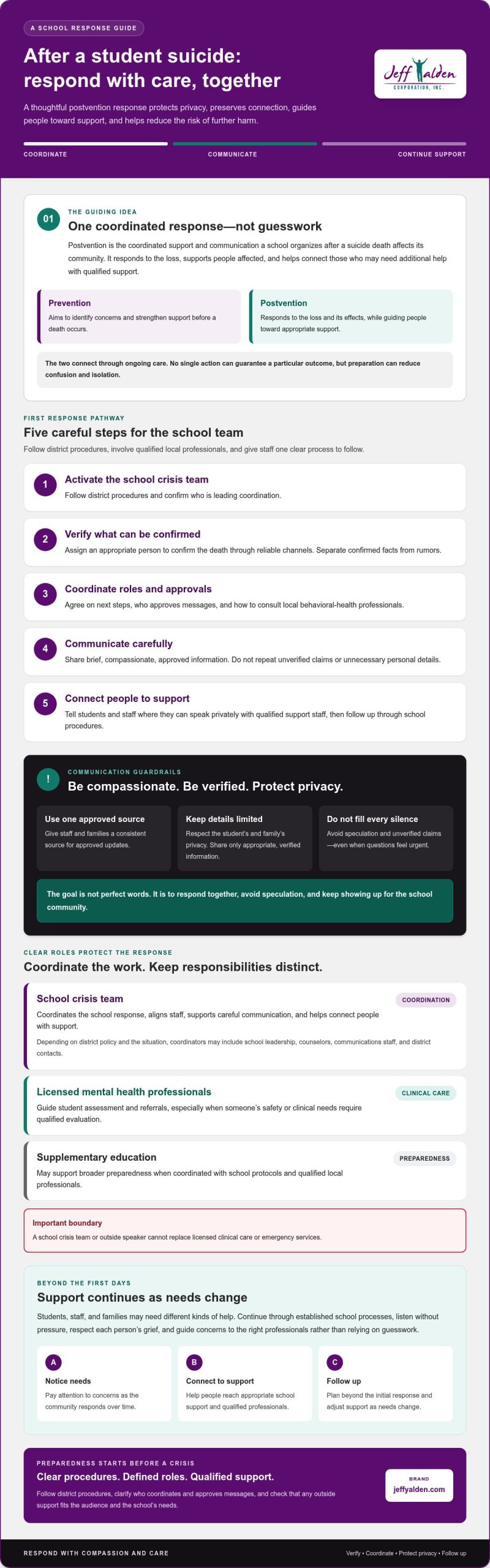
Start by activating the crisis team, verifying what can be confirmed, coordinating with the appropriate people, communicating through an approved source, and connecting affected students and staff with support.
- Activate the school crisis team. Follow district procedures and confirm who is leading coordination.
- Verify information. Assign an appropriate person to confirm the death through reliable channels before any announcement. Separate confirmed facts from rumors.
- Coordinate the response. Agree on roles, next steps, and who approves messages. Consult local behavioral-health professionals.
- Communicate carefully. Share brief, compassionate, approved information. Don’t repeat unverified claims or unnecessary personal details.
- Connect people to support. Tell students and staff where they can speak privately with qualified support staff, then follow up through school procedures.
Coordinate before communicating with the school community
Before sending a message, identify who verifies information and who approves communication under district policy. Coordinate with the family and relevant authorities when appropriate and permitted. Give staff and families one consistent source for approved updates, such as a designated school contact or official communication channel. This can reduce conflicting accounts without suggesting the school can answer questions it hasn’t verified.
Use direct, caring language. Don’t speculate about circumstances, share private details, or describe the death in sensational terms. If students bring up rumors, acknowledge their concern and direct them to confirmed information and available support.
Connect students and staff with immediate support
Make clear where students can talk privately with qualified support staff and how to ask for help. Consider who may be especially affected, including close friends, classmates, siblings, and staff members. Don’t assume that only people who were visibly close to the student are grieving or struggling.
If someone may be in immediate danger, follow the school’s established safety and referral procedures and involve qualified professionals or emergency services as required. School staff shouldn’t manage an urgent safety concern alone or treat a general announcement as a substitute for an individual assessment.
Preparation helps staff understand their roles before pressure builds. Educator professional development focused on teen mental health and crisis intervention may contribute to broader school readiness when coordinated with district protocols and qualified local professionals. It’s supplementary education, not a replacement for the school crisis team, clinical care, or emergency response.
How to address privacy, rumors, and concerns about saying the wrong thing
Silence can feel like the safest choice, but when students have no clear information, rumors may fill the gap. A thoughtful postvention response in a school setting avoids both extremes: it protects private details without leaving the community to guess. Share a brief, compassionate message approved through the school’s communication process, and make support options easy to find.
Keep the message grounded in what the school has verified and is permitted to share. Respect the family’s privacy, follow district policy and applicable legal requirements, and coordinate with the family when appropriate. Don’t speculate about circumstances or repeat claims heard on social media. Avoid sensational language and details about the method of death. The purpose is to inform and guide, not to explain what the school can’t confirm or disclose.
What should a school say after a student suicide?
Use clear, age-appropriate language. Avoid euphemisms that may confuse students, while keeping the message focused on the loss, care, and available help. This simple framework can help keep communication consistent:
- Acknowledge the loss: Recognize that the school community is grieving and express care for those affected.
- Share verified information: State only what’s approved for release. Don’t include private details or describe the method or circumstances.
- Name support and updates: Tell students and staff where they can speak with qualified support staff and how the school will share further information.
For example, a school might say: “We’re saddened to share that a student in our community died by suicide. We’re thinking of the student’s family, friends, and everyone affected. Students and staff can speak with [designated support contact or team]. We’ll share any approved updates through [official channel].” Adapt the wording to district procedures, the audience’s needs, and what the school is authorized to share.
How can staff respond to rumors and difficult questions?
Give staff consistent language so no one is left to improvise. They might say, “I can’t confirm that, so I don’t want to repeat it. Let’s check the school’s official update, and I can help you connect with support.” This acknowledges the question without amplifying speculation.
Listen calmly. A student may need a caring adult more than a complete answer. Staff can acknowledge uncertainty, answer only within their role, and refer concerns through established support pathways. Don’t promise confidentiality. Explain that if someone may be in danger, staff must follow school safety procedures and involve the appropriate support people. Clear boundaries can protect trust while ensuring serious concerns reach qualified professionals.
How schools can sustain postvention support after the first days
The first days call for urgent coordination. The weeks that follow call for attention and continuity. Grief doesn’t follow a school calendar, and people may need different kinds of support at different times. A thoughtful postvention response in a school setting builds follow-up into the plan instead of assuming the initial response is enough.
Use the school’s established support team to assign responsibility for check-ins and next steps. Make a plan that fits district procedures, professional guidance, and community needs. It may include checking how students and staff are doing, reminding them where support is available, and reviewing whether referrals or additional help are needed. A student who appears composed may still be struggling, while another may prefer space. Offer support without pressuring anyone to share more than they’re ready to share.
Build a follow-up plan without imposing a fixed timeline
Set clear ownership rather than a one-size-fits-all schedule. The designated team can decide when to reconnect, who will handle outreach, and how concerns will be passed to qualified local providers or community resources. Respect privacy by sharing information only as permitted and necessary for coordinated support. Adjust the plan as needs emerge, and make sure students and families know how to seek help through established school channels.
Keep the focus on connection. A brief, private check-in can give someone room to ask for help, even if they weren’t ready earlier. If staff notice a concern involving safety or clinical needs, they should consult the designated professionals and follow school referral procedures rather than trying to assess or manage it alone.
Support staff who are carrying the response
School staff may be supporting students while grieving or managing their own reactions. Give them clear guidance about available resources, who to contact with concerns, and what to do if a student needs more support. Encourage staff to consult designated professionals and make room for them to seek appropriate support for themselves. Educator professional development, including trauma-informed teaching, can strengthen staff readiness as part of broader school preparedness. It doesn’t replace clinical care or the school’s crisis protocols.
After the immediate response, bring the team together to review what worked, where communication or coordination was unclear, and what should change. Protect private information during the review. Use lessons learned to update district procedures and preparedness, not to judge individuals who were working under pressure.
For support with educator learning around teen mental health and crisis intervention, explore Jeff Yalden’s educator professional development. This supplementary education can complement a school’s broader efforts when coordinated with established protocols and qualified local professionals.
Prepare your school team, and choose support that fits its role
Outside support can add value, but only when its role is clear. In a postvention response in a school setting, school leaders should distinguish who coordinates the response, who provides clinical care, and who offers education. These functions can work alongside one another, but they aren’t interchangeable.
- School-led crisis response: The school team follows district protocols, coordinates communication, and connects students and staff with established supports.
- Licensed clinical care: Qualified mental health professionals assess individual needs, guide referrals, and provide clinical services within their scope.
- Supplementary education: Assemblies and educator professional development can support learning and preparedness. They don’t replace crisis protocols, clinical care, or emergency services.
That distinction protects students and sets honest expectations. An educational program may contribute to a broader plan, but no speaker or assembly should be presented as a clinical intervention or a promise of specific outcomes.
What should school leaders ask before engaging outside support?
Ask how the provider will coordinate with school leadership and qualified mental health professionals. Confirm the intended audience, learning objectives, safeguarding practices, and what the program does and doesn’t provide. Clarify how concerns raised during a program should be passed to the school’s designated support team. Look for relevant experience, a fit with the community’s needs, and clear limits. Be cautious of guaranteed clinical outcomes or claims that one approach works for every student.
Where Jeff Yalden’s school programs may fit
Jeff Yalden provides school assemblies and educator professional development focused on teen mental health, suicide prevention, crisis intervention, and resilience. These offerings may fit as supplementary education when they align with a school’s goals and are coordinated with its response team and qualified local professionals. They aren’t a substitute for the team’s leadership or licensed clinical care.
Consider the timing and purpose. A school may use educator training as part of broader preparedness, or consider an assembly when educational programming suits its community and current plan. Let district procedures, professional input, and the needs of students and staff guide the decision. Prevention planning remains part of the bigger picture, alongside the response and support that follow a death.
If your school is weighing educational support, discuss whether an assembly or educator professional development fits your community’s goals and the role your team needs it to play.
Keep showing up with a thoughtful plan
A compassionate postvention response in a school setting depends on more than the first announcement. Follow district protocols, share only verified information, connect students and staff with appropriate support, and keep checking in as needs change. Clear roles help the school community respond with care without asking one message or one person to carry everything.
Preparation matters, too. School-led crisis coordination, licensed clinical care, and educational programming each have a distinct role. Jeff Yalden’s school assemblies focused on teen mental health, suicide prevention, and resilience, along with educator professional development and community programs, can offer supplementary support when they fit the school’s goals and are coordinated with its response team and qualified local professionals. They don’t replace crisis protocols or clinical care.
If your school is considering educational support for broader preparedness, explore school programs and educator support with Jeff Yalden. Thoughtful planning can’t erase a painful loss, but your team can help students, staff, and families feel less alone and better supported as they move forward together.
Frequently Asked Questions
What is postvention in a school setting?
Postvention is the coordinated response and support a school provides after a suicide death affects its community. A postvention response in a school setting may include careful communication, support for students and staff, and follow-up as needs change. It’s distinct from prevention, which focuses on reducing risk before a death, but both are part of a wider commitment to student well-being. Follow district procedures and involve qualified local professionals.
What should a school do first after a student dies by suicide?
Activate the school crisis team and follow district protocols. The team should confirm information through appropriate channels before sharing it, assign communication and coordination roles, and consult qualified local behavioral-health professionals. Then provide approved updates and make clear where students and staff can access support. Don’t rely on rumors or ask staff to investigate on their own. If someone may be in immediate danger, follow established safety procedures and contact emergency services as needed.
What should a school say to students after a classmate dies by suicide?
Use clear, age-appropriate language that acknowledges the death and offers care without describing the method or circumstances. Share only verified information approved through the school’s communication process. Name where students can speak privately with qualified support staff and explain how further updates will be shared. Staff don’t need to answer every question on the spot. They can acknowledge uncertainty, avoid speculation, and help students connect with support.
How can schools support students affected by a suicide?
Make support easy to find and responsive to individual needs. Let students know which qualified school support staff they can approach privately, and use established referral pathways for additional care. Pay attention to close friends, classmates, siblings, and students who may have other personal connections to the loss. Don’t assume everyone who is struggling will show visible distress. If a student may be in danger, follow school safety procedures and involve qualified professionals.
Should a school tell students that a death was by suicide?
When the death has been confirmed and disclosure is approved under school procedures, clear, careful language can help avoid confusion and rumors. Coordinate with the family and relevant authorities as appropriate, and respect privacy and applicable requirements. Don’t share personal details or describe the method. If the school can’t confirm or disclose information, staff should say so plainly, direct students to official updates, and still explain where they can find support.
How long should postvention support continue at a school?
There isn’t one fixed timeline that fits every school community. Continue support through the school’s established team, checking in as appropriate and adjusting the response as students’, staff members’, and families’ needs become clearer. Make follow-up responsibilities clear, and coordinate referrals with qualified local providers when needed. Some people may seek help later, even if they appeared composed at first. Review the response afterward and use lessons learned to improve school procedures.
Who should be on a school postvention response team?
Follow district policy when identifying the team. Potential coordinators may include school leaders, counselors, communications staff, and district contacts. Licensed mental health professionals should guide clinical assessment and referrals. Families and community partners may be involved when appropriate and consistent with school procedures and privacy needs. Clarify who verifies information, approves messages, coordinates support, and handles safety concerns so staff know where to bring questions instead of improvising during a difficult moment.
Can a speaker or assembly replace a school’s suicide postvention plan?
No. A speaker or assembly may offer supplementary education, but it can’t replace school crisis protocols, the response team, licensed clinical care, or emergency services. Jeff Yalden provides school assemblies focused on teen mental health, suicide prevention, and resilience, as well as educator professional development and community programs. School leaders should check that any program fits their goals and audience, then coordinate it with the team and qualified local professionals.
