
Your crisis checklist is lying to you. It says that once the immediate danger passes and the bells ring again, the work is done. But you know better. You’ve seen the hollow looks in the hallways and felt the heavy, suffocating silence in the teacher’s lounge. True school safety and mental health integration isn’t about checking boxes or filing reports by a deadline. It’s about the messy, heart-wrenching, and vital work of postvention. You’re likely terrified of suicide contagion, exhausted by your staff’s secondary trauma, and feeling the crushing pressure to pretend everything is “normal” when your world has been upended.
I’ve been in those hallways. I’ve stood where you are standing, and I’m telling you there’s a way through the darkness that doesn’t involve clinical detachment. This guide is your roadmap for a human-centered recovery. We’re moving beyond sterile protocols to focus on what actually works: restoring hope to your students and protecting your grieving staff. We will explore how to leverage new 2026 resources and legislation to build a culture of resilience. You’ll learn how to lead with radical transparency and transform a period of unimaginable pain into a foundation for lasting strength. Let’s get to work.
Key Takeaways
- Master the first 48 hours by choosing radical transparency over clinical perfection to build immediate trust with your community.
- Discover why suicide postvention is the most critical form of school safety and mental health integration for preventing future crises.
- Learn how to protect your staff from secondary trauma by prioritizing their mental health before they attempt to lead student healing.
- Gain a practical script for talking to students that validates their raw emotions without accidentally glamorizing the tragedy.
- See how an outside perspective can break through the emotional fog on campus to restore a sense of hope and future growth.
Immediate Post-Tragedy Response: The First 48 Hours for School Leaders
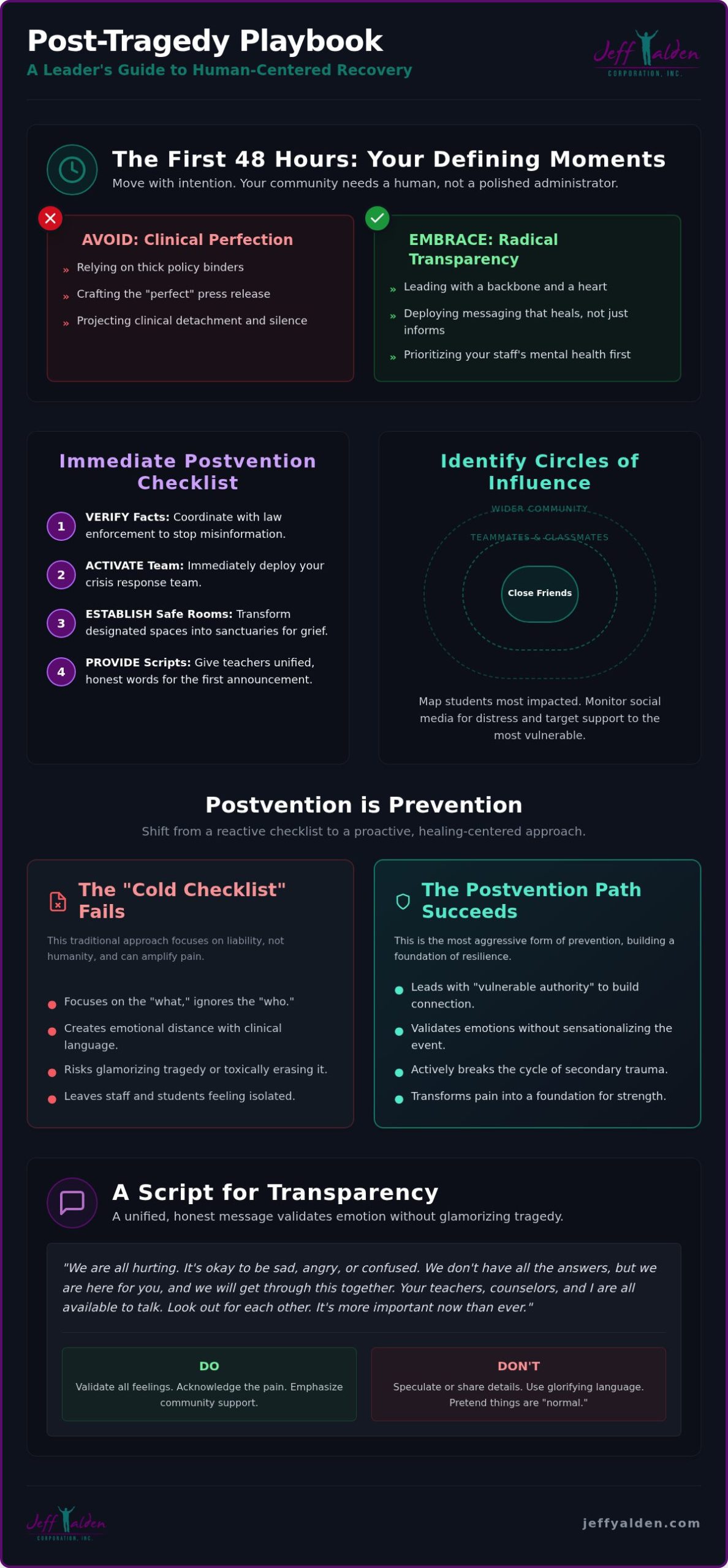
The first 48 hours after a tragedy are a visceral, bone-deep test of your leadership. You don’t need a thick binder of policies right now. You need a backbone and a heart. This is where school safety and mental health integration moves from a concept in a meeting to a lifeline on the ground. You have to move fast, but you must move with intention. Forget the “perfect” press release. Your community doesn’t want a polished administrator. They want a human being who is hurting alongside them. Radical transparency is your only path forward. If you don’t tell the truth, the rumors will fill the void. Rumors breed fear. Fear breeds contagion.
Your command center isn’t just for logistics. It’s for emotional coordination. While law enforcement handles the perimeter, you must handle the soul of the campus. This means drafting messaging that heals rather than just informs. Every word you send out should aim to lower the collective heart rate of your district. Most importantly, you have to look at your staff first. Your teachers are the frontline. They are terrified. If you don’t debrief them and give them space to breathe before they face a room full of grieving students, you’re setting them up for a total collapse. Understanding established crisis intervention models helps with the structure, but your presence provides the peace.
The Immediate Postvention Checklist
Speed matters, but accuracy is everything. Before you hit send on any public statement, verify the facts with law enforcement to stop the spread of misinformation. Activate your crisis response team immediately and transform designated “Safe Rooms” into sanctuaries for grief, not just holding pens. Give your teachers a “Real and Raw” script for that first announcement. They shouldn’t have to hunt for words when their voices are shaking. Your goal is to provide a unified, honest message that acknowledges the pain without sensationalizing the event.
Identifying Circles of Influence
Grief doesn’t hit everyone the same way. You must map the students most impacted by the tragedy, including close friends, teammates, and even neighbors. Watch the digital hallways. Monitor social media patterns for signs of high-risk distress or dangerous misinformation. Pay special attention to the “quiet” kids who have experienced previous trauma; they are often the most vulnerable when a new crisis hits. Deploy targeted support to these specific groups early to break the cycle of secondary trauma before it takes root.
The Psychology of Postvention: Why Traditional Crisis Response Often Fails
Most crisis plans are cold. They are checklists designed for insurance adjusters and legal teams. But a grieving campus doesn’t need a checklist. It needs a soul. Traditional response fails because it focuses on the “what” and ignores the “who.” One loss doesn’t stay in one classroom. It vibrates through the entire district like a seismic shock. This ripple effect can trigger old wounds in staff and students alike. Suicide postvention is actually the most aggressive form of prevention you have. If you don’t handle the aftermath with intention, you’re leaving the door wide open for contagion. This is where school safety and mental health integration becomes the difference between a community that heals and one that remains stuck in a cycle of pain.
You have to lead as a “vulnerable authority.” This means showing your humanity. Don’t be a robot behind a podium. When you’re transparent about your own struggle to process the tragedy, you give everyone else permission to be human too. Avoid the trap of over-memorializing, which can accidentally glamorize the event. At the same time, don’t try to “business as usual” the situation into non-existence. Erasing a tragedy is just as toxic as building a shrine. You need a middle path that honors the pain without making it a permanent monument.
The Science of Trauma in High School Students
High schoolers aren’t just small adults. Their brains are still under construction. When tragedy hits, the prefrontal cortex goes offline. That’s the part responsible for logic and decision-making. The amygdala takes over. This is why trauma often looks like “acting out” or total apathy. It’s not a discipline problem. It’s a survival response. You must distinguish between normal grief and clinical trauma. Referencing the Guide to Addressing Traumatic Events provides a framework for this, but the application must be raw and real. Your students need to know their brains are reacting normally to an abnormal situation.
Postvention is Prevention for the Next Generation
We have to stop asking “what happened” and start asking “how do we move forward together.” This shift is the cornerstone of true school safety and mental health integration because it addresses the root of the student experience. This is why teen suicide prevention programs must adapt after a loss. You can’t use a standard script when the air is still thick with grief. You build a culture where seeking help is the ultimate sign of strength. If you’re feeling the weight of this responsibility, bringing in a mental health speaker can provide the outside perspective your campus needs to breathe again. We’re in this together. Let’s find the hope.
Navigating the New Normal: Post-Tragedy Mental Health Resources for Educators
The “new normal” is a lie. There is no normal after a tragedy; there is only “what comes next.” You are building a new foundation from the rubble. This is where school safety and mental health integration shifts from a crisis response to a daily practice. You can’t just hand out pamphlets and hope for the best. You need to leverage vetted powerhouses like the American Foundation for Suicide Prevention (AFSP), NAMI, and the National Association of School Psychologists (NASP). These organizations provide the clinical backbone, but you provide the heart. You are the one walking the halls every day.
Before you can help a single student, you have to save your staff. Burnout isn’t just “tiredness” in this context. It’s secondary trauma. Teachers are witnessing the heartbreak of their students every hour. They must put on their own oxygen masks first. If your staff is crumbling, your students have no anchor. We need to adapt the 2026 curriculum to meet a grieving student body where they are, not where we want them to be. Peer support models are also vital. Empower your student leaders to be the “eyes and ears” on campus. They see what you can’t. They hear what you won’t. Trust them to help you lead.
Essential Educator Support Tools
Your staff meetings need a radical overhaul. Stop talking about bus schedules and start talking about souls. Integrating trauma-informed teaching professional development into every single gathering is non-negotiable. Use “Mental Wellness Moments” to ground your students before the lesson starts. It takes two minutes. It saves hours of dysregulation. With new 2026 regulations like California’s AB 1034 requiring mental health training for new educators, you have the mandate. Now you need the execution. Don’t forget your counselors. They are drowning. Give them the specialized support they need to manage these impossible caseloads.
Building Long-Term Resilience
Recovery is a marathon, not a sprint. You need a “Resilience Hub” on your school website where families can find truth in the middle of chaos. We aren’t just surviving; we are building resilience in teens as a permanent pillar of our culture. This isn’t a one-and-done assembly. It’s a commitment. Plan “Check-in” milestones at the 3, 6, and 12-month marks. The one-year anniversary is often the hardest. Be ready. Monitor the recovery. Stay in the fight. You are the bridge to their future, and that bridge needs to be made of stone, not straw.
Talking to Students After Tragedy: A Script for Radical Transparency
Teens don’t want your scripted responses. They don’t want a clinical conversation that feels like it was written by a committee of lawyers. They want the truth. If you want real school safety and mental health integration, you have to start with radical transparency. Sometimes, the most powerful thing you can say is, “I don’t know.” When you admit you’re confused or angry too, you validate their reality. You aren’t just an administrator anymore; you’re a human guide. This vulnerability doesn’t make you weak. It makes you reachable.
We have to be careful with the “Hero” narrative. It’s a natural impulse to want to say only wonderful things about someone we’ve lost. But glamorizing a tragedy is dangerous. It can inadvertently send a message that tragedy is a path to being celebrated. Instead, focus on honoring the person while being honest about the pain. Normalize the struggle. Tell them it’s okay to be a mess right now. In fact, it’s expected. When we treat mental health as a core part of school safety and mental health integration, we teach students that their well-being is more important than their performance.
Language Matters: Real Talk vs. Clinical Euphemisms
Stop using “passed away” or “unfortunate incident” when you mean suicide. Use direct, honest language like “died by suicide.” Euphemisms create a fog of confusion that teens will see right through. If they ask a “taboo” question in the middle of a math lesson, don’t shut it down. Lean into it. This is how you empower them to become mental health advocates for their peers. They need to know that no question is off-limits and no emotion is too big for the room. Clear language provides the safety that vague terms destroy.
The “Real and Raw” Connection
Immediate trust is built through vulnerability. When I stand on a stage, I don’t lead with my credentials. I lead with my scars. Sharing personal stories of resilience creates a safe space for radical transparency that a textbook never could. This is the heart of effective student assemblies. You are fostering an environment where every kid feels seen, heard, and valued. Often, the weight of a campus crisis is too heavy for internal staff to carry alone. That’s where a professional teen mental health speaker can break the ice and start the healing process. If your community is hurting and you need a voice that can cut through the noise, book a high school assembly that prioritizes real connection over clinical checklists.
The Role of Postvention Speakers: Restoring Hope and Resilience on Campus
Sometimes, the most courageous thing a leader can do is admit they can’t be the only voice in the room. Your staff is exhausted. They are carrying their own grief while trying to hold up their students. An outside voice isn’t a replacement for your team; it’s a catalyst. It breaks the heavy, stagnant air that settles over a campus after a loss. This is the final piece of school safety and mental health integration. You need someone who can say the things your staff is too close to the fire to say. An external speaker provides a “pattern interrupt” that allows the healing to actually begin. It shifts the energy from a place of mourning to a place of collective recovery.
The “Jeff Yalden Approach” isn’t about a rehearsed speech or a set of clinical bullet points. It’s about high-energy motivation meeting deep, raw emotional intelligence. I’ve spent over 30 years in gyms and auditoriums, specializing in suicide postvention since 1992. I know that approximately 1 in 6 children in the U.S. are dealing with a treatable mental health disorder. After a tragedy, that number feels much higher for your specific student body. High school assemblies serve as the turning point for campus culture. They take the collective pain and channel it into a shared mission of resilience. We don’t just talk about the tragedy. We talk about the triumph of choosing to stay and the strength found in vulnerability.
What to Look for in a Postvention Speaker
You need a speaker with specific, proven skin in the game. Don’t hire a “rah-rah” motivational speaker who doesn’t understand the nuances of trauma. Look for these three essentials:
- Proven experience: They must have a deep background in crisis intervention and teen suicide postvention.
- Vulnerable Authority: The ability to engage both students and staff by leading with their own imperfections and scars.
- Actionable Skills: A focus on life skills that students can use the very second they leave the gym.
Integrating a Speaker into Your Recovery Plan
Timing is a delicate balance in the school safety and mental health integration process. Don’t bring a speaker in during the first 48 hours when the shock is too fresh. Wait until the initial fog begins to lift, usually a few weeks in, when the community is ready to look toward the future. Ensure the message sticks by using follow-up strategies like teacher professional development and small group check-ins. If you’re ready to bring a radical voice of hope to your school community, booking a veteran speaker can help you transition from tragedy to a permanent legacy of resilience. It’s time to show your students that while the pain is real, hope is even louder.
Lead Your Campus Toward Lasting Healing
You’ve moved through the first 48 hours and learned that radical transparency beats a clinical checklist every time. You now understand that protecting your staff is the only way to save your students. True school safety and mental health integration isn’t a policy you file away; it’s a living, breathing commitment to long-term resilience. It’s about choosing to be a vulnerable authority who leads with heart and truth even when the air is thick with grief. You’ve seen how an outside voice can break the silence and how honest language can finally build a bridge to your students. This isn’t just about crisis management. It’s about transformation.
You don’t have to carry this crushing weight alone. With 30+ years of high school assembly experience and a deep specialization in suicide postvention and crisis intervention, I’ve been trusted by thousands of schools worldwide to navigate these exact moments. We can turn this tragedy into a legacy of strength and hope for your entire district. Bring Jeff Yalden to your school for a postvention assembly or staff PD today. Your community is waiting for a reason to breathe again. Let’s give it to them together. You are the leader they need. Keep pushing forward.
Frequently Asked Questions
What are the most immediate mental health resources schools should use after a tragedy?
Schools should immediately leverage national organizations like the American Foundation for Suicide Prevention (AFSP) and the National Association of School Psychologists (NASP) for vetted crisis protocols. Local mobile crisis teams and community mental health partners provide the necessary boots on the ground. Don’t wait for a perfect plan to seek help. These resources offer the clinical framework while you focus on the human connection. Reach out to established networks to stabilize your campus culture before rumors take root.
How do we talk to students about a classmates suicide without causing contagion?
Use direct, honest language like “died by suicide” rather than vague euphemisms that cause confusion. Avoid glamorizing the death or creating a “hero” narrative that might tempt vulnerable students to seek similar attention. Focus on the pain of the loss and the availability of help. Effective school safety and mental health integration requires validating student emotions without sensationalizing the act. It’s about being real with them while keeping the focus on hope and recovery.
What is the difference between crisis response and suicide postvention?
Crisis response is the immediate phase focused on physical safety and logistics; it’s about stopping the bleeding. Suicide postvention is the long-term, intentional work of healing a community and preventing future tragedies. Postvention is actually the most aggressive form of prevention you have. It addresses the emotional ripple effect that lasts months or years after the initial event. While response handles the bells and the buildings, postvention handles the hearts and the minds of your people.
How can we support teachers who are experiencing secondary trauma after a tragedy?
Teachers need dedicated space to process their own grief before they can lead a classroom. Provide mandatory debriefing sessions and integrate trauma-informed teacher professional development into every staff meeting. You can’t ask them to be strong for the kids if they’re crumbling inside. Encourage “mental health days” and ensure they have access to peer support groups. If your staff burns out, your recovery plan fails. They must put on their own oxygen masks first.
When is the best time to host a school assembly after a campus crisis?
Don’t rush into a large gathering during the first 48 hours when shock is at its peak. The best time is usually two to four weeks after the event, once the initial fog begins to lift and students are ready for a “pattern interrupt.” This timing allows the community to move from raw mourning toward a shared mission of resilience. An assembly serves as a powerful turning point that marks the transition from tragedy to triumph.
What are the long-term mental health effects of a tragedy on high school students?
Long-term effects often include chronic anxiety, depression, and a significant drop in academic performance. Since approximately 1 in 6 children in the U.S. already have a treatable mental health disorder, a tragedy can push vulnerable students into a full-blown crisis. You might see increased absenteeism or “acting out” as their brains struggle to regulate emotions. Recovery isn’t a straight line. It requires consistent check-ins at the 3, 6, and 12-month marks to monitor their well-being.
How can a motivational speaker help a school community recover from trauma?
A motivational speaker provides a critical outside perspective that internal staff often can’t offer during a crisis. They act as a “pattern interrupt” to break the cycle of grief and restore a sense of hope. By leading as a vulnerable authority, a speaker creates a safe space for students to admit they aren’t okay. This is a key component of school safety and mental health integration. It helps students see that resilience is possible even after unimaginable pain.
What role do parent seminars play in post-tragedy mental health support?
Parent seminars bridge the gap between school support and the home environment. They equip families with the direct language and tools they need to talk to their children about trauma without fear. When parents and schools use the same “real and raw” approach, it creates a unified safety net for the students. These sessions help demystify mental health and empower parents to be active partners in the community’s long-term recovery and resilience building.
