
Half of all mental health conditions begin by age 14 in the United States. Mental health literacy means understanding mental health and knowing how to seek help when it’s needed. Mental health training for school staff builds practical skills to recognize warning signs, respond supportively, and connect students with help.
A student’s struggles don’t always show up as a clear request for help. You may notice a change in behavior, difficulty concentrating, or withdrawal from others. School staff aren’t expected to diagnose students, but practical mental health training for school staff can help educators respond appropriately and make it easier for students to reach support.
This guide explains what mental health literacy looks like at school, how training can prepare educators for classroom situations, and which practices and resources can help. It covers common concerns, staff development, and ways to build a school environment where students feel able to ask for help. The goal is clear: notice concerns, respond thoughtfully, and help students connect with support.
Key Takeaways
- Build mental health literacy by helping students understand concerns, reduce stigma, and know how to seek support.
- Train school staff to notice changes, respond with care, and connect students with appropriate help without trying to diagnose them.
- Use developmentally appropriate classroom resources to teach mental health skills and make help-seeking easier to discuss.
- Choose staff training that fits classroom needs, from crisis-response approaches to professional development on stress and resilience.
- Use school assemblies to open honest conversations about mental health and resilience with students.
What is Mental Health Literacy?
Mental health literacy combines understanding mental health with knowing how to seek help. For educators, it includes discussing concerns clearly, noticing possible warning signs, and helping students connect with appropriate support.
Recognizing Warning Signs and Distress
Look for changes from a student’s usual behavior rather than interpreting a single moment on its own. A student who stops joining class activities, has trouble focusing, or becomes unusually withdrawn may benefit from a calm, private check-in. The REACH Action Signs Toolkit is designed to help non-clinical school staff recognize warning signs in students who may be at risk.
Use a clear sequence: notice the change, speak privately, listen without judgment, and follow school procedures for sharing concerns. For example, an educator might say, “I’ve noticed you’ve been quieter in class. How are things going?” This invites conversation without labeling the student or assuming a diagnosis.
Talking with colleagues can help staff connect observations across settings. Through appropriate school channels, share specific examples, such as missed assignments or a change in participation. Schools should prepare staff to support students in distress, seek help when immediate support is needed, and communicate concerns to families.
Referral and Intervention Skills
Mental health literacy helps educators recognize when classroom support alone may not be enough. If a student’s distress persists, disrupts learning, or raises immediate safety concerns, follow the school’s referral and escalation procedures. Staff can document observable changes and share them with the appropriate school support personnel instead of trying to diagnose the student.
Supportive classroom actions can promote well-being while a referral is arranged. A teacher might offer a quiet check-in, clarify the next step in an assignment, or help the student identify a trusted adult. These actions aren’t clinical treatment; they foster connection and help the student access appropriate support.
Effective mental health education also gives students language for discussing concerns. Curricula should cover causes and symptoms of mental illness, treatment options and barriers, stigma, and ways to talk with trusted adults. Educators can model direct, respectful language and explain how students can seek help through school processes.
Classroom education can strengthen students’ mental health knowledge and help them recognize concerns and seek help. Training clarifies educators’ role: notice, listen, respond according to school procedures, and connect students with support. A shared approach can help ensure early concerns lead to individualized support rather than being overlooked.
Mental health literacy training for educators and school staff
Useful mental health training for school staff turns concern into clear, appropriate action. It builds educators’ knowledge, referral skills, and confidence, while recognizing that staff need support, too.
Which mental health training programs are recommended for teachers and school staff in the United States? Options include Mental Health First Aid, Youth Mental Health First Aid, and Mental Health Essentials for Educators. The right fit depends on staff roles, school needs, and whether the focus is awareness, crisis response, or classroom practice.
What are the requirements for mental health training for school staff by state? Requirements vary. Virginia Code § 22.1-298.6 requires each school board to adopt and implement policies requiring full-time teachers and other relevant personnel to complete mental health awareness training or a similar program at least once.
How can a school choose and implement mental health training for staff? Start by identifying staff responsibilities and referral pathways, then select training that matches those needs. Set aside time to practice, explain how staff can access support, and reinforce learning through professional development.
How effective is mental health training for school staff? Training can build knowledge and confidence, but outcomes depend on what participants learn and how the school supports its use. An Australian evaluation of shortened Mental Health First Aid training found that teachers’ general knowledge and confidence increased, but their behavior toward students did not change.
What are the limits and risks of asking school staff to support students’ mental health? Educators can notice concerns, listen, and make appropriate referrals, but they aren’t substitutes for clinical care. Clear role boundaries, referral procedures, and staff support help prevent educators from taking on responsibilities beyond their roles.
Training and Referral Skills
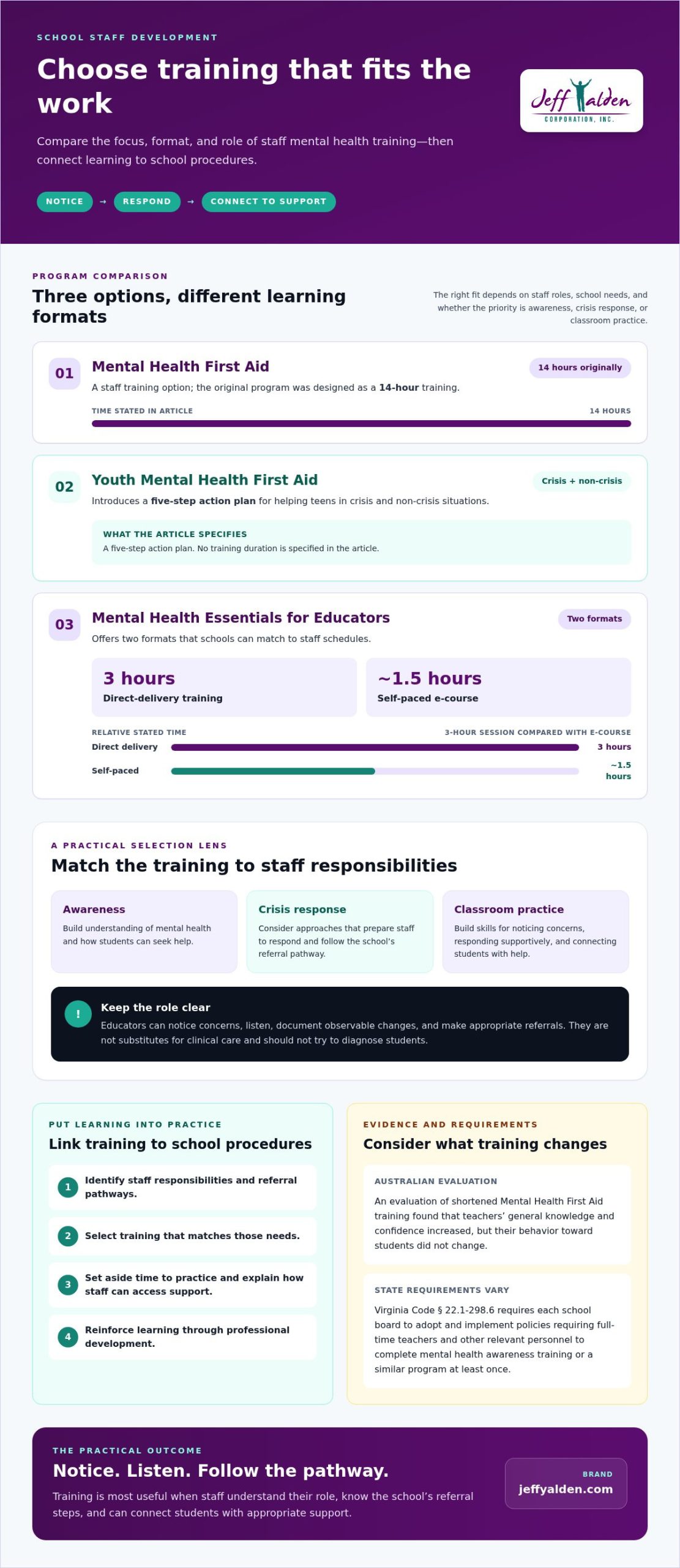
Strong training connects student mental health knowledge to specific school procedures. Educators practice noticing concerns, responding calmly, documenting observable information, and referring students through the school’s established pathway. Mental Health Essentials for Educators is a 3-hour direct-delivery training; its self-paced e-course takes approximately 1.5 hours. These formats can help schools match learning to staff schedules.
Mental Health First Aid was originally designed as a 14-hour training program. Youth Mental Health First Aid introduces a five-step action plan for helping teens in crisis and non-crisis situations. Schools can compare each program’s focus with the tasks staff actually need to perform.
Effectiveness, Limits, and Risks
Look beyond attendance when assessing training. Consider whether educators can describe referral steps, recognize their role boundaries, and apply learning in school situations. For Mental Health Essentials for Educators, participants must score at least 80% on the module post-tests to qualify for the training’s six continuing education credits.
Training should also consider educators’ well-being. School supports can include peer networks, stress-management training, mentoring, and wellness workshops. A curated video library can reinforce key ideas through short scenarios and follow-up discussion. Staff should understand how each lesson relates to school procedures.
Schools can strengthen student-facing conversations with shared language and consistent messages. A focused school-wide conversation about mental health can complement staff learning and help make respectful discussion part of school life.
Common mental health conditions in classrooms
Mental health needs can affect attention, attendance, peer relationships, and learning. Understanding common diagnoses helps educators consider what support may help, without treating classroom behavior as a diagnosis. In the United States, 1 in 6 children aged 6-17 experience a mental health disorder each year.
According to the Centers for Disease Control and Prevention, 8% of children ages 3-17 had current, diagnosed behavior disorders (10% of males and 5% of females). The same organization reports that 11% of children ages 3-17 had current, diagnosed anxiety (10% of males and 13% of females). It also reports that 4% of children ages 3-17 had current, diagnosed depression (3% of males and 5% of females). These figures describe diagnoses, not a way to identify an individual student.
In classroom life, anxiety may appear as repeated reassurance-seeking before a presentation, while depression may coincide with withdrawal from activities a student previously enjoyed. ADHD can affect a student’s attention, organization, or ability to wait during group work; 9.4% of children aged 2-17 years, approximately 6.1 million children, have received an ADHD diagnosis in the United States. A single behavior alone doesn’t establish a condition. Track patterns, context, and changes from the student’s usual participation.
Trauma-informed classroom strategies emphasize predictable routines, respectful communication, and choices that preserve dignity. Tell students before a schedule changes, offer written and spoken directions, and provide a quiet way to request a pause. If a student reacts strongly to a loud correction, lower your voice and give them space rather than escalating the exchange. These steps respond to what’s happening in class without asking students to disclose personal experiences.
Classroom management can support students in distress while keeping learning clear and consistent. Try this short sequence:
- State the expectation in specific language, such as “Open your notebook to today’s activity.”
- Offer a manageable choice, such as completing the first question independently or with a partner.
- Notice effort with precise feedback, such as “You returned to the task after the break.”
- Record recurring classroom patterns and share observations through school procedures.
A mental health program or course can help staff practice these strategies through realistic classroom scenarios. Ask educators to consider how anxiety, depression, behavior disorders, and ADHD might affect the same task differently. Then align classroom responses with student support plans and school procedures. Consistent expectations, calm interactions, and practical adjustments can help protect access to learning while staff address individual needs.
Mental health instructional resources
Reliable resources help teachers turn mental health education into lessons students can use. Choose materials that are medically accurate, developmentally appropriate, and practical to use at your school.
Teacher Resource Collection
A useful collection for teachers connects lesson plans and classroom activities with referral procedures and family communication. The CDC’s HECAT Module: Mental and Emotional Health can help schools develop, select, or revise mental health education curricula. Use it as a planning tool, then match the content to students’ ages, abilities, and learning needs.
Before using a resource, review its evidence, intended age group, and teaching goals. A lesson on recognizing emotions, for example, should give students clear language and a safe way to discuss concerns. Check that examples reflect varied youth experiences and don’t frame mental health challenges as personal failures.
Teachers also need guidance on what to do when a student raises a concern. Pair classroom lessons with the school’s referral pathway, staff roles, and family communication practices. This connection helps educators respond consistently and ensures students know what to expect next.
Free Training Resources
Free resources can support staff learning, but an instructional module isn’t necessarily a complete training program. The CDC’s HECAT module is designed for curriculum development. Schools can use it to guide professional learning, then add practice in classroom delivery, referral procedures, and responding to student concerns.
For example, a staff meeting can review a lesson, rehearse how to introduce it, and discuss what to do if a student asks for help. Schools can also organize relevant resources in a shared collection so teachers can easily find lesson materials and referral guidance.
Strong materials don’t stand alone. Classroom teachers, including health education teachers, or school counselors can deliver mental health education. Decide who will lead each lesson, how staff will coordinate, and which procedures apply when concerns arise. Coaching can give teachers an interactive structure for delivering interventions, with emerging research suggesting possible classroom benefits.
Use a clear selection process. First, identify the learning goal, such as reducing stigma or helping students recognize when to seek support. Next, review lesson content for accuracy, age suitability, and accessibility. Then test the activity with educators before introducing it in classes. A discussion prompt, for instance, should invite general reflection without pressuring students to share private experiences.
Schools can also include adult social-emotional learning in their resource plans. Activities that strengthen educators’ self-awareness and relationship skills can help them build nurturing connections with students. Pair this work with guidance on managing sensitive discussions, maintaining classroom boundaries, and following referral procedures. When resources and school practices align, teachers have a clearer path from delivering a lesson to connecting students with appropriate support.
What types of mental health training are available for school staff?
Training formats range from broad awareness to focused crisis-response skills. Schools can choose in-person instruction, self-paced courses, or professional development shaped around classroom responsibilities.
Mental Health First Aid teaches participants to recognize mental health concerns and respond with support. It was originally designed as a 14-hour training program. Youth Mental Health First Aid introduces a five-step action plan for helping teens in crisis and non-crisis situations. In much the same way that accredited providers like Siren Training deliver first aid courses focused on immediate response rather than medical diagnosis, these programs focus on recognizing concerns and connecting young people with appropriate help, rather than asking educators to diagnose conditions.
For educators seeking practical school-focused learning, Mental Health Essentials for Educators offers two formats. Its direct-delivery training takes 3 hours, while its self-paced e-course takes approximately 1.5 hours. Participants must score at least 80% on module post-tests to qualify for the training’s six continuing education credits. Schools can consider which format best fits staff schedules and learning needs.
Professional development can focus on mental health literacy and classroom referral skills. Staff learn to identify concerns, respond within their roles, and follow school referral procedures. A useful session connects those skills to familiar situations, such as a student withdrawing from class activities or expressing distress to a teacher. Build follow-up into the plan so staff can revisit procedures and practice applying them.
Some training addresses staff well-being directly. Professional development on stress management can give school employees strategies for managing stress and building resilience. Schools may pair it with peer support or mentoring, helping educators recognize their own needs while supporting students. For professionals interested in deeper qualifications to support physical and mental wellbeing, accredited training from Active Health Group offers structured programmes for health coaches and therapists. Staff support matters because difficult conversations and repeated exposure to student distress can affect those providing help.
Preservice education is another important opportunity to build these skills. Many teacher preparation programs lack mental health preparation, so schools can identify essential topics for onboarding and ongoing professional development. A staged approach might introduce mental health concepts, then cover referral procedures, followed by scenario practice. This gives new and experienced educators shared language without assuming every role has the same responsibilities.
Choose training that matches the work staff actually do. A classroom teacher may need to practice responding to a disclosure and knowing whom to notify; school support personnel may need deeper training in referral coordination. Review whether each program includes practical exercises, clear role boundaries, and next steps. Training is most useful as part of a broader school approach, with procedures and resources to help staff apply their skills in daily interactions.
Jeff Yalden: High School Assemblies
Jeff Yalden’s High School Assemblies help schools bring conversations about mental health and resilience to students as a group. When educators have established referral procedures and want to encourage open, respectful discussion across the school community, an assembly can complement staff learning. It doesn’t replace classroom instruction, individual support, or clinical care.
As a Teen Motivational Speaker and High School Speaker, Jeff Yalden speaks with students about mental health, resilience, and seeking support. Schools can consider a High School Assembly Program when they want students to hear a consistent message and encourage thoughtful conversations with trusted adults. School staff remain essential for responding to individual needs and connecting students with appropriate support.
If you’re considering an assembly for your school, visit jeffyalden.com.
Make the Next Conversation Easier to Start
Change takes shape in the choices a school makes after training: how staff start conversations, whom they involve, and how students can find support. Give your team a practical next step, such as agreeing on one shared message for students and deciding how it fits existing school procedures. Keep the conversation going in classrooms and staff discussions.
Mental health training for school staff can build a foundation, while a message for students can extend that work across the school community. Jeff Yalden offers High School Assemblies and High School Assembly Programs as a Teen Motivational Speaker. Schools can use these to create space for honest conversations about mental health and resilience alongside their ongoing support efforts.
Every school’s next step will look different. Choose an approach that fits your students and your staff’s role, then move forward with care and purpose. Contact Jeff Yalden to explore an assembly for your school. Your commitment to listening can help make support easier to reach.
Frequently Asked Questions
What materials do participants receive?
Useful training materials give participants tools they can apply afterward, such as a school referral map, discussion scenarios, and a reference sheet outlining staff roles. A scenario, for example, could show how to respond when a student raises a concern during class. Materials should also explain the school’s procedures for documenting and sharing concerns, so educators can refer to the steps when a real situation arises.
What topics should school staff mental health training cover?
Training should cover respectful ways to discuss sensitive topics, protect student privacy within school procedures, and communicate concerns to families. It should also address stigma, barriers to treatment, and ways students can approach trusted adults. A practical session could include a role-play about a student asking for help, followed by discussion of what to say, what to record, and which school process to follow next.
How can school staff recognize signs of mental health concerns in students?
Notice meaningful changes in a student’s usual participation, communication, or schoolwork, especially when they persist across settings or activities. A student who suddenly stops submitting assignments or withdraws from group work may benefit from a private, supportive check-in. Focus on observable details rather than labels: describe what changed, when it began, and how it affects learning. Then follow school procedures to share the concern and arrange support.
