
What if the apathy you see every day isn’t laziness? What if it’s a survival mechanism? You’re exhausted from trying to figure out how to motivate unmotivated high school students who checked out before the first bell even rang. You’ve tried the incentives and the stern talks. Still, the silence in your classroom or your home feels heavier than ever. It’s enough to make any educator or parent feel like they’re failing a generation that’s drowning in a mental health crisis we’re only beginning to understand.
I get it because I’ve been in those trenches. You don’t need more clinical theories; you need a way to break through that “apathy shield” and actually connect. This guide is a raw, real-world look at reaching the kids everyone else has written off. We’re moving past the surface-level tactics to build something deeper. We will explore why traditional motivation fails in 2026, how to use radical transparency to earn trust, and the specific tools you can use to turn a room full of “I don’t care” into a community of “I’m trying.” It’s time to stop chasing engagement and start building the human connections that actually change lives.
Key Takeaways
- Reframe student apathy as a protective defense mechanism to move from frustration to a position of supportive authority.
- Learn how to motivate unmotivated high school students by identifying the mental health struggles that often hide behind a mask of laziness.
- Adopt the “connection before curriculum” philosophy to earn the trust of students who feel invisible or misunderstood by traditional systems.
- Implement the “Small Win” method to replace passive lectures with high-energy, confidence-building learning experiences.
- See how a “raw and real” high school assembly acts as a powerful reset button for campus culture and student morale.
Understanding the ‘Apathy Shield’: Why High School Students Stop Caring
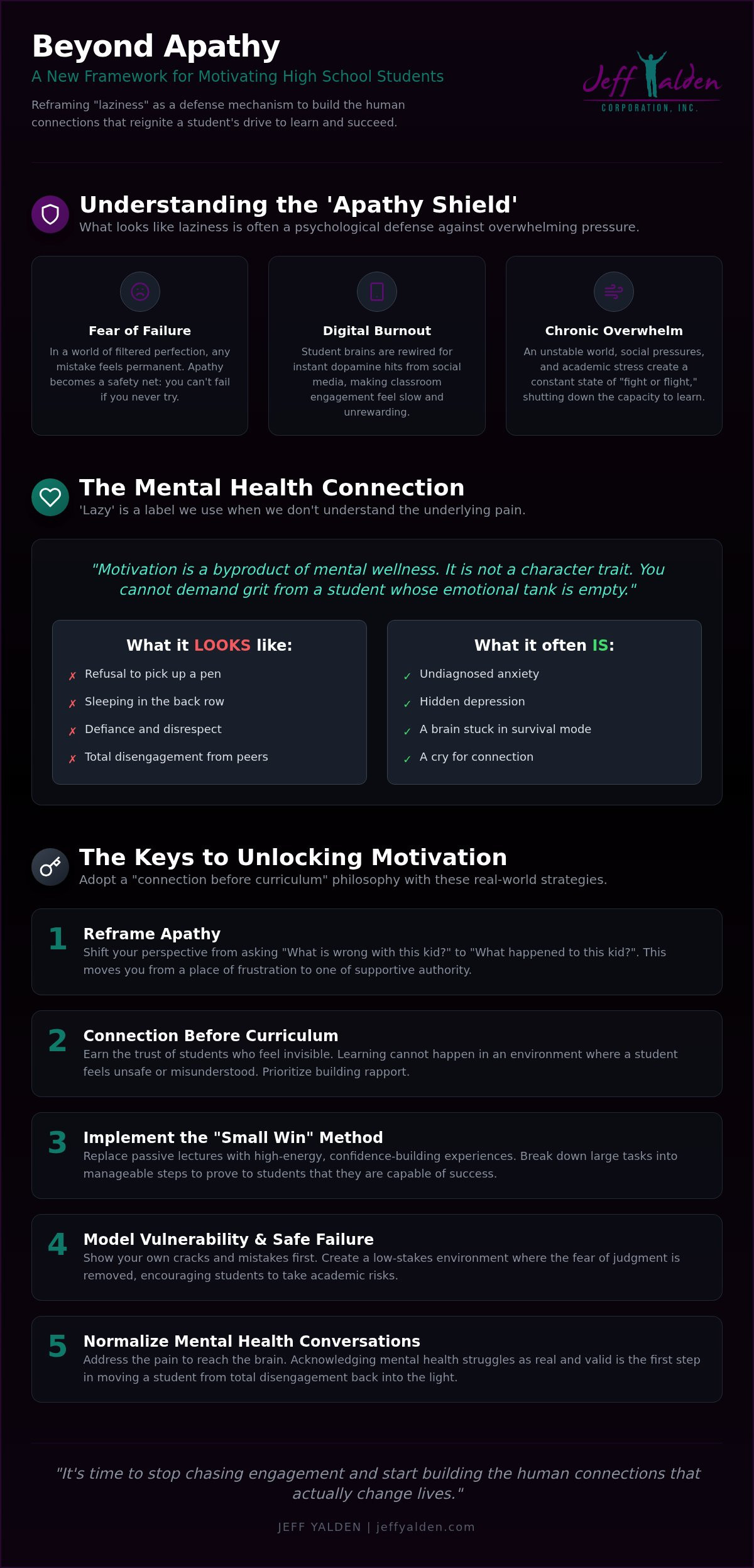
We see it every day. The slumped shoulders. The eyes glued to the floor. The heavy, suffocating silence when you ask a simple question. It looks like laziness. That heavy silence often feels like a personal attack on your hard work. But if you want to know how to motivate unmotivated high school students, you have to look past the surface. What you’re actually seeing is the Apathy Shield. It’s a psychological defense mechanism. It’s a wall built brick by brick to protect a fragile ego from the crushing weight of potential failure.
In 2026, the world is louder and more uncertain than ever. Our teens aren’t just “bored.” They are overwhelmed by a global landscape that feels increasingly unstable. When a student says, “I don’t care,” they are usually lying to you and themselves. What they really mean is, “I’m terrified that if I try, I’ll prove I’m not good enough.” Apathy is the ultimate safety net. You can’t fail at something you never started. We have to stop asking, “What is wrong with this kid?” and start asking, “What happened to this kid that made them feel this unsafe?” This shift in perspective is the foundation of any real connection.
The Fear of Trying and Failing
Social media has turned every mistake into a permanent, public record. In a world of filtered perfection, the risk of being “mid” or failing in front of peers is too high to handle. This pressure kills the desire to take risks in the classroom. Low self-esteem acts as a heavy handbrake on every attempt at engagement. If a student doesn’t believe they can win, they’ll simply refuse to play the game. As leaders, we have to model what safe failure looks like. We have to show our own cracks, our own mistakes, and our own imperfections first. If we aren’t willing to be vulnerable, we can’t expect them to lower their guard.
Digital Burnout and the Reward System
Their brains are rewired for the instant hit. Every scroll, every like, and every notification provides a dopamine spike that a standard lecture simply cannot match. This isn’t a character flaw; it’s a neurological reality we have to face. When the curriculum feels like a relic from a world that no longer exists, they tune out to protect their energy. Digital apathy is the primary barrier to 2026 student engagement. We are competing with algorithms designed by geniuses to capture and hold attention. To win them back, we have to stop lecturing at them and start building a world where their presence actually matters.
The Mental Health Connection: Why ‘Lazy’ is Usually a Mask for Pain
Stop calling them lazy. It is a lazy word. We use that label when we don’t want to do the hard work of understanding what is actually happening behind the eyes of a struggling teen. It is easier to dismiss a student than it is to diagnose a struggle. If you want to master how to motivate unmotivated high school students, you have to accept a hard truth. Motivation is a byproduct of mental wellness. It is not a character trait. You cannot demand grit from a student whose emotional tank is completely empty.
We are currently facing a hidden epidemic in our hallways. Undiagnosed anxiety and depression don’t always look like sadness or tears. In the classroom, they look like a refusal to pick up a pen. They look like a kid sleeping in the back row. They look like total defiance. My take is simple. We need to normalize conversations around mental health to truly unlock a student’s potential. If we don’t address the pain, we will never reach the brain. Recognizing the warning signs of a crisis is the first step in moving a student from total disengagement back into the light.
Anxiety: The Silent Motivator Killer
When a student’s brain is in a state of “fight or flight” due to overwhelming stress, the prefrontal cortex essentially shuts down. This is a physiological reality, not a choice. They aren’t choosing to ignore your lesson; they are stuck in a survival loop. There is a massive difference between a student who won’t work and a student who actually can’t work in that moment. To reach them, we have to lower the “affective filter.” This means creating a low-stakes environment where the fear of judgment is removed. When the pressure drops, the engagement naturally rises.
Resilience as the Foundation for Drive
You can’t ask a kid to move forward if they don’t know how to bounce back from a setback. Resilience is the engine; drive is just the fuel. I teach students to move from a victim mentality, where life happens to them, to a victor mentality, where they own their journey. This starts with “vulnerable authority.” When you share your own struggles as an adult, you give them permission to be imperfect. It shows them that struggle isn’t a stop sign. It is a part of the process. If your campus culture feels stuck in a cycle of apathy, bringing in a teen mental health speaker can provide the radical reset your students desperately need to start caring again.
Connection Before Curriculum: The Radical Shift in Student Engagement
They won’t care how much you know until they know how much you care. I call this the “Jeff Yalden Rule.” It is the heartbeat of every successful classroom and the foundation of my work in schools for over 30 years. Most advice on how to motivate unmotivated high school students focuses on bribes. They tell you to offer pizza parties, stickers, or extra credit. That is a band-aid on a bullet wound. Bribes might buy you compliance for an hour, but they will never buy you commitment. To reach the heart of a student who has given up, you have to build a bridge of genuine connection first.
Radical transparency is the tool that builds that bridge. When you are real with your students, you give them permission to be real with you. This doesn’t mean you dump your personal problems on them. It means you stop pretending to be a perfect, untouchable authority figure. This shift is the first step toward transforming campus culture into a place where students actually want to show up. You have to make time for “The Check-In.” Spend the first five minutes of your day seeing the person before you address the pupil. Ask the questions that matter. Listen to the answers that hurt. If you don’t connect, you can’t direct.
Being a ‘Real’ Adult in a World of Filters
Teens in 2026 live in a world of curated perfection. They are surrounded by filters, AI-generated “perfection,” and fake lives. They are starving for something authentic. You earn the right to be heard by sharing your own imperfections. Talk about your failures. Discuss how you handled a moment where you felt like giving up. You aren’t there to be their friend. A friend wants to be liked; a guide wants them to grow. Be a lived-experience guide who shows them that resilience isn’t a theory. It’s a practice. Showing them how you survived your own storms is a thousand times more powerful than telling them they should try harder.
Creating a Sense of Belonging
There is a direct, unbreakable link between social belonging and academic drive. If a student feels like an outsider, their brain will prioritize social survival over algebra every single time. Look for the “invisible” students. These are the ones who have checked out because they don’t believe they have a seat at the table. They aren’t always the disruptive ones. Often, they are just “gone” while sitting right in front of you. You have to actively pull them back into the fold by showing them they are seen and valued. A sense of belonging is the non-negotiable prerequisite for a student to even consider the risk of trying.
5 Real-World Strategies to Ignite Motivation in the Classroom
It’s time to get tactical. You understand the “why” behind the apathy. You know it is a shield. Now, let’s talk about how to dismantle it. Figuring out how to motivate unmotivated high school students isn’t about finding a magic app or a new piece of software. It is about changing the energy in the room. You have to stop the lecture and start the dialogue. Move toward interactive, emotive learning where the “why” matters as much as the “what.” When students feel the relevance of the work, they find the drive to actually do it.
1. The Power of the Small Win
Teens in 2026 are often drowning in a sea of “too much.” Their brains are wired to shut down when a task feels insurmountable. You bypass this “overwhelmed” response by using micro-goals. Don’t ask for a five-page paper on day one. Ask for three solid sentences. Celebrate that progress immediately. Provide positive feedback that focuses on the effort rather than the final outcome. This keeps the momentum alive and builds confidence in students who have forgotten what it feels like to succeed. You are building a “victor” mentality one small win at a time.
2. Ownership and Autonomy
Give them ownership and autonomy. Let them decide how they demonstrate mastery of the material. If one student wants to write a traditional essay and another wants to produce a high-quality video or a podcast, let them. Autonomy is a massive driver for teen engagement. When they own the process, they own the results. Shift your focus to growth over grades. The journey of improvement is where the real learning happens. When the pressure to be perfect is removed, the freedom to try takes its place.
3. Student-Led Discovery
You need to pivot from being the “sage on the stage” to the “guide on the side.” This is a radical shift, but it is necessary for 2026 engagement. Incorporate their actual interests into the “why” of your lessons. If they care about social issues, technology, or gaming, find a way to weave those threads into the curriculum. Build projects that have a real-world impact outside the school walls. When the work matters to the world, it starts to matter to the student. They need to see that their voice has power beyond the classroom.
4. Outside Voices
Sometimes, you can say the right thing a thousand times and it still won’t land because you are the “authority.” That is when you bring in an outside voice. A high school assembly speaker can often say exactly what you have been saying, but the students listen differently to an outsider. It provides a cultural reset for the entire building. If your staff is feeling burnt out and your students are checked out, it might be time to book a motivational high school speaker to reignite the spark and remind everyone why they showed up in the first place.
5. Make the Work Matter Beyond the Classroom
The most powerful motivator for an unmotivated student is genuine purpose. When a project connects to something real — a community problem, a cause they believe in, or an audience beyond their teacher — the work transforms from an assignment into a mission. Challenge your students to create something that actually gets used. Launch a campaign, solve a local issue, or present findings to a real panel. When the stakes are real, the engagement follows. Purpose-driven learning doesn’t just motivate students in the moment; it builds the kind of intrinsic drive that carries them well beyond your classroom walls.
Connecting classroom learning to future aspirations is key to this process. To help your students explore their interests and find that spark, learn more about Future Me, Answered and how it supports career discovery for teens.
Bringing the Spark Back: Why an Assembly is the Ultimate Cultural Reset
Sometimes, the daily grind of the classroom isn’t enough to break a cycle of deep-seated apathy. You need a jolt. You need a moment that stops the clock and forces everyone in the building to look at each other differently. A high-energy, “raw and real” assembly acts as the ultimate cultural reset. It isn’t just a speech; it is a shared emotional experience that lingers long after the gym has cleared. If you’re struggling with how to motivate unmotivated high school students, you have to realize that sometimes the message needs a fresh messenger to finally land.
There’s a specific reason students listen to Jeff Yalden differently than they listen to their daily teachers. It isn’t because the teachers are failing. It’s because Jeff is the “outside expert” who walks in with 30 years of experience and a willingness to be radically transparent about his own life. He normalizes the struggle. By creating a shared language for mental health across the whole school, he makes it safe for students to drop their “apathy shield.” This isn’t just a one-day event. It is the spark that ignites a year-long shift, especially when followed by targeted Teacher PD that gives staff the tools to keep the momentum alive.
The Emotional Arc of a Jeff Yalden Assembly
Every assembly follows a precise rhythm designed to break through the noise of 2026. It starts with high energy to capture those “unreachable” students in the back row who had their arms crossed before Jeff even spoke. Once the energy is up, Jeff moves into radical transparency. He shares the raw, messy parts of his story to build immediate, visceral trust. This isn’t a lecture. It is a human connection. The arc ends by handing the power back to the students. He provides a clear, supportive direction for every teen to take ownership of their life and move from a “victim” mentality to a “victor” mindset.
Supporting the Supporters
We can’t talk about student motivation without talking about the people leading the charge. Teachers are on the front lines of a massive mental health crisis, and many are running on empty. To keep kids engaged, educators need their own motivation and burnout prevention. You need a speaker who actually understands the 2026 high school landscape, not someone using a script from a decade ago. When the staff feels supported and seen, they have the emotional capacity to implement strategies for how to motivate unmotivated high school students effectively.
Don’t let another month go by where the silence in your hallways feels like a defeat. You can change the trajectory of your school culture in a single afternoon. It is time to stop the bleeding and start the healing. Bring Jeff Yalden to your school and start the cultural reset today.
It’s Time to Lead with Heart and Reset Your Culture
The silence in your halls doesn’t have to be the final word. We’ve explored how the “apathy shield” is actually a cry for safety and why connection must always come before the curriculum. You now have the mindset to shift from being a distant lecturer to a lived-experience guide. Understanding how to motivate unmotivated high school students starts with seeing the person before the pupil and replacing empty bribes with real, raw transparency. It’s about building a bridge of trust that can support the weight of their world.
Ready to turn the tide? Book Jeff Yalden for your next High School Assembly or Teacher PD day. As an expert in crisis intervention and postvention, I provide a life-changing emotional impact that lasts. The spark is still there. Sometimes, you just need a little help to find it. Keep fighting for them. You’ve got this.
Frequently Asked Questions
Why are high school students so unmotivated in 2026?
Students in 2026 are facing a world of constant digital noise and global uncertainty that makes traditional goals feel out of reach. This isn’t just boredom. It is a deep-seated response to a world that feels increasingly unstable. They check out because the pressure to perform in a perfect digital landscape is exhausting. Apathy becomes their only way to protect themselves from feeling like they can’t measure up to impossible standards.
How do you motivate a student who has completely given up?
You start by dropping the curriculum and picking up the connection. If you want to know how to motivate unmotivated high school students who have checked out, you have to find one small thing they care about. Use the “Small Win” method to build their confidence. Give them a task so simple they can’t fail. Success is a drug. Once they feel it once, they’ll want to feel it again.
What is the difference between laziness and a mental health struggle?
Laziness is a choice made from a place of comfort, but a mental health struggle is a lack of emotional capacity. Most of what we call laziness in teens is actually a mask for anxiety or depression. A lazy person can do the work but chooses not to. A student in pain wants to move but feels like they’re wading through concrete. We have to look for the pain first.
Can a school assembly really change student motivation?
An assembly acts as a massive reset button for the entire school culture. It isn’t just about a one hour talk; it’s about creating a shared emotional experience that breaks the cycle of daily apathy. When an outside speaker brings radical transparency, it gives students permission to be real. This moment of collective vulnerability opens the door for teachers to build deeper connections and keep the momentum going throughout the year.
How do I talk to a teen who refuses to engage in conversation?
Stop the interrogation and start the invitation. Teens often shut down when they feel cornered by direct questions. Try side by side communication, like talking while driving or doing a task together. Most importantly, lead with your own vulnerability. If you want them to be real, you have to be real first. Share a struggle from your own day. When you lower your guard, you make it safe for them.
What should I do if a student’s lack of motivation is tied to a crisis?
Safety must always come before the syllabus. If a student is in crisis, their brain is in survival mode and cannot process academic information. You need to involve your school’s crisis intervention specialists immediately. Don’t try to be a clinical counselor if that isn’t your role. Your job is to be the bridge to professional help while maintaining a supportive, non judgmental presence. The algebra can wait until the fire is out.
How can teachers prevent their own burnout while trying to motivate others?
You cannot pour from an empty cup, so you must prioritize your own resilience. Burnout happens when you take the weight of every student’s struggle home with you. Set clear emotional boundaries and seek out professional development that focuses on your well being, not just new grading tactics. Learning how to motivate unmotivated high school students requires you to be mentally healthy yourself. If you are drowning, you can’t save anyone else.
What are the first signs that a student is entering the ‘Apathy Shield’?
Look for the subtle shifts in body language and the “I don’t know” default. The Apathy Shield doesn’t go up all at once. It starts with a student withdrawing from their usual social circles or suddenly failing to turn in minor assignments they used to handle. When “I don’t care” becomes their automatic response to every challenge, they are building that wall. Catching these signs early allows you to intervene before the shield becomes a fortress.
