
School boards don’t approve programs. They approve solutions to the gut-wrenching crises that threaten their district’s safety and reputation. You’re sitting there watching 40% of your high school students report feeling hopeless, and you’re done waiting for the “right” time. It’s exhausting to feel like student lives are at risk while the board is hyper-focused on test scores. You need a clear roadmap on how to get school board approval for mental health programs without getting buried in politics. I’ve spent three decades in these boardrooms, and I know the frustration of being shut down because of budget fears. I’m here to tell you that the “no” you keep hearing isn’t final.
In this guide, you’ll master the art of high-impact persuasion to turn skepticism into enthusiastic support. We’ll navigate the shifting 2026 landscape and show you how to leverage state-level wins like California’s CYBHI or New Jersey’s Spark program to secure funding. I’m giving you the strategy to move from acknowledging the struggle to securing the high-impact assemblies and professional development your campus needs. Let’s stop the cycle of “we can’t afford it” and start building a culture of hope. You’re not just asking for a program; you’re leading a transformation.
Key Takeaways
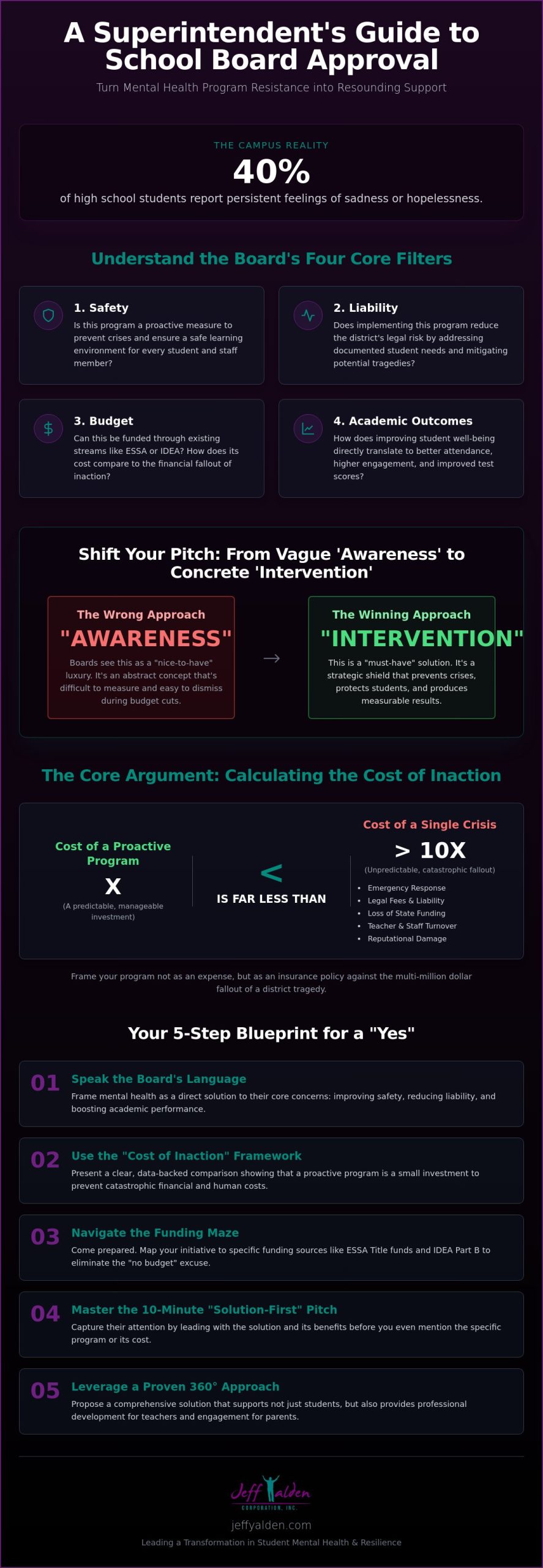
- Learn to speak the board’s language by framing mental health as a non-negotiable solution for district safety, liability, and academic performance.
- Discover the “Cost of Inaction” framework to show how to get school board approval for mental health programs by calculating the fallout of a single campus crisis.
- Navigate the 2026 funding maze by mapping your initiatives to ESSA Title funds and IDEA Part B to eliminate “lack of budget” excuses once and for all.
- Master the 10-minute “Solution First” pitch designed to capture the board’s attention and turn skepticism into enthusiastic support before you even mention cost.
- Leverage 30 years of proven results to implement a 360-degree approach that supports student resilience, teacher retention, and parent engagement.
Understanding the School Board Mindset: Why Good Ideas Get Rejected
Stop thinking of your school board as the enemy. They aren’t. They’re just filtered. Every proposal you send their way hits a wall of four specific fears: safety, liability, budget, and academic outcomes. If your pitch doesn’t clear these hurdles, it’s dead on arrival. You’re trying to figure out how to get school board approval for mental health programs while they’re trying to figure out how to keep the lights on and the lawsuits at bay. It’s a clash of priorities that leaves students suffering in the middle.
The biggest mistake? Selling “awareness.” Awareness is a “nice-to-have” luxury. Intervention is a “must-have” emergency kit. Boards don’t want to fund a feeling; they want to fund a result. They’re also terrified of controversy. They’ve seen the headlines. They’re scared that diving into Mental Health in Education will spark a political firestorm from parents. You have to show them that the fire is already burning on campus, and you’re holding the extinguisher.
The Gap Between Campus Reality and Board Perception
Boards are often the last to know the true emotional state of your students. They see data from three months ago. You see the kid who won’t come out of the bathroom today. You see the teachers who are one bad day away from quitting. To bridge this gap, you can’t just be an alarmist. You have to be a guide. Identify the “silent influencers” on the board. Usually, it’s the member who has a grandchild in the district or the retired educator who still remembers the weight of a classroom. Win them over with the raw truth of what’s happening behind closed doors before you ever step into the public meeting.
Identifying the Board’s Primary Pressure Points
Let’s talk about the bottom line. Mental health isn’t just a moral issue; it’s a fiscal one. When students struggle, attendance drops. When attendance drops, state funding disappears. It’s that simple. By focusing on building resilience in teens, you aren’t just helping them feel better. You’re directly improving their ability to sit in a chair, focus on a screen, and raise those test scores the board cares so much about.
Don’t forget the legal reality. Ignoring suicide warning signs isn’t just a tragedy; it’s a massive liability risk for the district. When you frame your request as a way to protect the district’s reputation and its bank account, the conversation shifts. You’re no longer asking for a favor. You’re offering a strategic shield. That is how to get school board approval for mental health programs in a world that demands proof before it offers support.
Building Your Case: Data, Stories, and the Cost of Inaction
Data alone is cold. Stories alone are anecdotal. To win over a skeptical board, you have to fuse them into a narrative that makes inaction feel like a liability they can’t afford. You’re building a bridge between cold spreadsheets and the raw, beating heart of your campus. This is exactly how to get school board approval for mental health programs when the budget is tight and the stakes are high. You aren’t just presenting a line item. You’re presenting a life raft.
Start with the “Cost of Inaction” framework. Boards are trained to look at the price tag of a teen mental health speaker or a new assembly program. You need to flip that script. Calculate the fallout of a single crisis. Think about the cost of emergency response, the massive drop in teacher morale, the potential legal fees, and the devastating loss of state funding when attendance craters after a tragedy. When you compare the cost of a proactive program to the million-dollar fallout of a district crisis, the “yes” becomes the only logical choice.
Leveraging Local Data vs. National Trends
National stats are a good start, but they’re easy to ignore. A board member can tell themselves, “That’s not our district.” You have to make it personal. While 40% of high school students nationwide reported feeling hopeless in the last year, what do your incident reports say? Show them the spike in counselor visits and the results of your latest student climate surveys. Use your “State of the Students” executive summary to highlight that while Federal Grants for School Mental Health are available to help bridge the gap, the need is happening right now in your hallways. If you want to see how these stories translate into high-impact results, you might want to explore how a veteran speaker connects these dots for your board.
The Power of Radical Transparency in Your Pitch
Drop the clinical jargon. Stop talking about “socio-emotional learning metrics” and start talking about kids who are drowning. Radical transparency is the bridge between adult authority and student trust. It means being real about the 9% of students who have attempted suicide. It means sharing anonymized, raw testimonials from students who feel like their school is a pressure cooker rather than a community. When you speak with this kind of gut-level honesty, you stop being a bureaucrat and start being a leader. This level of transparency demands a response. It forces the board to look past the numbers and see the faces of the children they were elected to protect.
Navigating the Bureaucracy: Funding, Policy, and Alignment
Money is never the real problem. It’s the excuse. When a board says there’s no budget, what they’re actually saying is they don’t see how your program fits into the boxes they’re allowed to spend from. If you want to know how to get school board approval for mental health programs, you have to stop asking for “extra” money. You have to start showing them how to use the money they already have. You need to become a funding detective.
Map your initiative to ESSA Title funds. Title I is for your most vulnerable students. Title II is perfect for trauma-informed teaching professional development because it focuses on empowering your staff. Title IV is specifically designed for safe and healthy students. Then there’s IDEA Part B. Mental health supports are often a “related service” for students with IEPs. If you aren’t using these pots of money, you’re leaving students behind. Look for unorthodox sources too. Opioid settlement funds are hitting local accounts in 2026. PTA grants and local foundation partnerships are waiting for a leader to ask for them.
Let’s address the elephant in the room. Some board members will tell you that mental health is a “parent issue” or a “doctor issue.” They’re wrong. When a student is in crisis, they don’t wait for a doctor’s appointment; they act out in your cafeteria. They fail your exams. They drop out of your district. Policy-backed evidence shows that schools are the primary mental health providers for the vast majority of students who receive care. If it’s happening on your clock, it’s your issue. Period.
Aligning with State and Federal Mandates
State laws are getting stricter. Implementing teen suicide prevention programs isn’t just a good idea; it’s often a legal requirement for school safety. Use the “Whole Child” approach to prove that emotional safety is just as critical as physical locks on the doors. When you navigate the RFP process, show the board a solution that checks every legal box while actually reaching the kids. This is how to get school board approval for mental health programs in a world that demands compliance and connection.
Reframing Mental Health as Academic Support
The Pitch: How to Present for a Guaranteed “Yes”
You’ve got ten minutes. That’s it. School boards are exhausted. They’re sitting through hours of bus routes, roof repairs, and budget audits. If you walk in with a 50-slide deck, you’ve already lost. To master how to get school board approval for mental health programs, you need to lead with the “Solution First” approach. Don’t start with the invoice. Start with the transformation. Describe the day after the program, where students are finally opening up and teachers feel equipped to handle the weight. If you can’t paint that picture in the first sixty seconds, the board will tune out before you ever reach the price tag.
Keep your visual aids lean. Use one graph that shows the upward trend of counselor visits. Use one anonymized quote that hits them in the gut. Finish with one clear call to action. You aren’t there to give a lecture; you’re there to facilitate a decision. When the Q&A starts, lean into your “Vulnerable Authority.” You don’t need to pretend you have every answer, but you must show them you’ve done the work. Be the bridge between their policy fears and the students’ reality.
Crafting a High-Impact Presentation Deck
Slide 1 is your reality check. Use the data we gathered in Section 2 to show the urgent need on your specific campus. Slide 2 introduces the specific vehicle for change: High School Assemblies. This is where you connect the program to the board’s goals of safety and liability protection. Slide 3 is the payoff. Show them the measurable impact: higher engagement, better attendance, and a campus culture that finally breathes again.
Anticipating and Neutralizing Objections
When they ask “Why this speaker?”, don’t talk about charisma. Talk about 30 years of crisis intervention and suicide postvention experience. Tell them this isn’t a “rah-rah” speech; it’s a strategic intervention. If they say it’s “too expensive,” remind them that the cost of one district-wide crisis or one liability lawsuit dwarfs the investment in prevention. If they’re still hesitant, offer a pilot program. It reduces their perceived risk while getting your foot in the door. This is how to get school board approval for mental health programs without compromising your mission.
Ready to bring this level of impact to your district? Book a consultation to discuss your specific campus needs today.
Implementing High-Impact Solutions: Why Jeff Yalden’s Programs Win Approval
Software doesn’t change hearts. People do. You can track data until the servers crash, but a spreadsheet won’t stop a student from making a permanent, devastating choice. When you’re fighting to learn how to get school board approval for mental health programs, you need a solution that boards feel safe saying yes to. You need a veteran who’s been in the trenches since 1992. Jeff Yalden isn’t just a speaker. He’s a specialist in suicide postvention and crisis intervention. Boards trust him because he doesn’t just talk at kids. He connects through radical transparency. This isn’t a “rah-rah” assembly. It’s a life-saving intervention backed by three decades of proof.
A high-impact program has to be a 360-degree mission. It’s not enough to reach the students. You have to reach the adults who support them every single day. By integrating teacher professional development and parent seminars, you create a unified front. To further bridge the gap between school and home, you can suggest that parents visit Power Within to access daily character-building tools for their children. Boards love this comprehensive strategy. It maximizes their investment. When you show them that your plan includes supporting staff mental health, you’re also addressing the staff retention crisis. It’s a win-win that turns a hesitant “maybe” into a bold “yes.”
From One-Day Events to Long-Term Culture Change
An assembly is the catalyst. It’s not the finish line. It’s the spark that makes it safe for students to finally walk into a counselor’s office and ask for help. This is how to get school board approval for mental health programs that actually stick. By using teacher PD to sustain the message, you build a resilience-first campus identity. You’re giving your staff the tools to keep the conversation going long after the microphone is packed away. This isn’t a one-and-done event. It’s a total cultural shift that protects your students and your district’s future.
Booking a Speaker Who Understands Board Dynamics
Jeff understands the pressure administrators face. He doesn’t just show up and speak. He works with you to justify the program’s value to the board with professional authority. He provides postvention checklists and staff toolkits that prove his expertise goes far beyond the stage. He’s been there. He’s navigated the politics, the budgets, and the heartbreaks. Now, he’s ready to help you lead your district toward hope and resilience. Stop waiting for a crisis to act. Bring Jeff Yalden to your school to start the transformation.
Take the Lead and Transform Your Campus
The time for waiting is over. You’ve seen how to reframe mental health as district safety and how to uncover the funding that’s already there. You have the exact blueprint for how to get school board approval for mental health programs by leading with radical transparency and a solution-first mindset. This isn’t just a presentation. It’s a rescue mission for your students’ futures. You aren’t just asking for a budget line; you’re demanding a shift in culture that saves lives.
With over 30 years of high-impact youth speaking experience, I’ve seen what happens when a district finally chooses courage over comfort. I’m a specialist in teen resilience and a trusted partner for thousands of schools in crisis postvention. Don’t wait for a tragedy to become the catalyst for change. Be the catalyst today. You have the tools, the data, and the heart to make this happen. Let’s turn that skepticism into support and start the healing process on your campus right now.
Book Jeff Yalden for Your Next High School Assembly. Your students are waiting for someone to stand up for them. You’re the leader they need. Let’s go.
Frequently Asked Questions
What is the most common reason school boards reject mental health programs?
Boards usually say “no” because they view mental health as a luxury or a liability risk. They’re often scared of parental pushback or they don’t see how the program directly impacts academic outcomes. You win them over by reframing the program as a non-negotiable solution for district safety and student retention. When you show them that an anxious brain cannot learn, the program stops being a “nice-to-have” and becomes an essential tool for their primary mission.
How can I find funding for a mental health speaker if our district budget is frozen?
Stop looking at the general fund and start looking at specialized pots of money like ESSA Title IV or local opioid settlement funds. Many districts have untapped resources in PTA grants or local foundation partnerships that are specifically earmarked for student safety. In 2026, we’re seeing more districts use these unorthodox streams to bypass frozen budgets. This is a key strategy for how to get school board approval for mental health programs when the treasurer is tightening the belt.
Do school mental health programs actually improve test scores?
Yes, because mental health is the physiological foundation for learning. When a student is in a state of chronic stress or “fight or flight,” their prefrontal cortex literally shuts down. By providing intervention and building resilience, you’re moving students back into a state where they can actually process and retain information. You aren’t just helping them feel better; you’re clearing the biological path for higher graduation rates and better exam performance.
What data points should I include in my presentation to the school board?
Focus on local “pain point” data like spikes in counselor visits, incident reports, and anonymized student climate surveys. National statistics are easy to ignore, but it’s much harder for a board to turn away from the raw reality of their own hallways. Show them the “Cost of Inaction” by comparing the price of a proactive assembly to the million-dollar fallout of a single district crisis. This level of local specificity is what creates the urgency needed for a “yes” vote.
How do I handle parents who are concerned about mental health topics being taught in school?
Lead with transparency and focus on “resilience” and “safety” rather than clinical jargon. Frame the program as a way to equip students with life skills that prevent tragedies and improve campus culture. When you position the speaker as a “vulnerable authority” who leads with lived experience, you bridge the gap between school authority and parental trust. It’s about showing them that these conversations are happening in the hallways anyway; we’re just making them safe and productive.
Can ESSA Title IV funds be used for high school assemblies?
Yes. ESSA Title IV, Part A is specifically designed for the “Safe and Healthy Students” initiative, which covers high-impact assemblies and speaker programs. These federal dollars are intended to foster a safe school environment and provide students with a well-rounded education. Using these funds is a brilliant way of how to get school board approval for mental health programs because it solves the budget problem without tapping into local tax dollars.
How long should a typical school board pitch for a new program be?
Aim for exactly 10 minutes. School boards are often overwhelmed with administrative details, so you need to be punchy and direct. Use the first 60 seconds to lead with the “Solution First” opening, describing the transformation you want to see on campus. Spend the rest of the time on your three-slide deck: the urgent need, the proposed solution, and the measurable impact. If you can’t make your case in 10 minutes, you’ll lose their attention before you hit the call to action.
What is the difference between a motivational speaker and a mental health speaker for schools?
A motivational speaker focuses on inspiration and “rah-rah” energy, while a mental health speaker provides strategic intervention and resilience tools. Motivational talks often provide a temporary high that fades by lunchtime. A mental health speaker, especially one with 30 years of crisis postvention experience, addresses the root causes of student struggle. It’s the difference between a pep talk and a life-saving intervention that changes the trajectory of a student’s life.
