
What if a zero-dollar assembly budget didn’t have to mean putting student well-being on hold for another year? If you’re searching for how to get a grant for a school assembly, you already know the pressure: students need support, staff are stretched thin, and the budget isn’t moving.
Funding may be available through district-administered federal funds, competitive grants, state programs, and local sources. The challenge is making a clear case for how the assembly addresses students’ needs and fits the funder’s priorities. Start with a focused plan that connects the program to outcomes your school is working toward.
This 2026 guide walks you through where to look, how to shape a proposal, and what steps can make the process less overwhelming. You’ll learn how to frame a speaker’s role around mental health, suicide prevention, resilience, and student well-being. Jeff Yalden provides school assemblies focused on mental health and resilience, along with teacher professional development. Let’s turn an urgent need into a funding plan your school can act on.
Key Takeaways
- Learn how to get a grant for a school assembly by connecting a defined student need to the funder’s priorities.
- Explore federal, state, and local funding pathways, and understand why some funds are managed through your district.
- Turn concerns such as bullying, low motivation, or the emotional impact of a crisis into a focused case for student support.
- Build a stronger proposal with counselors, administrators, and student leaders, supported by relevant local information.
- Explain how an assembly focused on mental health and resilience could fit into a broader student-support plan.
Understanding the 2026 Funding Landscape for School Assemblies
A school assembly can be more than a break in the timetable. It can bring students together and open conversations about mental health, resilience, safety, and belonging. For a basic overview of the format and its purpose, see What is a School Assembly? In funding terms, an assembly request is strongest when it shows how the program addresses a specific student need, rather than simply describing an engaging event.
Funders may prioritize student well-being, social-emotional learning (SEL), and safe, healthy learning environments. That makes the way a school describes the assembly important. A request focused only on entertainment may be difficult to prioritize. A proposal that explains how the program supports mental health awareness, resilience, or crisis response has a clearer educational purpose. Eligibility varies: some programs focus on high-need communities, while state, local, and private opportunities may have different rules and priorities.
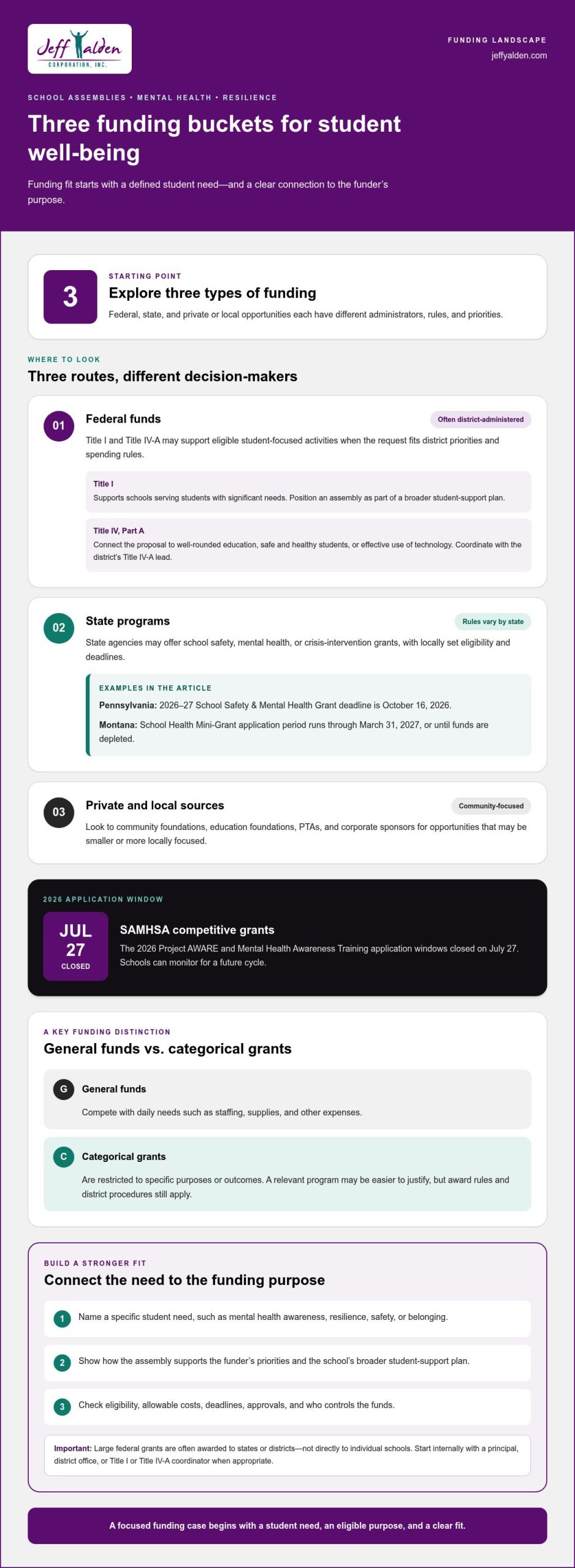
Start with three funding buckets:
- Federal: District-administered formula funds, including Title I and Title IV-A, may support eligible student-focused activities. Competitive programs also exist. For example, SAMHSA’s 2026 Project AWARE application window closed on July 27. Schools can monitor for a future cycle.
- State: State agencies set their own programs and deadlines. Pennsylvania’s 2026-27 School Safety & Mental Health Grant deadline is October 16, 2026, while Montana’s School Health Mini-Grant application period runs through March 31, 2027, or until funds are depleted.
- Private and local: Community foundations, education foundations, PTAs, and corporate sponsors can offer smaller or more locally focused opportunities.
Large federal grants are often awarded to states or districts, not directly to individual schools. That doesn’t shut the door. It means your next step may be to make the case internally to a principal, district office, or Title I or Title IV-A coordinator.
Why Mental Health Is the New Funding Priority
Student well-being and SEL can be part of how schools describe a supportive learning environment. In a proposal, explain how the assembly’s focus on resilience or mental health awareness relates to the need your school has identified. Avoid promising a measurable academic result unless you have evidence to support that claim. Suicide prevention and the emotional aftermath of a crisis call for careful attention. A mental health assembly can normalize conversation and reinforce that student well-being belongs in the school’s educational mission.
The Difference Between General Funds and Categorical Grants
General funds must cover competing daily needs, so an assembly can lose out to staffing, supplies, or other expenses. A categorical grant is restricted to specific purposes or outcomes. That defined purpose can make a relevant program easier to justify, but the school still needs to follow the award’s rules and district procedures.
Some district budgets operate on year-end spending timelines, and unspent funds may not carry forward under particular rules. Don’t assume every grant is “use it or lose it.” Ask your district how that funding source handles deadlines, allowable costs, and approvals. The key to how to get a grant for a school assembly is to match a student need to an eligible funding purpose, then build the request around that connection.
Top Grant Sources for Mental Health and Motivational Programs
The best funding source depends on who controls the funds and what outcomes they’re intended to support. For an assembly focused on mental health, resilience, or student engagement, start with district-administered federal funds, then look at state initiatives and community partners. The U.S. Department of Education Grants page is a useful starting point for federal opportunities, but local district rules determine how formula funds can be used.
Federal Title I and Title IV-A Funds
Title I supports schools serving students with significant needs. A school may be able to propose an assembly as part of a broader plan for student engagement and well-being, but the request needs to fit the district’s approved priorities and spending rules. Present the assembly as one element of a student-support strategy, not a standalone event detached from the school’s goals.
Title IV, Part A supports activities connected to well-rounded education, safe and healthy students, and effective use of technology. Make the connection explicit: explain how the program supports student well-being or learning, who it serves, and how staff will reinforce its message afterward. Districts administer these funds, so coordinate with the Title IV-A lead before building the proposal around them.
Federal funding priorities can shift by program and year. The SAMHSA Project AWARE and Mental Health Awareness Training grant application windows for 2026 closed on July 27. Schools can track future announcements and review state education agency guidance for current opportunities. For a proposal that connects student needs with safe-and-healthy-student goals, a teen mental health speaker can provide a focused assembly program.
State and Crisis-Intervention Funding
State education agencies may offer school safety, mental health, or crisis-intervention grants, with eligibility and deadlines set locally. The Stronger Connections program, established through the Bipartisan Safer Communities Act, provided competitive state subgrants for high-need districts to support safer, healthier learning environments. Its funding period ran through September 30, 2026, so schools should look to their state agency for current or future competitions rather than assume an earlier award cycle remains open. In a proposal, define the need clearly, whether it’s prevention, resilience, or support after a crisis, and show how the assembly fits the initiative’s stated purpose.
Private and Corporate Philanthropy
Local community foundations often invest in young people and community well-being. Approach them with a specific request tied to a local concern, and explain which students the program will reach. Nearby businesses may also support character education through sponsorships, especially when the school can describe the community benefit without promising outcomes it can’t measure.
PTA and PTO funds can help bridge a gap, contribute matching funds when a grant requires them, or support an application to a local foundation. Technology and healthcare companies may also have corporate social responsibility programs focused on youth, education, or mental health. Look for published giving priorities and application instructions. If your funding case centers on mental health, resilience, or suicide prevention, Jeff Yalden’s school assemblies give you a specific program to connect with those student needs.
Strategic Alignment: Matching Your Needs to Grant Missions
A strong funding request starts with a real student need, not a speaker’s name. Identify the challenge your school is addressing: the emotional aftermath of a crisis, bullying, disengagement, or low motivation. Then connect that need to the grant’s stated mission. A request for a speaker is more persuasive when it explains the role of the assembly within a broader effort to support resilience or student well-being.
Use information your school already tracks, such as attendance patterns, disciplinary records, climate survey results, or counselor-reported concerns. Choose details that relate directly to the need, describe the time period, and protect student privacy. Don’t overstate what the information proves. It can help demonstrate why support is needed, but it can’t guarantee that one assembly will change attendance or behavior.
For example, if the school has seen repeated concerns about peer conflict, the proposal might frame an assembly as part of a wider effort to strengthen belonging, respectful communication, and help-seeking. If the need involves suicide postvention, explain the school’s goal of supporting students after a loss and normalizing appropriate conversations about mental health. The SchoolSafety.gov Grants Finder can help identify funding opportunities tied to school safety. Jeff Yalden’s high school assemblies focus on mental health, suicide prevention, and resilience, giving schools a defined program to compare with relevant grant outcomes.
The Radical Transparency Approach to Grant Justification
Grant reviewers need a credible picture of the need, not a polished story that hides it. Be direct about what students and staff are facing, support the description with appropriate local information, and explain what the school hopes to address. A teen suicide prevention program may be described as one component of a postvention plan, alongside the school’s existing supports. Make the path from challenge to response clear, human, and specific.
Then show how the school will reinforce the message. Identify who will coordinate the assembly, which themes connect to the grant’s goals, and how staff will gather feedback afterward. That gives funders a clear sequence: an identified need, a relevant response, and a thoughtful plan to learn from the experience.
Student Well-Being and Academic Goals
Emotional well-being and academic engagement are connected parts of students’ school experience, but don’t promise higher test scores unless you have evidence to support that claim. Instead, describe how resilience and motivation relate to your school’s goals, and define indicators you can track, such as participation, student feedback, or attendance trends over time. Consider how an assembly focused on resilience might fit when a grant’s mission includes student well-being and engagement.
If an assembly is scheduled before testing season, explain its intended role in setting a supportive tone, not as a guaranteed way to raise scores. That honesty builds trust. To strengthen a proposal for how to get a grant for a school assembly, align the message, student need, and evidence without claiming more than the program can deliver. Jeff Yalden’s work centers on mental health and resilience, offering a clear basis for that connection.
The Grant Writing Process: From Proposal to Presentation
A compelling proposal is more than a request to book a speaker. It shows a clear line from student need to program, follow-up, and evidence of progress. Bring the right people into the process early, and keep the funder’s priorities beside you as you write. That’s how to get a grant for a school assembly without making the application feel like one more disconnected task for an already stretched team.
- Assemble your impact team. Include a counselor, an administrator, and student leaders who can speak to the school climate. Assign one person to coordinate deadlines and approvals, and make sure the team agrees on the need the proposal will address.
- Write the problem statement. Use local information, such as attendance patterns, school climate feedback, or disciplinary trends, to describe the challenge. Be candid, protect student privacy, and explain why the issue matters now.
- Set measurable objectives. Choose outcomes the school can reasonably track, such as student-reported confidence in identifying a trusted adult or staff feedback on follow-up conversations. A target like reducing crisis referrals by 15% should only be used if baseline data and a sound measurement plan support it.
- Build a complete budget. Include the speaker fee and any eligible follow-up resources, staff time, or evaluation expenses. Separate costs clearly, explain why each is needed, and follow the grant’s rules for allowable expenses. Don’t assume every funding source covers the same items.
- Review for fundability. Ask whether the application reads like a plan to address a student need or simply a request for a show. Check that the proposed program, objectives, timeline, and budget all support the grant’s stated mission.
Write a Problem Statement That Gets Noticed
Skip clinical jargon and use respectful, plain language that reflects what students are experiencing. A useful one-sentence starting point might be: “Students and staff are reporting growing concern about belonging and emotional well-being, and our school needs a shared, age-appropriate way to strengthen connection and help-seeking.” Adapt it to your own evidence. Then explain why a speaker with a direct, personal voice may reach students in a way standard announcements cannot.
Measure Success Beyond the Assembly
Plan evaluation before the event. A short pre- and post-assembly survey can ask the same questions about students’ understanding of resilience or awareness of support options. Summarize responses without identifying individual students. Pair that feedback with staff observations and a clear reporting timeline. A focus on resilience can anchor follow-up activities, while teacher professional development can help staff reinforce shared language and continue the conversation. These steps won’t prove one assembly caused a broad change, but they give your school a responsible way to document participation, learning, and next steps.
For a program centered on mental health, suicide prevention, and resilience, explore Jeff Yalden’s school assemblies as you shape a proposal that connects student needs with a clear plan for follow-through.
Why Jeff Yalden’s Programs are the Ultimate Grant-Eligible Investment
A grant proposal needs more than a compelling speaker. It needs a program whose purpose connects clearly to student well-being, social-emotional learning (SEL), or character education. Jeff Yalden has worked in schools since 1992, bringing a direct, personal voice to conversations about mental health, suicide prevention, and resilience. That gives schools a concrete way to explain how an assembly supports their goals, rather than presenting it as entertainment alone.
Jeff’s assembly programs focus on mental health, suicide prevention, and resilience. For grant planning, describe the fit precisely: name the student need, identify the relevant grant outcome, and show how the assembly contributes to a broader school effort. A clear connection can make a proposal more persuasive, but each award’s rules determine eligibility and allowable expenses.
Think beyond a single event, too. A school might pair a school-wide assembly with staff learning or follow-up activities that keep the conversation alive. Jeff provides teacher professional development as well as assemblies. Schools can describe how those elements could reinforce shared language and support continued reflection. A community night may also be a school-organized extension, if it fits the grant’s purpose and requirements. The goal is a connected plan, not a bigger event for its own sake.
A Partner in Your Grant Journey
Grant applications often ask schools to explain the program’s purpose, audience, connection to student needs, and intended outcomes. Build those details into your proposal, then retain the approved program description, budget records, attendance information, and evaluation results required by the funder. Jeff’s focus on normalizing mental health conversations gives schools meaningful language for describing the program’s role. Keep the claims grounded: an assembly can open dialogue, but it shouldn’t be presented as a guaranteed solution or a replacement for ongoing school support.
Students can tell when a message feels scripted. Jeff’s approach draws on personal experience to meet young people with honesty, helping schools make a program feel relevant rather than routine. The longer-term value is in what happens next: adults keep listening, students have language for difficult experiences, and mental health becomes a conversation the school can approach openly.
Ready to Strengthen Your School Culture?
Start by naming your school’s challenge and the funding requirements you’re working within. Then connect the program to a clear purpose, realistic measures, and a follow-up plan. Explore Jeff Yalden’s school assemblies as you build a proposal focused on resilience and student well-being. Budgets can be tight, but a thoughtful case for support can help make students’ needs visible.
Make Your Next Step Count
A funding application is more than paperwork. It’s your chance to advocate for students and make their needs visible. Start with one clear next step: bring your team together, name the change you want to support, and build a plan that keeps the conversation going after the assembly. That’s the heart of how to get a grant for a school assembly: connect the funding request to meaningful support for young people.
Jeff Yalden has been working in youth mental health since 1992, including crisis intervention and postvention support. His work speaks to young people with an honest approach to resilience, grounded in personal experience rather than easy answers. A school assembly can’t replace ongoing support, but it can help open the door to conversations that matter.
If you’re ready to shape a program around your school’s needs, book Jeff Yalden for a school assembly focused on mental health and resilience. Your students deserve adults who keep showing up, and your next step can help make that happen.
Frequently Asked Questions
Can we use Title I funds for a motivational speaker?
Possibly, if the assembly supports goals in the school’s Title I plan and meets district spending rules. Describe the audience, the student need, and how the event fits into the school’s broader strategy rather than treating it as a one-off reward. Have the district’s Title I coordinator review the purpose and budget category before including it in a proposal. That internal review can help identify eligibility issues early.
What is the most common grant for school mental health programs?
There isn’t one grant that’s most common for every school. Access depends on location, eligibility, and whether the district applies. Title IV-A is a potential district-administered route for safe and healthy student initiatives. SAMHSA’s Project AWARE and Mental Health Awareness Training grants are competitive options, but their 2026 application windows closed on July 27. For future cycles, track SAMHSA announcements and ask district staff which funding streams they manage.
How do I find local grants for a school assembly in my specific town?
Search your town or county name with phrases like “education foundation grant,” “youth mental health grant,” and “school wellness funding.” Check the district foundation, local community foundation, PTA or PTO, and state education agency. Ask the district grants office about local funder calendars and past awards. Keep a tracker with eligibility, deadlines, required attachments, and contact details so your team can act when a relevant opportunity opens.
Do I need a professional grant writer to get funding for a speaker?
No, a professional grant writer isn’t automatically required. School staff can often prepare a clear application when they have the funder’s instructions, an agreed student need, supporting local information, and a realistic evaluation plan. A grants coordinator can help interpret application requirements and district procedures. Consider additional writing support if the application is unusually complex or your team lacks time, and make sure the school retains control of the facts and commitments in the proposal.
What information do I need from a speaker to include in a grant proposal?
Gather a concise program description, intended student audience, topics covered, learning goals, and an explanation of how the presentation relates to the grant’s priorities. You’ll also need the proposed schedule and budget details in the format your application requires. Request supporting materials that help describe the program accurately, then avoid claiming outcomes the speaker cannot substantiate. Your application should make clear what the school will do before and after the event.
How long does the grant approval process usually take for school assemblies?
There’s no standard approval timeline. A district’s internal budget review may follow a different schedule from a state or federal competition, and each funder sets its own application and decision dates. Build backward from the event date: allow time for district approvals, application review, award notices, contracting, and any required purchasing steps. Don’t book against funds that haven’t been approved. Confirm your school’s process with the grants office before setting a firm event date.
Can a grant cover the cost of teacher professional development along with the assembly?
It may, if the grant permits professional development expenses and the training supports the award’s goals. Explain how staff learning complements the student presentation, such as helping educators continue conversations about resilience or student well-being. Separate the assembly and training costs in the budget, and describe the intended audience and purpose for each. Jeff Yalden provides teacher professional development, which schools can include in a proposal when it fits the funder’s requirements.
What happens if our grant application is denied?
A denial doesn’t mean the school’s need is unimportant. Review any feedback, identify whether the issue was eligibility, evidence, budget, or fit with the funder’s priorities, and revise before applying elsewhere. Ask whether the funder allows resubmission or provides reviewer comments. Meanwhile, explore another funding cycle, a local foundation, or PTA/PTO support. Keep useful proposal materials organized so your team can strengthen the next application without starting from scratch.
