
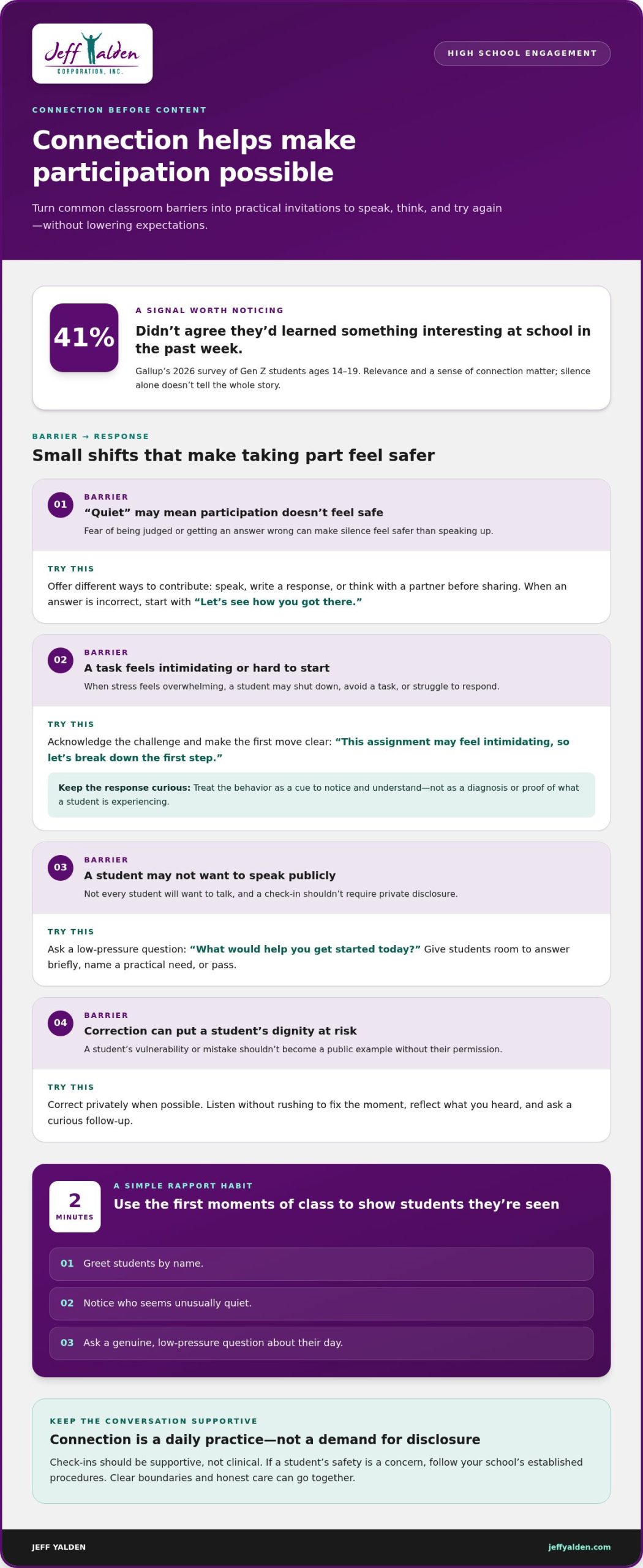
In Gallup’s 2026 survey, 41% of Gen Z students didn’t agree they’d learned something interesting at school in the past week. That’s a hard truth. If you’re looking for student engagement strategies for high school, you already know the challenge isn’t simply getting teens to put their phones away or answer a question. It’s reaching students who feel anxious, disconnected, or done trying.
Another classroom-management trick won’t solve that challenge. Students are more willing to participate when they feel respected and safe enough to speak up, make mistakes, and take intellectual risks. Connection isn’t a reward for engagement. It helps make engagement possible.
This guide offers practical ways to build connection, make learning relevant, and give students meaningful choices without lowering expectations. You’ll also find ways to bring resilience into everyday learning and build a more sustainable classroom for teachers. Jeff Yalden brings more than 30 years of experience in high schools to honest conversations that can open the door to deeper engagement. Let’s move beyond quiet compliance and create classrooms where students feel seen, heard, and ready to take part.
Key Takeaways
- Recognize how digital distraction and classroom “quiet quitting” can signal barriers to participation, not simply a lack of discipline.
- Use student engagement strategies for high school that put trust, respect, and honest connection before content.
- Invite student voice with practical approaches, including a structured “Real Talk” circle and purposeful collaborative activities.
- Help students treat setbacks as information they can learn from, and weave resilience into everyday subject lessons.
- Build engagement across the school, not just through one-off classroom fixes. Assemblies can help open conversations and shift mindsets.
Why High School Student Engagement is Failing in 2026
A student stares at the desk. Another checks a phone beneath it. A third knows the answer but won’t risk saying it aloud. These moments can look like apathy, but “quiet quitting” in class may also signal that students don’t feel connected, confident, or safe enough to participate.
The pressure is real. In Gallup’s 2026 survey of Gen Z students ages 14 to 19, 41% didn’t agree they’d learned something interesting at school in the past week. Phones and social media compete for attention, and a long, passive lesson can be harder to follow amid a constant stream of digital content. That doesn’t mean teenagers are incapable of focusing. It means attention is pulled in several directions, and relevance matters.
Another barrier may be less visible: fear of being judged. For a student who worries about getting an answer wrong or drawing attention, silence can feel safer than participation. A classroom built around quiet compliance can mistake that silence for success. Understanding Student Engagement means looking beyond who appears attentive and noticing whether students are thinking, contributing, and connecting with the learning.
The Impact of the Mental Health Crisis on Learning
When stress feels overwhelming, a student may shut down, avoid a task, or struggle to respond. Teachers sometimes describe this as a “freeze” response, but it isn’t a diagnosis or proof of what a student is experiencing. Treat it as a cue to look with curiosity rather than label the behavior. Distraction can reflect stress or disconnection, not simply defiance. A predictable, respectful classroom can help students feel safer taking the risks learning requires: asking questions, sharing unfinished ideas, and trying again.
The Fallacy of the “Perfect Lesson Plan”
A carefully designed lesson can still miss the mark if students don’t feel the teacher is with them. Strong content matters, but connection can help students engage with it. That’s why student engagement strategies for high school need more than tighter rules or more entertaining slides. They should make room for voice, choice, and mutual respect.
Compliance is visible: eyes forward, work submitted, no interruptions. Engagement goes deeper. A quiet student may be thinking hard; another may question an idea because they’re genuinely wrestling with it. Shift from “teaching at” students to “learning with” them. Invite students to connect a concept to their lives, explain what’s confusing, or choose how to show what they understand. Structure still matters. The goal is to make participation feel possible, not risky. That’s where engagement begins.
Connection Before Content: The Ultimate Engagement Strategy
“Connection before content” doesn’t mean lowering expectations or turning every lesson into a personal conversation. It means recognizing that students are more likely to take part when they trust the adult leading the room. Relationship is not a reward students earn after they behave. It helps create the conditions for learning.
Try a simple two-minute rapport habit: use the first moments of class to greet students by name, notice who seems unusually quiet, or ask a low-pressure question about their day. Keep it brief and genuine. Not every student will want to talk, and that’s okay. Consistent, small gestures show students they’re seen as people, not just names on a roster.
Build Rapport Through Radical Transparency
Being a “vulnerable authority” means holding clear boundaries while being honest about your humanity. Share a brief story about a mistake you learned from or a setback you worked through. A “victor” story doesn’t have to end perfectly. It can show students that difficulty can be faced and growth can follow. Acknowledge the elephant in the room, too: “This assignment may feel intimidating, so let’s break down the first step.”
Then listen without rushing to fix the moment. Give students time to answer. Reflect what you heard, ask a curious follow-up, and don’t turn their contribution into a public lesson unless they invite that. Small acts of attention build trust. So does admitting when you don’t have an immediate answer and explaining how you’ll follow up.
- Make mistakes discussable. Respond to an incorrect answer with, “Let’s see how you got there,” before correcting it.
- Offer ways to participate. Let students speak, write a response, or think with a partner before sharing.
- Protect dignity. Correct privately when possible, and don’t use a student’s vulnerability as a classroom example without permission.
Normalize Mental Health Conversations
Everyday check-ins can make it easier to acknowledge that people have hard days without asking students to disclose private details. A simple “What would help you get started today?” gives students room to name a practical need, pass, or answer briefly. Ideas from a teen mental health speaker can help educators frame honest conversations around resilience and reduce shame around not feeling okay. Keep classroom check-ins supportive, not clinical, and follow your school’s established procedures when a student’s safety is a concern.
Model resilience in ordinary moments. If a lesson flops, say so without blaming the class: “That didn’t land the way I hoped. Let’s reset.” Then adjust together. These student engagement strategies for high school turn respect into a daily practice, not a slogan. Jeff Yalden brings honest conversations about connection and resilience to school assemblies and teacher professional development, giving educators ideas to carry into classroom life. His school engagement work centers on connection, resilience, and honest communication.
5 High-Impact Classroom Strategies for Real Engagement
Real engagement isn’t a quick trick or a prize for finishing work. It grows when students have a reason to contribute, room to make choices, and a clear role in learning. These student engagement strategies for high school connect participation with responsibility, resilience, and belonging.
- Hold a “Real Talk” circle. Set aside 10 minutes for a low-pressure check-in. Offer a prompt such as “What’s taking up your attention today?” Students can speak, write, or pass. Don’t demand personal disclosures or promise secrecy. If a student shares a safety concern, follow your school’s established procedures. The goal is to make it easier to notice when someone needs support, not to turn class into counseling.
- Make gamification purposeful. Use team challenges, role-based simulations, or collaborative puzzles to practice the lesson’s actual skills. A group might earn progress for explaining its reasoning, listening to each member, and revising an answer. Keep the focus on growth and teamwork, not public rankings that can embarrass or discourage students.
- Give students choice and voice. For a project, set the learning goal and offer options for the topic, format, or question students investigate. A history class could let students explain an event through a written analysis, presentation, or visual timeline. Clear criteria provide structure; choice gives students a reason to own the work.
- Turn problem-solving into shared work. Present a real question, give small groups time to develop possible solutions, then ask them to explain the evidence behind their thinking. Rotate roles such as facilitator, researcher, or summarizer so students practice different strengths. The teacher still guides learning, but students do more than wait for the answer.
- Build feedback loops around progress. Pair a grade or rubric with one specific observation and one next step. For example: “Your claim is clear. Now add evidence that supports it.” Give students time to use the feedback, then ask them to reflect on what changed. Feedback is useful when learners can act on it.
The “Real Talk” Circle: More Than a Check-In
“How are you?” can invite an automatic “fine.” Try a more specific, optional prompt: “What’s one thing helping you focus, or making it harder today?” Set norms for listening without interruption, allow students to pass, and avoid asking them to explain private details. A circle can surface a need for follow-up, but it can’t guarantee a crisis will be prevented. Respond calmly and use school support procedures when concerns arise.
Empower Student Leadership in Every Lesson
Leadership shouldn’t belong only to students who raise their hands first. Offer rotating “expert roles” tied to the work, such as vocabulary coach or discussion connector, and let students mentor peers around a specific task. Invite students into roles rather than labeling someone as disengaged or putting them on the spot. Shared responsibility makes contribution visible and gives classmates a reason to rely on one another.
Building a Resilience-First Classroom Culture
A wrong answer isn’t a verdict on a student’s ability. It’s information. Teach students to treat failure as a data point: What did I try? What happened? What can I change next time? This makes mistakes part of learning rather than proof that someone doesn’t belong. It also gives students a practical way to keep moving when a test, draft, or presentation goes badly.
Resilience is a muscle that grows stronger through daily practice: facing challenges, learning from setbacks, and trying again.
Make that practice part of every subject. In science, students can revise a hypothesis after a surprising result. In English, they can strengthen a draft using feedback. In math, they can explain where their reasoning changed. The goal isn’t to praise struggle for its own sake. Recognize useful effort, thoughtful revision, and help-seeking. These are skills students can carry beyond one assignment. For a deeper look at building resilience in teens, connect classroom setbacks with the broader practice of bouncing back.
The Neurobiology of Resilience in High School
Introduce neuroplasticity in plain language: the brain can change as we learn and practice. That doesn’t mean every skill becomes easy or that effort alone solves every barrier. Stress can make it harder to focus and take in new information, so pause before interpreting a student’s shutdown as laziness. Offer a calm reset, such as an optional slow breath or noticing a few details in the room, then return to a manageable next step.
Try a simple “Bounce Back” protocol after an academic setback. Keep it predictable, brief, and focused on learning:
- Name what happened. Describe the result without labeling the student: “This quiz showed some gaps in the last unit.”
- Find the information. Identify one question, skill, or step that needs another look.
- Choose a next move. Select a reasonable action, such as reviewing an example, asking a question, or revising one part.
- Notice progress. Recognize the strategy the student used, not only the final score.
Celebrate the process with specific language: “You checked your reasoning and changed your approach.” That’s more useful than empty praise because it shows students which choices helped them learn. Keep expectations clear while making room for revision and a fresh attempt.
Character Education as an Engagement Driver
Academic effort can teach responsibility, patience, and intellectual honesty when students see those values in action. Invite them to disagree respectfully, share airtime, and help peers without taking over. Empathy matters: students are more likely to contribute when classmates treat mistakes with care. Model the same standard by acknowledging when an explanation needs improvement and showing how you revise it.
Resilience-focused student engagement strategies for high school turn setbacks into teachable moments without minimizing how hard they can feel. Jeff Yalden’s high school assemblies and teacher professional development bring resilience and honest conversation into school communities. Explore resilience-focused school support to help build a culture where students can learn from setbacks and keep going.
Beyond the Lesson Plan: Transforming Your School Culture
A classroom strategy can spark participation, but it won’t carry across a school if students experience respect in one room and shame or silence in the next. Lasting engagement needs a shared culture: adults who communicate consistent expectations, students who know their voices matter, and routines that make connection part of the school day. The shift is from a “School of Compliance” to a “School of Connection.”
That shift takes more than a slogan. Agree on practical behaviors staff can model, such as listening without ridicule, responding calmly to mistakes, and making it clear how students can seek support. Revisit those commitments in classrooms and staff conversations. When student engagement strategies for high school are reinforced across campus, they’re less likely to fade as a one-off initiative.
The Power of the “Pattern Interrupt”
A high-energy assembly can interrupt the usual school routine and give students and staff a shared moment to reflect. One speaker can’t instantly fix a campus culture. An honest, engaging message can, however, create an opening for conversations that may otherwise feel difficult. Jeff Yalden’s high school assemblies focus on radical transparency, resilience, and mental health conversations, helping bridge the gap between student experience and school leadership.
Keep the momentum moving after the event. Teachers can invite students to name one idea that stayed with them, connect it to a class discussion, or agree on a phrase they’ll use to ask for support. Give staff shared language for discussing setbacks and well-being. Follow-up turns a powerful moment into a cue for daily practice, rather than asking students to carry the message alone.
Take the Next Step for Your Staff
Culture also depends on how prepared and supported teachers feel. Professional development can help staff recognize when distress or overwhelm may be affecting classroom participation, respond steadily, and understand how to follow school procedures when a concern needs more support. Teacher professional development can connect shared language with practical classroom responses while keeping teachers’ roles distinct from clinical care.
Teacher wellness matters, too. Repeated exposure to students’ difficult experiences can weigh on educators. Make space for staff to debrief appropriately, share strategies with colleagues, and know the school’s pathways for support. This isn’t about asking teachers to carry every struggle. It’s about building a culture where responsibility is shared and adults aren’t expected to handle hard moments in isolation.
Jeff Yalden brings students, educators, and administrators into conversations about resilience and mental health through high school assemblies and teacher professional development. His work offers a shared starting point for connection and follow-up across the school community.
Make Connection the Next Step
The next shift doesn’t need to begin with a sweeping initiative. Choose one moment this week to make a student feel noticed, invite an honest response, or show that a setback isn’t the end of the story. Then keep showing up. Trust grows through consistency, and the student engagement strategies for high school that last are the ones your school community puts into practice together.
When your campus needs a shared starting point, Jeff Yalden brings a direct, resilience-focused message shaped by experience with more than 4,000 schools worldwide. A specialist in suicide postvention and crisis response, he has also been featured on MTV’s Made and in national media. His work helps open conversations that students and educators can carry into everyday school life.
Ready to create a more connected school community? Bring Jeff Yalden to your school for an assembly and take a meaningful next step toward a culture where students feel seen, heard, and ready to engage.
Frequently Asked Questions
What are the most effective student engagement strategies for high school in 2026?
The most effective student engagement strategies for high school make participation relevant, accessible, and worth the effort. Connect a lesson to a real question students care about, then offer more than one way to contribute, such as a written response, partner discussion, or brief poll. Set a clear phone expectation before activities begin, and check whether students understand the task before interpreting silence as refusal.
How does teen mental health affect classroom engagement?
Teen mental health can affect concentration, attendance, energy, and willingness to speak up. A student who seems distracted may be carrying worries that make it harder to follow instructions or start an assignment. Those behaviors don’t tell you what a student is experiencing, so avoid diagnosing from the classroom. Respond with calm curiosity, offer a manageable first step, and follow school procedures if you have a concern about their well-being or safety.
Can a school assembly really improve student engagement?
A school assembly can give students and staff a shared experience that makes difficult topics easier to discuss afterward. It can’t guarantee lasting engagement or replace consistent classroom practice. To extend its impact, invite students to reflect on one idea, help staff connect the message to existing school values, and plan a follow-up activity. The assembly becomes a starting point for conversation, not a standalone fix.
What is the “Connection Before Content” philosophy?
“Connection Before Content” means paying attention to whether students can access the learning relationship as well as the lesson itself. Before a demanding group task, for example, explain its purpose, clarify how students can ask for help, and offer a moment to get oriented. The idea isn’t to delay instruction until every student feels comfortable. It’s to reduce avoidable barriers so more students can begin.
How do I reach a student who has completely checked out?
Start with a private, non-accusatory check-in rather than calling the student out in front of peers. You might say, “I noticed you haven’t started. Would you rather begin with question one or review an example with me?” Keep the invitation small and specific, then give the student time to respond. If disengagement continues, document what you observe and use your school’s support process to coordinate next steps.
What role does teacher vulnerability play in student engagement?
Teacher vulnerability can show students that adults learn, adjust, and take responsibility too. Keep it purposeful and boundaried: saying “I explained that poorly, so I’m going to try again” models accountability without asking students to manage your feelings. Avoid sharing details that shift the focus onto you or blur professional boundaries. Students benefit most when honesty is paired with steadiness, clear expectations, and follow-through.
How can I implement resilience training in my classroom without losing instructional time?
Build resilience into work students already need to do. After a challenging problem, ask for a quick written reflection: “What did you try, and what will you try next?” Use a brief exit response after a quiz to identify one skill to revisit, not to judge the student’s character. These small routines connect reflection to academic learning without requiring a separate unit or lengthy activity.
How do I handle a student mental health crisis during a lesson?
Follow your school’s crisis-response procedures immediately, and contact the designated staff member or administrator. If there’s an immediate safety concern, use the school’s emergency process. Keep your voice calm, protect the student’s privacy as much as the situation allows, and don’t promise secrecy. If possible, arrange appropriate adult supervision while the rest of the class continues with a quiet independent task. Don’t try to provide clinical care; your role is to connect the student with the school’s response system.
