
Your teen isn’t a broken machine in need of a clinical ‘fix’. I know the gut-wrenching exhaustion of walking on eggshells in your own living room, wondering if one wrong word will send them spiraling back into isolation. You’re terrified they’re missing out on their best years, and you’re tired of the ‘wait and see’ approach that leads nowhere. If you’ve been searching for how to help a teen with social anxiety, you’ve likely felt the sting of helplessness as they pull away. It is a heavy burden to carry alone.
It is time to stop the guesswork. You deserve a clear path forward that focuses on radical resilience and connection, not just correcting behavior. This 2026 guide is built on lived experience and the raw truth about what actually works. We are going to dive into how to bridge the communication gap, restore your family’s bond, and give your teen the tools to navigate a crowded cafeteria or a high-pressure classroom with their head held high. No more clinical jargon. Just real strategies for a future where your teen doesn’t just survive, but thrives with confidence.
Key Takeaways
- Stop the cycle of enabling and learn to build radical resilience by differentiating between keeping your teen safe and keeping them stuck.
- Master the ‘Ladder of Exposure’, a proven method for how to help a teen with social anxiety reclaim their life through small, intentional victories.
- Reframe social anxiety as an overactive ‘threat detection’ system rather than a character flaw, shifting the focus from correction to connection.
- Discover how modeling your own social imperfections can dismantle the ‘performance’ culture that keeps your teen paralyzed by the fear of being seen.
- Explore how shifting the entire school culture through collective transparency can destroy the stigma that feeds social isolation.
The Raw Truth: When Your Teen’s World Starts Shrinking
Social anxiety isn’t just a case of the jitters before a school play. It is a paralyzing, soul-crushing fear of being seen and immediately found wanting. When your teen stops going to parties or starts eating lunch in a bathroom stall, they aren’t just being “shy.” They are navigating an internal minefield where every gaze feels like a spotlight and every whisper feels like a verdict. This is the reality of Social Anxiety Disorder; it’s an overactive alarm system that screams “danger” in the safest of rooms. You see them withdrawing. You hear the “I’m fine” that actually means “I’m drowning and I don’t know how to reach for your hand.” They aren’t being difficult or dramatic. They are in pure survival mode, trying to protect themselves from a social death they believe is inevitable.
Recognizing the ‘Social Noise’ in 2026
The world has changed. In 2026, the digital landscape has turned every high school hallway into a potential viral stage. For a teen with social anxiety, the pressure to perform is constant. It isn’t just about the person standing in front of them anymore; it’s about the thousand invisible eyes behind the screen. This “social noise” makes offline interaction feel like a high-stakes gamble they can’t afford to lose. You might mistake their behavior for laziness or disinterest. It isn’t. When they refuse to go to practice or skip a club meeting, it is clinical avoidance. They aren’t choosing to be bored; they are choosing to stay safe from the perceived threat of judgment. Knowing how to help a teen with social anxiety starts with understanding that their silence is often a shield, not a lack of ambition.
The Emotional Toll on the Family
Living with this is exhausting. I know you feel like you’re walking on eggshells every single day, terrified that one wrong question will trigger a shutdown. It is a lonely place for a parent to be. You want to protect them, so you start making excuses for them. You call them out of school. You let them skip the family dinner. This is “protective enabling,” and while it comes from a place of deep love, it reinforces the idea that the world is too dangerous for them to handle. We have to break that cycle. When social anxiety goes unchecked, a teen’s world begins to shrink until the only place they feel safe is behind a closed bedroom door. Learning how to help a teen with social anxiety requires us to trade our “eggshell” walk for a firm, supportive stride that leads them back into the light.
Beyond the Diagnosis: What Social Anxiety Really Is
Social anxiety is a biological lie. It is an overactive threat detection system that treats a biology presentation like a face-to-face encounter with a predator. Your teen’s brain is literally trying to protect them from “social death.” In their world, being laughed at or judged isn’t just embarrassing; it feels like an existential threat. This is More Than Just Shyness. It is a physiological lockdown that prevents them from engaging with the world. Resilience isn’t about making that fear disappear. It is about learning to move with it. We need to stop treating this like a family secret. When we hide the struggle, we validate the shame they already feel.
Physical vs. Cognitive Symptoms
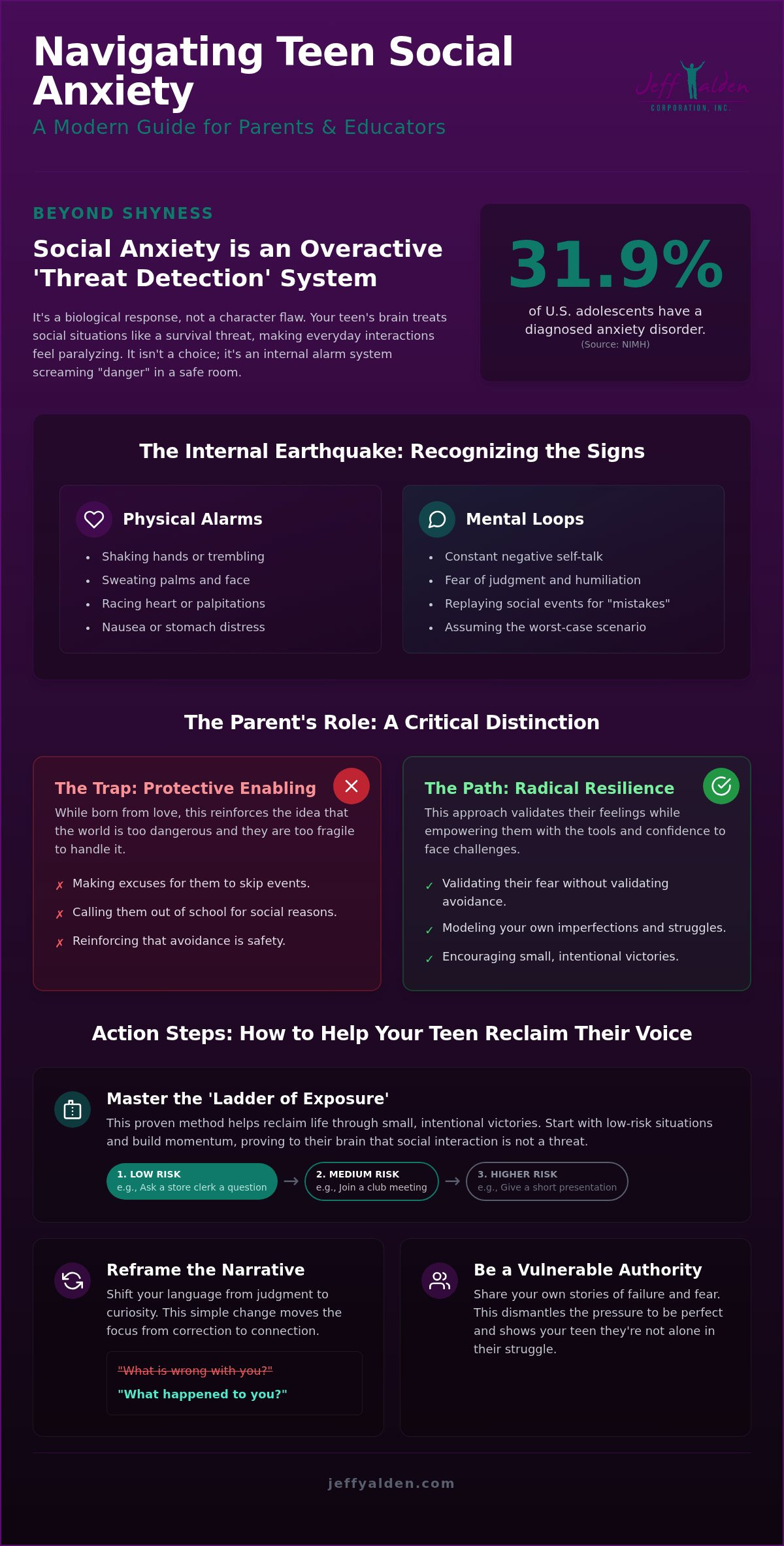
The “internal earthquake” is real. It is the shaking hands, the sweating palms, and the heart that beats so fast it feels like it might burst. These physical alarms are triggered by the “mental loop.” This is the negative self-talk that starts days before an event. “Everyone will stare.” “I’ll say something stupid.” Your teen would rather stay home in the dark than face the perceived threat of a school cafeteria. In 2026, where 31.9% of U.S. adolescents have an anxiety disorder, these symptoms are a cry for a new strategy. If you are wondering how to help a teen with social anxiety, you have to acknowledge the physical toll first. It isn’t all in their head. It is in their nervous system.
When these physical symptoms require a professional medical evaluation, services like YA Medical offer a less intimidating alternative through mobile urgent care and house calls, ensuring the teen feels safe and supported in a familiar environment.
The Role of the ‘Vulnerable Authority’
I believe in being a “vulnerable authority.” This means you lead by example through the sharing of your own imperfections. When you tell your teen about a time you failed or felt paralyzed by fear, you break their isolation. You become a partner in the struggle. Jeff Yalden, a veteran Teen Life Coach, uses this radical transparency to connect with students in a way that clinical sessions often can’t. He shows them that you can be successful and still have scars. We have to move from asking “What is wrong with you?” to asking “What happened to you?” This shift in perspective is a massive part of how to help a teen with social anxiety. It turns a problem into a shared mission. You aren’t just their parent; you are their lived-experience guide.
The Resilience Framework: Support vs. Enabling
Enabling says “I’ll protect you from the pain.” Resilience says “I’ll walk through the pain with you.” When you let your teen skip the party or call in sick for the presentation, you’re confirming their worst fear: that they aren’t strong enough to handle life. You’re robbing them of the chance to prove themselves wrong. Real support means building resilience in teens through consistent, small victories. We use the “Ladder of Exposure” to climb out of the hole. You don’t start with the crowded cafeteria. You start with a five-minute walk through the hall. These intentional, uncomfortable steps are how we stop the clinical guesswork and start the real work.
This process is about Helping Your Teen Reclaim Their Voice by teaching them that discomfort isn’t a dead end. It is a doorway. If you are desperate to know how to help a teen with social anxiety, you must understand that “fixing” the problem for them is the fastest way to destroy their self-worth. They need to know they can survive a shaking hand or a cracked voice. They need to see that they are capable of doing hard things even when their heart is racing.
The Trap of Avoidance
Avoidance is the oxygen that keeps anxiety alive. Every time they stay home, the fear grows bigger and the world grows smaller. You have to identify when your “support” is actually a barrier to their growth. I advocate for a “bravery contract.” This is a clear, written agreement between you and your teen. It outlines the specific social challenges they will face this week. It isn’t a demand; it’s a partnership. It’s about showing up for themselves and proving that the “social death” they fear isn’t coming. When we stop avoiding, the anxiety loses its power.
Communication That Actually Works
Stop the interrogation. “How was your day?” is a dead-end question that invites a one-word answer. Start asking, “What was a moment you felt brave today?” This shifts the focus from their failure to their effort. Use staccato-like fragments in your check-ins. Short. Punchy. Direct. No lectures. Just connection. I use “I” statements to model radical transparency. “I felt nervous in my meeting today, but I did it anyway.” This shows them that you are a human, not just an authority figure. It is the most powerful way to show how to help a teen with social anxiety without making them feel like a broken project.
Action Steps: Helping Your Teen Reclaim Their Voice
Enough theory. It’s time for action. If you’re searching for how to help a teen with social anxiety, you have to be willing to get in the trenches with them. Step one is simple but radical: validate the feeling, but challenge the thought. Tell them, “I believe you feel terrified, but I don’t believe you are in actual danger.” Step two is about you. Model “imperfect” social interactions. Let them see you make a mistake in public, like forgetting a name or fumbling an order, and laugh it off. This kills the “performance” culture they live in and shows them that social “failure” isn’t fatal.
Step three: create a no-phone zone. We know from 2026 data that 77% of teens feel the “perfection” they see online negatively impacts their self-esteem. Practice eye contact and active listening during dinner. It is a muscle that has atrophied in the digital age. Step four is about bringing in a pro. Sometimes, a teen won’t hear the truth from a parent because the emotional stakes are too high. A youth life coach offers a neutral ground and a clear path forward that isn’t colored by parental worry. Finally, celebrate the effort. If they walked into the cafeteria but sat alone, that is still a win because they faced the door. This is the core of how to help a teen with social anxiety: moving from protection to empowerment.
Mindfulness and Grounding in the Moment
When the heart starts racing in the hallway, they need a tool they can use immediately without looking “weird” to their peers. The 5-4-3-2-1 technique is a lifesaver. Have them name 5 things they see, 4 they can touch, 3 they hear, 2 they smell, and 1 they can taste. It pulls the brain out of the “mental loop” and back into the physical room. Their breath is the only tool they always have with them. Teach them to label the anxiety as “The Noise” or “The Alarm.” It is an external force, not their identity. When they can say “My alarm is going off” instead of “I am dying,” they’ve already won half the battle.
When to Seek Professional Help
You have to know the line between a struggle and a crisis. If you see signs of total withdrawal, a refusal to eat, or hear mentions of hopelessness, do not wait. Look into teen suicide prevention programs for early intervention. A multi-disciplinary approach, combining professional coaching with school-wide support, creates a safety net that actually holds. If you’re ready to see your teen stand tall again, bringing in a Teen Motivational Speaker can break the silence school-wide and let every student know they aren’t alone in the dark.
Transforming the Campus: Why Community Resilience Matters
Social anxiety thrives in silence. It lives in the gaps between lockers and the quiet corners of the library. It is a monster that feeds on judgment and isolation. But here is the truth: it dies in community. If you are searching for how to help a teen with social anxiety, you have to look beyond your own front door. You have to look at the campus culture. When we treat anxiety as an individual problem, we miss the bigger picture. We need to shift the entire vibe of the school from one of competition to one of connection.
This is where high school assemblies change the game. In just 60 minutes, a room full of teenagers can go from guarded and cynical to open and connected. It happens through radical transparency. When the “cool kids” on the football team and the “quiet kids” in the back row realize they are both struggling with the same paralyzing fears, the social hierarchy crumbles. Jeff Yalden doesn’t do “sit-and-get” lectures. He brings real, raw talk that makes it okay to not be okay. This approach isn’t about clinical checklists; it’s about heart-to-heart recognition. It is about normalizing the struggle so no one has to carry it alone.
Empowering Student Leaders
Peer-to-peer support is a weapon. It is more powerful than any adult lecture could ever be because it speaks the language of the hallway. We need to train our students to look for the “lonely” in the cafeteria. It is about building a culture where vulnerability is seen as the ultimate strength, not a weakness. When a student leader stands up and shares their story, it gives everyone else permission to breathe. This collective resilience is a massive part of how to help a teen with social anxiety. It creates a safe harbor in the middle of the high school storm. Students stop being spectators of each other’s pain and start being partners in each other’s growth. This is how we dismantle the digital comparison culture that leaves 77% of teens feeling inadequate.
Bringing the Message to Your School
Real change needs a spark. A teen mental health speaker can be that catalyst for your district. Parents, you have more power than you think. You can advocate for mental health programming that actually resonates with students and disrupts the status quo. Don’t settle for “wait and see” policies that leave teens isolated and afraid. Demand the kind of radical transparency that saves lives and builds lasting resilience. If you are ready to change the culture and give your students a clear path forward that isn’t just clinical guesswork, it is time to take the next step. Ready to change the culture? Book Jeff Yalden for your next high school assembly.
Reclaim the Future: Your Teen is Ready to Lead
You have the tools. You understand that social anxiety isn’t a character flaw; it’s a survival mechanism gone into overdrive. By shifting from “fixing” to “connecting,” you’re already changing the trajectory of your child’s life. We’ve explored how to help a teen with social anxiety by building a “Ladder of Exposure” and modeling imperfect social wins. This isn’t just about getting through the day. It’s about building a foundation of radical resilience that lasts a lifetime.
I’ve spent over 30 years in the trenches, impacting millions of students through a message of radical transparency that actually resonates with Gen Z and Alpha. As a specialist in crisis intervention, I know that one powerful moment of connection can shift an entire school’s culture. You can bring that transformation to your district right now. Bring Jeff Yalden to your school to transform your campus culture.
Your teen is stronger than they know. They just need you to show them the way. Keep pushing. Keep connecting. Let’s start building that resilient future today.
Frequently Asked Questions
Is social anxiety in teens just a phase they will grow out of?
No, social anxiety is rarely something teens simply outgrow without intervention. Over 75% of people with social anxiety disorder see symptoms start in childhood or the early teenage years. If left unaddressed, it often leads to long-term isolation or depression. Waiting for it to pass is a dangerous gamble. You need to be proactive. Early intervention is the key to building radical resilience before their world shrinks.
What is the difference between being shy and having social anxiety disorder?
Shyness is a personality trait; social anxiety is a paralyzing fear of being judged. A shy teen might be quiet but can still function in a classroom. A teen with social anxiety feels an existential threat in social settings. Their threat detection system is stuck on high alert. If their fear persists for six months and occurs in peer settings, it is more than just a personality quirk. It is a clinical hurdle.
How can I help my teen without being pushy or making them more anxious?
You help by validating their feelings while challenging their negative thoughts. Stop trying to fix them and start connecting with them. Use “I” statements to share your own social fumbles. This breaks their isolation without making them the problem. If you’re looking for how to help a teen with social anxiety, focus on partnership. Small, intentional wins are better than forced, high-pressure situations. Be their guide, not their boss.
Should I let my teen stay home from school if they are having a panic attack?
No, letting them stay home reinforces the idea that the world is too dangerous to handle. Avoidance is the fuel that makes anxiety grow. While you must acknowledge the physical toll of a panic attack, you have to encourage them to face the day once the peak passes. Use grounding techniques like the 5-4-3-2-1 method. Support them through the discomfort instead of helping them escape it. That is how resilience is built.
Can a life coach help more than a therapist for social anxiety?
A life coach offers a direct approach focused on action and resilience. While therapists often dive into the past, a Teen Life Coach like Jeff Yalden focuses on the “now” and the “next.” Coaching provides a lived-experience guide who understands the high school social hierarchy. It is about building a victor mentality. Often, a multi-disciplinary approach that combines coaching with professional support provides the most comprehensive safety net for a struggling student.
What are the warning signs that my teen’s social anxiety is becoming a crisis?
Look for total withdrawal, a refusal to eat, or a complete shutdown of communication. If your teen expresses feelings of hopelessness or starts mentioning self-harm, you are in a crisis. Don’t wait for a sign that is clearer than that. These are the moments where teen suicide prevention programs and immediate professional intervention become non-negotiable. Trust your gut. If you feel like they are drowning, reach for a lifeline immediately.
How do I talk to my teen’s teachers about their social anxiety?
Be direct, transparent, and focus on collaboration. Tell the teacher exactly what your teen is experiencing without using clinical jargon. Explain that their silence isn’t disinterest; it is a survival mechanism. Ask for small accommodations, like not being called on randomly, while they work on their Ladder of Exposure. Most educators want to help. They just need to know how to help a teen with social anxiety in a way that supports the classroom.
Does social media make social anxiety worse for high schoolers?
Absolutely, because it creates a 24/7 performance culture. 77% of teens report that the perfection they see online negatively impacts their self-esteem. Social media turns every hallway moment into a potential viral disaster. It keeps them stuck in a loop of comparison and fear. You have to create tech-free zones to help them practice real-world eye contact and active listening. They need a break from the digital noise to find their own voice.
