
What if the spreadsheets you’re using to track student wellness are actually masking the very crisis you’re trying to solve? We spend months evaluating school mental health programs by counting heads in a counselor’s office, yet 40% of our high school students are still reporting persistent feelings of hopelessness. It’s a gut-wrenching reality. You feel the crushing pressure from your board to prove a return on every dollar spent. You’re exhausted by the fear that your programs are just surface-level fixes while student crisis rates remain high. I’ve been in those trenches, and I know that data without a soul is just noise.
You deserve to know that your hard work is actually saving lives. I promise to show you how to move beyond clinical spreadsheets and measure the real-world impact of your school’s mental health initiatives. We’re going to build a radical framework for 2026 that doesn’t just satisfy an audit, but actually sparks student engagement and validates your commitment to safety. This guide breaks down how to capture the heartbeat of your student body, shifting from reactive crisis management to a proactive culture of resilience that works.
Key Takeaways
- Stop treating student wellness like a math problem; learn why effective evaluation is a living, breathing process rather than a static yearly report.
- Focus on the two non-negotiable pillars of modern care: radical accessibility and building deep, cultural trust between students and staff.
- Master a clear, 5-step protocol for evaluating school mental health programs that aligns your resources with a single “North Star” goal to save lives.
- Shift your focus from clinical attendance numbers to the “heartbeat” of your school by capturing raw, anonymous student sentiment that spreadsheets miss.
- Bridge the gap between services and students by using high-impact assemblies to validate your strategy and open the door to counseling.
Beyond the Spreadsheet: Why Traditional Evaluation Fails Our Students
Let’s get real for a second. Most evaluation reports are just expensive paperweights. We spend thousands of dollars on school-based prevention programs, yet we only look at the data once a year when the board asks for a slide deck. That’s not evaluation. That’s an autopsy. In 2026, evaluating school mental health programs has to be a living, breathing pulse check. It’s not about what happened last semester. It’s about what is happening in your hallways right now. Numbers don’t bleed, but students do. If your evaluation process doesn’t reflect that, it’s failing.
We’re currently plagued by “Check-the-Box” syndrome. We buy the curriculum. We hire the staff. We check the box and breathe a sigh of relief. But there’s a massive chasm between “Program Presence” and “Program Impact.” Presence is having a counselor on the payroll. Impact is a student actually trusting that counselor enough to stop a plan for self-harm. Passive monitoring is a relic of the past. 2026 requires a shift toward active engagement. You can’t just wait for the data to come to you; you have to go out and find the truth of the student experience.
The High Cost of Poor Evaluation
When evaluation is surface-level, the price is paid in student lives and wasted potential. Ineffective programs lead to massive budget drains and, worse, student apathy. If kids see a program as “cringe” or out of touch, they stop listening. This creates a dangerous sense of false security for administrators. You think the “safety net” is there because the spreadsheet says so, but the holes are big enough for your most vulnerable kids to fall through. Leading with radical transparency means being brave enough to admit when a program isn’t hitting the mark. It means asking the hard questions before a crisis forces your hand.
What “Success” Really Looks Like in 2026
Success isn’t found in the number of sessions booked; it’s found in the depth of connection made. A modern framework for evaluating school mental health programs prioritizes how much the conversation has been normalized on campus. Are students talking about their struggles in the cafeteria, or is it still a whispered secret? Real success looks like:
- A measurable increase in students self-referring for help because they actually trust the system.
- Student voices being the primary drivers of program adjustments, not just adult assumptions.
- Teachers feeling empowered to have “real talk” with students without fear of saying the wrong thing.
Success is a culture where “I’m not okay” is met with immediate, relatable support rather than a clinical referral and a cold shoulder. We have to stop measuring the paperwork and start measuring the heartbeat.
The Core Pillars of a Modern School Mental Health Framework
Let’s be blunt. Legislative compliance is a participation trophy. It doesn’t mean your kids are safe. It just means you won’t get sued. If we’re serious about evaluating school mental health programs, we have to look at the four pillars that actually sustain a culture of wellness. We’re moving past the “check the box” mentality and into the “change the life” reality. These pillars aren’t just suggestions. They’re the non-negotiables for a school that actually cares about its heartbeat.
We have to weigh evidence-based intervention against lived-experience guidance. Clinical tools provide the “how,” but lived experience provides the “why.” One without the other is incomplete. Finally, we have to talk about sustainability. Your program’s impact is tied directly to staff wellness. You can’t ask teachers to be the first line of defense if they’re running on empty. Evaluating your program means evaluating the health of the adults who run it. If the adults are drowning, the kids don’t stand a chance.
Accessibility: Breaking the Barrier to Entry
Can a kid actually get help? It sounds like a simple question, but the answer is often buried under a mountain of bureaucracy. We have to evaluate the “referral loop” on your campus. If a student is in crisis and they have to fill out three forms and wait four days, the system is broken. The latest data on school mental health services from the 2021-22 school year shows that while 96% of public schools reported providing some type of mental health services, the depth and speed of that care are what truly matter. You must measure the “stigma gap” on your campus. It’s the difference between having a service available and having a student who feels safe enough to use it. Immediate crisis support isn’t a luxury; it’s the baseline. If it’s not low-friction, it’s not accessible.
Relatability: The Heart of Character
Do they trust you? This is the Relatability Pillar. Clinical expertise is vital, but it’s useless if the student doesn’t feel seen. Students can smell “fake” from a mile away. They don’t need a distant expert; they need a guide who has been through the fire. This is central to building resilience in teens. When staff members model resilience by sharing their own imperfections, they give students permission to do the same. This isn’t about oversharing. It’s about being human. You need to evaluate how your staff models resilience. Are they showing kids how to bounce back, or are they just reading from a script? Trust is built in the raw moments, not the clinical ones.
Sometimes, the best way to kickstart this culture shift is through the power of a teen motivational speaker who can say the things your students need to hear in a way they’ll actually accept.
Quantitative Data vs. Qualitative Impact: Measuring the Heartbeat
Numbers are safe. They’re clean. They look great in a board meeting. But let’s be real: attendance numbers for counseling sessions tell you absolutely nothing about whether a student actually felt heard. You can have a packed waiting room and a campus that’s still drowning in silence. When evaluating school mental health programs, we have to stop worshiping the spreadsheet and start measuring the heartbeat of the hallways. If you’re only looking at quantitative data, you’re missing the “vibe”—that invisible culture where most mental health struggles actually brew.
A single mental health event or high school assembly creates a ripple effect that a tally mark can’t capture. Did the “energy” in the cafeteria shift? Are kids mentioning a speaker’s name three days later? This is qualitative impact. It’s messy, but it’s real. To truly understand this, look at UCSF’s School-Based Behavioral Health Projects, which emphasize that effective evaluation requires looking at the actual implementation and behavioral shifts within the school community. We also need to use our teachers as barometers. They see the eye rolls, the slumped shoulders, and the sudden bursts of engagement. Their feedback is the ultimate barometer for classroom climate.
The Metrics That Matter Most
If you want the truth, look at the ratio of disciplinary referrals versus mental health referrals. In a healthy program, the latter should rise as the former drops. It means kids are being seen as humans with needs rather than problems to be managed. Watch for the growth of student-led initiatives. When kids start their own “wellness clubs” or peer support groups, your program is winning. Also, track academic shifts in high-risk groups. Mental health isn’t separate from grades; it’s the engine that drives them. If the engine is fixed, the car starts moving again.
Capturing the “Raw” Truth
How do you get the real story? You run an anonymous student survey that doesn’t feel like a test. Ask questions that matter, like “Do you feel like anyone here actually gives a damn?” Then, be prepared for the answer. This is where radical transparency hurts. You might find out your favorite program is a total flop with the kids. Don’t get defensive. Handle negative feedback with a victor mentality. Use it to pivot. Host focus groups that students actually want to join. Feed them, respect their time, and listen more than you talk. When you lead with vulnerability, they’ll give you the raw truth you need to actually save lives.
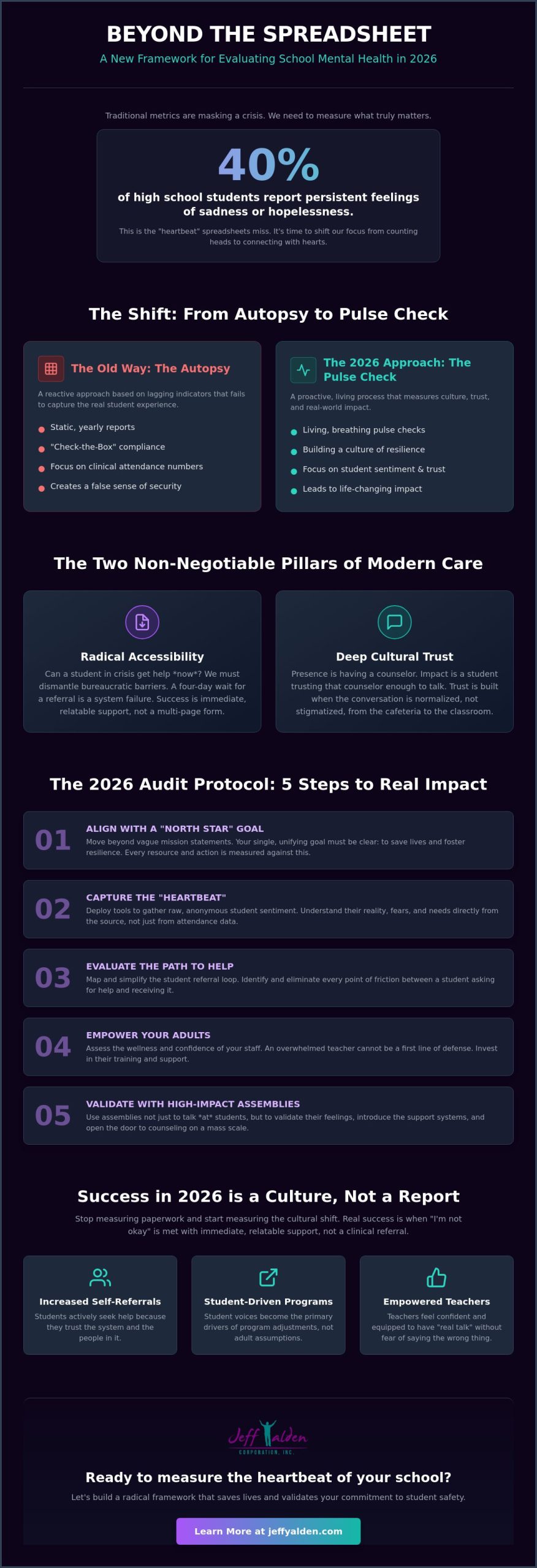
The 2026 Audit Protocol: 5 Steps to Evaluating Your Program
Stop guessing. If you’re serious about evaluating school mental health programs, you need a battle plan that works in the high-stakes environment of 2026. This isn’t a suggestion; it’s an audit protocol designed to cut through the noise and find the truth. Much like the rigorous preparation standards advocated by Align Quality, we’re moving from theory to execution in five radical steps. Theory is dead. We need action that saves lives.
First, you have to define your “North Star.” If your goal is just “legislative compliance,” you’ve already lost. Your goal should be a single, life-saving metric, like reducing self-harm incidents or increasing student-led help-seeking behaviors. Once you know where you’re going, you can start looking at what you actually have on the ground. Step three involves surveying every stakeholder. I’m talking about real talk with parents, teachers, and the students themselves. Step four is the clinical reality check: analyze your crisis intervention lag time. In 2026, speed is a mental health metric. If a student cries out and the system takes three days to move, that’s not a program; it’s a bottleneck.
Step 2: The Resource Map
You can’t manage what you haven’t mapped. We’re looking for “dead zones” in your coverage. These are the times, places, or student groups that currently have zero support. You might have great counselors, but do you have effective teen suicide prevention programs that actually resonate with 2026 students? A resource map isn’t just a list of names; it’s a gap analysis. It ensures your curriculum, speakers, and professional development are actually reaching the kids who are currently invisible. If the resource doesn’t match the modern student profile, it’s just clutter.
Step 5: The Courage to Pivot
This is the hardest part. You have to be willing to kill the “sacred cows.” If a program has been in place for ten years but student engagement is at zero, cut it. With 2026 federal budget proposals suggesting a 15% cut to the Department of Education, you can’t afford to waste a single cent on underperforming assets. Don’t be afraid to re-allocate that budget toward things that actually work, like updated teacher professional development that addresses current trauma. “We’ve always done it this way” is the mantra of a sinking ship. Be the leader who has the guts to pivot toward high-impact, high-engagement interventions.
If your audit reveals a massive gap in student trust, it might be time to bring in a teen motivational speaker who can bridge that divide and get your students talking again.
The Missing Link: How High School Assemblies Validate Your Strategy
You’ve mapped the resources and analyzed the lag times, but how do you know if the kids are actually buying what you’re selling? This is the final frontier in evaluating school mental health programs. You can have the best clinical team in the state, but if the students don’t trust the brand of “mental health” on your campus, they won’t show up. This is where high school assemblies act as the ultimate validator. They aren’t just one-off events; they’re the stress test for your entire culture. If your programs are working, the assembly will prove it by how the students respond.
Think of an external speaker as an auditor who doesn’t look at books, but looks at eyes. When I stand on that stage, I see what your spreadsheets miss. I see the walls coming down in real-time. A speaker opens a door that many students have kept locked for years. This creates the “Assembly-to-Counseling” pipeline. It’s a direct hand-off from a shared moment of vulnerability to the professional support you’ve worked so hard to build. If your program is the engine, the assembly is the spark that finally turns it over. It validates your strategy by proving that the students are ready to engage if the message is right.
The Catalyst Effect
The impact is immediate. When a teen mental health speaker breaks the silence, the stigma doesn’t just fade; it shatters. Schools often see a massive surge in counseling requests in the days following a high-impact presentation. This isn’t a crisis. It’s a breakthrough. It provides a common language for the entire school to use. Suddenly, “I’m struggling” isn’t a confession; it’s a conversation. Evaluating your program means measuring this spike in engagement. It’s the raw, visceral ROI of radical transparency that you can’t get from a textbook.
Postvention as Evaluation
The ultimate test of your framework happens in the aftermath of a tragedy. Postvention is the ultimate test of a mental health program’s resilience. It’s not just about crisis management; it’s about how your culture stabilizes and recovers when the unthinkable happens. A speaker acts as a stabilizing force, helping students and staff process the struggle while your clinical team handles the intervention. If your program holds firm during these dark moments, you know your foundation is solid. I’m here to be your partner in this journey. I want to help you validate every dollar and every hour you’ve invested in your students’ lives. Let’s make sure your impact is real.
Take the Lead on Your School’s Heartbeat
The spreadsheets are filled. The audit protocol is in your hands. But the real work starts when you step out of the office and into the hallways. We’ve explored how evaluating school mental health programs requires a radical shift from passive monitoring to active, heart-centered engagement. You now have the tools to measure the “stigma gap” and the courage to pivot your resources toward what actually saves lives. Don’t let your framework sit on a shelf. Use it to build a culture where students feel safe enough to speak their truth.
I’ve spent over 30 years with my boots on the ground, serving as an expert in crisis postvention and suicide prevention for thousands of high schools worldwide. I’ve seen the transformation that happens when a school moves from checking boxes to changing lives. You don’t have to navigate this journey alone. I’m ready to help you validate your strategy and spark a movement of resilience on your campus. Bring Jeff Yalden to your school to ignite your mental health strategy! You have the power to change the narrative. Let’s get to work.
Frequently Asked Questions
What are the key indicators of a successful school mental health program?
Successful programs show a rise in student-led help-seeking and a drop in punitive disciplinary referrals. It’s not just about session counts or clinical paperwork. It’s about whether your kids feel safe enough to say they’re struggling. When you’re evaluating school mental health programs, look for a culture where “I’m not okay” is met with immediate, relatable support rather than a cold referral and a long wait.
How often should a school audit its mental health resources?
You should conduct a comprehensive audit once a year, but pulse checks need to happen quarterly. In 2026, waiting twelve months for a report is dangerous. Students change fast; your data needs to keep up. Real-time sentiment surveys and teacher feedback loops can help you catch a culture shift before it turns into a full-blown crisis. Stay proactive, not reactive.
Can a motivational speaker actually improve mental health outcomes?
Yes, by acting as the spark that turns the engine over. A speaker doesn’t replace your counselors; they drive traffic to them. By breaking the silence on a massive scale, a speaker validates your clinical strategy and makes the act of seeking help feel like a brave, necessary choice. They open the door that your clinical programs are designed to walk through.
What is the difference between clinical mental health programs and school-based wellness?
Clinical programs focus on diagnosis and symptom reduction, while school-based wellness is about prevention and connection. Schools are the front lines of accessibility. You provide the culture that makes clinical intervention possible. Your job is to create a low-friction environment where kids can breathe before they break. It is about the “how” of daily survival and resilience.
How do we measure student engagement in mental health initiatives?
Measure self-referral rates and the growth of student-led wellness initiatives. If kids are starting their own support groups or wellness clubs, your engagement is high. You also need to look at the honesty in your anonymous surveys. If students are giving you raw, unfiltered feedback, it means they trust the system enough to tell you the truth. That trust is the ultimate metric.
What should we do if our evaluation shows our current program is failing?
Be a victor, not a victim of your own bureaucracy. If the data says a program is a dud, kill it. Re-allocate that budget toward high-impact interventions like better staff training or relatable speakers. Evaluating school mental health programs is useless if you don’t have the guts to pivot when the results are ugly. Don’t let a failing program drain your resources and your students’ hope.
How do we involve parents in the evaluation of school mental health?
Ask parents about the “home-life ripple” through transparent surveys. You need to know if their children are talking more about their emotions at the dinner table or showing increased resilience at home. Parents are your eyes outside the building. Their feedback tells you if the skills students learn in school are actually sticking when the bell rings and the pressure is on.
What role does teacher burnout play in the evaluation of student programs?
Teacher wellness is the foundation of student wellness. If your staff is burnt out, your mental health initiatives will fall flat on delivery every single time. You have to evaluate the health of the adults in the room alongside your student programs. A school with a burnt-out staff can’t lead students to a place of peace. Staff health is a leading indicator of student success.
