
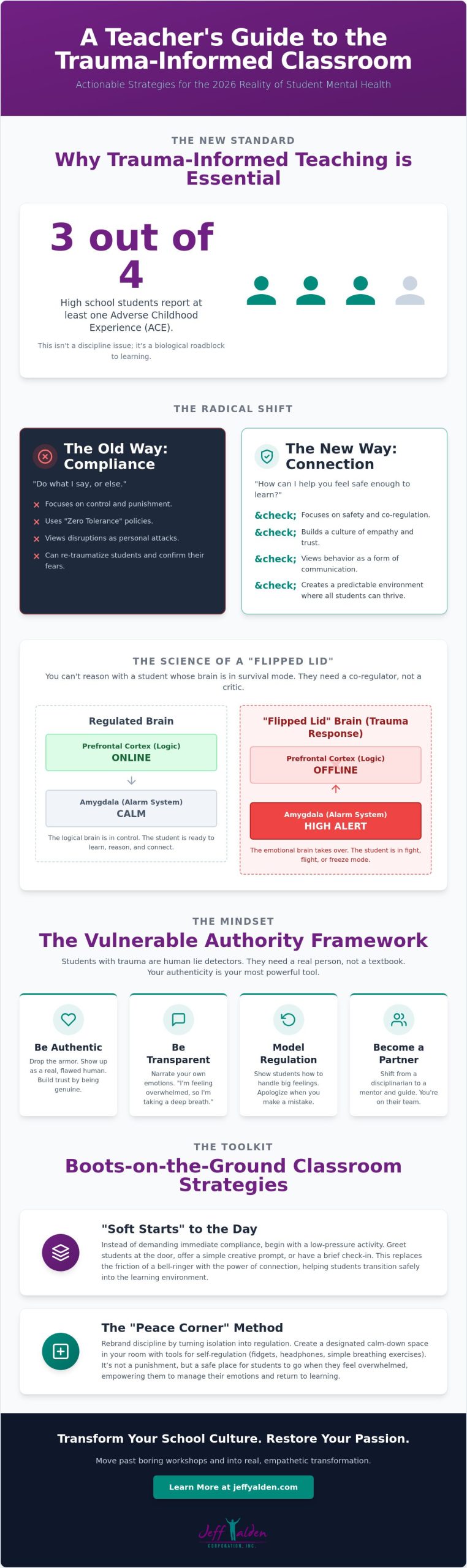
What if the student screaming in the back of your room isn’t trying to ruin your lesson, but is actually fighting for their life? It’s exhausting to feel like you’re a teacher, a therapist, and a parent all before the first bell rings. You’re drained. You’re tired of disruptions that feel like personal attacks. You aren’t alone. With three out of four high school students now reporting at least one adverse childhood experience, the old ways of demanding compliance are breaking. You need classroom strategies for trauma-informed teaching that actually work in the heat of the moment, not just in a clinical manual.
I’ve been in those trenches. I know the weight of secondary trauma. I’m here to tell you that there’s a way back to the passion that brought you to this career. We’re moving past the theory to find raw, actionable ways to de-escalate chaos and build real safety. This guide breaks down the impact of the 2026 Supporting Trauma Informed Instructional Practices Act and provides tools to restore a sense of calm. We’ll explore how to prioritize connection and turn your classroom into a sanctuary for every student, especially those carrying the heaviest burdens.
Key Takeaways
- Stop treating trauma as a clinical checkbox and start seeing it as the new standard for reaching every student in the 2026 landscape.
- Master the “Vulnerable Authority” framework to build trust with students who can smell a lack of authenticity from a mile away.
- Implement actionable classroom strategies for trauma-informed teaching, like “Soft Starts,” to replace the friction of compliance with the power of connection.
- Rebrand discipline by turning isolation into regulation through the “Peace Corner” method that prioritizes student safety.
- Learn how to drive a total cultural shift in your building that moves past boring workshops and into real, empathetic transformation.
The 2026 Reality: Why Trauma-Informed Teaching is the New Standard
The classroom has changed. It isn’t just about test scores or quiet rows anymore. In 2026, we are facing a mental health crisis that clinical manuals didn’t prepare us for. Trauma-informed teaching is no longer an “extra” skill for specialized staff. It’s the new standard for every educator. This pedagogical approach recognizes that Adverse Childhood Experiences (ACEs) aren’t just sad stories. They are biological roadblocks to learning. We are finally moving toward a model of trauma-informed care that treats the root cause rather than just punishing the symptoms. With the 2026 Supporting Trauma Informed Instructional Practices Act now in play, our mission is clear. We must lead with empathy.
Old-school “zero tolerance” policies are failing our kids. They were designed for students who feel safe. But when a student is in a constant state of fight-or-flight, a suspension doesn’t teach a lesson. It confirms their fear that the world is a hostile place. These students aren’t being “bad.” They are surviving. Effective classroom strategies for trauma-informed teaching start by acknowledging this 2026 reality. We use these classroom strategies for trauma-informed teaching to build a culture where safety comes first. This shift doesn’t just help the kids with the heaviest burdens. It creates a predictable, safe environment that benefits every single student in the room.
The Science of the Trauma-Impacted Brain
We need to talk about neuroplasticity. Trauma keeps the amygdala, the brain’s alarm system, in high gear. Think of it as a “flipped lid.” When the emotional brain takes over, the logical prefrontal cortex goes offline. You can’t reason with a kid whose lid is flipped. They aren’t choosing to be difficult. Their biology is literally preventing them from “just calming down” on command. They need a co-regulator, not a critic. They need you to be the calm in their storm.
The Radical Shift: From Compliance to Connection
The old mentality was simple: “Do what I say or else.” That doesn’t work here. We’re shifting to a new question: “How can I help you feel safe enough to learn?” Building resilience in teens starts with your presence. You are the safe adult they have been looking for. Your consistency is their anchor. Trauma-informed teaching is the bridge between a student’s crisis and their eventual classroom success.
Moving Beyond the Manual: The Vulnerable Authority Framework
These aren’t just theories. They are essential classroom strategies for trauma-informed teaching that prioritize the human over the curriculum. When you stop acting like a disciplinarian and start acting like a partner, the power struggle vanishes. You’re no longer fighting for control. You’re building a bridge. This shift is radical because it requires you to drop the armor. It’s scary to be vulnerable in front of thirty teenagers, but it’s the only way to build a connection that lasts. Your authenticity is the most powerful tool in your kit.
Modeling Regulation Through Radical Transparency
Show them how it’s done. Narrate your own emotional state. “I’m feeling a bit overwhelmed by the noise right now, so I’m going to take a three-second pause.” That isn’t a sign of weakness. It’s a masterclass in survival. Use evidence-based classroom strategies to show them how to navigate big feelings in real-time. And when you lose your cool? Apologize. Explicitly. “I shouldn’t have snapped. I’m sorry.” That apology builds more safety than a thousand clinical protocols ever could. It proves that mistakes aren’t the end of the world and that relationships can be repaired.
The Teacher as a First Responder
You are on the front lines every single day. The classroom is often the first place we see the signs for teen suicide prevention. Trust your gut. If a student’s vibe shifts or their behavior doesn’t fit their history, don’t ignore it. We’re moving them from a “victim” story to a “victor” story. Focus on their strengths. Celebrate their resilience. If you need a partner to help spark this shift in your school, bringing in a teen motivational speaker can break the ice and start these hard conversations with radical honesty. We’re in this together, and the goal is to see every student win.
Relational vs. Clinical: Why Connection Beats Compliance
Compliance is a trap. We’ve been taught that a “good” classroom is a quiet one where every student follows the script. But for a child who has been hurt by the people meant to protect them, your clinical checklist feels like another cage. It feels like control. In 2026, we have to realize that the quality of the student-teacher relationship is the single greatest predictor of academic success. If they don’t trust you, they won’t learn from you. It is that simple. You can have the most beautiful, flexible seating in the world, but a pretty room doesn’t fix a broken bond. We need Trauma-Informed Teaching Strategies that prioritize the human soul over the grade book.
This requires unconditional positive regard. Even when they are screaming. Even when they are defiant. You have to be the one person who doesn’t walk away. This isn’t about enabling bad behavior. It’s about understanding the root cause. When a student acts out, they are communicating a need they don’t have the words for yet. Understanding isn’t a hall pass for chaos; it’s the foundation for real change. You’re looking past the outburst to find the child who is terrified. That’s how you win. That’s how you lead.
De-escalation Strategies That Save the Day
When things get heated, go low and slow. Lower your volume. Slow down your speech. Your calm can be contagious if you stay consistent. Try the “2×10” strategy: spend two minutes a day for ten days straight talking to your most challenging student about anything except school. Build that bridge before the next storm hits. And whatever you do, never ask a triggered student “Why are you doing this?” They don’t know. Their logical brain is offline. Asking “why” only adds to their frustration and shame.
Creating Islands of Competence
Every kid has a “thing.” Find it. Maybe they are a gifted artist, a tech wizard, or just really good at organizing the supply closet. Identify that one island of competence and leverage it. Give them a role that makes them feel essential. This is where academic life coaching becomes a game changer. It helps rebuild a student’s shattered self-worth by focusing on what they can do. When you give feedback, focus on the effort and the growth. Avoid the red pen of shame. These classroom strategies for trauma-informed teaching are about building victors, not just passing students. You are helping them rewrite their own story.
5 Boots-on-the-Ground Classroom Strategies for Trauma-Informed Teaching
You don’t need more theory. You need tools that work at 10:00 AM on a Tuesday when the room is spinning. Real transformation happens in the small, repetitive moments. These are the boots-on-the-ground classroom strategies for trauma-informed teaching that move the needle from chaos to calm. We’re moving beyond the clinical manual and getting into the raw reality of the classroom.
- Strategy 1: The “Soft Start.” Greet every single student by name at the door. Ask a non-academic question. “Did you see that game last night?” or “How’s your dog doing?” This proves you see them as a human before you see them as a test score.
- Strategy 2: The “Peace Corner” vs. Time-Out. Rebrand isolation. A time-out is a punishment; a Peace Corner is a tool for regulation. Fill it with soft pillows, noise-canceling headphones, and fidgets. It’s a place to go to, not a place to be sent.
- Strategy 3: Predictive Scripting. Anxiety lives in the unknown. Give them a roadmap. “First, we’ll do the warm-up for five minutes. Then, we’ll watch a short clip. Finally, we’ll work in pairs.” No surprises means less stress.
- Strategy 4: The “Check-In” System. Use non-verbal cues. Have students place a red, yellow, or green post-it on the corner of their desk. It lets you gauge the emotional temperature of the room without calling anyone out.
- Strategy 5: Postvention Recovery. This is the radical part. When a community crisis hits, the next day isn’t for a lesson plan. It’s for processing. Acknowledge the event. Provide a space for silence or talk. Don’t pretend the world isn’t hurting outside your door.
Predictability as a Safety Tool
Transitions are the most dangerous times for a trauma-impacted student. Moving from the hallway to the desk feels like a threat to a hyper-vigilant brain. You need to be the narrator of their safety. Try this 30-second script: “In one minute, we are going to close our notebooks. Then, we will stand up and push in our chairs. I will be standing by the door to walk with you.” This routine calms the amygdala. It tells the brain that the world is predictable and safe.
Reframing Discipline as Skill Building
We’re changing the question. We’ve moved from “What is wrong with you?” to “What happened to you?” Now, we must ask: “What do you need?” Restorative justice keeps kids in the room. If a student is refusing to work, don’t escalate. Try saying: “I see you are struggling to start; what can we do together for the first 5 minutes?” This builds a bridge instead of a wall. If you want to bring this radical shift to your entire staff, I offer Teacher Professional Development that moves past the fluff and into the heart of what matters.
Transforming School Culture: PD That Actually Sticks
A single day of training won’t fix a broken culture. We’ve all sat through those dry, clinical workshops where a presenter reads off slides while we grade papers in the back. That isn’t professional development. It’s a waste of time. True classroom strategies for trauma-informed teaching require a total cultural shift, not just a one-off checkbox. You can’t just “do” trauma-informed teaching on Tuesdays. It has to be the air your building breathes. This starts with administrators providing radical support for their staff. You’re out there taking the hits every day. If the leadership doesn’t have your back, burnout isn’t just a risk; it’s a guarantee. We need to move toward a model where empathy flows from the top down.
Setting the tone for this shift often starts with a spark. Impactful high school assemblies can serve as the catalyst for this transformation. When you bring the entire student body together to talk about resilience and mental health with radical transparency, you’re giving everyone a shared language. You’re proving that the school is a place where it’s okay to not be okay. This creates the “buy-in” that teachers need to make their classroom strategies stick. It’s about moving the needle for the whole campus at once.
Why Real-Experience Speakers Outperform Clinical Trainers
There is a massive difference between hearing from a researcher and hearing from someone who has been in the trenches with hurting teens. Teachers are tired of being told what to do by people who haven’t managed a classroom in twenty years. That’s why trauma-informed teaching professional development needs to be real and raw. My approach is high-energy because the mission is urgent. We don’t have time for fluff. When you lead with transparency, you break down the natural resistance to “one more thing” on a teacher’s plate. You show them that this isn’t a burden. It’s the solution to the burden they’re already carrying.
Next Steps for Your Campus
Ready to move beyond the manual? Evaluate your current climate with these questions:
- Do students have a designated “safe adult” they trust?
- Is your discipline policy focused on exclusion or restoration?
- Does your staff feel supported or just supervised?
- Are you prioritizing connection over compliance in every room?
If you’re ready to bring a real-world perspective to your next professional development day or student event, reach out. Let’s build a path for a student assembly or a staff session that actually changes lives. Remember this: you cannot pour from an empty cup. Take care of your own heart so you can continue to take care of theirs. The work you do matters. You are the victor in this story, and your students are watching you lead the way.
Lead Your Classroom Into a New Era of Connection
The 2026 reality is heavy, but you don’t have to carry it alone. We’ve moved past the dry manuals and into the heart of what actually works: radical transparency and human connection. You’ve learned that your authenticity is a “human lie detector” for students who have been hurt, and that connection will always beat compliance. By mastering these classroom strategies for trauma-informed teaching, you aren’t just managing a room; you’re building a sanctuary. You’re helping students move from a story of “victim” to a story of “victor.”
This mission requires more than a single blog post. It requires a cultural revolution in your building. I’ve spent over 30 years in high school mental health, and I’ve been trusted by thousands of schools to handle crisis intervention and postvention. I don’t do boring workshops. I do radical transformation. If you’re ready to redefine your school’s culture through transparency and empathy, it’s time to Bring Jeff Yalden to your school for a Radical Professional Development Day. Let’s give your staff the tools they need to stay in the fight without burning out. You are the anchor your students need. Keep leading with heart.
Frequently Asked Questions
What is the most important classroom strategy for trauma-informed teaching?
Predictability is your most powerful tool. When the world outside is chaos, your room must be the anchor. Consistency in your routines tells a hyper-vigilant brain that it can finally rest. This doesn’t mean you’re a robot; it means you’re a reliable adult. When kids know exactly what to expect from you, they feel safe enough to take risks and learn. Presence is power.
How do I handle a student who is being disrespectful without triggering their trauma?
Move the conversation to a private space immediately. Public call-outs trigger a shame response that leads to explosion or shutdown. Use a “low and slow” voice to state the boundary. Say, “I see you’re having a hard time, let’s chat for a second in the hall.” This protects their dignity while maintaining your authority. It’s about de-escalation, not winning a fight. Keep it real.
Can trauma-informed teaching work in a classroom with 30+ students?
Absolutely, because these are whole-room environmental shifts. You don’t need 30 individual plans; you need one culture of safety. Implementing universal classroom strategies for trauma-informed teaching actually makes large classes easier to manage. When you build predictable transitions and soft starts for everyone, the overall noise and friction in the room drop significantly. It’s about the collective vibe. It works if you’re consistent.
Is trauma-informed teaching just “being soft” on bad behavior?
Not even close. It’s about high expectations paired with high support. We don’t excuse the behavior; we seek to understand the “why” so we can fix it for good. Real accountability requires a relationship. You can’t hold a student to a high standard if they don’t feel safe in your presence. Empathy isn’t weakness; it’s the bridge to lasting change. It’s the hardest work you’ll do.
How do I avoid secondary traumatic stress as a teacher?
You must build a fortress of self-care and set rigid boundaries. You are a teacher, not a 24/7 crisis counselor. Secondary traumatic stress is real and it will take you out if you let it. Find your tribe of colleagues who get it. Don’t take the trauma home. You have to protect your peace so you can show up for them tomorrow. Your health matters too.
What should I do if I suspect a student has experienced recent trauma?
Document what you see and follow your school’s reporting protocols immediately. Your job is to be the observer, not the investigator. Reach out to your school counselor or social worker to ensure the student gets professional support. In your room, simply focus on being a consistent, safe presence. Don’t push for details. Let them share when they are ready. Just be there.
How can I explain trauma-informed practices to parents who want stricter discipline?
Frame it as a strategy for academic success and classroom order. Explain that “stricter” discipline often backfires on trauma-impacted brains, leading to more disruptions for everyone. Show them the results. When we use effective classroom strategies for trauma-informed teaching, the whole room becomes calmer. Parents want a safe environment for their kids. This is the most effective way to get there. It’s about logic, not just feelings.
What are the first steps to take after a student death or school crisis?
Acknowledge the reality and prioritize emotional safety over the curriculum immediately. The first step is presence. Don’t ignore the elephant in the room. Provide a space for silence or guided discussion. Re-establish routines as quickly as possible to provide a sense of normalcy, but allow for massive grace. Presence is more important than a perfect lesson plan. We heal together or not at all.
