
Alternatives to school suspension include restorative approaches, in-school suspension, tailored learning programs, and prevention supports. These options help schools respond to harmful behavior while keeping students connected to learning and giving them a way to repair harm. The right response depends on what happened and what support the student needs next.
Schools need clear, consistent responses when behavior disrupts learning or causes harm. But sending a student home does not, by itself, teach them how to handle the next challenge. This guide explains how restorative justice can build accountability, what a purposeful in-school program involves, and how prevention can stop problems from escalating. It also covers practical options schools can adapt to student needs, so discipline can mean more than removal from class. Accountability and a real chance to reconnect can go together.
Key Takeaways
- Use restorative conversations, problem-solving, and meaningful repair to address harm while helping students rebuild trust.
- Design in-school alternatives around academic support, behavior skills, and a clear path back to class.
- Look for patterns behind behavior and strengthen prevention before problems escalate into repeated removals.
- Choose supports that fit the student and situation, from mentoring and behavior plans to schoolwide conversations about resilience.
1. Restorative justice
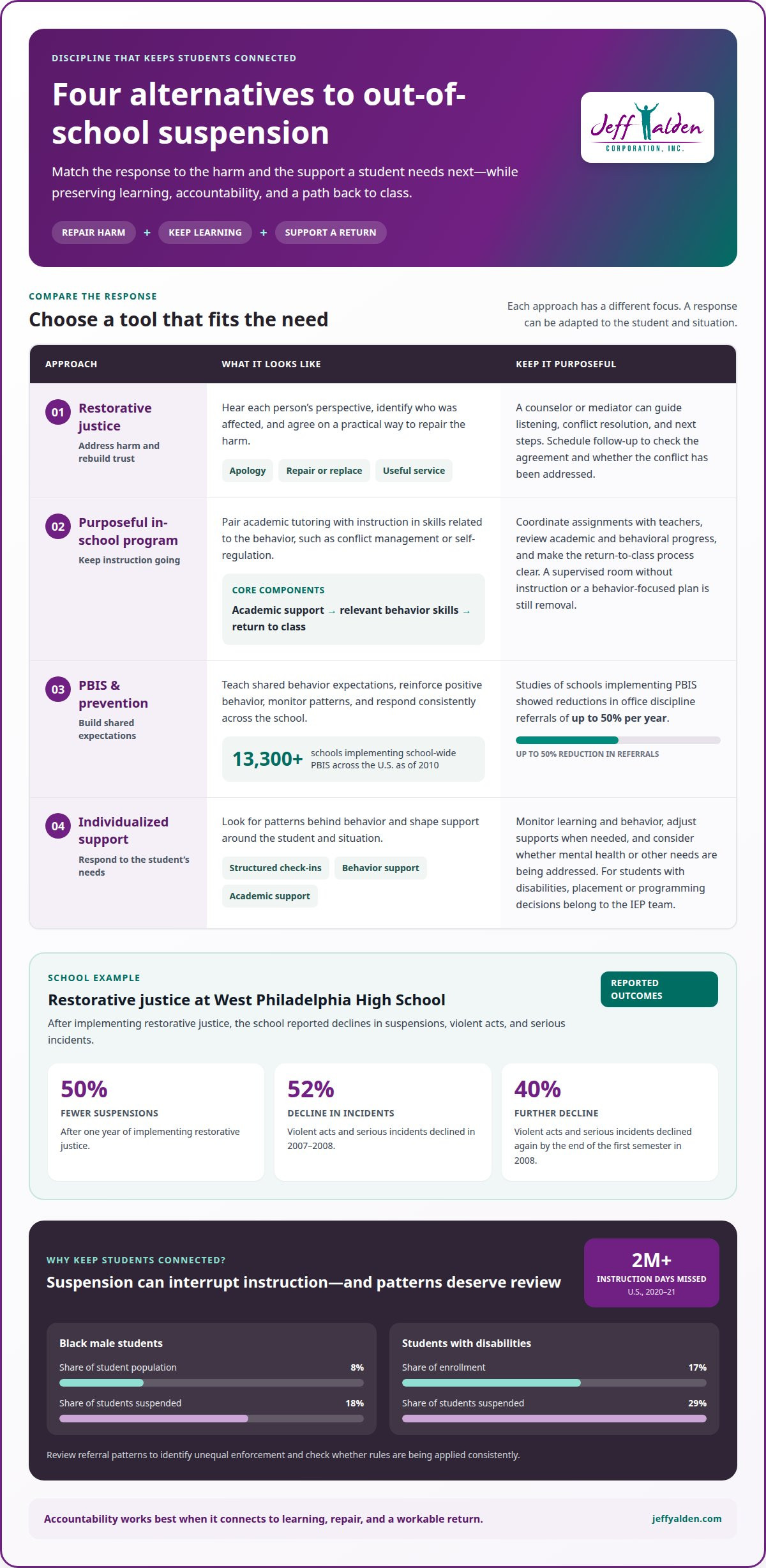
Restorative justice treats a harmful incident as something students need to address, not just a rule violation to punish. The school can bring affected students together to identify the harm and agree on a practical way to repair it. That agreement creates a clear consequence and learning opportunity instead of relying automatically on suspension or expulsion.
Schools can use counseling, mediation, and conflict resolution to help students discuss what happened, how others were affected, and what needs to change. A counselor or mediator can guide students in listening, naming the conflict, and agreeing on next steps. The response should be specific: a student might apologize, replace damaged materials, or take part in a problem-solving meeting.
Restitution works best when it directly repairs the harm. If a student damages a classroom resource, for example, the school might agree on a task to repair or replace it. Restitution in kind, such as completing a useful service, avoids financial payments that could fall on parents. The consequence should fit the incident and build accountability, not shame the student.
Community service can make the repair tangible. Students might help with after-school or lunch clean-up, contributing to the shared space they affected. One middle school in Westchester County, New York, created an in-school alternative that included individual academic support, daily counseling, community service, and a closing ceremony. The ceremony gave students a defined opportunity to reflect and return to the school community.
West Philadelphia High School offers another example. After one year of implementing restorative justice, suspensions dropped 50%. Violent acts and serious incidents declined 52% in 2007-2008, then declined another 40% by the end of the first semester in 2008. These figures show how a school can track both discipline outcomes and serious incidents while changing its response.
Make the process concrete: establish what happened, hear each person’s perspective, agree on how to repair the harm, and schedule a follow-up. A closing conversation can confirm whether students completed the agreement and whether the conflict has been addressed. Restorative approaches do not erase consequences. They connect consequences with learning, repair, and a workable path back.
2. Alternative programming and in-school suspension
In-school suspension is useful only when students continue learning and build relevant skills. For example, a student who disrupts class might complete assigned coursework with academic tutoring, then practice conflict management or self-regulation. A supervised room without instruction or a behavior-focused plan is simply removal within the school building.
A strong in-school program has three parts: academic tutoring, instruction in skills related to the behavior, and a clear process for returning to class. Staff can review academic and behavioral progress to guide when the student rejoins class. This makes the consequence purposeful and gives the student a clear opportunity to show readiness.
Alternative programming should meet the student’s needs while preserving progress toward graduation. Schools can coordinate assignments with classroom teachers, track completed work, and adjust support when a student struggles. For example, a student returning after a conflict might have structured check-ins alongside regular lessons, rather than lose access to instruction.
What federal and state laws govern suspension alternatives? In the United States, IDEA is relevant for students with disabilities; Washington’s RCW 28A.600.015 addresses suspensions and expulsions, RCW 28A.600.022 addresses reengagement plans, and RCW 28A.600.410 encourages alternatives. Requirements depend on the applicable law and student circumstances.
What do these programs cost, and what funding is available? Costs depend on staffing, training, space, and the academic and behavioral supports included. Schools can plan around district or school budgets and consider applicable funding opportunities in light of their program needs.
How can parents request an alternative? Send the school a written request explaining the concern, the support that may help, and a proposed meeting to discuss an in-school plan. For a student with a disability, the Individualized Education Program team must make decisions about changes to placement or programming.
What are the risks and limitations? A poorly staffed program can interrupt instruction without teaching new skills, while an unsuitable placement may fail to address mental health or behavior needs. Schools should monitor learning and behavior, adjust supports, and establish a clear return-to-class process. A broader conversation about student mental health can complement individual school supports.
3. Reducing out-of-school suspension
Removing a student from school can interrupt instruction without changing the behavior that triggered discipline. Students in the United States missed more than 2 million days of instruction due to out-of-school suspension in the 2020-21 school year. A practical first step is reviewing each incident, identifying what support may prevent a repeat, and keeping academic work accessible.
Look closely at who is being suspended and how often. Black males made up 8 percent of the total student population but 18 percent of students suspended. Students with disabilities made up 17 percent of enrollment but 29 percent of students suspended. Reviewing referral patterns can help school teams spot unequal enforcement and examine whether rules are applied consistently.
Positive behavioral interventions and supports, or PBIS, create shared expectations and reinforce positive behavior across a school. Staff can teach those expectations, monitor behavior, and respond consistently instead of relying on suspension for every problem. As of 2010, more than 13,300 schools across the United States were implementing school-wide PBIS; studies of these schools showed reductions in office discipline referrals of up to 50% per year.
What does research say about suspension alternatives and repeat behavior? Research indicates that suspension and expulsion are unlikely to change the involved students’ behavior or deter other students. Schools can track repeat referrals alongside academic progress, then adjust supports such as parent-teacher communication, mentoring, or counseling if concerns recur.
Prevention starts before a crisis. Positive interactions, appropriate instruction, and close supervision can help stop behavior problems from escalating. For example, if a teacher notices repeated conflict during group work, they can speak with the student and parent and arrange a check-in or behavior support plan before another incident leads to removal.
For students with disabilities, the New York City Department of Education says they are entitled to a Manifestation Determination Review if suspended for more than 10 consecutive school days, or more than 10 cumulative school days in a school year as a result of a pattern of removals. Schools should consider this requirement when reviewing disciplinary decisions and patterns of removal.
4. What are effective alternatives to out-of-school suspension?
Effective alternatives to school suspension address the behavior while keeping students connected to learning. For repeated class disruptions, a teacher might use a behavior contract, regular progress reviews, and a planned check-in with a parent. Set expectations clearly, record what happens, and adjust the plan when it isn’t helping. For example, review whether the student starts assignments and follows agreed classroom routines.
Mentoring offers another option. A student can meet with a teacher, counselor, or staff member before or after school to review a conflict and plan a different response. Parent supervision, regular school-family communication, and coordinated behavior support can reinforce consistent expectations across settings. Brief follow-up conversations help adults notice whether the student is using the agreed strategy.
Build a support plan around the possible reasons for the behavior. Identify what needs to change, reinforce a desirable replacement behavior, and monitor progress. For example, if a student disrupts lessons to avoid difficult work, staff can provide appropriate help alongside clear expectations and feedback. A behavior contract can make the plan visible to the student and supporting adults.
Schools can make alternatives to school suspension more effective by matching each response to the incident. Options include counseling, community service, a supervised break, or before- and after-school detention. A student who interrupts a lesson might take a supervised break, then return with a plan for rejoining class. Loss of privileges, such as recess or social time, can also be tied to clear expectations.
A conflict between classmates may call for mediation or counseling. A student facing emotional challenges may benefit from a referral to community mental health services. Parent-teacher communication can support follow-through, while behavior monitoring helps staff see whether the plan addresses recurring concerns. Use those observations to adjust support instead of repeating a consequence that is not helping.
For a schoolwide effort, align adult responses and teach students how to seek help before conflict escalates. Jeff Yalden’s School Assemblies can support conversations about resilience and mental health as part of broader prevention work. Pair those conversations with individual plans, clear expectations, and consistent follow-up.
Jeff Yalden: High School Assemblies
Jeff Yalden’s High School Assemblies can extend conversations about mental health, resilience, and student choices beyond a disciplinary meeting. For schools working to build a culture where students can speak up and seek support, an assembly can bring these themes to the wider student community.
As a Teen Motivational Speaker, Jeff Yalden brings a perspective schools can use alongside consistent discipline, prevention, and individual support. High School Assembly Programs do not replace a student’s behavior plan or school-based support. They can create a shared starting point for discussing challenges, connection, and constructive next steps.
If your school is planning a broader conversation with students, contact Jeff Yalden to discuss High School Assemblies.
Choose a response that keeps the door open
Choose one recurring discipline challenge and build a response around what students need to learn, repair, or practice. Involve educators and families in planning, agree on how to observe progress, and set a time to review whether the approach is helping. Clear expectations matter, as does listening when a student’s needs change.
Alternatives to school suspension work best as part of a deliberate school culture, not as a quick swap of one consequence for another. A schoolwide conversation about resilience and mental health can help students feel more able to speak up and seek support. Jeff Yalden’s work with schools and students can contribute to that conversation.
If you’re ready to explore that next step, connect with Jeff Yalden. Keep building a school response that holds students accountable while leaving room for growth. Small, consistent choices can help make that future possible.
Frequently Asked Questions
What is restorative justice in schools, and how does it work?
Restorative justice brings students affected by an incident into a structured process focused on impact, accountability, and repair. For example, after hurtful messages in a class chat, a facilitated conversation can help students explain the impact, agree on respectful boundaries, and decide how to rebuild trust. Handle participation carefully, especially if a student feels unsafe speaking directly with someone involved.
How do in-school suspension and alternative learning programs compare?
In-school suspension usually keeps a student on campus in a separate supervised setting, while an alternative learning program may change the student’s learning arrangement more broadly. A student needing a brief reset after a classroom incident might stay at school; someone facing ongoing barriers may need a tailored program that supports continued coursework and credit progress. The key difference is the scope and duration of the learning arrangement, not simply where the student sits.
