
Continuing the conversation after a speaker starts with one attentive move: pick up a noun or verb they used and ask an open-ended follow-up. Stay close to what they shared, then give them room to answer. This helps turn a speech into a genuine exchange.
It can feel awkward when the room goes quiet or you’re unsure what to say next. You don’t need a perfect line or a string of clever questions. You need to listen, respond to the person’s actual words, and let the conversation take turns.
Learn how to ask follow-ups that show genuine interest without making the moment feel like an interview. Match the conversation’s depth, borrow the speaker’s nouns and verbs, and use a pause as a natural opening for the next thought.
Key Takeaways
- Keep follow-up questions close to what the speaker just shared, and match the depth of the moment.
- Let each person take a turn; a pause can be an opening to continue, revisit an earlier point, or begin a new topic.
- Use a meaningful noun from the speaker’s words to shape an open-ended question that invites more than a yes-or-no answer.
- Pick up an action word they used to ask about what happened, what mattered, or what they want to do next.
1. Keeping conversations going with follow-up questions
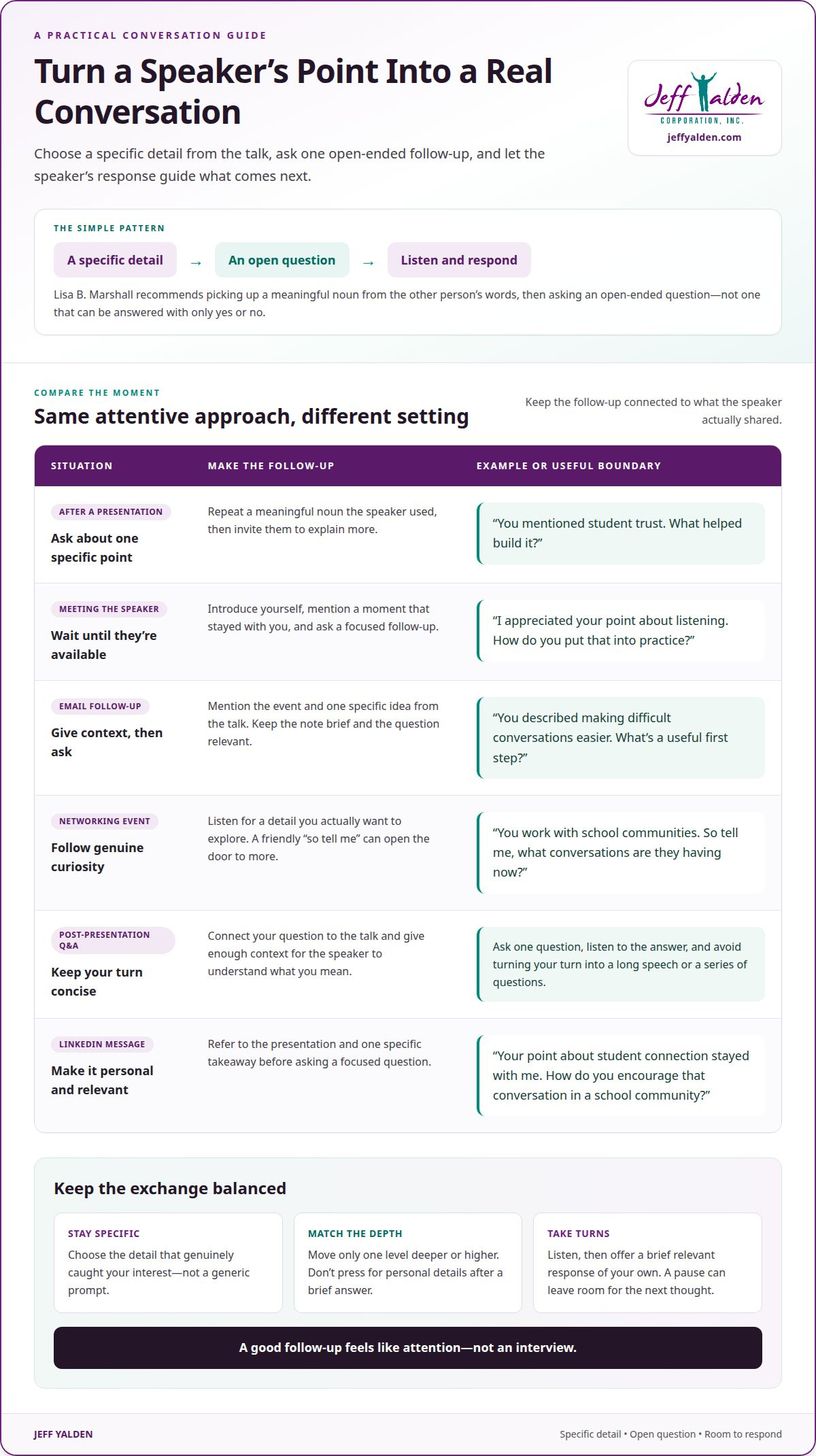
After a presentation, ask about one specific point the speaker made. For example: “You mentioned student trust. What helped build it?” Lisa B. Marshall recommends repeating a noun from someone’s statement, then asking an open-ended question. This invites detail rather than a quick yes or no.
To approach a speaker after a talk, wait until they’re available, introduce yourself, and mention a moment that stayed with you. Try: “I appreciated your point about listening. How do you put that into practice?” Keep the exchange focused and let the speaker’s response guide your next question.
In an email follow-up, mention the event and a specific idea from the talk. Then ask one clear, relevant question, such as, “You described making difficult conversations easier. What’s a useful first step?” A brief note gives the speaker context and makes it easier to respond.
At a networking event, listen for a detail you genuinely want to explore. Marshall recommends following up with “so tell me” in a friendly, interested manner. For example: “You work with school communities. So tell me, what conversations are they having now?”
During a post-presentation Q&A, keep your question concise and connected to the talk. Give the speaker enough context to understand what you mean, ask one question, and listen to the answer. Avoid turning your turn into a long speech or a series of questions.
To keep the exchange engaging and respectful, match its depth and move only one level deeper or higher. If the speaker shares a practical example, ask what shaped that choice. If they give a brief answer, don’t press for personal details.
On LinkedIn, refer to the presentation and one specific takeaway before asking a focused question. For example: “Your point about student connection stayed with me. How do you encourage that conversation in a school community?” Keep the message personal, relevant, and easy to follow.
Avoid interrupting, asking questions unrelated to the talk, or treating the speaker like an interviewer. Marshall says good conversation includes both questions and shared stories. After asking, listen, then offer a brief, relevant response of your own, such as how the idea connects to your work.
2. Turn-by-turn talk
A conversation moves through turns, not one uninterrupted speech. After a pause, your next words can signal that more talk is coming. A simple “That connects to something you said earlier” shows the speaker you’re continuing, not ending the exchange.
When a conversation stalls, you have three options: return to an earlier point, introduce a new topic, or let the interaction end. E.M. Hoey examined how people resume conversations after a lapse. His analysis shows how the next turn can make the direction clear. If you want to continue, refer to a specific detail; if you’re ready to close, say so warmly.
Try mirroring before adding a new thought. Mirroring can involve restating your conversation partner’s idea in different words, which may show you understood and invite clarification. If a speaker says, “Students need room to speak honestly,” you might reply, “You’re saying trust grows when students can be direct.” Then pause. The speaker can confirm, correct, or expand on the point.
The pause matters. Don’t rush to fill every quiet moment with another question. In E.M. Hoey’s study, the conversation data came from U.S. and UK English. The study reported suggestive quantitative evidence that people prefer continuing after a conversational lapse. That doesn’t mean every pause must be rescued. A thoughtful next turn can keep the exchange open.
Notice how your words land. If the speaker responds to your reflection with more detail, stay with that topic. If they give a short response and turn away, respect the signal instead of pushing. In a school discussion, “You mentioned students feeling heard” can reopen the topic; “I’ll let you go, but I appreciated that example” can close it with care.
When a presentation sparks deeper discussion, meaningful conversations in schools can help carry the exchange beyond the speaker’s final words.
3. Using nouns from someone’s statement in follow-up questions
A noun gives you a clear handle on what the speaker discussed. If they mention a “community garden,” pick up that phrase rather than reaching for a generic question. Try, “What made the garden important to your neighborhood?” The speaker can choose which part of the story to expand.
Lisa B. Marshall recommends repeating a noun from the other person’s statement, then asking an open-ended question. The noun anchors your follow-up; the open question invites more than yes or no. If a speaker describes a “career change,” ask, “What helped you decide it was time?” This keeps the focus on their experience.
Choose a meaningful noun, not just the last word you heard. “Project” may be too broad if the speaker also mentioned a “first performance” or “unexpected setback.” Ask about the detail that genuinely caught your interest. For example: “You mentioned the first performance. What do you remember most about that night?”
Then match your question to the conversation’s depth. If someone mentions a “new routine,” you might ask what changed in their schedule. A more personal question about family or stress may feel too intense unless they’ve already opened that door. Keep the noun, question, and relationship in proportion.
Let the answer shape what comes next. If the speaker says, “The rehearsal brought everyone together,” you could ask, “What happened during rehearsal that changed the group?” Listen for a fresh noun in the reply, such as “trust” or “teamwork,” and follow that thread if the speaker seems eager to continue.
One thoughtful noun-based question is often enough to open a meaningful exchange. Avoid repeating a word mechanically or stacking questions around it. Use the noun naturally, ask about the detail you want to understand, and leave room for the speaker to choose the direction. That small choice can make your response feel attentive, specific, and human.
4. Using verbs from someone’s statement in follow-up questions
A verb points to movement: what someone chose, changed, built, or learned. Lisa B. Marshall calls repeating another person’s verb in a follow-up question “verbing.” If a speaker says, “We rebuilt trust after a difficult year,” ask, “How did you rebuild trust?” Repeating the action keeps your question connected to their account.
Listen for the verb that carries the speaker’s meaning, not simply the first action word. If they say, “I tried to bring the team together,” you could ask, “What helped bring everyone together?” That invites them to explain what worked. “Did you bring the team together?” narrows the response to yes or no.
Shape the verb into a question about process, choice, or impact. If someone says they “changed” a school routine, ask what prompted the change. If they “learned” to speak up, ask what made speaking up easier. These prompts let the speaker choose what to share instead of pushing them toward your preferred answer.
Keep the follow-up close to the original meaning. A speaker who says, “We’re trying to include quieter students” may welcome, “What are you trying that helps them join in?” Avoid changing “trying” into “succeeding” or assuming the effort has worked. That distinction respects what they said and leaves room for an honest answer.
After asking, listen for the next action in the reply. “We invited students to lead” gives you a natural opening: “What happened when they led the discussion?” Ask one question, then let the speaker set the depth. For school communities, start a conversation about student connection and make room for the voices behind each action.
Jeff Yalden: High School Assemblies
Jeff Yalden’s High School Assemblies help schools bring conversations about mental health and resilience into a shared setting. When students and educators want to keep those conversations going beyond a presentation, an assembly can create a starting point for listening, reflection, and follow-up questions.
Turn to Jeff Yalden when your school is planning an assembly and wants a Teen Motivational Speaker to engage students around these topics. His High School Assembly Programs bring the discussion to a school community, while a live presentation can help make the subject easier to approach.
Continue the conversation with care: invite students to reflect, listen without rushing, and make room for questions. To discuss a school assembly, contact Jeff Yalden.
Make the Next Conversation Count
Continuing the conversation after a speaker isn’t about finding a perfect line. It’s about making the next exchange feel possible. In your next discussion, notice what someone chooses to share, respond with care, and allow the conversation to take its own shape.
In a school community, this kind of dialogue can begin with a presentation and continue through the questions students and educators carry afterward. Create room for those questions without forcing anyone to speak before they’re ready. A thoughtful exchange can start small and still matter.
If your school is considering a speaker and wants to encourage open conversations among students, contact Jeff Yalden to discuss speaking. You don’t need to script every moment. Start with a genuine intention to listen, and let the next honest question open the door.
Frequently Asked Questions
How Do I Continue a Stalled Conversation?
A stalled conversation can restart with a shared observation or a clear topic shift. At a school event, you might say, “That student question changed the room. What did you make of it?” If the reply is brief, offer a related thought of your own rather than firing off another question. If the other person seems ready to leave, close warmly: “I enjoyed hearing your perspective.”
What does “continuing the conversation after a speaker” mean?
It means carrying an idea from a presentation into an exchange that explores what it means beyond the stage. That might happen during audience discussion, in a later conversation, or through a thoughtful written response. For example, a school team could connect a speaker’s point about resilience to a challenge students are facing and discuss what support might help.
What are good follow-up questions to ask a speaker?
Good follow-ups invite a speaker to explain a lesson, a choice, or an audience takeaway. Try, “What do you wish people understood about this topic?” or “What’s one idea you hope students carry into tomorrow?” For a reflective conversation, ask, “What surprised you while preparing this talk?” Choose a question that fits the presentation and let the speaker decide how much to share.
