
A practical answer to how to improve teacher morale is to make support part of everyday school life: strengthen relationships among colleagues, give teachers a meaningful voice in decisions, connect their work to student learning, and pair newer educators with mentors. Morale grows through daily experiences of trust, purpose, and belonging, not slogans alone.
A caring staff can make difficult days more manageable, but goodwill needs to be reflected in how a school operates: time to collaborate, leaders who listen, and support that helps teachers find their footing. Small, thoughtful changes can make that support visible.
These practical strategies can help schools strengthen collegiality, share leadership, make work more meaningful, and build mentoring relationships for new teachers. The aim is simple: help educators feel connected, heard, and supported in the work that brought them to teaching.
Key Takeaways
- Create regular opportunities for colleagues to recognize one another and work together, so support becomes part of the school’s daily culture.
- Invite teachers into decisions that shape their work, then show how their feedback influences plans and priorities.
- Reconnect professional learning with classroom practice and teachers’ interests to make challenging work feel purposeful and achievable.
- Pair new teachers with mentors and make time for ongoing conversations, helping them build confidence and feel less alone.
1. Building collegiality and staff relationships
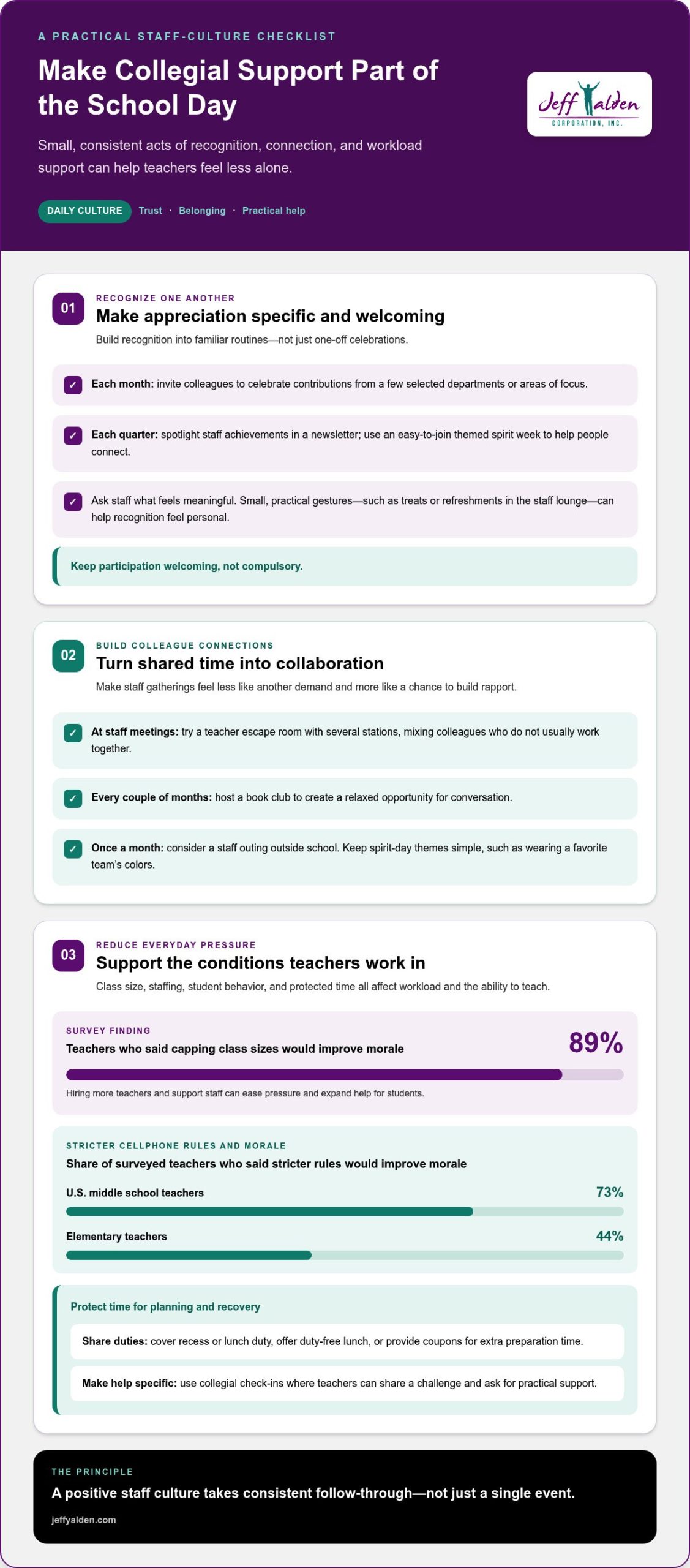
Strong staff relationships grow through repeated, specific moments of recognition. Each month, school leaders can select a few departments or areas of focus and invite colleagues to celebrate their contributions. A quarterly newsletter can spotlight staff achievements, while a themed spirit week gives educators an easy reason to connect beyond daily routines. Keep participation welcoming, not compulsory.
Recognition can be personal and practical, even on a small budget. Treats or refreshments in the staff lounge offer a simple touch. Ask staff what feels meaningful, then encourage colleagues to recognize one another regularly.
Make staff meetings feel less like another demand. A teacher escape room with several stations can turn problem-solving into collaboration, especially when groups bring together colleagues who don’t usually work together. A book club every couple of months or a staff outing outside school once a month can also help people build rapport. Spirit days work best when themes are easy to join, such as wearing a favorite team’s colors.
Classroom resources, staffing, and student behavior shape morale because they affect educators’ workload and ability to teach. In one survey, 89% of teachers said capping class sizes would improve morale; hiring more teachers and support staff can ease pressure and expand help for students. Clear, consistent behavior expectations matter too: 73% of surveyed U.S. middle school teachers said stricter cellphone rules would improve morale, compared with 44% of elementary teachers.
To help prevent burnout, leaders can cover recess or lunch duty, offer duty-free lunch, and provide coupons for extra preparation time. These steps protect time for planning and recovery. Pair practical support with collegial check-ins, where teachers can share a challenge and ask for specific help. A positive staff culture takes consistent follow-through, not just a single event.
2. Including teachers in school leadership and planning
Trust grows when a principal asks teachers for input before making decisions, then explains how that feedback shaped the outcome. Before the next school year, invite staff to help shape the schedule, meeting rhythm, and professional development choices. A survey can reveal priorities; a follow-up meeting can show which ideas will move forward and why. Visible follow-through helps teachers feel their voices matter.
Give educators meaningful influence, not just a chance to comment. A rotating teacher group could review draft schedules, while a staff vote could help select professional development topics. Autonomy over decisions that affect daily work can strengthen motivation. Build psychological safety with clear meeting norms: listen without interrupting, welcome respectful disagreement, and allow staff to raise concerns without personal attacks.
Pay and benefits also shape retention, so leaders should treat them as real workplace concerns. In one survey, 10% of teachers said a pay raise was the only change that would improve morale; 82% of teachers in Texas said better, more affordable health care would help. District leaders can use staff feedback to identify compensation and benefits priorities, then communicate what actions are possible.
For a clear picture of morale, ask teachers directly and consistently. A short survey can cover workload, leadership communication, autonomy, professional development, and support for student needs. Review responses by theme, discuss findings in staff meetings, and share next steps. Repeat the process during the school year to see whether changes address the concerns teachers raised.
Curriculum decisions need the same openness. Sixteen percent of surveyed teachers said their morale would decrease if schools increased or added diversity, equity, and inclusion to curriculum and pedagogy. Leaders can hold structured discussions before changes, explain the educational goals, and invite questions from staff with different perspectives. Clear facilitation makes disagreement easier to discuss while keeping the focus on students and teaching.
3. Meaningful work connected to teaching and learning
Teachers stay engaged when professional learning connects to their interests and classroom goals. Offer choice-based sessions three times a year, in fall, winter, and spring. Keep each session to a maximum of 30 minutes, so educators can focus without adding another heavy demand. After pandemic-related disruption, make space to identify which teaching practices now deserve attention and support.
Choice matters, even when a topic attracts only one participant. One school ran its selected professional development sessions with a single participant, recognizing that individual learning can still strengthen practice. Let teachers choose a goal, such as refining a reading lesson or making group work more engaging. Then give them time to apply that learning with students.
Classroom learning walks can turn collaboration into practical inspiration. Schedule a 15-minute learning walk once a month during team collaboration time, or arrange brief visits of about 10 minutes to a colleague’s classroom. Agree on a focus first, such as student discussion or lesson transitions. Keep the purpose on noticing ideas, not evaluating colleagues.
Meaningful work connects teacher effort to students’ learning and the wider school community. Losing a teacher during the school year has been linked to a loss of between 32 and 72 instructional days for students. That finding underscores why supportive working conditions matter for continuity. Leaders can reduce stress by protecting collaboration time and giving teachers achievable challenges.
Motivation shifts as interests, tasks, context, and colleagues change. Work that feels too difficult or too easy can weaken engagement, so help teachers set a clear, attainable next step. For example, a team might try a new discussion routine, reflect on student participation, and adapt it together. That cycle builds a learning culture where teachers can see their work making a difference.
4. Mentoring programs for new teachers
In the United States, forty to fifty percent of teachers leave teaching within their first five years. A mentor can help new educators navigate the daily realities behind that decision, from classroom routines to communicating with families. The goal isn’t to hand them a script. It’s to offer a trusted colleague who listens, shares practical experience, and helps them think through choices.
Make the relationship dependable. Schedule monthly meetings and protect that time from routine calendar changes. Mentors and new teachers can choose one focus for each conversation, such as lesson planning, classroom management, or understanding the curriculum. Brief check-ins between meetings can address pressing questions before they become sources of stress.
Choose mentors for their listening skills and willingness to share, not only their years in the role. Pairing works best when both people can speak openly about challenges without fear of judgment. School leaders should clarify that mentoring is support, not evaluation. That boundary creates room for honest feedback and real learning.
Give each pair a simple structure: identify a challenge, consider options, choose a next step, and revisit the result. For example, a new teacher struggling with transitions might observe a colleague, try a routine, then discuss how students responded. A short survey can help school leaders identify shared needs among new staff and plan relevant professional learning.
Keep improving the program. At the end of each school year, ask mentors and new teachers what helped, what felt awkward, and what support they still need. Use that feedback to refine pairings, meeting time, and resources. For broader support that complements mentoring, explore ways to support your school community.
Jeff Yalden: High School Assemblies
Jeff Yalden’s High School Assemblies can complement staff support when a school wants to open conversations about student mental health and resilience. Strong staff relationships, teacher voice, meaningful learning, and mentoring remain essential; an assembly adds a shared moment for students to hear those themes addressed openly. It can support a school culture where asking for help and talking about challenges feel more approachable.
As a Teen Motivational Speaker and High School Speaker, Jeff Yalden speaks to students. An assembly is not a substitute for practical staffing changes or ongoing support for educators. It can be one part of a wider school effort to strengthen connection and encourage honest conversations.
If an assembly fits your school’s goals, visit jeffyalden.com to learn more or get in touch.
Make support the next step
Change begins when a school chooses a practical commitment and follows through. Pick a next step educators can feel in their working day, then make space to hear whether it helps. That steady attention turns how to improve teacher morale into an everyday leadership practice, rather than another initiative that fades after launch.
When student connection and resilience are part of a school’s wider support, Jeff Yalden offers High School Assemblies and High School Assembly Programs as a Teen Motivational Speaker. These can complement, not replace, the everyday conditions teachers need to do their work well. Keep the focus on a school community where students and staff can speak openly and find support.
If this feels like a useful next step for your school, contact Jeff Yalden to discuss support. The work of improving morale is real, ongoing, and worth starting. One thoughtful action can help your staff move forward together.
Frequently Asked Questions
How Can Leaders Harness Motivation Among Personnel?
Leaders can strengthen motivation by connecting responsibilities to purpose, choice, and visible progress. Ask each educator what part of the role energizes them, then offer a fitting leadership responsibility, such as piloting a family communication routine. Agree on what success looks like and revisit it together. Recognition matters most when it names the contribution and its effect on students, rather than offering generic praise.
What are the most effective ways to improve teacher morale?
A practical answer to how to improve teacher morale is to identify the daily friction teachers name most, then remove or simplify one source of it. For example, if staff repeatedly struggle to find current student-support information, create a shared, easy-to-use reference. Follow up with teachers to see whether the change helped. Consistent, visible action builds more trust than a new initiative without follow-through.
How does teacher workload affect morale, and how can it be reduced?
Workload drains morale when tasks crowd out planning, teaching, and recovery. Leaders can map a typical week with teachers, then identify duplicate data entry, unclear approval steps, or meetings that produce no decisions. For instance, replace overlapping updates with one shared reporting process. Keep essential responsibilities clear, and review the change with staff to find out whether it frees time for instruction.
How can teachers have more autonomy and input in school decisions?
Give teachers clear decision-making space within shared school goals. For example, leaders can set the learning outcome while allowing grade-level teams to choose lesson approaches and classroom routines. Invite teacher representatives to review proposed changes before they are finalized, and explain which constraints cannot change. This makes input meaningful: staff can see where their judgment shapes implementation, even when some boundaries remain fixed.
What professional development and career growth opportunities improve teacher morale?
Professional learning builds morale when educators can apply it in their classrooms and see a path to further contribution. Offer opportunities to lead a curriculum project, facilitate a peer workshop, or develop expertise in an area they care about. Pair each opportunity with time to apply the learning and share results. Growth feels more valuable when it strengthens both personal practice and the school community.
What role do mentoring and peer collaboration play in teacher morale?
Mentoring and peer collaboration make it easier to solve problems before isolation takes hold. A new teacher might bring a challenging lesson plan to a trusted colleague, compare possible approaches, and choose one adjustment to try. Shared planning materials can also reduce repeated effort across a team. Protect confidentiality in these conversations so asking for help feels like professional learning, not a performance review.
