
The clinical white walls and the “how does that make you feel” questions aren’t working anymore. They’re actually driving your teen further into a shell of silence. You’re likely terrified of the burnout, the academic pressure, and the dark thoughts they won’t share with you. You see them drowning in a digital world of perfection while they’re actually struggling to just get through the day. Finding a Youth Life Coach who speaks their language is no longer a luxury; it’s a lifeline for your family’s future.
I know you want a breakthrough in communication before the next crisis hits. This guide reveals how radical transparency and lived experience can help your teen navigate mental health challenges and build lasting resilience. We’ll explore the shift toward the “vulnerable authority” model that’s defining 2026. You’ll learn how practical coping strategies and real-talk mentorship can turn an unmotivated student into a self-reliant victor. It’s time to stop guessing and start connecting. Let’s get real about what it takes to help your child thrive in a world that feels increasingly heavy.
Key Takeaways
- Learn how a Youth Life Coach acts as a mentor-guide, bridging the gap between a teen’s current struggle and their future self by focusing on emotional intelligence over just grades.
- Understand the critical difference between therapy’s focus on the “why” of the past and coaching’s focus on the “how” of a resilient future.
- Discover why traditional “expert” authority fails with modern teens and how radical transparency earns the right to be heard.
- Explore the 5 Pillars of High-Impact Coaching, including extreme ownership and no-filter truth, to help teens take the wheel of their own lives.
- See how integrating school-wide motivational assemblies with personalized coaching creates a culture of resilience that transforms campus culture.
Beyond the Labels: What a Youth Life Coach Really Does in 2026
Stop looking at a Youth Life Coach as a high-priced tutor or a clinical babysitter. In 2026, the world is louder, faster, and more isolating than ever. Teens are drowning in a sea of digital “perfection” while feeling like failures in their own bedrooms. A coach isn’t there to fix a grade; they’re there to save a life. This is about closing the gap between where your teen is right now and the person they feel capable of becoming.
In 2026, the pressures are relentless. With the average teen spending nearly five hours a day on social media, the comparison trap is constant. To understand what is life coaching in this context, you have to look past the academic surface. A Youth Life Coach serves as a mentor-guide, using lived experience as the currency of trust. Gen Z and Gen Alpha don’t want a distant expert with a framed degree. They want a “vulnerable authority” who has been in the trenches and come out the other side. They need someone who understands the post-pandemic social shifts that have made real-world connection feel terrifying.
The Core Mission: Resilience Over Perfection
The goal isn’t to create a teen who never fails. It’s to build a teen who knows how to get back up. We’ve moved away from the “victim” narrative that keeps kids stuck in their trauma. Instead, we lean into a “victor” mentality. This shift happens through radical transparency. It’s about building character, not just modifying behavior for a week. We stop trying to “fix” the teen and start empowering them to take the wheel. Youth coaching is the bridge between a state of constant crisis and a life of intentional thriving.
Who Benefits Most from Youth Coaching?
Coaching vs. Therapy: Choosing the Right Path for Your Teen
Parents often find themselves at a crossroads, wondering if their child needs a doctor or a mentor. It’s a heavy weight to carry. You see the light fading in their eyes and you just want them back. Therapy focuses on the “why” of the past. It’s clinical. It’s diagnosis-led. It is absolutely necessary for deep-seated trauma or clinical disorders. But a Youth Life Coach focuses on the “how” of the future. We don’t look back to stay there; we look forward to move. We don’t diagnose; we mobilize.
There is also the “Stigma Factor” to consider. Many teens recoil at the word “therapist” because it makes them feel broken. They feel like a patient to be analyzed. But a “coach”? That’s someone on their team. It’s about performance, resilience, and life skills. This shift in perspective is what makes effective youth programs so impactful in 2026. Coaching and therapy can even work together. A counselor heals the wounds while a coach builds the strength to keep walking.
The Clinical vs. Motivational Divide
Jeff Yalden isn’t a clinician; he’s a lived-experience guide. He uses his teen suicide prevention programs to set a baseline of radical safety. If your teen is in an immediate mental health crisis, coaching isn’t the first step. You need clinical intervention. But once the immediate danger passes, coaching becomes the catalyst for real change. It moves the needle from “not dying” to “truly living.” It replaces the clinical jargon with raw, real talk that actually penetrates the wall of silence.
When to Make the Call
For families who need specialized support for substance use or co-occurring mental health challenges, The Recovery Coach NY offers private, customized recovery coaching and case management to help bridge the gap between clinical care and sustainable wellness.
How do you know it’s time? Look for the “faking fine” mask. Your teen says they’re okay, but the door is always locked, the grades are slipping, and the social withdrawal is deafening. If traditional therapy feels “stuck” or repetitive, coaching often provides the breakthrough. It’s action-oriented. We don’t just talk about feelings; we build a 90-day roadmap for ownership and purpose. If you’re ready to see your child stop drifting and start driving, a Youth Life Coach might be the missing piece to their puzzle.
The Wall of Silence: Why Teens Reject Experts and How to Break Through
Teens are professional BS detectors. If you walk into a room with “I’m an expert” tattooed on your forehead, you’ve already lost the battle. They see the suit, the degrees, and the clinical clipboard as barriers, not bridges. This is the Wall of Silence. It’s a survival mechanism. They live in a world that constantly judges their value based on a screen or a score, so they stop talking to avoid being “fixed” by another adult. A Youth Life Coach doesn’t approach from a pedestal. We approach from the dirt.
Breaking through that wall requires radical transparency. It means sharing the scars, not just the trophies. When I talk to a teen, I don’t lead with my 30 years of success. I lead with my failures. I share the times I felt broken, lost, and invisible. This isn’t just “sharing”; it’s a strategic dismantling of their skepticism. It’s visceral. It’s raw. It’s the only way to move from clinical detachment to a real, heart-to-heart connection. You have to earn the right to be heard by being the most honest person in the room.
Earning the Right to be Heard
Street cred isn’t given; it’s earned through thousands of hours in the trenches. Since 1992, Jeff Yalden has stood in front of millions of students in high school gyms, facing the same crossed arms and eye-rolls you see at the dinner table. That history matters. Teens know when someone has “been there.” By using the “Vulnerable Authority” model, we lead by example. We show them that perfection is a lie and that resilience is the only truth that matters. We stop being the “expert” and start being the trusted peer-mentor who isn’t afraid to speak their language. Short. Punchy. Real. That’s the rhythm of trust.
The Power of Postvention
Crisis experience changes how you communicate in everyday moments. When you’ve stood in the middle of a school community reeling from tragedy, you learn how to stay calm in the storm. This postvention expertise informs every one-on-one session. We use the same strategies as a teen mental health speaker to break the silence in a private living room. Vulnerability becomes a tool for empowerment. This is why a Youth Life Coach with crisis experience is fundamentally different. We teach teens that their struggle isn’t a life sentence; it’s a training ground for the victor they’re meant to be.
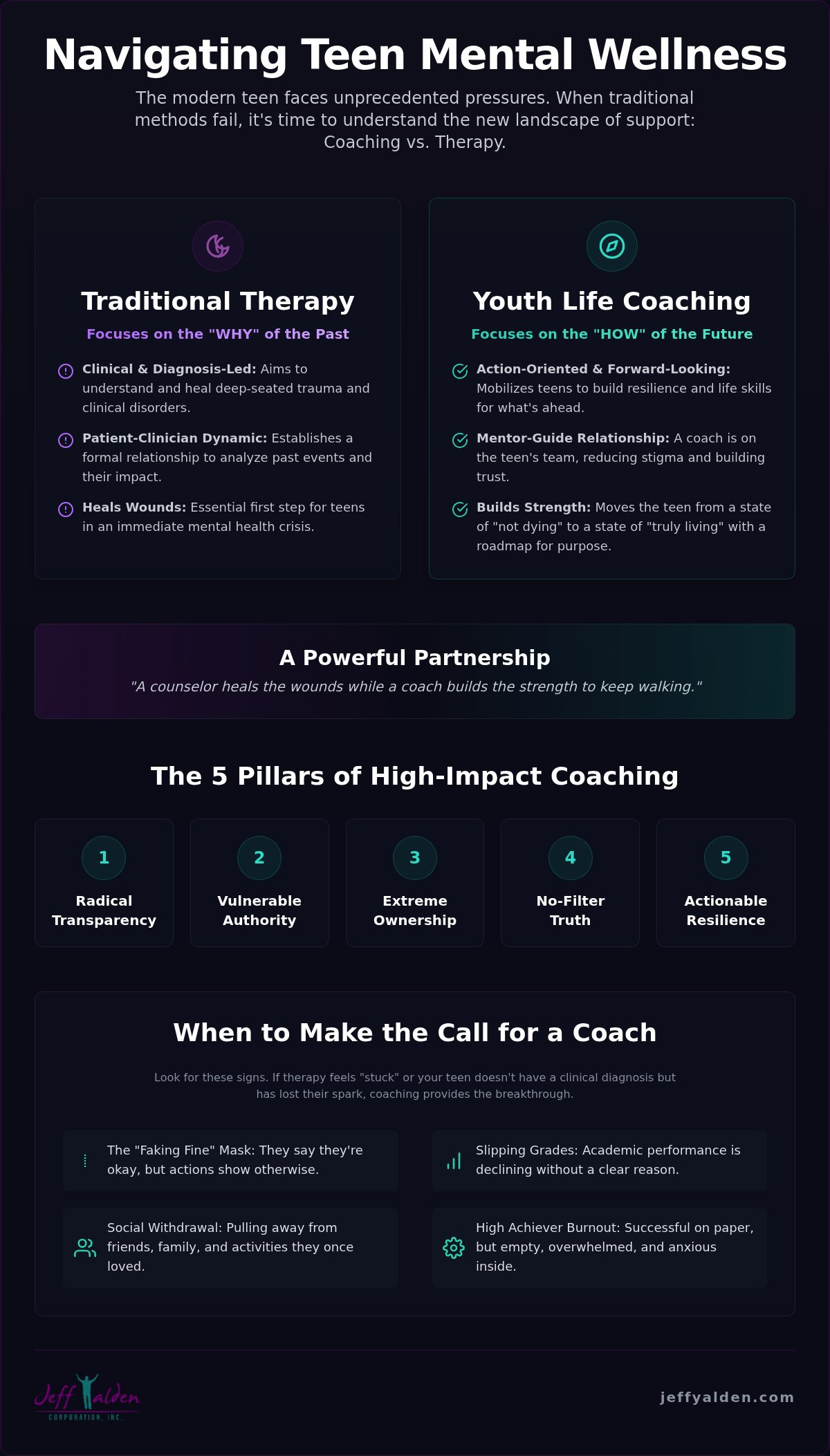
5 Pillars of High-Impact Youth Coaching in 2026
Coaching isn’t about a set of “professional competencies” that look good on a certificate. It’s about the transformation that happens in the heart of the teen. In 2026, we don’t have time for fluff or clinical distance. We need a foundation that holds up when life gets heavy. These five pillars are the bedrock of everything we do to move a teen from a place of “faking fine” to a place of genuine power.
- Pillar 1: Radical Transparency. No fluff. No filters. Just the truth. Teens are starving for reality. When we lead with our own scars, we give them permission to be honest about theirs.
- Pillar 2: Extreme Ownership. We teach teens to take the wheel. Stop blaming the parents, the teachers, or the social media algorithms. You are the pilot of your life, not a passenger.
- Pillar 3: Resilience Framework. Life is going to hit you. We focus on building resilience in teens so they don’t just survive the hit; they use the impact as fuel for growth.
- Pillar 4: Future-Focused Action. We don’t stay stuck in the “why” of the past. We hunt for small, immediate wins that lead to massive identity shifts. Win the morning, win the day.
- Pillar 5: Mental Health Normalization. We kill the shame. Struggling with mental health isn’t a life sentence or a character flaw. It’s a human experience that we face head-on with courage.
Developing the “Victor” Mentality
The world currently rewards the “victim” narrative, but that path only leads to powerlessness. We reject that entirely. We help teens develop a “victor” mentality by setting “edge-of-your-seat” goals that actually excite them. These aren’t goals their parents want; these are goals that set their own souls on fire. This requires high-level accountability in a space that is fiercely supportive but never judgmental. We expect more because we know they are capable of more.
Measuring Success in Teen Coaching
A GPA is a number, not a measure of a human soul. Real success in coaching looks like a teen who can finally advocate for themselves without fear. It looks like emotional regulation during a high-stress week. When a teen finds their voice, the “Ripple Effect” begins. The tension in the house starts to melt. The school dynamic shifts. Resilience is a skill you build through repetition, not a personality trait you’re lucky enough to be born with. If you’re done with the fluff and ready for a real transformation, it’s time to work with a Youth Life Coach who leads with truth.
The Jeff Yalden Method: Transforming Teen Struggles into Resilience
The Jeff Yalden Method isn’t a textbook. It’s a heartbeat. While other programs offer transactional 50 minute sessions that feel like a clinical appointment, we offer a transformational movement. It’s high-energy. It’s advocate-driven. It’s the voice of someone who has stared down the darkest days and chose to keep walking. When a Youth Life Coach leads with this kind of fire, teens don’t just listen; they engage. We use a fast-paced rhythm and visceral storytelling to bridge the gap between their current pain and their future potential.
The real magic happens when we integrate school-wide motivational school assemblies with personalized coaching. Imagine the impact of a student seeing a speaker on stage who finally “gets” them, and then having that same person guide them through a one-on-one breakthrough. We move fast because the need is urgent. We don’t waste time on clinical detachment. We close the gap between the assembly stage and the heart of the individual student. It’s about taking the energy of a thousand students and focusing it on the one who needs it most.
A Legacy of Impact Since 1992
Three decades in the trenches isn’t just a statistic. It’s a promise. Since 1992, Jeff Yalden has been the “vulnerable authority” that schools and families trust. We don’t do clinical. We do life. This legacy is exactly why Jeff is the preferred choice when families look for an academic life coach for high school students. It’s about building resilience for real success, not just passing a test. We’ve seen every struggle, heard every excuse, and we know the way out. We don’t just talk about resilience; we model it.
Your Next Steps: Booking the Breakthrough
Starting the conversation with your teen can feel like walking through a minefield. Don’t make it about what’s “wrong” with them. Make it about the support they deserve. Tell them you found someone who isn’t going to lecture them or treat them like a patient. In the first session, expect radical honesty. Expect a Youth Life Coach who listens more than he speaks and cares more about their future than their past mistakes. We’re here to change the narrative from struggle to strength. You don’t have to navigate this alone. Ready to change the narrative? Book Jeff Yalden for Teen Coaching Today.
Stop Faking Fine: Build the Resilience Your Teen Deserves
The silence in your home doesn’t have to be permanent. We’ve explored how radical transparency dismantles the wall of skepticism and how extreme ownership turns a struggling student into a victor. Resilience is a muscle, not a gift. It’s built through the “how” of the future rather than the “why” of the past. Choosing a Youth Life Coach who leads with lived experience and raw truth changes the entire trajectory of a young life.
With 30 plus years of high school impact and a deep specialization in teen suicide prevention, Jeff Yalden has been featured on major media outlets as a trusted youth expert. He doesn’t just talk. He connects. It’s time to stop guessing and start building a foundation that lasts. You don’t have to navigate this storm alone. Take the first step toward a breakthrough today. Book Jeff Yalden for Radical Teen Coaching and Mentorship. Your teen is capable of greatness. They just need a guide who has already been there.
Frequently Asked Questions
What is the difference between a youth life coach and a therapist?
A therapist focuses on clinical diagnosis and healing past wounds, while a Youth Life Coach focuses on future-oriented action and building internal strength. Therapy looks at the “why” behind behavior; coaching builds the “how” for moving forward. If your teen is in a clinical crisis, start with therapy. If they are stuck and need a mentor to help them take ownership of their life, a coach is the catalyst they need.
How do I know if my teenager actually needs a life coach?
Look for the “faking fine” mask or a sudden loss of spark. If your teen is drifting without direction, withdrawing from social circles, or showing signs of academic burnout, it is time to act. They might not have a clinical disorder, but they lack the internal tools to handle modern pressure. A coach provides a safe, non-clinical space where they can stop being a patient and start being a victor.
Will a life coach help with my teen’s anxiety and depression?
A coach doesn’t treat clinical depression but provides practical coping strategies to manage the daily weight of anxiety. We focus on building the “bounce-back” muscle. By normalizing the struggle and removing the shame, we help teens navigate these heavy emotions without feeling broken. It is about movement. If they are already in clinical treatment, coaching acts as a powerful partner to help them apply resilience in the real world.
Can a youth life coach help with academic motivation and burnout?
Yes, because academic burnout is rarely about the books and usually about the pressure. A Youth Life Coach helps teens reclaim their identity outside of their GPA. We focus on small wins that lead to massive shifts in confidence. By teaching extreme ownership, we help them stop seeing school as a prison and start seeing their future as something they actually want to drive and control.
How long does youth life coaching typically last for a breakthrough?
Real transformation takes time, but you can see immediate breakthroughs in communication within the first few sessions. We typically work on a 90-day roadmap to build lasting habits. This isn’t a quick fix or a transactional appointment. It is a journey of building resilience. The goal is to move from a state of constant crisis to a state of intentional thriving where the teen finally takes the wheel.
Is youth life coaching effective for “troubled” teens who refuse help?
Absolutely, because we reject the “expert” pedestal that teens hate. “Troubled” teens usually refuse help because they don’t want to be judged or “fixed” by another clinical authority. Our radical transparency earns the right to be heard. When a teen sees a coach who shares their own scars and failures, the wall of silence crumbles. We don’t talk down to them; we stand with them in the dirt.
What qualifications should I look for in a teen life coach?
Look for lived experience and a proven track record in the trenches. While certifications are common, they don’t replace “street cred” with actual students. You want a coach who understands crisis intervention and has decades of experience in school environments. Look for a “vulnerable authority” who can handle the raw truth of teen life without flinching. Experience in suicide prevention is a critical differentiator for your child’s safety.
How much does youth life coaching cost compared to therapy?
Youth coaching costs vary, but they are often comparable to private therapy sessions. In 2026, one-on-one sessions typically range from $35 to $90, while comprehensive monthly packages can range from $400 to $1,400. Unlike therapy, which can last for years, coaching is often a focused, high-impact investment designed for a specific breakthrough. You aren’t just paying for time; you’re paying for a transformation and a completely new life trajectory for your teen.
