
The community meeting after a student death isn’t a formality. It’s a lifeline. And how you run it in the next 24 to 72 hours could be the difference between a community that begins to heal and one that fractures under the weight of fear, rumor, and unspoken grief.
You already know this is one of the hardest rooms you’ll ever walk into. Parents are scared. Staff are shattered. Students are watching every adult in their life for a signal that says, “we’ve got you.” The pressure to say the right thing, to not say too much, to hold it together while you’re falling apart inside, it’s real. That fear is valid. And you’re not alone in it.
This guide is going to change how you think about that meeting. You’ll walk away with a clear, actionable agenda, language that balances radical transparency with safety, and the confidence to lead your community through the crisis without making it worse. We’re going to cover exactly what to say, what to avoid, and how to structure a meeting that becomes the first real step toward healing, not just another event people leave feeling more afraid than when they walked in.
Key Takeaways
- A well-structured community meeting after a student death is a critical postvention tool — and how you design the agenda in the first 72 hours can either contain the crisis or deepen it.
- Silence is not safety. You’ll learn why radical transparency, handled with care, is the most powerful weapon against rumor, fear, and the dangerous contagion effect.
- Leading the room means managing energy, not just information — discover how to handle the “Why?” questions and emotional outbursts that will inevitably surface without losing control of the meeting.
- The meeting is just the beginning. You’ll walk away with a concrete post-meeting action plan — including on-campus safe spaces and trauma-informed staff support — to keep the healing moving forward.
- Sometimes the most powerful voice in the room isn’t yours. Find out why bringing in an outside expert like Jeff Yalden can say the things school leaders can’t, and why that distinction saves lives.
The High Stakes of Postvention: Why the Community Meeting Matters
Postvention. It’s a clinical word for something deeply human. At its core, postvention refers to the structured, intentional response that happens after a traumatic death, particularly a suicide, to support survivors, stabilize the community, and prevent further harm. It’s not grief counseling. It’s not a press release. It’s a deliberate act of leadership that says: we see what just happened, and we’re not going to pretend otherwise.
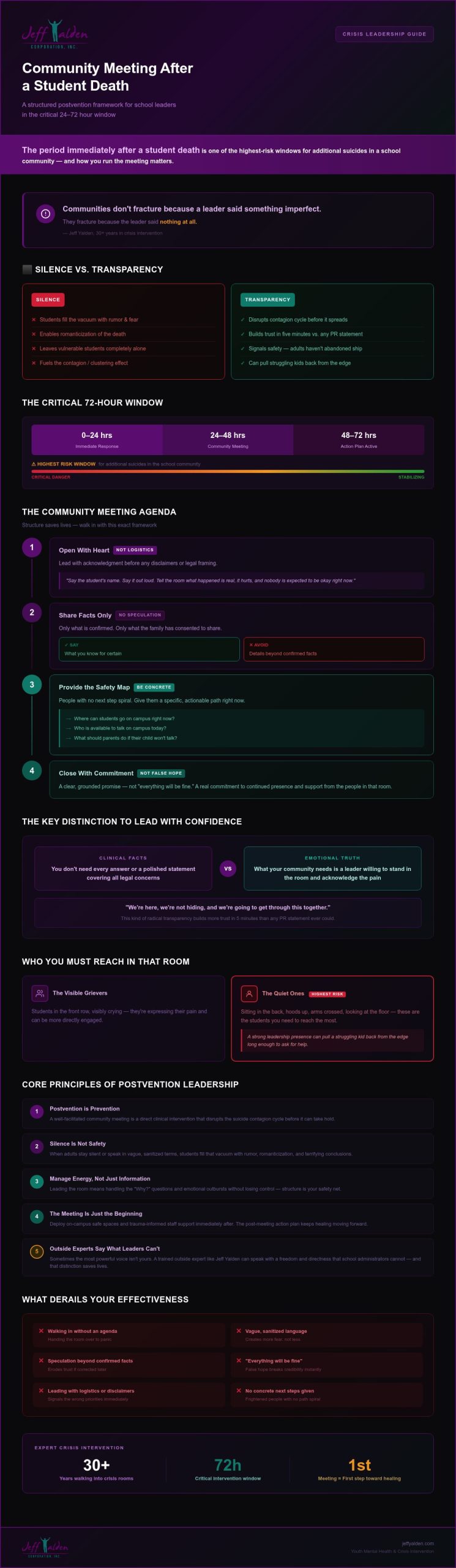
Here’s what the research consistently shows: the period immediately following a student death is one of the highest-risk windows for additional suicides in a school community. This is the contagion effect, sometimes called “suicide clustering,” and it’s not a myth. When a death goes unaddressed, when adults stay silent or speak only in vague, sanitized terms, students fill that vacuum with rumor, romanticization, and their own terrifying conclusions. Silence doesn’t protect anyone. It leaves the most vulnerable kids in your building completely alone with their thoughts at exactly the moment they need the opposite.
A well-facilitated community meeting after student death isn’t just a compassionate gesture. It’s a direct clinical intervention that disrupts that contagion cycle before it can take hold.
Postvention as a Form of Prevention
Think about the students who aren’t in the front row crying. The ones sitting in the back with their hoods up, arms crossed, looking at the floor. Those are the students you need to reach most, and a community meeting is one of the only environments where a trained, visible leader can actually see them. A strong leadership presence in those first 48 to 72 hours signals safety. It tells every student in that room that the adults haven’t abandoned ship. That signal alone can pull a struggling kid back from the edge long enough to ask for help.
Addressing the Fear of Saying the Wrong Thing
Let’s be honest about something. Most school leaders walk into these meetings terrified. Not of the crowd, but of themselves. Of saying the wrong name, the wrong detail, or the wrong word that somehow makes everything worse. That fear is completely understandable, and it’s also the thing most likely to derail your effectiveness if you don’t address it directly.
Here’s the distinction that changes everything: there’s a difference between clinical facts and emotional truth. You don’t need to have every answer. You don’t need a polished statement that covers every legal concern. What your community needs is a leader who’s willing to stand in the room, acknowledge the pain, and say clearly: we’re here, we’re not hiding, and we’re going to get through this together. That kind of radical transparency builds more trust in five minutes than any carefully worded PR statement ever could.
Jeff Yalden has spent over 30 years walking into exactly these rooms, and the consistent truth he’s seen is this: communities don’t fracture because a leader said something imperfect. They fracture because the leader said nothing at all.
Designing the Agenda: What to Say and What to Avoid
Structure saves lives. That’s not hyperbole. When you walk into a community meeting after student death without a clear agenda, you hand the room over to panic. And panic doesn’t heal anyone. So before you say a single word, you need to know exactly what your meeting is going to do, in what order, and why.
Here’s the framework that works:
- Open with heart. Not logistics. Not legal disclaimers. Lead with acknowledgment. Say the student’s name. Say it out loud. Tell the room that what happened is real, that it hurts, and that nobody is expected to be okay right now. This isn’t weakness. It’s the only honest place to start.
- Share facts only. What do you know? What has the family consented to share? Stick to that. No speculation. No details that go beyond what’s confirmed. Parents and students don’t need a full report. They need to know you’re not hiding something.
- Provide the safety map. Concrete. Specific. Where can students go right now? Who is on campus? What does a parent do if their child comes home and won’t talk? Give people a next step, because a room full of frightened people with no next step is a room that spirals.
- Close with commitment. Not false hope. Not “everything will be fine.” A clear, grounded promise that this school sees every student, that the support doesn’t end when this meeting does, and that you’ll keep communicating as more information becomes available.
Navigating the Cause of Death
This is where most leaders freeze. And it’s understandable. The cause of death changes everything about the language you use, but the principle stays the same: be honest without being harmful. If the death was a suicide, do not describe the method. Do not speculate about why. The Safe Messaging Guidelines developed by mental health organizations specifically warn against detailed descriptions and narratives that center the “story” of how someone died, because that framing is what creates the contagion risk. Instead, shift the language entirely. Don’t ask “why did this happen?” Ask “how do we take care of each other right now?” That pivot is everything. For accidental or violent deaths, the same rule applies. Acknowledge the tragedy without sensationalizing it. The community doesn’t need graphic details. They need a steady voice.
Managing the Digital Rumor Mill
Here’s the gap almost every school misses, and it’s costing them. The meeting ends. Parents drive home. And within the hour, their kids are deep in a thread of posts, screenshots, and tribute pages that are doing the exact opposite of what your meeting tried to accomplish. Social media grief is real, and it moves faster than any administrator can keep up with.
Address this directly during the meeting. Tell parents, out loud, that tribute pages and memorial posts, while they come from a place of love, can sometimes include details or framing that puts vulnerable students at greater risk. Ask them to monitor their children’s digital spaces, not as surveillance, but as care. Then use your own school channels, email, the parent app, the school social accounts, to push out a consistent, calm message that reinforces what was said in the room. One clear voice across every platform cuts through the noise. Silence on your official channels just means the rumor fills that space instead. If you need support facilitating both the in-room conversation and the follow-up communications, working with a crisis speaker like Jeff Yalden can give your team the language and the presence to hold both fronts at once.
Leading with Radical Transparency: Managing the Room’s Energy
You can have the perfect agenda. The right words on paper. A carefully structured plan. And then you walk into that room, and a parent stands up shaking, voice cracking, and says: “Why? Why did this happen?” And everything you prepared suddenly feels completely inadequate.
This is the moment that separates a community meeting after student death from just another school event. It’s not about information management anymore. It’s about energy management. And that’s a skill nobody teaches in administrator training.
When “Why?” questions surface, and they will, resist the pull to answer them. That’s not avoidance. That’s clinical wisdom. Speculation about motive, backstory, or circumstance doesn’t bring comfort. It creates more questions, more rumors, more risk. Instead, pivot immediately and without apology: “I hear you asking why, and I want you to know that question matters. What I can tell you right now is this: we’re focused on how we take care of each other today.” That redirect isn’t a dodge. It’s a lifeline that pulls the room back from the edge of a spiral.
Anger is going to show up too. Expect it. A parent who raises their voice isn’t attacking you. They’re grieving. Anger is one of the most natural and least understood parts of the grief cycle, and when it surfaces in a public meeting, the instinct is to shut it down. Don’t. Acknowledge it directly: “Your anger makes complete sense. This shouldn’t have happened.” Five words of validation can defuse what might otherwise become a moment that fractures the room’s trust in leadership entirely.
Then there’s the pause. Don’t fear silence. Use it. After a particularly heavy moment, a deliberate pause of even ten to fifteen seconds tells the room that you’re not rushing past their pain. You’re sitting in it with them. That’s what presence actually looks like.
Your body is communicating the entire time you’re speaking. Squared shoulders, a steady voice, eye contact that moves across the whole room, not just the loudest voices, these aren’t performance tricks. They’re signals of safety. Stay accessible. Don’t retreat behind a podium. Move toward the crowd. That physical proximity communicates something no script can: I’m not afraid of this grief, and you shouldn’t be either.
The ‘Vulnerable Authority’ Model
Jeff Yalden’s approach to crisis facilitation is built on a counterintuitive truth: the most powerful thing a leader can do in a grieving room is be visibly human. Not broken. Not performative. Human. That means acknowledging when something is hard to say. It means letting your voice carry weight without hiding behind professional distance. Communities don’t rally around polished. They rally around real. When a leader says, “I don’t have all the answers, and I’m hurting too, but I’m not going anywhere,” that’s not weakness. That’s the most credible thing anyone in that room will hear all night. Professionalism in a crisis isn’t about composure. It’s about showing up fully, even when fully means imperfectly.
Identifying High-Risk Individuals in the Crowd
While you’re leading the room, your staff needs to be reading it. Before the meeting starts, brief your counselors and school psychologists on what to watch for: students or parents who become suddenly silent and withdrawn, individuals who leave abruptly, anyone whose reaction seems disproportionately intense or eerily flat. Both extremes matter. Station counselors near the exits, not just at the front. People who are struggling rarely walk toward help in a public setting. They walk out. Catching them at the door is the intervention. For parents who seem exceptionally distraught, have a staff member follow up directly, by phone if not in person, within 24 hours. That follow-up call is often the moment someone finally says what they couldn’t say in a room full of people.
The Post-Meeting Action Plan: Keeping the Momentum
The community meeting after student death is not the finish line. It’s the starting gun. What you do in the days and weeks that follow will determine whether that room full of grieving people becomes a community that actually heals, or one that quietly unravels while everyone assumes someone else is handling it.
Three things need to happen immediately after the meeting closes.
- Establish a Safe Room on campus. For at least the following week, designate a specific, clearly communicated physical space where students can go without a pass, without a reason, and without judgment. Staff it with counselors. Keep it quiet. Let it be what it is: a place where falling apart is allowed. Students won’t always ask for help directly. But they’ll walk into a room that feels safe.
- Schedule a trauma-informed teaching professional development session for your staff. Teachers are grieving too, and they’re expected to walk into a classroom the next morning and hold it together for thirty students who are watching their every move. That’s an impossible ask without support. A dedicated PD session focused on trauma-informed practices gives educators the language, the tools, and the permission to acknowledge what’s happening in the room without derailing the learning environment entirely.
- Review your teen suicide prevention programs. A crisis exposes gaps. Use this moment to honestly audit what’s in place, what’s outdated, and what’s missing. Programs that haven’t been updated in several years may not reflect current best practices. Now is the time to fix that, not after the next crisis.
Then there’s the empty chair. In classrooms. At graduation. At senior night. Plan for it now, before it blindsides a teacher who doesn’t know what to say when a student points to it. Acknowledge it with intention. Silence around that chair doesn’t honor the student. It just makes the grief louder.
The Timetable of Grief for the 2026 School Year
Here’s what most postvention plans miss entirely: the two-week slump. The immediate crisis gets attention. The first week is structured. But around days ten to fourteen, the visible support fades, staff return to routine, and the students who were holding it together start to crack. That window is when the most vulnerable kids feel most alone. Build a check-in protocol specifically for that period. Don’t wait for someone to raise their hand.
Birthdays and anniversaries of the deceased student are equally critical pressure points. Mark them on the school calendar now. Brief staff before they arrive. A teacher who walks into class on a student’s birthday unprepared is a teacher who will say the wrong thing, not out of cruelty, but out of shock. Preparation is protection.
Long-term memorialization deserves its own conversation with the school community, ideally involving the family. A permanent memorial can be a source of comfort or a source of ongoing pain depending on how it’s handled. The goal isn’t to erase the student’s memory. It’s to honor it in a way that supports healing rather than anchoring grief in place.
Normalizing Mental Health Conversations
Tragedy can be a catalyst. That’s not a callous statement. It’s a clinical truth. The weeks following a student death are the moments when a school community is most open to real change, when parents are paying attention, when students are asking questions, and when staff are willing to do things differently. Don’t waste that window.
Integrate teen mental health speaker sessions into your regular school assembly calendar, not as a one-time crisis response, but as a recurring part of your school culture. When students hear these conversations normalized in the same space where they celebrate homecoming and hear pep talks, the stigma around asking for help starts to erode. That erosion saves lives.
Empower your student leaders too. Peer-to-peer connection is one of the most powerful early warning systems a school has. Train your student council, your peer mentors, your club leaders to recognize the signs of a struggling classmate and to know exactly who to tell. They’re already the eyes and ears of your campus. Give them the tools to act on what they see.
If your team needs support building out this kind of sustained, culture-shifting approach, connect with Jeff Yalden about school assembly programs that go beyond the crisis moment and build lasting resilience into the fabric of your school community.
Bringing in an Outside Expert: The Jeff Yalden Advantage
Here’s something most postvention guides won’t tell you: your internal team might be the worst people to lead the community meeting after student death. Not because they’re not capable. Because they’re grieving too. A counselor who knew that student personally, a principal who watched them walk across the stage at last year’s ceremony, a teacher who still has their paper on their desk — these are people who are carrying their own trauma into a room that needs steady, grounded leadership. That’s not a failure. That’s humanity. And it’s exactly why an outside voice can do something your team simply can’t.
An outside expert arrives without the weight of personal loss clouding the message. They can say the hard things, name the risks, address the contagion concern directly, and hold the room’s pain without being consumed by it. That’s not distance. That’s the clinical and emotional bandwidth your community needs right now.
Jeff Yalden has spent over 30 years walking into these exact situations. His high school assemblies aren’t polished presentations with bullet points and handouts. They’re real. They’re raw. They meet students exactly where they are, in the shock, in the anger, in the silence, and they don’t flinch. Jeff speaks from lived experience, not just training. That distinction is something a grieving teenager can feel in the first sixty seconds. And it’s what makes the difference between a student who shuts down and one who finally opens up.
No two communities grieve the same way. A rural school of 300 students processes loss differently than an urban campus of 2,000. Jeff customizes every engagement to the specific culture, the specific loss, and the specific needs of your student body. That means your community gets a message that actually lands, not a generic script recycled from the last school down the road.
From Crisis to Resilience
Postvention isn’t just about surviving the moment. It’s about building something stronger on the other side of it. Jeff’s approach is grounded in building resilience in teens as an active, ongoing practice, not a one-time pep talk. He helps students move from a victim mindset into a victor mentality: acknowledging the pain fully while refusing to let it become their identity. That shift doesn’t happen in a single assembly. It happens through consistent presence, honest conversation, and a message that says, “I’ve been there, and I’m here to help you navigate this.” Jeff means that literally. His commitment to the communities he works with doesn’t end when he walks off the stage.
Next Steps for School Leadership
If you’re reading this in the middle of a crisis, here’s what to do right now. Reach out to request a consultation for immediate crisis intervention support. From there, Jeff can help you prepare a school-wide assembly that addresses the full student body with the kind of direct, compassionate honesty that a community meeting after student death demands. For the students most deeply impacted, consider integrating youth life coaching as a follow-up resource, giving the most vulnerable kids a sustained, one-on-one relationship with someone trained to meet them where they are.
Don’t wait until the next crisis to build this support into your school. The time to act is now.
Your Community Is Counting on You. Don’t Walk In Alone.
Leading a community meeting after student death is one of the most consequential things you’ll ever do as a school leader. Get the agenda right, and you disrupt the contagion cycle before it spreads. Speak with radical transparency, and you give your most vulnerable students a reason to stay. Follow through with sustained support, and you don’t just survive the crisis. You build something stronger on the other side of it.
You don’t have to figure this out alone. Jeff Yalden has spent over 30 years walking into the hardest rooms in schools across the country, trusted by thousands of schools worldwide as a specialist in teen mental health and suicide prevention. He knows what to say when words feel impossible. He knows how to hold a grieving community steady when everything feels like it’s falling apart.
Your students need steady leadership right now. Book Jeff Yalden for immediate crisis intervention and postvention support and give your community the grounded, experienced presence it deserves.
You showed up for them today. Keep showing up.
Frequently Asked Questions
What is the primary purpose of a community meeting after a student’s death?
The primary purpose of a community meeting after student death is to disrupt the contagion cycle before it takes hold. It’s a direct clinical intervention, not a formality. You’re cutting through rumor, giving frightened people accurate information, and signaling to every vulnerable student in your community that the adults haven’t abandoned ship.
Secondary to that, the meeting establishes a clear support map. Parents need to know what to do when they get home. Students need to know where to go tomorrow morning. Without those concrete next steps, even the most heartfelt gathering leaves people more anxious than when they walked in.
Should we mention the word ‘suicide’ if that was the cause of death?
Yes, but carefully. Avoiding the word entirely creates a vacuum that rumor fills instantly. Use it once, clearly, to confirm what the community already suspects. What you must never do is describe the method, speculate about motive, or frame the death as a narrative with a beginning and an end. That storytelling approach is what drives contagion risk, not the word itself.
After you’ve named it, pivot immediately to the present: “What we’re focused on right now is how we take care of each other.” That single redirect keeps the conversation grounded in action rather than spiraling into details that put vulnerable students at greater risk.
How do we handle parents who are angry at the school’s response?
Don’t shut it down. Validate it directly and without hesitation: “Your anger makes complete sense. This shouldn’t have happened.” Those words do more to de-escalate a volatile moment than any carefully managed PR response ever could. Anger in a grieving room is almost never about you personally. It’s grief wearing a different face.
Once you’ve acknowledged the emotion, bring the conversation back to what’s actionable. Offer a private follow-up conversation after the meeting for parents who need more time. Publicly committing to that follow-through tells the whole room that you’re not hiding, and that accountability matters more to you than optics.
Is it better to have one large meeting or several small ones?
It depends on your community’s size and the specific loss. For most schools, a combined parent and staff meeting works well for the initial 48-hour response because it projects a unified leadership presence. Splitting too early can create information gaps where one group hears something different than another, and those gaps become the next round of rumors.
After the initial meeting, smaller breakout sessions for specific groups, close friends of the deceased, student athletes, a particular grade level, become genuinely valuable. Those smaller spaces allow for more personal processing that a large auditorium simply can’t hold. Think of the large meeting as the container and the small ones as the follow-through.
How long should the community meeting last?
Sixty to ninety minutes is the practical ceiling for most community meetings after a student death. Beyond that, emotional fatigue sets in and the room stops processing information effectively. Grief has a short attention window, especially in a public setting where people are also managing their composure in front of others.
Structure your time so the first twenty minutes cover acknowledgment and facts, the middle section addresses the support map and resources, and the final portion opens briefly for questions before closing with a clear, grounded commitment. Leave time at the end for informal conversation. Some of the most important connections happen in the parking lot after the formal meeting ends.
What should we do if a student has an emotional breakdown during the meeting?
Have a counselor positioned near the exits specifically for this reason. When a student becomes overwhelmed, a staff member should move quietly to their side and guide them out of the room without drawing the crowd’s attention. The goal is to get them to a private space quickly, not to manage the optics of the moment.
Brief your team before the meeting starts on exactly this protocol. Nobody should be improvising in that moment. Once the student is out of the room, a counselor stays with them for as long as needed. Don’t rush that conversation. A student who breaks down publicly is often a student who’s been holding something much larger than what the room just witnessed.
How do we handle the media if they show up to the community meeting?
Set the boundary before anyone walks through the door. Designate one staff member, ideally your communications director or a district-level spokesperson, to meet media outside the building and communicate a clear, consistent message: this is a private gathering for our school community, and access is not being granted tonight. That’s not hostility. That’s protection.
Prepare a brief written statement in advance that media can use, covering the confirmed facts and the support resources available. Giving them something concrete reduces the incentive to linger or to interview grieving parents in the parking lot. Your goal is to control the narrative without creating a story about the school being secretive, so transparency in the statement matters as much as the boundary itself.
When is the best time to hold the meeting after the tragedy occurs?
Within 24 to 48 hours is the target window. Any sooner and you may not have enough confirmed information to speak accurately. Any later and the rumor cycle has already done significant damage. The first 72 hours are the highest-risk period for contagion, so waiting until everything feels “ready” is a risk your community can’t afford.
Evening meetings on weekdays tend to work best for parent attendance, typically between 6:00 and 8:00 PM. Avoid scheduling during school hours for the parent-facing meeting since many families can’t attend and will feel excluded from information the community received. Communicate the time through every available channel simultaneously, because the meeting you announce matters as much as the meeting you hold.
